a lens for all reasons

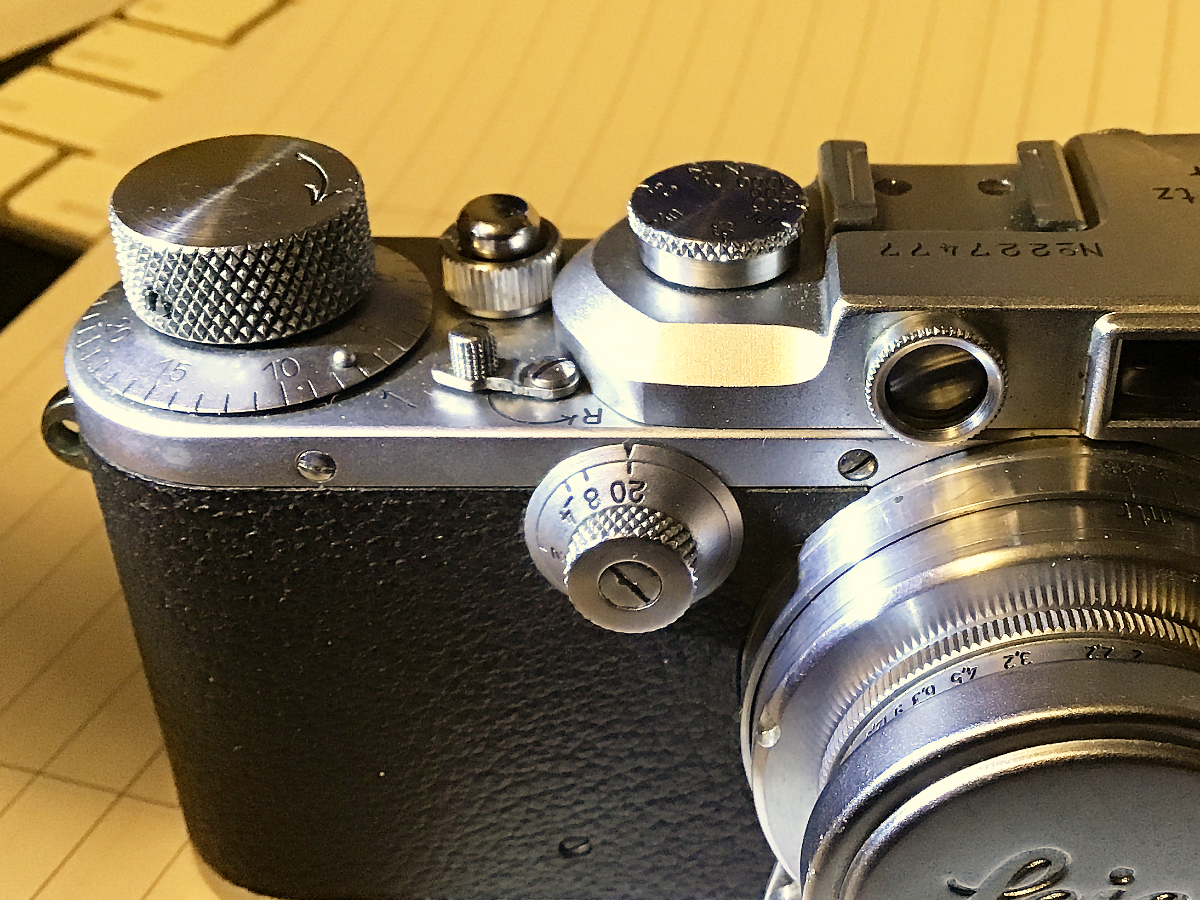
for Leica II (or model D) with a removable Elmar 5cm lens

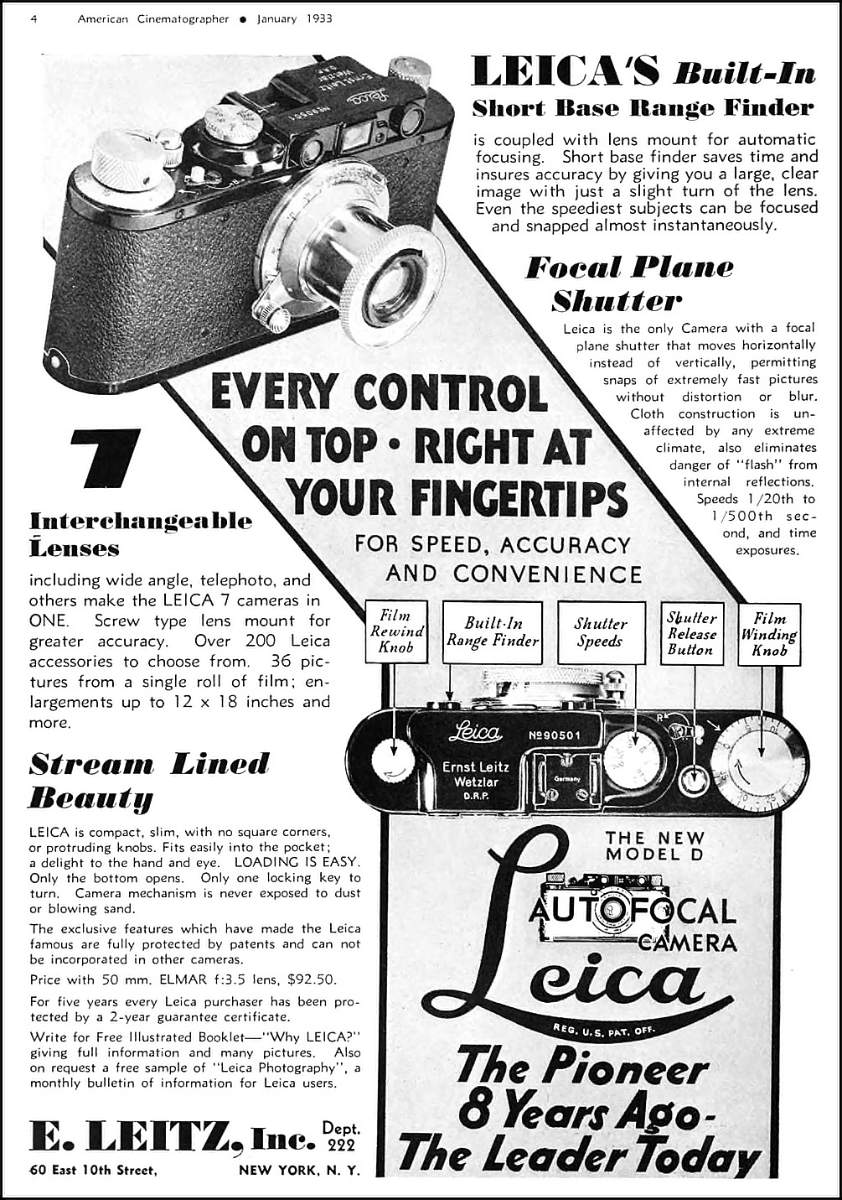
Toronto. When Leitz first marketed the Leica in the mid 1920s, it was an innovative success. By 1933 other makers had competing cameras out. The mighty Carl Zeiss organization not only marketed cameras, but their Tessar lens was a excellent product well known to the photographic industry. And their Contax – an answer to the Leica – came out in 1933 too.

To compete, Leitz promoted their Elmar lens as a universal lens at home on camera, projector or enlarger. And as a great lens for closeup shots via extension tubes (to allow subject distances under one metre). The lens could even be used for stereo shots with a beam splitting prism attachment.

This February, 1933 issue of American Cinematographer shows a typical Leitz NY advertisement of the period. Featured is a Leica II (Leica model D in the USA) with the interchangeable Elmar lens.  Thanks are due to my good friend and fellow photographic historian for sharing this find with us!

Note, the title of this post is a riff on the title of Robert Bolt’s 1954 BBC radio play, “A Man For All Seasons” about Sir Thomas More.

Posted in history | Tagged , , , , , , , | Comments Off on a lens for all reasons

catching the fire light just right

A properly exposed time delay shot …

Toronto. I remember taking photos of fireworks one summer many years ago using 35mm colour slide  film and bracketing my shots. I was surprised when the film was processed and the fireworks were captured – with some burnt out highlights and detail in the shadows rather than the intended silhouettes.

On December 27, 2019 Harry Guinness wrote an article called, “How to Take Photos of Fireworks” for the blog, “How-to Geek“. The difference in this article, is that the author expects you to use a digital camera and be able to adjust the aperture based on instant feedback (images too light or too dark).

Whe I used film, I also used a tripod and time exposure but without the luxury of immediate feedback on over or under exposure. Film processing instead took literally many days before I could view the results.

Posted in activities-other | Tagged , , , , | Comments Off on catching the fire light just right

blue water line

Toronto. Well this is executive meeting two two via zoom and as they say in the Corner Gas song “… nothin’ much going’ on …”. The most significant event recently is the January, 2022 presentation by Brandon Leung, winner of a recent thesis prize. Brandon will talk on the images of Jim Wong-Chu’s Pender East in the Vancouver area. Don’t miss it! The Ontario Election this coming June and may affect our fair date or locale if COVID doesn’t. Stay tuned. Note that coordination of this executive ZOOM session was by our president as the programs secretary is in midst of moving. Celio did show up via his cell phone (and excellent technical skills).

Just a note. The title is a line from the song of the same name as sung by the Brothers Four.

Posted in activities | Tagged , , | Comments Off on blue water line

a neater meter

ad for a c1934 Weston light meter

Toronto. One area of photography that absolutely demanded consistency in exposure was movies. Any unexpected exposure shift between scenes or reels was obvious and annoying to theatre goers, especially those who paid hard earned money for the movie experience.

Weston was delighted to be praised in print and used letters from satisfied users like cinematographer Chas Clarke in advertisements such as this one on page 237 of the October 1934 issue of American Cinematographer. Two and a half decades later, I used a Weston III to read light. It was a pleasure to use outdoors during the day but like all meters of the period, was nearly useless in dim light or indoor light.

A thank you to good friend, George Dunbar, for sharing his find with us. I have to admit, for much of my youth Weston and quality meters were synonymous. I own Weston electric meters that are over a century old now and still working like new. Wonderful old instruments from the days when things were built to last!


Posted in history | Tagged , , , , , | Comments Off on a neater meter

anchors aweigh!

1933 ad for a 500 watt home movie projector

Toronto. Those were the heady days of home movies when people lugged out the heavy projector and its awkward screen. Today, we call such marvels ‘boat anchors’ – not much value to a camera collector, and only good if you suddenly need a projector.

I wonder how many viewers remember Stewart-Warner and the days of home movies? A 500w bulb gave great brightness to each movie but was very hot! Special projector bulbs were used with a relatively short life rating at full brightness.

This ad in the January 1933 issue of American Cinematographer (page 38) extols “The New 500 Watt Stewart-Warner 16mm. Projector” as giving “theatre like brilliance” to home movies. My dad had a Eumig 8mm projector which while compact was still a heavy clunker as was my Braun 300 watt slide projector. When my newly minted wife upgraded me to a Kodak Carousel, I bought an extra bulb just in case – I still have both bulbs in working order today. But of course the days of 35mm slides – and          home movies – are long over.

My thanks to that diligent pursuer of photographic history, George Dunbar, for sharing this bit of nostalgia with me. Apologies to the 1945 movie of the same name as my post.

Posted in history | Tagged , , | Comments Off on anchors aweigh!

daylight blues

GE advertisement for Mazda bulbs c1935

Toronto. In the mid last century, one could buy daylight or tungsten transparancy (slide) film. The difference was in their white balance. Incandescent bulbs would have a colour balance around 2700 degrees kelvin and a special blue filter on the camera would allow daylight film (designed for 6000 degrees kelvin light) to be used indoors. Alternatively, tungsten bulbs could be tinted a special blue to emulate the 5000 to 6000 degrees kelvin of sunlight. And, of course negative colour film could be colour balanced during printing so the prints appeared to be correctly colour balanced.

Preferring to shoot stills in natural light for the most part, I often forgot the efforts taken by professionals to properly illuminate a scene by floods or flash. When I was first attracted to photography, advertisements used girls and/or the actual equipment to catch the reader’s eye. In the 1930s, Walt Disney characters were a big deal and ads often used them to attract readers. One such ad extolled GE Mazda light bulbs, tinted ‘Photo Blue’ as ideal for color movies.

Like any printed matter back then, the ad itself was in black and white, since color was very expensive requiring a number of ink changes, print runs, and very careful registration. It was about a decade after WW2 before newspapers began the regular use of  colour, often just in ads at first.

So called natural colour was used in movies in a very limited way. Tints and various early colour processes often set the tone of the scene. This ad suggests that the Disney studio cartoons were stepping up to natural color for new releases. In the ad, GE takes advantage of their blue tinted Mazda light bulbs to promote their slogan, “General Electric makes lamps for every lighting need.”.

My thanks once again to George Dunbar – friend, fellow PHSC member, and retired cinematographer – for emailing me this ad on page 237 of the June 1935 issue of American Cinematographer.

Posted in history | Tagged , , , , , , , , , , | Comments Off on daylight blues

boys will be boys

Ad for Leica G (or Leica IIIa as it is known by outside the USA)

Toronto. Most of us have heard of the rivalry between Leica (Leitz, Wetzlar) and Contax (Zeiss, Jena) last century. On page 455 of the October 1935 issue of American Cinematographer,  Leitz, New York placed this ad to extol the virtues of its 1935 model Leica – model G (or IIIa) with its f/2 lens rather than the slower f/3.5 Elmar.

Also noted was the camera’s ‘modern chrome finish’ option which wore better than the traditional black enamel that was prone to faster ‘brassing’ when in heavy use. Leica was made by the family-owned optical house of Ernst Leitz while Contax was the brain child of the mighty Zeiss organization commissioned to rationalize the German camera industry and run Zeiss-Ikon for the German government.

A big thanks to good friend and retired industrial cinematographer, George Dunbar, for sharing this interesting bit of history.

Posted in history | Tagged , , , , , | Comments Off on boys will be boys

the good, the bad, and the ugly – again

Leica Screw Mount design

Toronto. The last time I used this title. it was for a Leica accessory . This time it is camera design at and after the mid 1930s and the minicam revolution. Good camera design encompasses many considerations. Ergonomically designed, utilitarian, light, fast, reliable, simple to make, repair and adjust come to mind. The screw mount Leica is a case of good design as is its later brother, the famous M-series Leicas. When Oskar Barnack set out to design the Leica, he made a simple, utilitarian camera that was easily held with all the main controls right at the photographer’s finger tips. Improvements were modest and prompted by user feedback.

The Contax, and later its companion the Contarex, suggest both good and bad design decisions. The longer rangefinder base and vertical focal plan shutter seemed better (Leitz New York disagreed per January 1933 ad), but was the longer base really needed? The shutter running vertically gave a faster shutter speed and later on, a faster flash synchronization. The use of metal slats for the shutter seemed stronger than the cloth shutters of the day (no risk of pin holes), but using silk ribbons within the slats led to future issues (slats were supposed to last for at least 400,000 shots) when it was time to replace the ribbons – the slats broke when the ends were bent out for access. The first models of the contax had a knob on the front of the camera making expensive bevel gears necessary and placing the knob in an awkward position.

In later years, the Contarex SLR was designed and sold. It seemed far more robust than the M-series, but not so. The camera was very large and heavy for the tiny 35mm film it used. It had so many parts technicians needed special training to even disassemble the camera for routine  adjustments and cleaning. Worse, if the user deviated from the shooting procedure there was a real likelihood the shutter mechanism would be seriously damaged.

Legions of other cameras were designed seemingly with no regard at all for the user. The designs were unique but often awkward in use and repair. Market share and earnings seemed to be placed ahead of ergonomic design and ease of repair and adjustment. Cameras like the Mercury with its semi circle ‘hump’ and the Argus C3 come to mind (the C3 was actually very popular).

Note: The title is  from a 1966 ‘spaghetti western‘ that featured a young Clint Eastwood.

Posted in history | Tagged , , , , , , | Comments Off on the good, the bad, and the ugly – again

riding the rails

1940s riding rails to hunting camp in Northern Ontario

Toronto. View or Field cameras and Kodak folders, etc used a rail or two rails in parallel to move the lens, lens board (and shutter, if part of the lens) away from or closer to the sensitive media to capture the desired subject in focus.

A ‘box in a box’ design in the 1800s allowed the photographer to pull the boxes apart to focus his scene on the ground glass back. And of course any simple box camera was just a rigid box holding the ‘film’ and lens the correct distance apart for subjects (perhaps at the hyperfocal distance or at infinity depending on the camera design).

Cameras without a rangefinder or a ground glass back, like the folders, etc, usually used a simple scale to measure the distance from camera to subject.  The depth of field determined by the aperture setting would compensate for most minor errors in adjustment.

As shown in this snap shot, taken with a Kodak Six-20, the only way in to many hunting camps mid last century was by rail (or by boat). Cars were adapted to run on the rails but one had to be aware of train schedules to avoid a catastrophe!

Posted in history | Tagged , , , , , , , , | Comments Off on riding the rails

Happy New Year’s 2022

Well, here we are at the top of the calendar, looking down a fresh new year, full of hope and anticipation. With any luck, we will see the end of COVID which has over-stayed its welcome by a couple of years!

I made this image with a Sony F828 camera and a Zeiss zoom lens almost two decades ago. The little bird houses were kits from Canadian Tire that year. They sit on some poles I had kicking around (and painted black) If you look carefully at the middle bird house, you can see the lens of a video camera I was testing out at the time.

Posted in activities | Tagged , , , | Comments Off on Happy New Year’s 2022