elementary, my dear Watson …

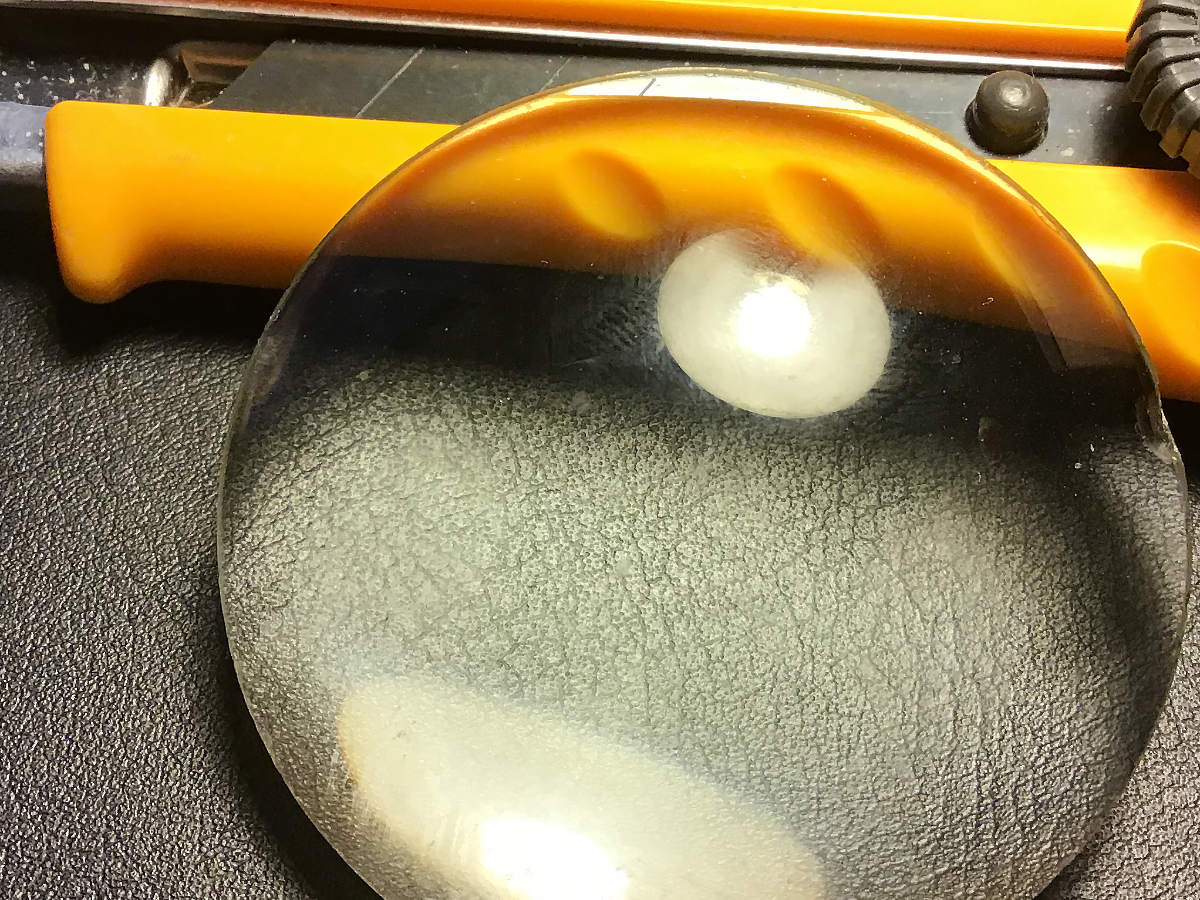
lens element with one flat surface, one convex surface

Toronto. … as Sherlock Holmes was supposed to have said (but never did say in Conan Doyle’s stories). However; Holmes often said ‘elementary’ to his side kick, in his usually superior and snobbish way. And of course our photographic lenses all use elements – from a single element meniscus lens to multi-element zooms.

Basically an element is made of selected glass and each surface is ground as a part of a sphere. Some times one surface is left flat. By using different curves and glasses, a number of elements could be stacked to correct lens aberrations and help flatten the image field at the film. If two colour bands were focussed at the same film plane, the lens design was achromatic. If all three bands focussed at the same film plane, the lens was called apochromatic and likely far more expensive.

The larger the lens aperture, the harder it was to correct all aberrations. The greater the number of elements in an uncoated lens, the lower the contrast on the film and the greater the amount of internal reflections. Around mid last century some elements were made with aspheric surfaces making for an even greater cost but  higher correction, higher resolution and larger aperture. The Leitz Noctilux was one such lens.

Today, many lenses employ both coatings and aspheric lens element surfaces to allow for a larger aperture with fewer elements , yet with higher correction of aberrations, higher resolution, and higher contrast (and price). Elementary, my dear Watson!
 

Posted in history | Tagged , , , , | Comments Off on elementary, my dear Watson …

reflections

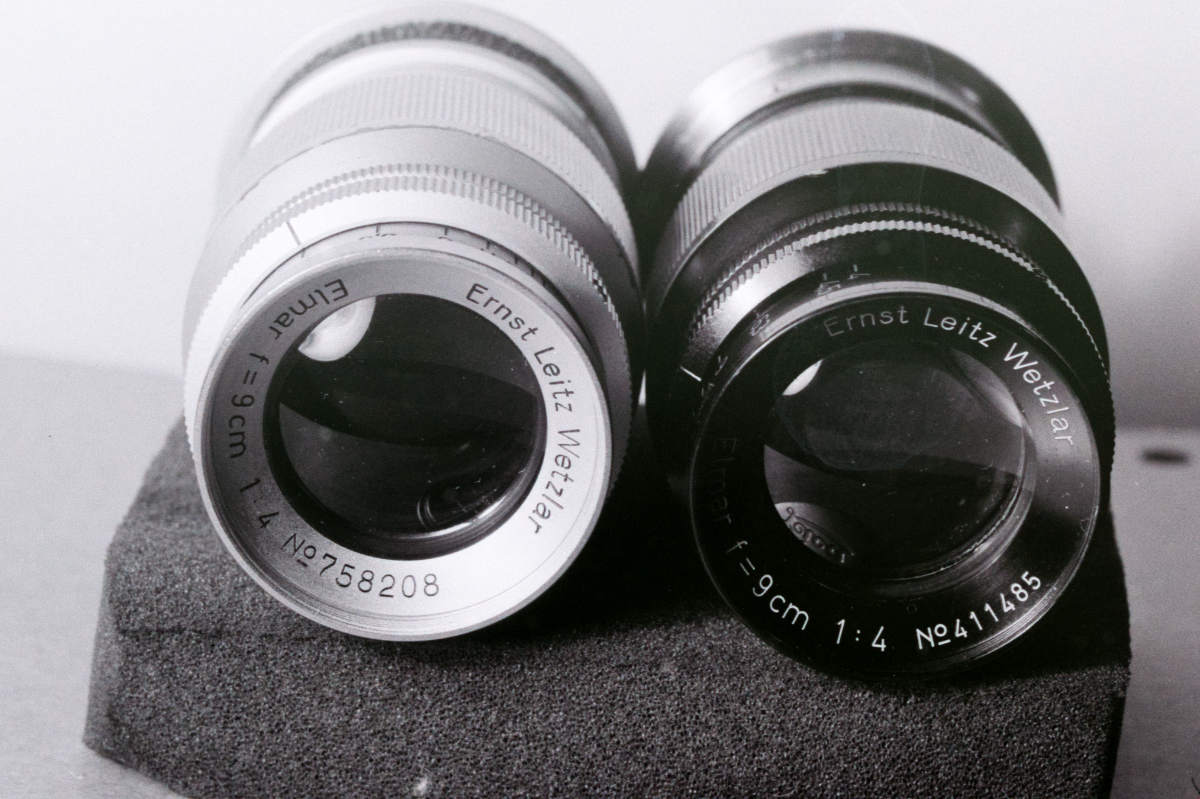
Elmar lenses post and pre WW2.

Toronto. No, not the introspective kind you dream about on a cold winter’s day. I mean the kind that reduce image contrast and limit the number of lens elements used. At left I show two lenses for a film camera. The one at right was made before WW2 and uncoated; the one at left after WW2 and coated.

Generally, pre war lenses were uncoated resulting in a limit to the number of elements in the lens and a reduced contrast range in the resulting negative. After the war, we began to see coated lenses where a transparent coating was deposited on each lens element before assembly into a photographic lens. These coatings cancelled out internal reflections. For a time, makers touted their specific coating, but soon all lenses were coated so the branding of coating technique just disappeared.

It is hard to see into an uncoated lens while coated lenses seem crisp and clear.  Of course the smart phone bunch never saw uncoated lenses. Modern larger lenses reflect what looks like a colour band from an oil slick (if held in a certain way). The use of added elements led to sharper resolution designs and zoom lenses (taken for granted now, but a big deal when they first came to market).

Posted in history | Tagged , , | Comments Off on reflections

will that be 8 or 16?

Early 1940 ad for a 16mm B&H Filmo camera

Toronto. Bell & Howell was a respected name in Hollywood movie equipment. For home movies, they used the “Filmo” brand. In the March 1940 issue of Popular Mechanics, B&H advertised both the 8mm and the 16mm versions of their Filmo line.  For 16mm, the camera film could be changed mid reel in daylight for B&W or colour (16mm Kodachrome had been released just a few years earlier).

That year, much of the world had been drawn into war for over six months. At the time of this advertisement, the USA was neutral while their politicians hotly debated whether or not to join the war effort.

In December of 1940, the attack on Pearl Harbor resolved the debate and America with its might, industry, and money, came to the aid of a struggling Britain, tackling Hitler and Germany on one hand and Tojo and Japan on the other.

This ad is courtesy of my good friend, George Dunbar. George likes photographic history and found the small ad while browsing back issues of Popular Mechanics.


Posted in history | Tagged , , , , , , , , | Comments Off on will that be 8 or 16?

jumping in with both feet

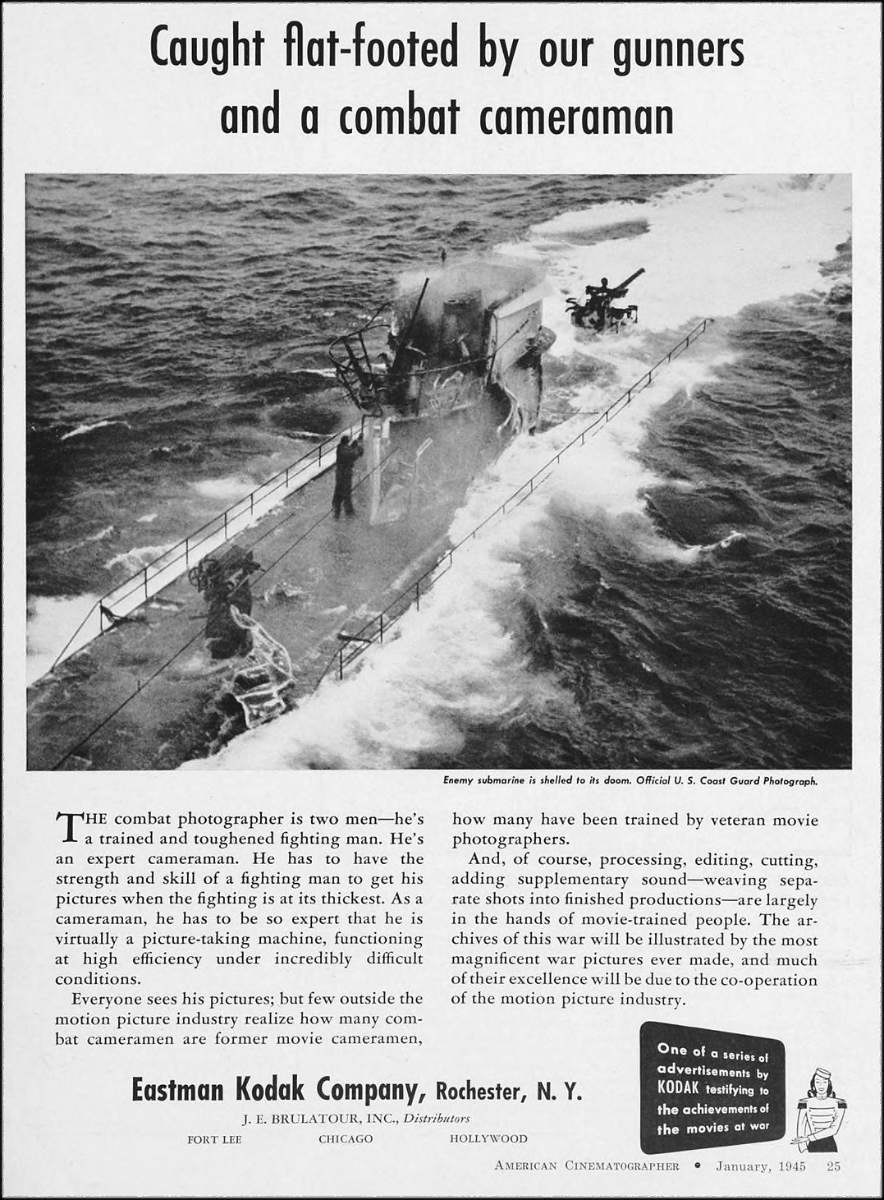
Kodak at War – January 1945 advertisement

Toronto. America was a bit late to the WW2, but made up for it in spades after Pearl Harbor was attacked by an ally of Germany. All industries quickly turned to the war effort. Hollywood cranked out propaganda movies galore encouraging young men to sign up for the war effort.

The movies were always upbeat and showed American men and women in the best light. Advertisements like this Kodak ad from late in the war (January 1945 issue of American Cinematographer) supported the war effort.

My thanks to my good friend and fellow PHSC member, George Dunbar, for sharing this find with us. Well Done!

NB. This post title is a riff on a common expression for fast action without stopping to consider the consequences. Churchill had begged the USA to help earlier but the US President was helpless while the house and congress debated whether to join in or stay neutral. That is, until the Pearl Harbor disaster.

Posted in history | Tagged , , , | Comments Off on jumping in with both feet

January 19, 2022 Presentation via ZOOM

Join us at 8pm on the 19th of January via ZOOM to see and hear Brandon Leung on “Asian Canadian Activism in the 1970s” The poster below designed for our January PHSC News, or the EventBrite link gives more details.

Register on EventBrite here. Problems or questions, email our programme coordinator at program@phsc.ca.


Posted in program | Tagged , , , | Comments Off on January 19, 2022 Presentation via ZOOM

PHSC News newsletter for January 2022

Voigtlander Bergheil c1930

Toronto. The Voigtlander Bergheil shown here is from the right top of page 1 in this month’s PHSC News newsletter. A Bergheil model was a favourite camera of Brassai when he haunted French street life.

Well, most of us made it to January, 2022. The local TV news reports the so called fifth wave of COVID has nearly crested here in Canada. World-wide, the Omicron variant is even more transmissible than the Delta. While Canada is just seeing the sharp rise of COVID cases, the changes have been somewhat eased by our vaccination levels (the third – a booster shot – is well underway with some elderly folk getting a fourth jab!). And helping the high levels of vaccinations is a close adherence to common sense guidelines.

In spite of COVID, our editor, Sonja, and her team were able to produce another tasty issue of PHSC News for you.  PHSC News (21-07) has the usual bunch of thought provoking articles  – short, crisp, and ripe for argument. Take a few moments and read them to ease your  symptoms of virus lethargy 🙂

On page 1 under “Decisive Time for Montreal” our editor compares that city’s issues and photos to those of M. Cartier-Bresson. Page 2 in “PHSC PRESENTS (virtually)” captures what might be the oldest known computer (analogue, not digital). Page 3, under NEO PHOTOGRAPHY ruminates on a post-modernist, pre-Raphaelite synthesis (say that fast …). This month, Streamables on page 4, has an article on, “Hollywood Cliches” which you may relate to, especially if you watch a bunch of TMC presentations; while page 5 looks at how we are coping with the healthcare competition here in Ontario.

Page 6 discusses, “Otoscopography: You Won’t Need a Gondola for This Canal“ in David’s EQUIPMENT REVIEW (always written in a provocative and interesting way).   John Morden’s  thoughtful selection of WEB LINKS. on page 7 will take you to some nifty web sites (the links are live, saving you the toil of a ‘cut and paste’ operation).

Page 8 as usual features the poster for our January speaker event via ZOOM where  Brandon Leung will be speaking about Asian Canadian Activism in the 1970s – as shown by Jim Wong-Chu’s poetic photographic album, “Pender East“. And we see those friends Ivy & Izzy, on page 9, chatting on the topic “Nancy Evans and the Good Side of the McMoon“. This issue’s wrapper, page 10, is John’s compilation of shows, events, and exhibitions of interest to collectors/photographers everywhere.

P.S. As usual, every link shown in the newsletter is a hot link just waiting for your click!

P.P.S. You can visit this issue by clicking here, or by g0ing to the menu item NEWSLETTER at the top of the page. There is a drop down menu that takes you to older issues dating back a couple of decades to the very beginning.

Posted in newsletter | Tagged , , , , | Comments Off on PHSC News newsletter for January 2022

a rose by any other name

1935 ad for an orthochromatic film called Plenachrome by the maker

Toronto. One of the earliest ambitions of film makers was to expand their film’s sensitivity spectrum down to the reds. By the mid 1930s when Agfa-Ansco made this film, yellows, greens through near violet blues could be captured. Such a film was known as orthochromatic by the industry. Agfa chose to use the term “Plenachrome” and to tout the film as ‘ideal’ for outdoor subjects. It was actually just too slow for use indoors or at night. It faithfully reproduced most of the colours of nature.

Five years later, Agfa-Ansco advertised a panchromatic film finally capable of recording oranges and reds too. While the Plenachrome film was sold in 100 foot and 50 foot rolls of 16mm size, 35mm film was similar in sensitivity. Agfa sold this movie version with processing included in either straight negative or reversible (positive, ready to project after processing) options. The films of the era were mostly monochromatic black and white films.

My thanks to our retired corporate photographer, George Dunbar, whose talents range from stills to videos. George shared this tasty bit of history with me which he found in the March, 1935 issue of American Cinematographer magazine.

The more expensive panchromatic films were slow to take off, especially in still format since the processing had to be done in a fully darkened room by the time-temperature method after very accurate exposure. Orthochromatic film was cheaper and could be developed and viewed  by a dim red light allowing the development time and/or temperature to be adjusted to help compensate for any exposure error.  Savvy photographers used yellow or green filters of various density on the camera lens to modify the film’s H-D curve (eg. show both clouds and sky).

NB. The name of this post is a line from Shakespeare’s play Romeo and Juliette.

Posted in history | Tagged , , , , , , | Comments Off on a rose by any other name

modern times

original daguerreotype of a little girl taken over 1 1/2 centuries ago

Toronto. These days of digital cameras and smartphones make photography a piece of cake. You see it; you shoot it; you send it. Easy Peasey.  But it wasn’t always the case. Many of those who haunt our fairs and shows enjoy the retro photography of the days of film.

Some even dabble in wet plate photography and salt paper or albumen prints. The really daring take a shot at making Daguerreotypes from scratch.

I bought this original daguerreotype portrait c1845 of a little girl around 1976 from Bill Marshall of Deux Montagnes, Quebec. The case cover was missing. NB. The daguerreotype has 90 degree corners, not the slight distortion shown here. The flesh tone in the middle right is my hand holding my iPod Touch as I took this image. The sharpness was affected by my hand held shot and slightly corrected with the focus plug-in (Focus Magic) that I use with Affinity Photo.

Modern day Daguerreian photographers are truly rare. In fact, there are only around a half dozen serious Daguerreian photographers in the world according to a friend of mine,

Dr Mike Robinson here in Toronto is one of the very few practitioners of the art that dates back to the very earliest days of photography when Louis Daguerre was collaborating with Nicéphore Niépce to create images by the action of natural light. The Daguerreotype is one of the earliest (January 1839) processes for photographs. The image is created in-camera on a silver-plated copper plate coated with a light sensitive emulsion. The resulting positive latent image is ‘developed’ outside the camera via mercury vapour.

And the post title? It was used by Charlie Chaplin as the name of his 1936 movie. Never seen it? What are you waiting for? It is a classic! Here is a sample.

Posted in history | Tagged , , | Comments Off on modern times

fleet of foot, with fully adjustable slow speeds too

Leica III (or model F) advertisement in fall 1935

Toronto. In 1935, advertisements pointed out how a particular camera or maker was different. Was superior to the rest. Was a far better buy than the competition.

This was especially noticeable in highly competitive America. For example, Leitz NY would not just show the technical specifications and how well built their products were, but how much better they did their job – faster speeds, easier and faster to use, and far superior in construction.

In a typical ad (September, 1935 issue of American Cinematographer), a new model F (Leica III) is shown (top shutter speed 1/500th) but the copy states Leica had a top speed of 1/000 second (actually this was for the Leica IIIa or an earlier model factory modified). With a fast shutter speed and a fast SUMMAR f/2 lens, the camera could easily take a sequence of bicycle shots in a couple of seconds (a model with 1/500th shutter speed and a slower lens would be just fine, too).

Because the higher end models had a slow speed mechanism that was continuously adjustable from 1/20th second to a full second, a feature not available for other cameras, this was also emphasized in the ad.

The mechanism used was a clockwork device that held the second shutter curtain back briefly to extend the shutter speeds down to a second. If a lower cost Leica model without the slow speeds was returned to the factory, this device could be easily retrofitted.

My thanks to my good friend and retired corporate photographer, George Dunbar, for both the ad and the idea.

Posted in history | Tagged , , , , , , , | Comments Off on fleet of foot, with fully adjustable slow speeds too

to the victor …

1935 ad for Victor cameras

Toronto. … go the spoils (well, most times). Do you remember the Victor 16mm movie gear? The majority of their products suffered from very small sales. A government contract during WW2 was far more promising as was their knockoff of the B&H Filmo camera.

The Iowa company stuck with 16mm movie gear as far as I can tell. The cameras and projectors are of modest interest to collectors. Like many products, Victor added Disney characters to some advertisements. For example, the above left advertisement from the July, 1935 issue of American Cinematographer magazine features the Mickey Mouse character and a letter from Walt Disney.

My thanks to good friend and retired cinematographer, George Dunbar, for sharing this historic find with us. When we once more are able to have fairs, you may just possibly discover someone offering a Victor camera or projector. While the Victor company always stated they were the first to offer 16mm cameras, Eastman Kodak actually beat them to market by a few weeks according to this Wikipedia article.

Posted in history | Tagged , , , , | Comments Off on to the victor …