who needs bells and whistles?

1939 ad for a $15 UniveX movie camera

Toronto. 1939 – what a year! The great depression of the dirty ’30s was a decade old and rapidly becoming part of the landscape. One of the worst wars ever (WW2) was about to erupt in Europe inspite of Hitler’s platitudes and the optimism of others.

Universal Camera Corp (UniveX) of the Big Apple, like many Kodak wannabe’s in America was busy flogging its special fifteen dollar home movie camera that used 69 cent film and had, “sensational high-priced features“.

This particular ad from the April 1939 issue of  Popular Mechanics shows a UniveX movie camera with a “faster f/4.5 lens” and a “built-in view-finder“. It was touted as having, “the simplicity of operation – the dependable performance – the thrilling life-like results you’d expect only from high-priced cameras“. While $15 dollars looks dirt cheap today, in 1939 it was easily a week’s wage for those in the target audience.

According to the ad the camera was as easy to use as taking snapshots – and cheaper!

A big thank you goes to my good friend George Dunbar for findings and sharing this advertisement with us. While we mostly collect still cameras and images in the PHSC, everyone seems to have an odd 8mm or 16mm movie camera in their collection too.

Posted in history | Tagged , , , , | Comments Off on who needs bells and whistles?

where the girls are

Hannah Maynard’s studio in Victoria, 1888.

Toronto. Many photographers over the years were female, in spite of the majority being male. Some members have researched the history of women in photography, and occasionally given a presentation on the topic. Any discussion of women in photography brings to mind PHSC member Laura Jones who established the Baldwin Street gallery many years ago.

George Dunbar writes, “The latest issue of Canada’s History magazine (Aug/Sept, 2022) features the works of some of Canada’s earliest women photographers. Included are Alvira Lockwood, Mrs. Chauncey Miller, Elise L’Heureux Livernois and Hannah Maynard. Some great insights here for PHSC members.”

I can recall only Hannah Maynard, who was in business in BC with her husband and was the subject of a Photographic Canadiana article, and Elise L’Heureux Livernois of Quebec. I have a Livernois cabinet card and came across Elise while searching out information on the famous Quebec studio.

Thanks to my good friend for sharing this find with us.

Note: The title of this post is a riff on a song by Connie Francis called,”Where the Boys Are“. The song is from a movie of the same name, based on a book also of the same name.

Posted in history | Tagged , , , , | Comments Off on where the girls are

#28 – A Corner Gas Rerun

Toronto. Amazing! Our twenty-eighth  executive meeting via ZOOM was the first  Wednesday evening in July – the 6th. And as the song says, “… nothin’ much going’ on …”. Of course behind the scenes there is a lot going on. Next meeting is September 7, 2022 and most likely via ZOOM too unless otherwise noted.

Our TRUNK SALE is today, JULY 16th. The fall fair is at the Trident centre on October 1st this year.  Our speaker program will start up again in September as will our executive meetings and newsletters.

Have a great summer everyone and lets hope the seventh wave of COVID-19 and the restrictions it may bring are very modest at best.

Clint and a small group meet for the July Executive meeting – next meeting will be September 7, 2022

Posted in activities | Tagged , , | Comments Off on #28 – A Corner Gas Rerun

seeing double

print viewer offered in the June Port Colborne auction

Toronto. “It’s deja vu all over again“, as Yogi Berra was thought to have said. This wonderful old tabletop viewer (stereo, I believe) was offered at the recent auction down in Port Colborne – our first auction outside Toronto and our first two-day auction.

In January of 1992 at a monthly Toronto meeting, the late Bob Wilson brought along his Taxiphote. The story of his Taxiphote and one displayed by our January, 1992 speaker, Peg Forbes, was written up in the next issue of Photographic Canadiana,  Volume 17-5. I have attached a copy of that issue in pdf format for your entertainment and enlightenment.

Our ancestors made and sold many remarkable photography related things to entertain and amaze one and all. As a matter of interest, Bob Wilson and Stan White formed the nucleus of a stereo group within our society. Stan went to great lengths to collect and donate our stereo collection (CSC or Canadian Stereo Collection) first to Sheridan College and years later to the AGO before it was ‘decollected’.

Perhaps the CSC will become of interest once again when the inevitable peaking of interest in ‘3D’ resurfaces.

Posted in history | Tagged , , , , | Comments Off on seeing double

far out, man!

star forming region of Carina Nircam courtesy of NASA (and CSA and ESA)

Toronto. Shades of Cheech and Chong! NASA has posted the first images from the James Webb Space Telescope shot up in space. The name of the Space Telescope remains controversial.  It was carried by a space vehicle shot up in space in December, 2021. The pictures were taken by the telescope now 1 million miles above the earth!

NASA’s James Webb Space Telescope is a partnership with ESA (European Space Agency) and CSA (Canadian Space Agency) The Canadian agency is located in St Hubert, QC, just south of Montreal.

Once again we can see the tremendous impact photography has, not only on earth, but in the far reaches of space. Photography has many uses today in helping mankind to understand its role in the universe. Browse the photos on the above links and you too will be amazed at the way our art helps everyone better understand our world and the great universe!

Posted in activities-other | Tagged , , , | Comments Off on far out, man!

street walker

snapping a strolling couple, 1934 style

Toronto. Not that kind! Some cities have a street photographer who snaps folks walking the streets just like him/her. For example, Vancouver had its Foncie – his fame spred well beyond Vancouver.

This November, 1934 article from Popular Mechanics tells how some photographers use a shoulder held movie camera to get a trio of fast shots.

Like most street photographers, the subject is given a card to retrieve the photos (card plus coin).  A good percentage of cards were submitted for photos last century when photography took special talent.  The card identified the correct prints (hopefully) while the coin paid for the prints and postage (in the days when stamps were inexpensive).

My thanks to good friend and photo history bug, George Dunbar,  for sharing this odd article about ways a movie camera can take photos of people as they stroll along the city streets.


Posted in history | Tagged , , , | Comments Off on street walker

smartphone, anyone?

Pictures by Phone back then

Toronto. This November, 1934 article from Popular Mechanics brought back memories. Mid last century, the telephone was still voice-only in spite of this article decades earlier. As a young employee of “Ma Bell’, I remember Bell Labs in New Jersey tinkering with a gadget to send tiny B&W images over the telephone line to another person with similar gear.

Today, such conversations are common place – but not via the lowly ‘land line’ telephone. Computers, be they desktop, laptop, or smartphone, routinely allow conversations and videos between people. The old telephone? Nah, still just voice (although clearer than in yesteryear).

Today, we can even hold conferences and online teaching with people viewing people and notes or photos – all by the above media. My thanks to good friend, George Dunbar, for suggesting this article and the memories it brought back of the days when we felt (well, me anyway) that the Bell System would produce the ‘video phone’. We had no idea of the bandwidth we would need for such a venture to become reality. At the time, a quality telephone line ran about 100 cycles to 5,000 cycles – not even close to the bandwidth necessary for colour video.

To multiply the number of calls that a line could carry, we used ‘carrier systems’. For example the ‘N carrier’ offered 12 lines at a heavy penalty. Repeater stations had to be located every seven miles or so with every third station large enough to house huge Ni Cad batteries to power the repeaters at the station and either side of it.

Posted in history | Tagged , | Comments Off on smartphone, anyone?

watch da birdie

watch da birdie

Toronto. As WW2 was winding down, companies became more innovative in their advertising. Pepsi-Cola – the major competitor to Coke – tried a humorous approach using a cartoon based on the old idea of a studio photographer capturing a portrait of a reluctant child.

When the traditional ‘birdie’ didn’t work, the photographer held up a bottle of Pepsi. It worked – too well! The poor photographer ended up taking  the wrong portrait!

The  expression, “watch the birdie” was intended for children. Photographers used a toy bird (sometimes it even whistled) in an effort to catch the child’s eye. And an interesting pose for mom and dad. Occasionally our fairs and auctions have an old ‘birdie’ used by photographers in the late 1800s – early 1900s. In fact there was one offered in an estate auction we held earlier this spring.

My thanks to good friend and fellow PHSC member, George Dunbar, for this c1944 comic advertisement from Popular Mechanics magazine.


Posted in history | Tagged , , , , , , , , | Comments Off on watch da birdie

night scenes

Kodak ad Nov 1934 for ways to snap night scenes

Toronto. Today’s savvy smartphone and digital camera users would roll their collective eyes at anyone touting ‘night scenes’ as a big deal. But it really was back in the mid 1930s in the days of slow film and generally slow lenses.

Kodak had a ready solution: turn every serious amateur into a studio mogul on the cheap! This November, 1934 advertisement lets the cat out of the bag – so to speak. Just buy a genuine Kodak camera plus a couple of flood lights and a ‘super fast’ B&W film. The main criteria was the ‘couple of flood lights’. Following Kodak’s guide for subject/light/camera placement, a decent photo was inevitable!

Our thanks to good friend and fellow photo history enthusiast. George Dunbar, for this trip down memory lane and the days when ‘night scenes’ usually meant food lights.

Posted in history | Tagged , , , , | Comments Off on night scenes

flexing some muscle

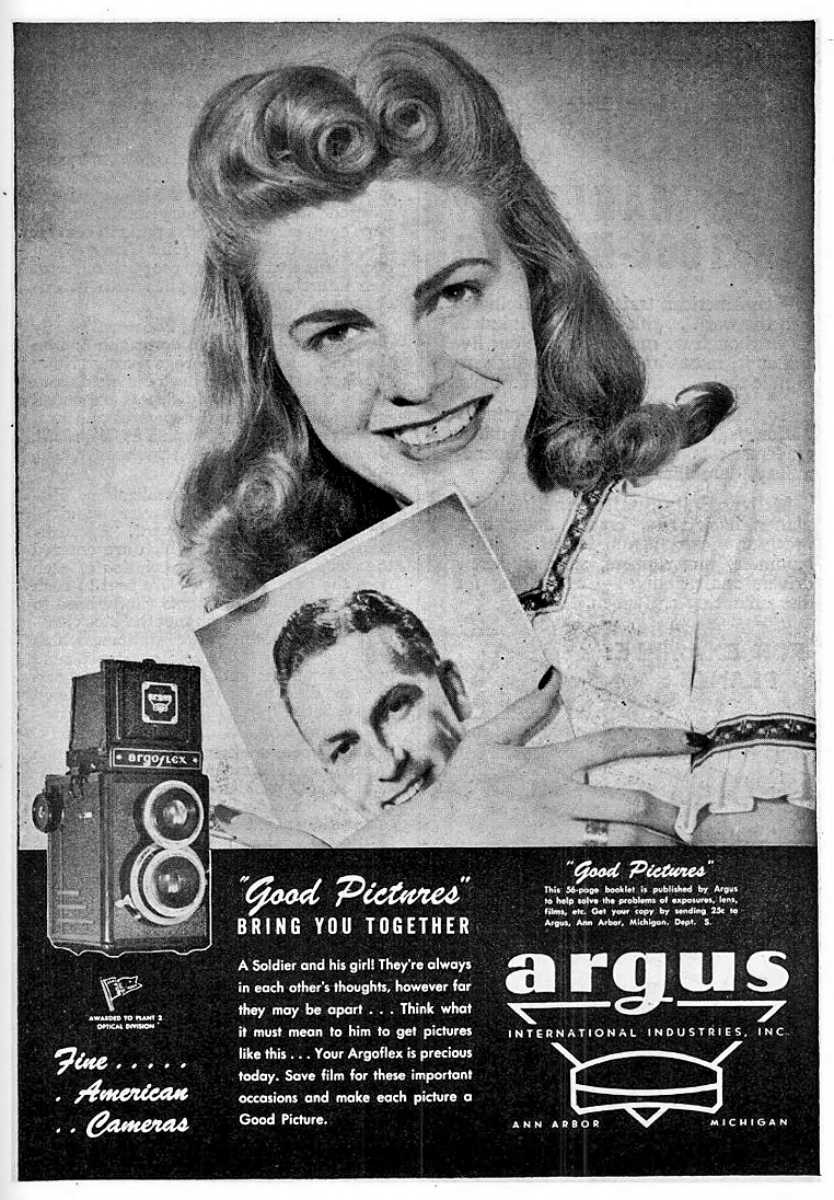
1944 ad for Argoflex camera

Toronto. Argus was known for American made cameras, especially the ‘brick‘ – the Argus C3. However, the company also dabbled in TLR designs. This ad shown at left is for the Argoflex – Likely a model E given the date and look – although the company did make an earlier TLR simply named Argoflex.

The basic lens and shutter have some settings (at least one article calls the plain Argoflex a ‘box camera’). The design mimics the Rollei cameras of the day which were unavailable here or in the States after WW2 began.

This ad is from the June, 1944 issue of Popular Mechanics, hence the war theme. My thanks to my good friend, George Dunbar, for sharing this find with us. I can only recall the 35mm cameras Argus sold over the years. Nevertheless, visit our trunk sale this month – you may fine a TLR for your collection – even an Argoflex …

Posted in history | Tagged , , , , | Comments Off on flexing some muscle