giving it both barrels

A Kodak 35mm camera made for colour transparencies.

Toronto. Kodachrome movie film was release in 1935 followed a year later as 35mm ‘slide’ film. The whole spectrum of Kodachrome films and processing were redesigned in 1938.

In 1940, Kodak strongly promoted the new colour film for amateurs with a line of 35mm cameras, and 2×2 inch slide projectors. Both cameras and projectors were heavily advertised in ads such as this June, 1940 ad in Popular Mechanics hitting Kodachrome, cameras, projectors and the NY World’s Fair (1939-1940) which opened in 1939 when WW2 hadn’t yet touched the huge and wealthy American nation. (The ad says ‘field’ a sly reference to the NY World’s Fair in Flushing Meadows, Queens.)

A big thank you to that photography historian and good friend, George Dunbar. George kindly shared this find with us. As I noted elsewhere, my first use of Kodachrome was in the late 1950s when the transparency film had an incredibly slow ASA 10 rating. As knowledgeable photographers can attest, films with such low sensitivity are extremely contrasty. Over expose a stop and the slide seems washed out but under expose a stop and you get almost blackness.

Thus exposing for highlights gave inky shadows while exposing for shadows gave washed out highlights bereft of detail.

Posted in history | Tagged , , , | Comments Off on giving it both barrels

did ya hear da news ….

Trident Hall home of our Fall Fair – October 1st, 2022

Toronto. Well the Ontario election is over. A bit underwhelming all in all, but Dougie is back in power and the Trident Hall is open for business once again.

Our FALL FAIR – THE BIG ONE – is on Saturday, OCTOBER 1st, at the TRIDENT HALL (Evans and Islington) in westend Toronto this year (Note the day:SATURDAY).

Free parking, modest admission cost, good food. As usual there will be cameras, lenses, accessories, darkroom gear, studio stuff, camaraderie, books, film, digital things – all there to add to your collection or shooting equipment whether you favour film or digital!

Want a table? contact fair@phsc.ca and place your request/pay the fee. A reservation form in pdf format is on this site here and under FAIRS in the black horizontal menu bar above.

No idea where the hall is located? Not to worry, as we near October, directions etc will be posted here.

Posted in fair | Tagged , , , , , , , | Comments Off on did ya hear da news ….

PHSC Trunk Sale July 16, 2022

Our Annual Outdoor Trunk Sale at Trident Hall this year is on SATURDAY, July 16th, 2022 from 8am until Noon. Vendors – call Clint (see poster below) to reserve a spot! Need more information? Email fair@phsc.ca or info@phsc.ca! Use this old map on the Big One Bookmark for TTC and parking (sorry, no snack bar).

Posted in fair | Tagged , , , , , | Comments Off on PHSC Trunk Sale July 16, 2022

last call

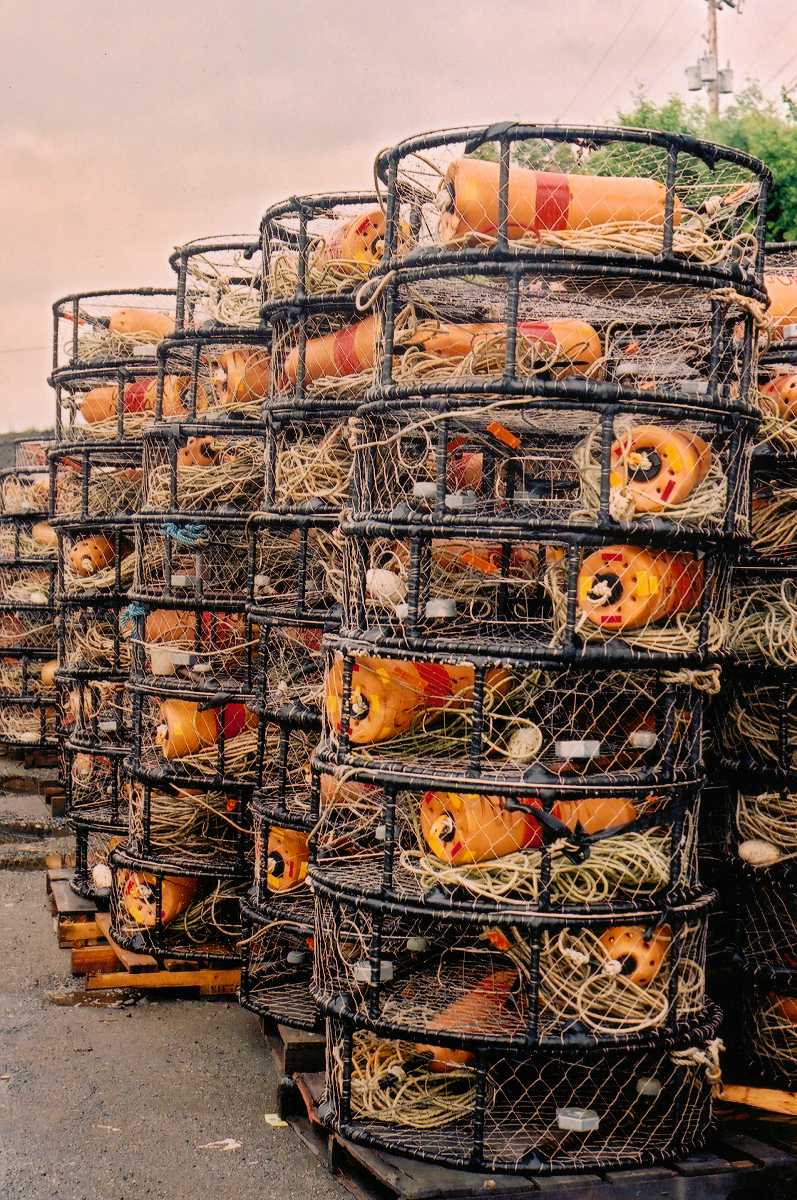
Fishing nets on Kodak ASA 800 colour negative film

Toronto. Twenty years ago this month was the last time I ever shot film. I used Kodak colour negative film with a rating of ASA 800 – an amazing speed at the time. The film was used during a trip out west.

Preparing for the trip, I had both my Leica M4 and a Coolpix 990 (about 3.14 mpx) as choices. The month-long trip around BC and Alberta  by rail, boat, and auto was with my youngest. I had planned to take the 990, using the trip as an excuse to buy more digital cards. I was soundly outvoted and ended up taking my all mechanical Leica instead.

I added a 50mm lens and a 28mm lens plus a Gossen light meter. The Gossen used mercury cells which were banned by then. I belatedly found out that a converter to fit the Gossen was ‘special order’, so instead I used alkaline cells and calibrated the meter each morning.  I think the shot at left was during our visit to Prince Rupert – fishing nets resting on the pier.

Since returning home, I have used various digital cameras. My newest being an elderly NEX-6 (16.1 mpx) along with the camera in the last version of the iPod Touch (8 mpx). Both have auto white balance, auto focus, auto metering, etc. making them nearly idiot proof.

I still have my M4. While I like the ease and flexibility digital technology, analogue images developed and carefully printed have a certain mystique about them. As I think film, I think those were the days! To modern day folk, film was a dead slow media and old film cameras just unforgiving mechanical and optical instruments. Good results took skill, not just pointing and clicking… Last call, anyone?

Posted in history | Tagged , , , , , | Comments Off on last call

in pursuit of colour

Autotype of baby c 1900 courtesy of Felix Russo

Toronto. A Happy July 4th to our American friends! Here’s to a super year down south!

Colour photography is an interesting  topic. Those of us who form the smart phone brigade, are used to colour as a norm and black and white as a special feature for stills and videos. It wasn’t always so. From the beginnings of photography as we know it, in 1839 to mid last century, black and white was the norm.

How we see colour was postulated before photography, in 1802 by Thomas Young and refined by Hermann von Helmholtz. We call their theory today, the Young-Helmholtz theory. Their theory remained just that until it was validated by James Maxwell in 1861 with the help of photography. It was astounding that Maxwell’s demonstration even worked give the insensitivity of photographic media to certain colour bands back then.

With Maxwell’s pivotal experiment in hand, a young Frenchman named du Hauron proceeded to describe how just about any colour process would work. By the turn of the last century, the idea of tiny colour filters on a black and white glass negative evolved to the point where such concepts were marketable (eg, Autochrome by the Lumiere Brothers).

To improve speed and resolution, photographers resorted to exposing three black and white plates, each through a different filter. This approach was limited to still life, of course. To over come this barrier, cameras were concocted that exposed three plates simultaneously each through a different filter.

Regular cameras could shoot colour after the tri-pack film was created. Around 1935, Kodachrome became available and the quality resolution returned, but only if transparencies were made. Colour film was still abysmally slow. Mid last  century, colour negative film offered colour prints but initially resolution was poor. So poor that an embossed design was resorted to masking the resolution issue. Later last century print quality improved so much that colour became the norm.

Movies were a strong influence on colour with various tones and technicolor processes evolving. But even by mid last century colour was too expensive to be used for regular feature length movies. And today, we use super tiny filters over the pixels in our smart phones and digital cameras to create the illusion of colour. Autochrome anyone?


Posted in history | Tagged , , , , | Comments Off on in pursuit of colour

minute men

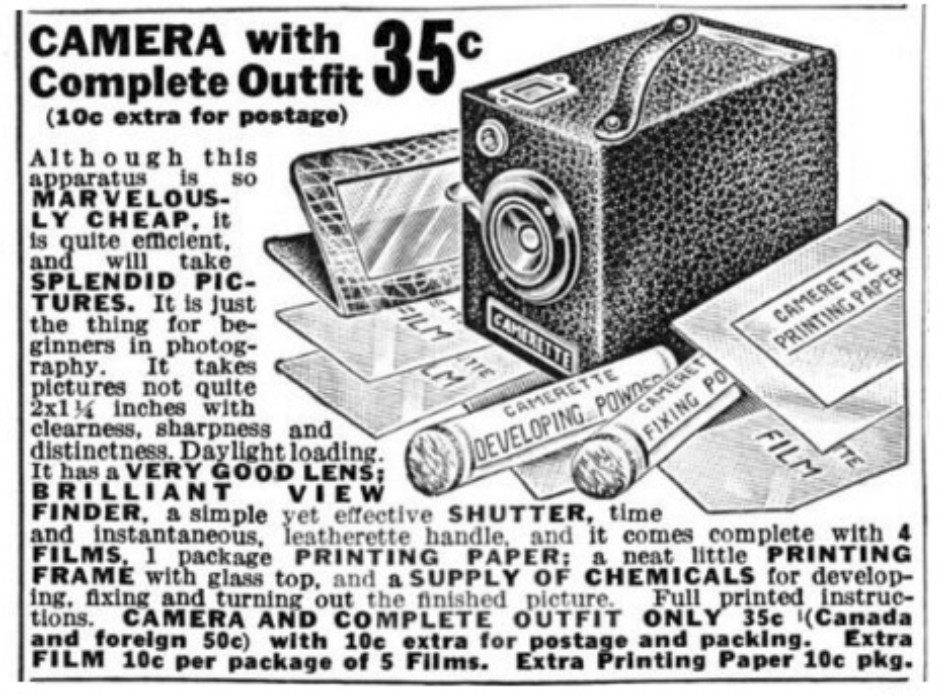
October 1934 ad for the ‘Camerette” photography kit.

Toronto. Old P.T. was tagged as saying, “There’s a sucker born every minute“. If not, how could the old Popular Mechanics ads attract anyone? Take for example this October, 1934 advertisement they ran aimed at all wannabe photographers: For a measly 35 cents US (or 50 cents in Canada – another 15 cents up  here in the frozen north). Plus 10 cents for “shipping and handing”. And how can you order a ‘kit’ when no address is noted? Write the magazine, perhaps.

Real photographers will see this ad offers a cheap box camera, contact printer, film, chemical powders, and paper. The camera makes negatives ‘not quite 2″ x 1-1/4″‘ – kinda tiny for these old eyes. No mention of the lens sharpness, elements, etc.  Eye balling the camera and the contact printer hints that the camera too is tiny. The text for the advertisement is entirely marketing – very little hard information but lots of vague statements and glowing comments that the naive reader can interpret favourably and be impressed.

The camera itself was made by Yen-Kame in Japan and took ONE shot on a piece of cut film in a paper holder – no winder (Kodak usually placed their winder on the side hidden in the ad). So when the ad says “complete with four films”, it means four shots! Ironically, the cameras were popular in the 1930s and post war, and were worth about $20 – $30 US a couple of decades ago to collectors according to McKeown’s 2001-2002 price guide.

My thanks to my old friend George Dunbar, who once again has delved into photographic history back in the days when everyone tried to raise interest in the unwashed majority to invest in our art, deep in the greatest depression to ever hit the modern world.

Posted in history | Tagged , , | Comments Off on minute men

In the Wake of Progress

In the Wake of Progress, Ed Burtynsky courtesy the Toronto Star

Toronto.  I first saw/heard about the work of Edward Burtynsky when his 2006 movie called, “Manufactured Landscapes” was shown that fall at TIFF. The film was introduced by its director, Jennifer Baichwal. Between a ticket mess-up and volunteers who were supposed to let those in line and ‘ticketless’ in to use the empty seats and didn’t, I ended up seeing this amazing film alone.

A few years later I saw one of his “Three Gorge Dam” prints in person at the AGO, narrated by PHSC member and now retired Curator of Photography (AGO), Maia Sutnik. This was at the February, 2009 meeting held at the AGO and titled, “A Night at the Gallery (AGO)“.

PHSC President Lewko (Clint) Hryhorijiw sent me this link to a Toronto Star column titled, “Edward Burtynsky’s ‘In the Wake of Progress’ lets visitors get up close to nature’s destruction” by Sue Carter in last Thursday’s Toronto Star.


Posted in activities-other | Tagged , , , | Comments Off on In the Wake of Progress

a Kodak challenge in 1934

The Kodak SIX-20 Challenge

Toronto.  This challenge may simply spark curiosity or indifference with the smart phone crowd, who shoot full colour indoors and out; be it sunny or gloomy; on subjects close and far (and all things in-between) then casually send the best views instantly to friends near and far!

The Kodak advertisement in the August, 1934 Popular Mechanics magazine said, “Compare this 1934 Kodak with your present camera”. The ad introduced the then new Kodak SIX-20 line of cameras. A few years later, my dad bought it’s less expensive junior version to capture his first born (me).

My thanks to my good friend and fellow PHSC member, George Dunbar, for sharing this advertisement with us. What a great reminder of the days when we relied on those terribly  slow old films and a snappy folder camera fresh from Kodak in Rochester or Kodak Heights in Mount Denis.

My dad used his SIX-20 folder for most of his life. I later bought him a Polaroid and then an Instamatic, but neither camera was as satisfying to him as his old folder! Oh, yes. All the best for a Happy Canada Day (Canada was established as a Dominion in 1867).

Posted in history | Tagged , , , , | Comments Off on a Kodak challenge in 1934

national (USA) camera day

Studio camera, Ross of London, mahogany, brass, bellows, c.1880, 6 x 4 in., $270.
Photo: Thomaston Place Auction Galleries

Toronto. For a price, Kovels will gladly show you the latest prices for antiques – including those of a photographic nature. Yesterday, June 29th, was known down south as ‘National Camera Day‘ and celebrated as such by Kovels. As far as I can see, Canada does not celebrate June 29th – but you never know …

Shown at left is a beautiful example of a c1880 view camera by Ross of London, England. Lens extra …

The camera was made of wood and brass when the cameras where usually used on a tripod to get a jiggle free result. This camera uses 6×4 glass plates, in the era of dry plate photograph, less than a decade away from early roll film technology..

Kovels graciously show prices and sources for the images reproduced in their post celebrating June 29th.

Thanks to author, sports photographer, collector, PHSC member and more, Les Jones,  for suggesting the National Camera Day page at Kovels.

Posted in history | Tagged , , , , , | Comments Off on national (USA) camera day

summer in the city

Summer 2022 PhotoEd magazine, Toronto

Toronto. Editor Rita Godlevskis just keeps on creating these wonderful issues! Great work Ms Godlevskis! Rita is the person in charge (editor) at PhotoEd magazine.

Take a few minutes and browse all the amazing talent on display. There is both a print magazine and an online magazine. If the print magazine is not on your newsstand any longer, subscribe and have it mailed directly to you.

Note. This note uses the same title as a song sung here by Joe Cocker, “Summer in the City“. I remember hearing it as a youth on long hot summer days.

Posted in magazine | Tagged , , | Comments Off on summer in the city