look back in anger

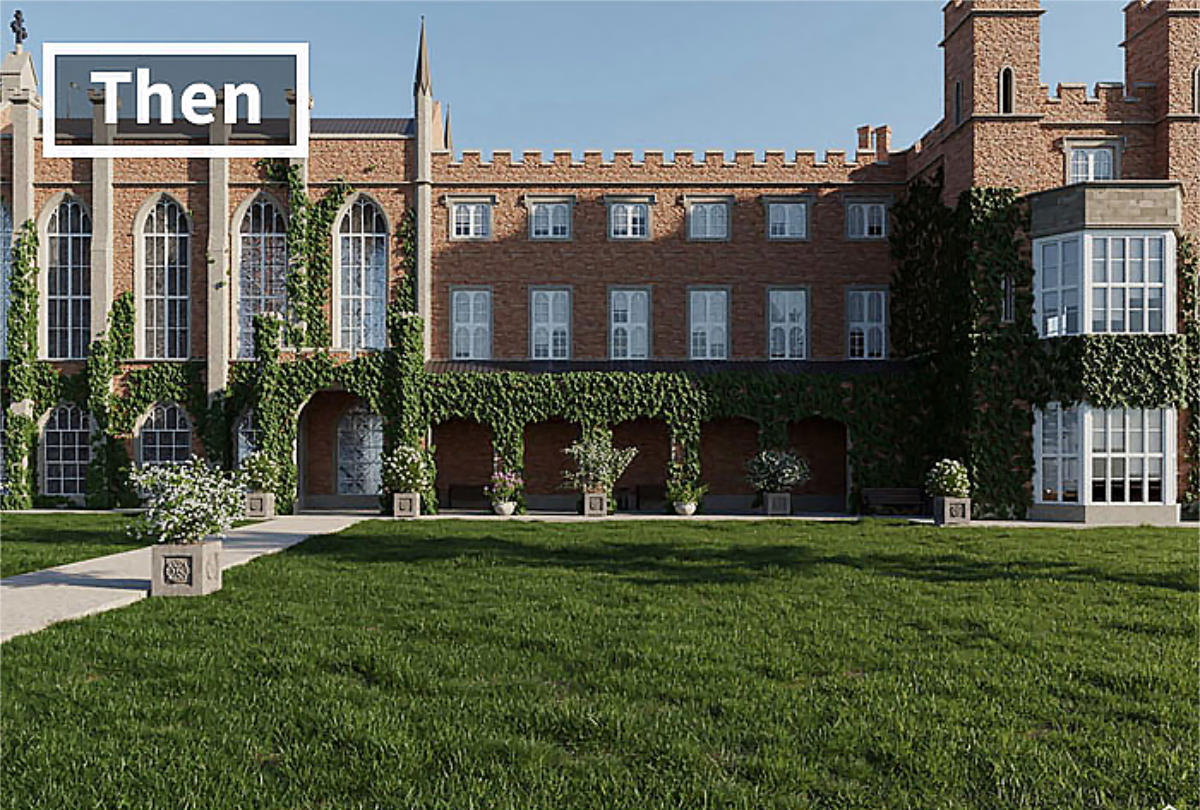
Cassiobury House (Watford, Hertfordshire) from BoredPanda article

Toronto. Many of us come from British roots. We often think about the olden days when thinking about ‘over home’. Sadly, nothing rarely stands still. Like here and elsewhere, many old places give way to the new. Historians are constantly battling ‘progress’ to save historic buildings/ruins/structures.

Some we think deserve saving, others get a casual shrug. Les Jones sent me a link the other day that hit home. On a site called ‘BoredPanda‘ Les discovered an article by Hidreley published four months ago called, “3D Renders Of England’s Historical Country Mansions And What Replaced Them (7 Pics)“.

While not photography related (other than the 3D reference) , all the country mansions and replacements are represented here by photos.

The title of this post is a take off on the play and movie of the same name – Look Back in Anger. I must have seen the movie, or a poster for it, way back when.

Posted in history | Tagged , , , | Comments Off on look back in anger

a Mitchin great camera

Jan 1947 ad for the 16mm version of the famous Mitchell 35mm camera

Toronto. Did you ever see a movie in the days when movie scenes were captured on 35 or 16 mm film? Well the chances are a Mitchell camera was used! Mitchell Cameras took over from Bell & Howell a few years before ‘the talkies’ – they were much quieter by design.

This ad in the January 1947 issue of Popular Photography was spotted by my good friend George Dunbar while he was doing some photographic history research recently. A Michell’s 35mm camera was the camera to be used in movie film shoots in Hollywood and around the world for over half a century. The cameras were designed and made in Los Angeles.

Modern day movies are shot digitally and the files are downloaded ready for projection with no urgent time limit demanding their return whether the movie ran to a full house or not!

Time passes; things change, but the old Mitchell cameras are still valued by serious collectors and professionals. An indication of their excellent design is the wilful copying by the U.S.S.R. to capture Eastern Block films. NB the Eastern Block used a different sprocket set up than the west, affecting film choice and film projection.

Posted in history | Tagged , , , , , , , | Comments Off on a Mitchin great camera

Graham Bezant, Photographer 76

Graham Bezant courtesy of Dick Loek and Toronto Star Archives/tpl.

Toronto. PHSC president Clint Hryhorijw dropped me a note late May 10th that photographer Graham Bezant had died. Graham was Australian but for a time he did photographs for the Toronto Star here in Toronto and world wide too.

Staff reporter Cheyenne Bholla wrote this obituary on the 10th. Graham died on the Gold Coast, Australia due to a cycling accident. He was almost 77 years old.

We are always sorry to hear of the loss of a photographer. A heartfelt thank you to Clint – one of the few people I know who still have a hardcopy newspaper delivered to the door. TV news is a bunch of frilly video bites with little serious analysis. Sadly, the days of such in depth newspaper-style analysis are now just a memory.


Posted in people | Tagged , , , , | Comments Off on Graham Bezant, Photographer 76

PHSC News for May 2021 (Vol 20-11)

a tasty film camera …

Toronto. At right top of page 1 in the PHSC News newsletter is a disposable film camera made by the Candy Camera company for all you die-hard film fans.

As our 5th month of 2021 gets underway, our editor, Sonja and her team, have produced a thought-provoking May 2021 edition to take your mind off certain medical issues. Speaking of which, COVID-19 vaccinations are accelerating in spite of the COVID-19 variations world-wide. Vaccines and close adherence to common sense guidelines seem to be affecting the cases in a good way.

This latest issue of PHSC News (20-11) has a flock of delightful articles – short, crisp, and provocative as usual. Take a few moments and read our latest newsletter to ease your personal cares (and boredom)!

The page 1 article, ‘Vicarious Vacay‘ speaks to the neon lit dark and empty streets.  Next, under PHSC Presents is, “Dream of a Rarebit Fiend (1906)“, showing how creative special effects were around over a century ago in movies.. On page 3, the column STUDENT PHOTOBOOK“ announces the Ryerson University students very best photo books (sponsored by a grant from the PHSC); while page 4 features a whimsical look at “The Photography of an Abstract Expressionist” in the column called “THEORY INTO PRACTICE“.

Page 5 discusses “How to Success in Business Without Really Crying”  in the “MEDIA-ROLOGY” column’s take on our Premier’s recent TV appearance. David does his usual tongue-in-cheek Equipment Review, on the “The So Not Treasures from My Collection“ article about things we collect but are of rather little value; while page 7 has a trio of WEB LINKS of interest to us all.

And of course, Page 8 features a poster on our forth-coming ZOOM event  “A Conversation with Rita Godlevskis Editor and Publisher, PhotoEd Magazine. You may find the poster vaguely familiar since I used it in a recent post :-)! On page 9, Ivy & Izzy discuss “The Photography of  Many Happy Returns” quietly followed by John’s page of classifieds covering things we find interesting.

P.S. As usual, every link shown in the newsletter is a hot link just waiting for your click!

P.P.S. You can visit this issue by clicking here, or by g0ing to the menu item NEWSLETTER at the top of the page. There is a drop down menu that takes you to older issues dating back a couple of decades to the very beginning.

Posted in newsletter | Tagged , , , | Comments Off on PHSC News for May 2021 (Vol 20-11)

let’s try small …

A version of the Classic 35 from Craftmen’s Guild in California

Toronto. … and aluminum, and made in America, and 35mm film. Sadly nothing worked, and the ‘Classic 35’ came out in 1948 and disappeared. Just another flop, but worth far more today for collectors – if they can find one!.

The name ‘Classic 35’ was later used by Peerless in the States for their branded imported cameras. This aluminum camera with the horizontal stripes was American-made and marketed out of  Hollywood, CA by the Craftmen’s Guild. It was basically a half frame box camera. The lens was f/4.5 to f/22 fixed focus with a single shutter speed of 1/50th second (plus time).

The Guild tried to ride the wave of enthusiasm for 35mm cameras, but never survived the rush of German and later Japanese cameras after the war. American-made cameras? Really? Just read this little ad from Popular Photography’s November 1948 issue and say thanks to my good friend and fellow PHSC member, George Dunbar for sharing his search results with us.


Posted in history | Tagged , , , , , , | Comments Off on let’s try small …

wild lights

sync adjustment slider for VIII flash and new camera base

Toronto. Okay, flash is “the next big thing” and you don’t have a flash socket (pc) or a hot shoe. So what can you do?? Welll, if you are Leitz of Leica fame, you could make a base and flash gun for your camera. The synchronization just needs to connect to the shutter, so you could add the adjustment and connection to the new base and then connect your flash trigger via a cord to the base et voilà!

As this advertisement in the January, 1947 issue of Popular Photography shows, E Leitz in New York solved it and sold flash guns for the screw mount Leicas. Mind you, the shutter synchronization limit was a trifle slow at 1/20th or 1/25th second for a wide open focal plane aperture (first curtain fully across, second curtain not yet started).  A special long burn FP bulb could sync at any shutter speed, of course (light stays on to follow the slit between the two curtains across the film plane).

Note. The title is a riff on the Canadian retail subsidiary of E Leitz in the 1970s called Wild-Leitz. Their repair department correctly fixed the shutter of my M4.

Posted in history | Tagged , , , , , , | Comments Off on wild lights

time slicers

slicing it right

Toronto. I often think of a shutter as a means to control speed and illumination. However when the image is framed and the shutter button pushed, it captures on film, a ‘slice of time’ in the subject’s life.

I have discussed shutters in many posts like, “shudder and stutter – our shutter supplement“, “freezing motion at slow shutter speeds“, “Self capping miniature FP shutter”, “The Need for a Shutter in the 1890s, “Spring? I Shutter at the Thought 🙂, Etc.

From the beginnings in 1839 to the 1870s the ‘slice’ was measured in minutes outdoors or by strong northern light in studios. A lens cap or gentleman’s hat was enough to block the light. When Richard Maddox invented the dry plate in 1871, this changed. Outdoors, sub-minute ‘slices’ became practical and various mechanical shutters emerged and stepped up to the task.

For most of the next century, shutter speeds and media sensitivity increased. Electronic flash offered good lighting and extremely brief exposures. When digital technology and especially smart phones took hold, mechanical shutters disappeared to be replaced by fully electronic technology and both media sensitivity and shutter speed soared making both in door and night time photography practical – often without resorting to flash illumination.

Posted in history | Tagged , , | Comments Off on time slicers

A Conversation with Rita Godlevskis

Toronto.  A Conversation with Rita Godlevskis, Editor and Publisher, PhotoEd Magazine On line MAY 19, 2021 – 7:30 EDT – PHSC May 2021 presentation for Toronto Meeting (virtual)

The migration to online consumption of text and the COVID-19 pandemic have had devastating effects on Canadian magazines, wiping many publications off the map. If there ever was a time to adapt or die, this is it. Rita Godlevskis, Editor and Publisher of PhotoEd Magazine and a pioneer in the rapidly-changing field of online media, discusses some strategies and initiatives for keeping the information industry relevant in the 21st century.

Zoom audience questions are welcome.

Our May Presentation. Click below for reservation – free

Register on Eventbrite for FREE tickets:
www.eventbrite.ca/e/in-conversation-with-rita-godlevskis-editorpublisher-photoed-magazine-tickets-139959082383

Any questions? Email us at program@phsc.ca

Posted in program | Tagged , , , , | Comments Off on A Conversation with Rita Godlevskis

Faye Schulman photographer 1920-2021

Toronto. Ms Schulman lived for 101 exciting years. She was born Faigel Lazebnik on Nov. 28, 1919, in Lenin, a Polish town near the Russian border. She died here in Toronto just over a century later.

Read about her exciting life in the Globe and Mail obituary written in some detail by Mr  Tu Thanh Ha back on May 5th.  She lived in Europe during the war, evading Nazi extermination and eventually fleeing to Russia. She married and with her husband emigrated to Canada in 1948. settling in Toronto.

My thanks to our president Lewko (Clint) Hryhorijiw for alerting me on Ms Schulman and her accomplishments. Clint is a professional photographer here in Toronto.

Posted in people | Tagged , , | Comments Off on Faye Schulman photographer 1920-2021

quirks and quotes

tongue in cheek ‘Kodak’ ad

Toronto.  The old bromide “a photo is worth a thousand words” was around when I was a kid. Petapixel built on this theme by offering an article “70 Inspirational Quotes for Photographers” by TAMMY LAMOUREUX back on 

The quotes are often from well known photographers. Have a look and see some fresh ideas for the digital era.

Thanks to photo-historian, good friend, and fellow PHSC member, George Dunbar.

The title of this post is a riff on Bob McDonald’s excellent CBC radio show “Quirks and Quarks“. By all means take a listen if you have any interest in science.


Posted in history | Tagged , , , | Comments Off on quirks and quotes