what’s in a name

Zeiss Protar V lens from c1900

Toronto. In the early days of photographic lens design there was no established standard for the data recorded on the lens. Early lenses usually had the patent number and/or date shown, but what else was needed? The coverage of the sensitive media depended on the choice of f/stop. The smaller the aperture opening, the greater the coverage.

Who made the lens was also deemed important. And its name, of course, but focal length, widest aperture, or angle of view were not considered important.

Consider the lens show here above (click image for a larger view). Made by Bausch & Lomb (in Rochester NY); licensed design by Zeiss; name of lens is PROTAR; series V (you have to look up the series in a catalogue or text book to know this lens is a wide-angle lens with a maximum aperture of f/18); Pat. Jan 13 ’91 (patented in January 13, 1891, likely in Germany); No 1648682 (serial number) 6 1/2 X 8 1/2 (coverage in inches at widest opening, full plate, larger cameras cannot use the widest aperture. A catalogue or text book will show the maximum usable aperture for larger plates).

On the body of the lens is an index and marks to show smaller aperture settings (if you have young eyes…), and the clearly marked word BACK so the photographer doesn’t mount the lens backwards and then complain about its quality.

The Protar series V wide-angle lenses were sold into the 1930s. They were originally called Anastigmat lenses, but Zeiss lost the court challenge on the name. The other Anastigmat/Protar series fell by the way side much earlier as better glass and better designs made the lenses redundant.

Posted in history | Tagged , , , , | Comments Off on what’s in a name

some thoughts on contrast

Digital HDR for contrast in 2013

Toronto. The other day as I watched a 1938 movie with Boyer and Lamarr, I got to thinking about contrast. The movie I watched was a dark, contrasty,  flick called ‘Algiers’. Some scenes had inky black shadows, others nearly washed-out highlights.

In the 19th century, most efforts on photography went into increasing the media’s sensitivity and trying to capture colour. Tripods, steady subjects (or sturdy supports) and lots of  sunshine were key ingredients for the day.

In the 20th century, the goals for film were: greater sensitivity, softer contrast, higher definition, and full colour. In general, the lower the sensitivity (ASA or as we know it, ISO), the higher the resolution, and the greater the contrast. One solution was using physically large cameras to expose glass plates or film. In the early days of experimentation with minicams, the 35mm cine film traded resolution for speed and hence softer contrast.

By the late 1930s, when the minicam revolution was in full swing, 35mm movie film had changed to low sensitivity and high resolution making scenes very contrasty. The mid 20th century was spent devising developers touted as reducing grain, softening contrast and offering ‘push’ processing to increase the sensitivity of the film by a stop or so.

Meantime, manufactures researched ways to capture colour, reduce grain, soften contrast and increase sensitivity in the off the shelf films. On my last outing to BC using film, in the summer of 2002, full colour negative film with an astonishing ISO 800 rating was available everywhere. The film’s colour accuracy, gentle contrast, fine grain, and sensitivity   made it the go-to choice for my Leica.

A decade later, digital HDR for contrast was in full swing. On-board computing power allowed the camera to combine rapid shots to give the typical look to HDR images such as the tree above which I took late at night by available light (and a tripod) at ISO 400. The trip to BC in 2002 was the last time I used film.

Posted in history | Tagged , , , , , , , | Comments Off on some thoughts on contrast

having a blast with photography

Beirut Blast courtesy of Nabih on Twitter

Toronto. For years our thirst for social media images has decimated the numbers and profits of serious professional photographers. The value of these ‘amateur social media’ recordings changed shortly after the huge blast on Beirut’s waterfront. On August 4th, 2020, world wide news stations and papers reported the massive explosion. After much speculation, it turned out to be caused by incorrectly stored ammonium nitrate.

A few months later, on November 20th, 2020, Jaron Schneider reported on Petapixel the article written by  Andrew Liszewski for Gizmodo called, “Forensic Experts Used Photos and Videos From Social Media to Reconstruct Beirut Explosion“.

The Forensic Experts used readily available stills and short videos on social media to create the time line of the explosion in perhaps a first for crowd sourcing images and video clips to reconstruct an historic event.

My thanks to past president, author, and sports photographer Les Jones for sharing ths amazing source with us.

Posted in history | Tagged , , , , , , | Comments Off on having a blast with photography

NJ Photographer GUSTAVUS PACH (1845-1904)

photo by Pach Bros, NJ, courtesy of the Monmouth County Historical Association

Toronto. Our president Lewko (Clint) Hryhorijiw passed along this note from the Monmouth County Historical Association in New Jersey. The MCHA do a number of online presentations. Unfortunately I missed this one on the 20th of May when Gary Saretzky, professor of Photography spoke on Gustavus Pach.

“The Pach Brothers were prolific photographers who captured many facets of Monmouth County history in the late 19th and early 20th centuries. They photographed the fabulously wealthy, but also documented intimate glimpses of everyday American life through their images. If you’ve ever wondered what it was like inside a local apothecary shop, or perhaps how familiar places like the main streets or boardwalks in New Jersey have changed since 1880, then the Pach Brothers are for you!

“See the sights and styles of this bygone era. Cars, clothing, and even beloved pets tell the story of those who lived here well over a century ago. Gary Saretzky, professor of Photography and total rock star among archivists highlight this incredible photography studio with a focus on Gustavus Pach.”

If you are interested in history, have a look at the MCHA web site and join up for the next free monthly lecture.


Posted in history | Tagged , , , , | Comments Off on NJ Photographer GUSTAVUS PACH (1845-1904)

a marr connection

Book on the Boston Studio of T E Marr & Son

Toronto. Journal editor Bob Lansdale sent me an email he recently received from Buffalo announcing a new 110 page photographic history monograph  written by Ron Polito covering another Boston Photographic Studio (other than Southworth & Hawes).

Rob McElroy of Buffalo, NY writes, “I just received the announcement from the Photographic Historical Society of New England (PHSNE) about a fascinating new photo history publication written by PhotoHistory member and author, Ron Polito, which is the culmination of eight years of research into the history, aesthetics and techniques of a little known father and son photographic studio, T. E. Marr (& Son), that was founded in Boston in 1899.  All proceeds from the sale of the book benefit the Society.”

Contact the PHSNE for further details, purchase options, etc. The link is to their temporary website. Alternatively you can visit their page on MagCloud.

Note, the title is a riff on the photographer’s name. Many do it yourselfers as well as all electricians know that Marr Connectors (generically named wire nuts) are used to join electrical wires together without a need to solder and tape the join. Ironically, these common items were patented here in the big smoke a few years before the American patent.


Posted in book | Tagged , , , , | Comments Off on a marr connection

camera boy

Camera Boy – left half of a stereo card

Toronto. My good friend and fellow PHSC alumni, George Dunbar spotted this interesting web site and the sample German stereo card added by John Robertson of the UK back on January 18th of this year (2021).

Browse the interesting links to the right side of the British Photographic History website and see how fascinating history can be. The site is hosted by Dr Michael Pritchard who spoke to us October, 1997 on Christie’s Auction House,

Note: The title of this post is an unintentional riff on Loverboy, the Canadian rock band formed in 1979 in Calgary and still around as far as I know. You may have heard one of their songs – their 1980 hit “Turn Me Loose“. This version has many B&W movie clips.

Posted in history | Tagged , , , , , , | Comments Off on camera boy

The Amalgamated Photo History Newsletters Vol 2-5 (May 2021)

Amalgamated Newsletters
Vol 2-5, May 2021

Toronto. A couple of special items are reproduced here in our special members-only supplement. As a member of the PHSC, you received this supplement Friday, the 21st of May.

Vol 2-5 was sent out last Friday afternoon to all current members with an email address. If you did NOT get a copy, please email me at info@phsc.ca and I will send you a copy after verification of your membership. Not YET a member? well, for heaven’s sake! Grab your plastic and register via PayPal on the upper right of this page! And you can donate to the society the same way via PayPal, or go to our Canada Helps entry on the link below the PAY NOW button.

In the preamble, journal editor Bob Lansdale write, “Here, I bring you a special story from the Photographic Historical Society of Canada, concerning the D-Day Landings in France, June 6th, 1944. I’ve published this story several times but cannot interest public media to pick it up. They favour “Back to the Beaches” or “The last surviving veteran.” I hope with this world-wide distribution you will pass it on to your local media: press, TV, radio and blogs. Or an Army or Veteran’s magazine which might find it interesting. This new aspect of events may catch their eye. It’s in time for the June 6th anniversary.

“I also include a wonderful layout of pictures on “The Families of the Dump” by Gerry Yaum of Edmonton, Alberta. He recorded the images in Thailand.”

Posted in journal | Tagged , , , , , | Comments Off on The Amalgamated Photo History Newsletters Vol 2-5 (May 2021)

sink, sank, sunk

Silhouette of B-17  bomber off Holland

Toronto. years ago a friend of mine dropped off a camera. Inside was a roll of mostly exposed film. The kicker? The camera was recovered from the glove box of a car that sunk through the ice on a local lake and was left submerged for a few days. I succeeded in the recovery, but the photographs were unremarkable in content.

Recently, my good friend and fellow PHSC member, George Dunbar, sent along this nifty article from the end piece column of the Royal Photographic Society‘s Photographic Journal for February 1974. The column discusses film recovered and successfully processed nearly three decades after the B-17 bomber sunk just off Holland after the German Luftwaffe shot it down.

With careful washing and unrolling it is possible to process and print film that sat in a hostile environment for days or years! By all means enjoy the RPS archives of samples of its remarkable Photographic Journal. The articles are a historic rendering from a British perspective.

Posted in history | Tagged , , , , , , | Comments Off on sink, sank, sunk

a plausible camera

Plaubel Makina III c1930

Toronto. In North America, we considered the Graphic and Graflex cameras the work horses of news hounds. In Europe, this pride of place went to the Plaubel Makina made in Frankfort, Germany.

The Plaubel Makina drawing for this post is courtesy of the late Brian Coe‘s 1978 book titled, “CAMERAS from Daguerreotypes to Instant Pictures“. The book is copyright AB Nordbok in Sweden and my version is the American book published in 1978 by Crown Publishers.

While we are still in lockdown at least to June 2, 2021, Our friends across the lake in Ohio plan to host their first auction in many months. The OCCC annual auction will be held May 21, 2021 from 1-6pm with preview starting at noon the same day. The auction will be an in person event with the usual COVID social distancing rules.

Hopefully, the situation up here north of the border will settle down by this fall/winter so we too can get on with our fairs, auctions, and shows once again. Meantime, the Ohio Camera Collectors Club will be soldiering on with their auction (including at least one Makina).


Posted in auction | Tagged , , , | Comments Off on a plausible camera

old wine in new bottles

click image for article

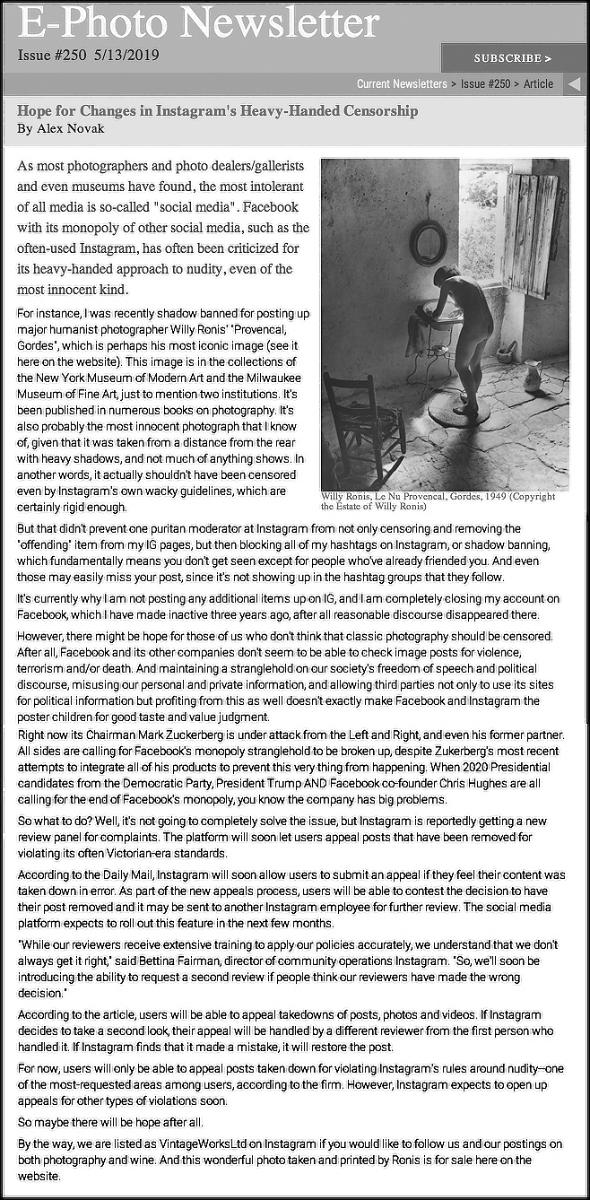
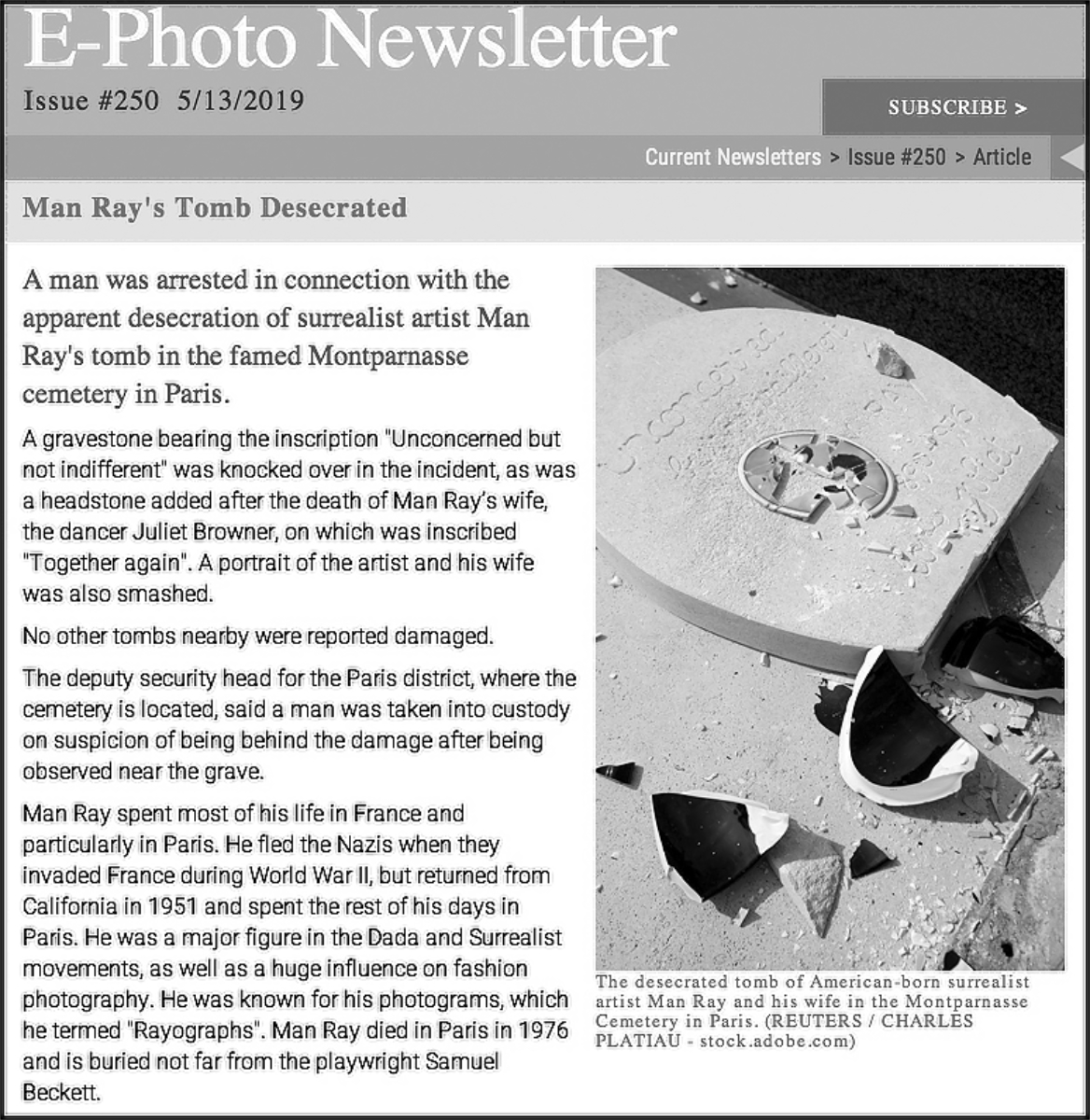
Toronto. We often see interesting articles in traditional books that can be held and felt as the pages are turned. Here are a couple of old familiar topics presented using new technology: E- Photo Newsletter #250 for May 13, 2019 has two interesting articles we would traditionally see in hard copy: First is an article covering the desecration of Man Ray’s tomb in Paris; the second by Alex Novak, complains about Instagram’s ‘Heavy-Handed Censorship’ not differentiating between art and obscene images.

Many thanks to my friend, George Dunbar, for once again sharing his discoveries while investigating photographic history.

Note: The title of this post is an old saying that is in turn a riff on a saying in the New Testament of the bible.


Posted in miscellaneous | Tagged , , | Comments Off on old wine in new bottles