Photographic Canadiana Supplement 2-4 (May 2021)

Photographic Canadiana Supplement 2-4 May 2021

Toronto. This year, the PHSC sponsored a project by students in the Film + Photography Preservation and Collections Management Program at Ryerson University. The project will mount an exhibition of images from the Sovfoto Archive at the MacLaren Art Centre at the Ryerson Image Centre  (September 15 – October 24, 2021).

We are circulating a PDF of the exhibition catalogue as a special thank-you to those whose memberships and renewals allow us to support important student work of this kind. As a member of the PHSC, you received this supplement Friday, the 7th of May.

Vol 2-4 was sent out last Friday afternoon to all current members with an email address. If you did NOT get a copy, please email me at info@phsc.ca and I will send you a copy after verification of your membership. Not YET a member? well, for heaven’s sake! Grab your plastic and register via PayPal on the upper right of this page! And you can donate to the society the same way via PayPal, or go to our Canada Helps entry on the link below the PAY NOW button.

Posted in history | Tagged , , , , , , , | Comments Off on Photographic Canadiana Supplement 2-4 (May 2021)

engine, engine, number 14

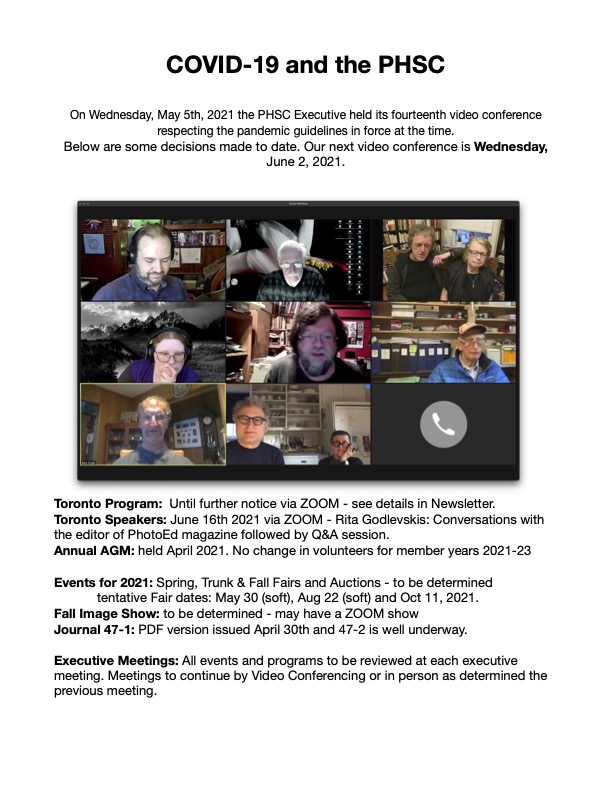
Toronto. We held our 14th ZOOM exec meeting Wednesday evening. And Celio out did himself in arranging this meeting and investigation alternate ZOOM features. The third wave still has Toronto under total lockdown and stay at home status. ALL live events continue to be cancelled and our monthly meeting venue (North York Memorial Hall) remains closed. Meantime, vaccination race is slowly winning out.

The May issue of our newsletter, ‘PHSC News’, goes next week to nearly 1,900 addresses (sign up at news@phsc.ca for your free pdf copy). Members get specials plus the journal via pdf. (contact me if you are a member and HAVE NOT seen the pdfs). Some members have unsubscribed to MailChimp; some emails are invalid; and others have no email on file with us or with MailChimp. Questions? Drop me a note at info@phsc.ca.

Note this post title is a riff on the old kids song, “Engine, Engine, Number 9“.

Posted in activities | Tagged , , | Comments Off on engine, engine, number 14

The Amateur Photographer et al

The Amateur Photographer, summer, 1940

Toronto. Post WW2 we became very American-centric whereas we focused on Britain prewar and during the war years. Many of our books and nearly all magazines come from the States today and we seem to have forgotten the wealth of material produced in England.

I have a couple of copies of the long running weekly ‘The Amateur Photographer’ plus lots of books by Hove, Focal Press, and even one by Thames and Hudson. Many of my books on photography and camera collecting came from Focal Press and Hove in England.

My good friend and fellow PHSC member, George Dunbar, emailed me a wonderful link the other day that sent me searching for my old copies of Amateur Photographer (July 17, 24, 1940). George found this link to a history of AP and the magazines it absorbed. The site, Photographic Memorabilia, looks very dated but was last updated just a few weeks ago. A big thanks to George for sharing this link with us in his search for photographic history. Note that the magazine has slowly increased in price but is still being published!

Posted in history | Tagged , , , , , | Comments Off on The Amateur Photographer et al

just like a Leica

Russian Fake Leica II from Stephen Gandy’s Camera Quest site

Toronto. When we were first organized in the 1970s, Leicas, Zeiss-Ikons and other old cameras were everywhere at reasonable prices. We had red curtain Leicas, K (German for ball bearing) stamped curtains (these shutter worked reliably under very low temperature conditions), black Leicas, “hockey stick” Leicas (the original infinity stop on fixed-lens Leicas – it was removed if the camera ever went back to Leitz for any reason) and those with German military markings, etc. Few books existed on camera history and variations.

Once the buyers began to pay more for the rarer models, the fraudsters crept in and it was buyer beware time. A more common model in good shape was easily “transformed” into  a fake rare version and immediately saw a big value increase if sold to the innocent or unwary who had no immediate access to serial number tables and model illustrations.

I chaired our 6th annual fair in the Park Plaza hotel (June 14/15, 1980). Just at closing on the 15th, a little old gentleman came in offering to sell his war memento – a Luftwaffe Leica with a brass bar on the back. Engraved on the bar was the name ‘Hermann Goring‘. The engraving  (Luftwaffe), serial number, model type, etc. all appeared genuine to the Leica collector at one table and he bought the camera, showing it to me as he closed up his offerings.

I called him in the States a few days later as I wanted a photograph. He declined my request, telling me although it was a good screw mount camera, authentic in all other ways, the engraving was wrong – the umlaut in ‘Göring’ was missing and such an egotistical German Officer in WW2 would never accept such a spelling error.

The Leitz factory in Wetzlar was spared from Allied bombs and its detailed serial number list became readily available, limiting people flogging fake ‘black Leicas’ at elevated prices to the naive beginner who wanted an authentic black Leica for their collection. As years passed, Russian cameras, based on the Leica, like the Zorki, were transformed with a suitably engraved cover and became a far higher value ‘Leica’. Gold plated versions with rather crude engraving posed as the far more highly valued Leica Lexus. In most cases such fakes were easily spotted by a Leica expert – even a casual one like me.

Note: the title is a riff on Bob Dylan’s 1966 song, “Just Like a Woman“.

Posted in camera | Tagged , , , , | Comments Off on just like a Leica

Kodak goes to war

Kodak Medalist I courtesy of Rick Soloway

Toronto. It was massive, heavy, and awkward to use, but with a great lens. It was the Medalist I 620 camera. Kodak built it for the US and British military after Germany cut off the German supply of cameras including the precision Leicas, Zeiss-Ikons, and Kodak’s own Retinas (made in German factories bought from August Nagel in the 1930s). Medalist I cameras were made beginning in 1941 with the Medalist II version marketed after the war. For a few years Kodak made high quality precision cameras in the States.

While the cameras were rugged and very heavy, they had a couple of weaknesses. Settings done in the wrong sequence could materially damage their shutters; and the cameras used the 620 film with skinny reel cores, now long out of manufacture (recently revived, but not by Kodak). 620 film lost out to 120 film (same film size) on a thick wooden reel core and used by all non-Kodak professional medium size cameras. 620, while it lasted, was relegated to the cheaper cameras manufactured by Kodak and many others.

The larger image, by Rob F, (click on the Medalist image at left) is from the June 12, 2017 article, “The Mighty Medalist 620 Camera!“, by Leslie Lazenby on the “Film Photography Project” website.


Posted in camera | Tagged , , , , , | Comments Off on Kodak goes to war

not with a bang, but a whimper

Zeiss Contarex Bullseye Advertisement brochure

Toronto. Talk about bad timing laced with bad decisions! Zeiss introduced the Contarex SLR just as Nippon Kogaku introduced it’s Nikon F. The Contarex was an engineer’s dream – a massive three pounds; over 1,000 parts per camera body; every part of high precision and tolerance; and so complex only a talented and well trained technician could do any repair/adjustment needed. And it was both very expensive and difficult for the photographer to use.

In Larry Gubas’s epic book, “Zeiss and Photography“, all of chapter 37 is devoted to this line of cameras. McKeown’s list availability as 1959-1972 with the bullseye version shown here running 1959-1966.

Unfortunately for Zeiss, the Nikon F was well built, much less expensive, lighter, and easier to use and adjust. It became a world-wide winner. The Contarex fizzled.

Note. The title of this post is the last line of T S Eliot’s famous 1925 poem, “The Hollow Men“. I always enjoyed reading his works.

Posted in history | Tagged , , , , | Comments Off on not with a bang, but a whimper

yikes! that’s big

Earth Cam Panorama with Sony $25,000 camera

Toronto. Around year 2000, digital technology took off with sensors only a few mega pixels in size. Look what the whiz kids have done about two decades later!

Modern day smart phones use a 12 mp sensor plus a computer chip to increase image quality. My iPod Touch has only an 8 mp sensor plus a non optical zoom prime lens equivalent to a 35mm focal length. It has become my go to camera.

Technology has far outstripped this sensor – if you can anty up the bucks. For example, journal editor Bob Lansdale sent this link to an article on PetaPixel (a link sent to him by PHSC past president Les Jones).

The PetaPixel article, written by Jaron Schneider, is dated April 27, 2021 and titled, “This 120 Gigapixel Photo is the Largest of New York City Ever Taken“.

Read about the amazing Sony technology behind the huge panorama then click on the fully interactive Earth Cam site photo and zoom/scroll about to enjoy the huge image to the fullest.

Thanks to both gentlemen for sharing this discovery with me.

Posted in history | Tagged , , | Comments Off on yikes! that’s big

Photographic Canadiana Vol 47-1

Photographic Canadiana 47-1 is released in pdf format for PHSC Members

Toronto. Our editor is at it again – its been a bit windy and soggy here in the big smoke. Bob Lansdale had this issue nearly ready weeks ago and has 47-2 well underway! Yesterday, members WITH an email address received this delightful 32 page magazine via pdf. It  is  the Photographic Canadiana 47-1 dated May-June  2021.

This is another colourful issue as  envisioned by editor Lansdale to help create the excitement we all feel as we await an end to a rotten  pandemic which has dragged its heels into this year too. Like last year, we plan on doing at least five issues.

Drop me a line at info@phsc.ca if you are a member and haven’t received this special pdf edition. Not a member? Easy-peasy, just break out your plastic (VISA, MasterCard, etc.), follow the rules at the upper right of this page and sign up via PayPal (no PayPal account needed – we will pay the modest fee). Membership is an incredible bargain. Period!

Posted in journal | Tagged , , , , , , , | Comments Off on Photographic Canadiana Vol 47-1

picture perfect – Thaddeus Holownia book

Headlighting 1974-1978

Toronto.  I had an email from PHSC president Clint Hryhorijiw the other day. The email contained a link to this book release on a site called, “BK On The Scene“. The book post was dated April 21st of this year and directed viewers to visit Jane Corkin Gallery for any orders.

On the Corkin Gallery web site was this article: “Thaddeus Holownia, ‘Headlighting 1974-1978’

“The images in this book comprise photographer Thaddeus Holownia’s large-format portrait series, Headlighting 1974–1978. This project, on the theme of internal-combustion-engine vehicles and their drivers, ostensibly ‘car culture’, is a body of work that has become increasingly provocative at the ‘end of oil’. It was Allan Fleming, the distinguished Canadian graphic designer, who first suggested to fledgling photographer Holownia—when he presented his portfolio to Fleming at the University of Toronto Press in 1974—that he might consider using a view camera. Holownia freely admits that this meeting changed his life. Shortly thereafter he began Headlighting, a series which originated in Toronto but overflowed into the US Midwest and ended with his move to New Brunswick, Canada.

“-Robert Tombs”

Thaddeus Holownia
Headlighting 1974-1978
59 duotone reproductions
66 pages, 12 x 18 in.
Hardbound, in limited edition.
$85.00 + Tax

Order at info@corkingallery.com.

Posted in book | Tagged , , , , , , | Comments Off on picture perfect – Thaddeus Holownia book

light my fire

Bay Studio lighting in late 1970s

Toronto. Back to the very beginnings of photography, savvy studio artists used lighting to model their subjects, control contrast, and at just the right instant capture the fire or essence of each subject. Over the decades, books have proliferated with the results of this careful rendering.

Typical is this late 1970s colour studio lighting set-up ready for portraits of all subjects. The big square soft light gives the overall illumination; a spot light softens the backdrop and dissolves  shadows; while another spot adds modelling to the subject children.

All that is left is the professional’s skill and sharp eye to snap his camera and capture the image just as the subjects sparkle with inner fire.

Note. The title of this post is the famous Doors song of 1967. Here you can listen to Jim Morrison and company sing the song.

Posted in history | Tagged , , , , , | Comments Off on light my fire