all things to all people

An all encompassing advertisement for Kodak of Rochester in late fall of 1951. Think Christmas. Think gifts.

Toronto. Mid last century we called Kodak, “The Great Yellow Father”. Kodak was everywhere. To think photography was to think Kodak. Sure other companies touted their photographic wares but Kodak was photography to so many of us.

The above advertisement from the December, 1951 issue of Popular Photography makes just such a point (thanks, George Dunbar). In my family anything photographic was Kodak – be it films, photos, or cameras.

Sadly, today Kodak, literally the creator of the digital era, is but a footnote in history. Kids with the ubiquitous smartphones are never without a camera – who cares the make – just snap and send – anywhere from storing in the camera’s memory to emailing to friends or relatives thousands of miles away. Kodak, we are so sad to see you fade away like a poorly fixed and washed print.

Posted in history | Tagged , , , | Comments Off on all things to all people

dialling for Dags

A sample lot from the Oct 29, 2022 auction by the Daguerreian Society.

Toronto. Our friends to the south often hold fairs and auctions to market images from the beginnings of photography. They do a wonderful job for those enamoured with old photographs, especially Daguerreotypes.

Their annual is a massive soft cover book (hard cover for a premium) of manuscripts and photographs from the mid 1800s. Each annual is an education in itself. Many of our members are also members of “The Daguerreian Society“.

The society recently sent around an email announcing that their next auction is coming up fast. At the time I saw the email, it was, “T minus 7 days and counting!”

The email continued, “Have you checked out the more than 130 lots of fantastic images and other items that will be offered in our annual Benefit Auction on Saturday, Oct. 29, starting at 9:30 pm ET?

“Bidding will be in person at Chicago’s Palmer House Hotel for DS Symposium attendees and online through LiveAuctioneers and Cowan’s Auctions, which is generously waiving its platform fees.

“Thirty percent of the proceeds will go to The Daguerreian Society, helping fund website improvements and programming, among other operating expenses. ”

Then the coordinators suggested, “To see the full catalog on Cowan’s (20% buyer’s premium), click here; to see it on LiveAuctioneers (25% buyer’s premium), click here.

This another chance to add to your collect (live if you are in Chicago for the symposium) or from the comfort of your home. …

Note: The title of this post is a riff on a line from an old Janis Joplin tune, “Mercedes Benz“. I first heard this c1970 song on one my CDs titled, “Pearl” which was said to be the late singer’s middle name.

Posted in activities-other | Tagged , , | Comments Off on dialling for Dags

photographers’ blues on October 24, 2022

announcing the October, 2022 WPS

Toronto. Nope. Not a sad occasion but a happy one! A cyanotype photograph has much in common with the blueprint used before the days of cheap copy processes. Horst Herget is a collodion process photographer here in Toronto and has spoken to the PHSC membership as well (September, 2019).

I recently received an email from Horst on a related topic – Cyanotype prints. Horst offered a number of explanations of the process and his demonstration at a forth coming Wet Plate Social in his studio. Horst writes, ” FEATURE: This month Horst welcomes alt process printer Peter Friedrichsen to demonstrate the cyanotype process, from start to finish. Participants can send in one image each as a digital file. A limited selection of images from the submissions will then be chosen for printing. The selection will be based on prints that may help to express a particular attribute of the process rather than artistic merit.

WET PLATE SOCIAL – WPS: A get together to talk, ask questions, and share all things wet plate and alternative photographic processes. From first timers to old timers, the event is open to all that are interested in these beautiful and humbling artforms.

WHEN: October 24th, from 7 to 9pm.

LOCATION: Daylight Studio @daylight_studio_toronto in Toronto: 28 Industrial Street (off Laird, south of Eglinton), M4G 1Y9 unit 222. The building is painted white, and the main entrance is located at the EAST end (look for the very large ENTRANCE SIGN on the corner of the building) with free parking available in the lot in front.

TO ATTEND: All are welcome. Please RSVP. A $10 contribution is greatly appreciated, but not required.

CORRESPONDENCE AND UPDATES: If you have question, please contact Horst at horst@horsth.ca or on Instagram @horst.herget.

FUTURE MEETUPS: WPS are held on the third Monday of the month.

ABOUT HORST: Horst Herget is a wet plate photographer based in Toronto. He has been working with this alternative process for over ten years. His day job is working as corporate photographer www.horstherget.com and is owner & operator of Daylight Studio Toronto, @daylight_studio_toronto.”

Posted in activities-other | Tagged , , , , , | Comments Off on photographers’ blues on October 24, 2022

remembrance day next month

Remembrance Day in 1919 London, England

Toronto. As a kid in grade school we held a special remembrance each November 11th. The ritual was emphasized in high school with Vimy Ridge models, the ‘In Flanders Fields’ poem, minute of silence, pin-on poppy, etc.

George Dunbar spotted this original celebration in 1919 London, England in the BBC History Magazine for November 2009. What excitement! What relief!

Once again, we are shown the impact of photography on the world. A painting or drawing would be difficult to use to convey the feelings of the first year of the Great War Remembrance Day.

Posted in history | Tagged , , , , | Comments Off on remembrance day next month

a bridge too far …

news article from Lethbridge saved by George Dunbar.

Toronto. The other day, George Dunbar sent me an article on the Lethbridge, Alberta ‘High Level Bridge’ over the ‘Oldman River Valley’. The article is illustrated with a photo by the late Toronto photographer Jane Hinton (1936-2020).

Some of Ms Hinton’s work can be seen on the MutualArt website. A brief bio on that site states, “Jane Hinton was a Canadian artist who was born in 1936. Numerous key galleries and museums such as Mira Godard Gallery have featured Jane Hinton’s work in the past. Jane Hinton’s work has been offered at auction multiple times, with realized prices ranging from 251 USD to 262 USD, depending on the size and medium of the artwork. Since 2020 the record price for this artist at auction is 262 USD for CANADIAN CLICHÉ #3, B.C. WOODEN TRESTLE SINGEL, 2003, sold at Waddington’s in 2022. The artist died in 2020.”

George thinks she may have visited at one of our meetings around 2010.

NOTE. The post title is that of a 1977 movie about a WW2 operation in Holland  of the same name. In turn, the movie is based on a book – also of the same name …


Posted in history | Tagged , , , , , , , | Comments Off on a bridge too far …

October PHSC Meeting this coming Saturday

Stereo card of a nasty disease – part of the exhibit at TMUs RIC

Toronto. You may have noticed we were rather silent this Wednesday as the usual locale is still not open for meetings as yet. Our program chair has lined up an alternative session for this Saturday at the RIC. Celio writes, “PHSC PROGRAM FIELD TRIP!
4PM, Saturday, October 22, 2022 at The Image Centre’s Student Gallery.

“This Saturday October 22nd we will meet at The Image Centre’s Lobby (33 Gould St, Toronto) to visit “The Optics of Science: Early Western Stereographs from The Dr. Martin J. Bass and Gail Silverman Bass Collection” on its closing day. This wonderful exhibit is curated by the 2021-2022 second-year students from Toronto Metropolitan University’s Film + Photography Preservation and Collections Management program. [NOTE: the image and thumbnail used here are from this collection].

“The Optics of Science presents late 19th and early 20th-century three-dimensional stereographic cards and supplementary material from the Bass Collection, part of The Image Centre’s holdings.

“The exhibition and accompanying publication focus on representations of Western science and related knowledge at a time of unprecedented and rapid industrial, social, and geographical change.

“Comprising medical, clinical, anthropological, astronomical, and spirit photographs, the selection highlights the technical and historical intricacies associated with looking at images often entangled with colonial legacies.

“FPPCM Alumni & Friends”

Posted in program | Tagged , , , , | Comments Off on October PHSC Meeting this coming Saturday

sometimes a camera is really special

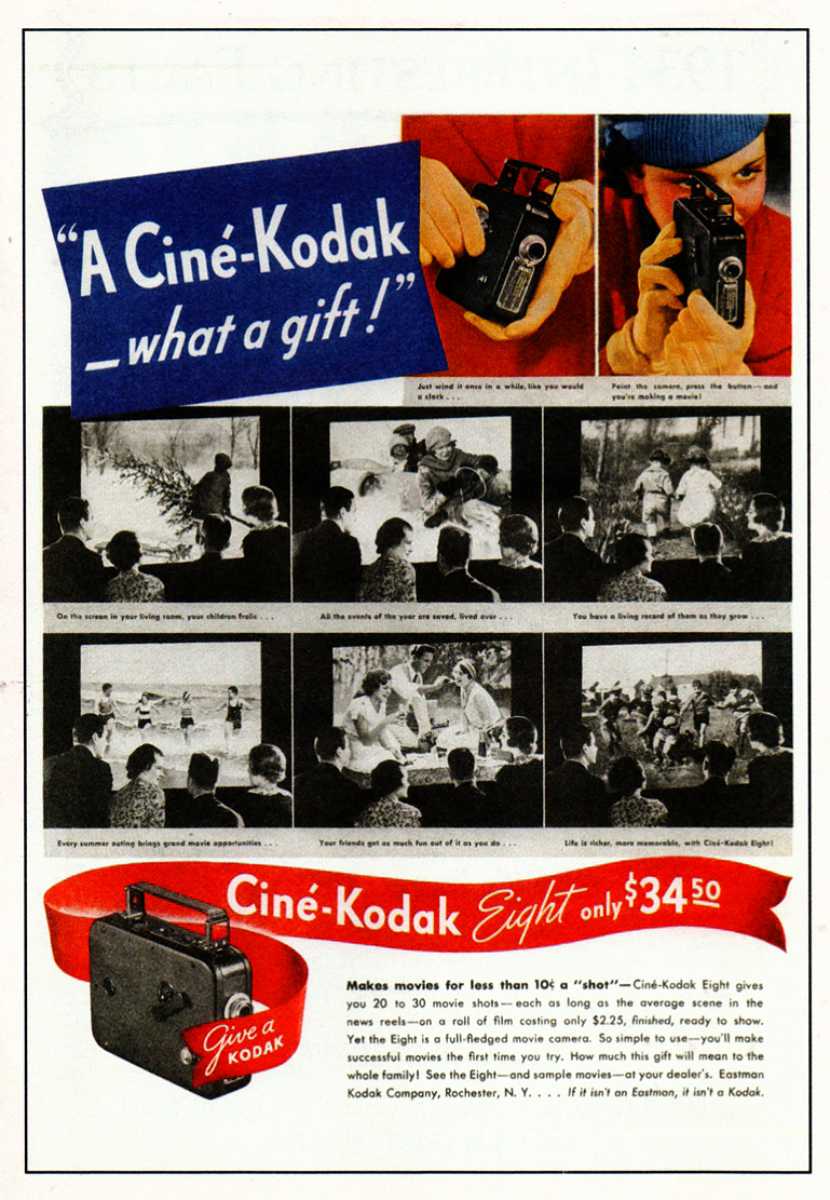
a Ciné-Kodak for Christmas ….

Toronto. Take for example the camera in this 1934 advertisement. Two years earlier in 1932, Kodak began marketing a new smaller film format for the family ‘movie’ photographer  starting out during the great depression when money and jobs were so scarce – the 8mm film.

A camera just like the one in the ad was George Dunbar’s introduction to a like-long interest in cinematography. George sent us the ad and with it he writes, “Published in a small brochure featuring ads from 1934 … this is the camera my Dad used to teach me “cinematography” when I was about six or seven.”

I’m guessing, but from the ribbon, the word ‘gift’ and the first scenes, it looks like a Kodak Christmas ad. In any case, just such a camera had a very special place in George’s life as he became an industrial cinematographer for IBM many years later.

Posted in history | Tagged , , , , | Comments Off on sometimes a camera is really special

time gentlemen please

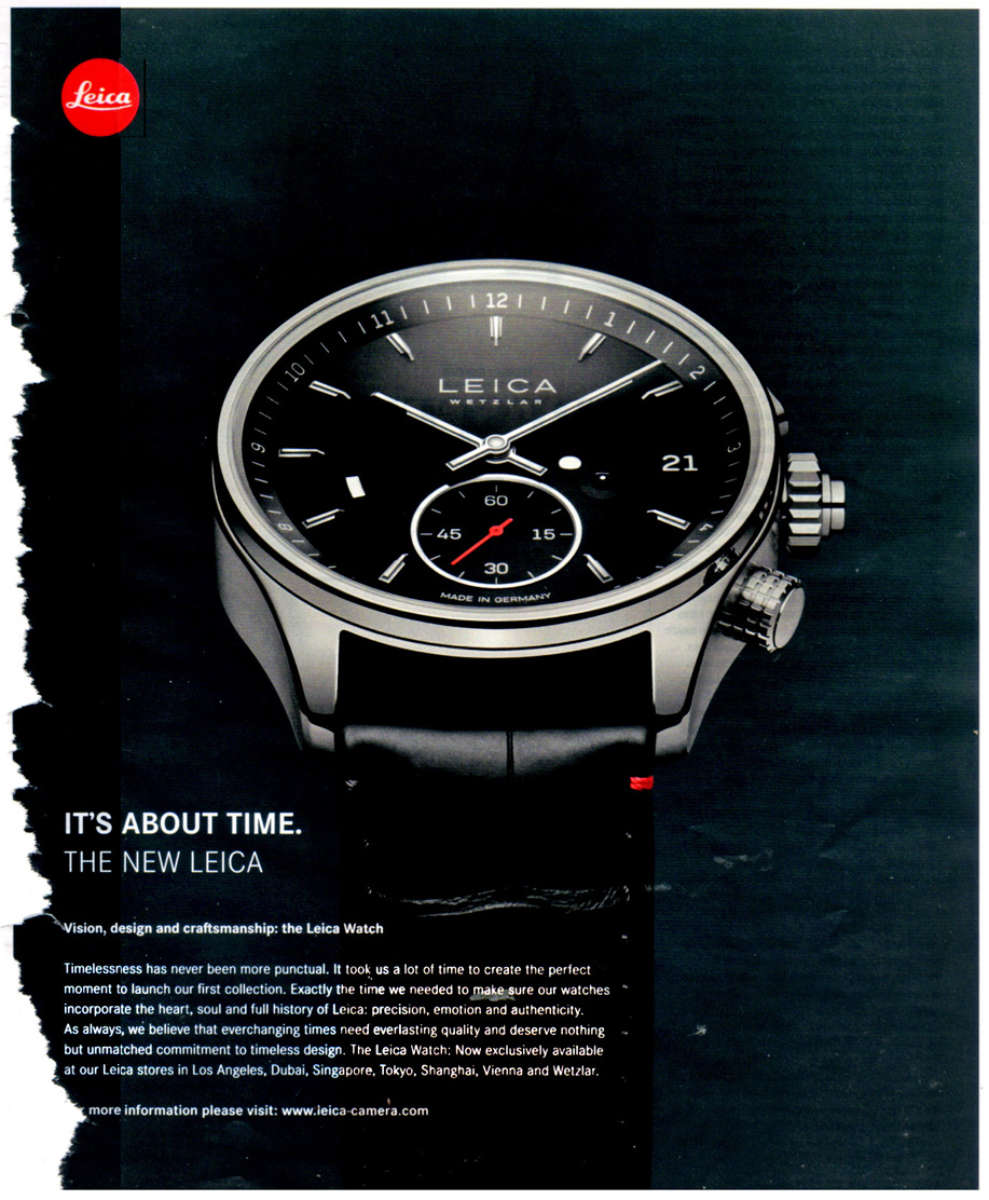
ad for the new Leica Watch line

Toronto.  For decades companies would rebadge fancy watches for sales staff and other folk, As a youth, I bought a Bulova Accutron which is a mechanism driven by a tuning fork in turn driven by a transistor. Companies like Amanda rebadged the Accutron which was the first electronic watch. Decades later, Apple created an electronic watch and the software to run it as another line of income.

Recently George Dunbar sent me a copy of an ad for a Leica Watch. Rather than compete with Apple and its all electronic watch, Leica chose to create a mechanical watch with some unique features. Leica is known for its high quality and introduction to the era of the minicam. Leica won its spurs for both lenses and mechanical precision.

George writes, “This full-page appears in the Oct. 16 issue of the New York Times Fashion Magazine.”. Take a look.

NB. This post title is from a British TV comedy series of the same name.

Posted in history | Tagged , , , , , | Comments Off on time gentlemen please

fiddling with film

new Lomography 35mm camera

Toronto. Birgit Buchart over at Lomography sent me a note the other day. Lomography announced a new 35mm camera with a bunch of accessories to bring out the experimental side of the snap shooter. The camera is offered in two versions:, ” LomoApparat Camera Black Edition MSRP: 89 USD https://shop.lomography.com/us/lomoapparat-21mm-point-and-shoot-camera

“LomoApparat Camera Neubau Edition MSRP: 99 USD https://shop.lomography.com/lomoapparat-neubau-wide-angle-camera

“- Fit every adventure in the frame with a 21 mm wide-angle lens
– With fixed settings for super simple snapping anywhere, anytime
– Packed with creative features to guide you through the analogue world
– Snap around the clock with a clever built-in flash & interchangeable colored gel filter design
– Load any 35 mm film for classic analogue character
– Use the close-up lens attachment to get closer…and closer
– Try the kaleidoscope lens attachment for unpredictable, experimental effects
– Experiment with the splitzer lens attachment for unique multiple exposure composition
– Shoot long exposures & multiple exposures with the flick of a switch”


Posted in camera | Tagged , , , | Comments Off on fiddling with film

trey trays

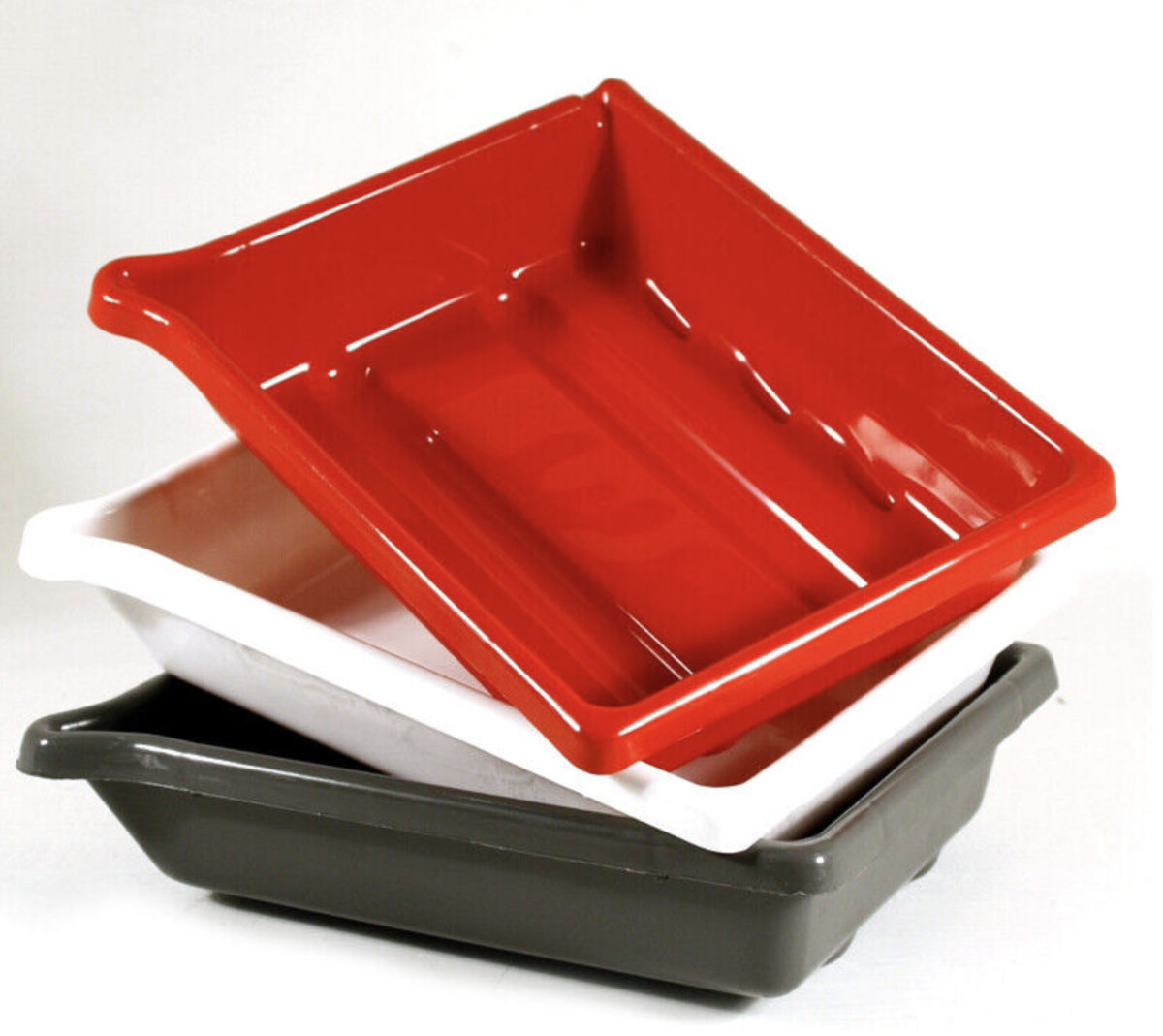
Paterson coloured plastic trays

Toronto. In the glory days of film photography anyone in the know would have or have the use of a darkroom to develop black and white prints. Common to almost all darkrooms was a trio of trays. The first held developer chemical; the second stop bath (or diluted vinegar); and the third the fixer solution.

Washing was done in a large sink under normal lighting and lots of running water to removed the fixer and the unused silver halides the fixer released from the paper. Kodak even sold a fancy siphon for use with a large tray in the sink.

As a high school scholar, the school darkroom was available (at the time, I had others develop my negatives since it was a far fussier process done with special tanks and usually in total darkness following traditional time and temperature guidelines).

Once I had my own darkroom, complete with a safelight, enlarger, paper, easel, and trays of chemicals, I could make my own prints. The trays were usually a bit larger than the paper. Too small and the paper would not fit; too big and more chemistry was needed plus a greater risk of oxidization happening. Darkrooms often had trays of various sizes to accommodate differing paper sizes. 8×10 trays seemed most common.

The trays could be plastic like those shown here courtesy of this Ebay link, hard rubber, or home-made from plywood using liners cut from very thin plastic tarp material. Regardless of size, using the same tray for the same chemistry minimized washing time and cross contamination.

Posted in history | Tagged , , , , | Comments Off on trey trays