red light district

“red light illuminated” darkroom with special filter (not red) in overhead light. Courtesy of Douglas Whitaker at English Wikipedia

Toronto. In the days of analogue (film) photography  seasoned photographers knew their way around a darkroom – often having one. Photographic paper was usually insensitive to red so it was common in movies or on TV to see darkrooms in red light festooned with drying or developing prints.

When the use of multigrade papers became popular, safe lights became a ‘dirty yellowish, brownish’ colour, but the fad for red light in popular media remained. With colour photographic paper, this changed. Any visible light would ruin the paper and light-tight drums took over. The average soul reverted to chains (Eddie Black’s, Japan Camera) offering processing and small prints (4×6) in an hour.

Now-a-days we use digital cameras and print images on an inkjet printer in full daylight – or just leave them on hard drives as digital files. Computer or smartphone apps like Affinity Photo or Adobe Lightroom ‘develop’ the digital image correcting light balance, saturation, etc..  You can read more about the film  safelight here.

Posted in Uncategorized | Tagged , , , | Comments Off on red light district

reminiscing

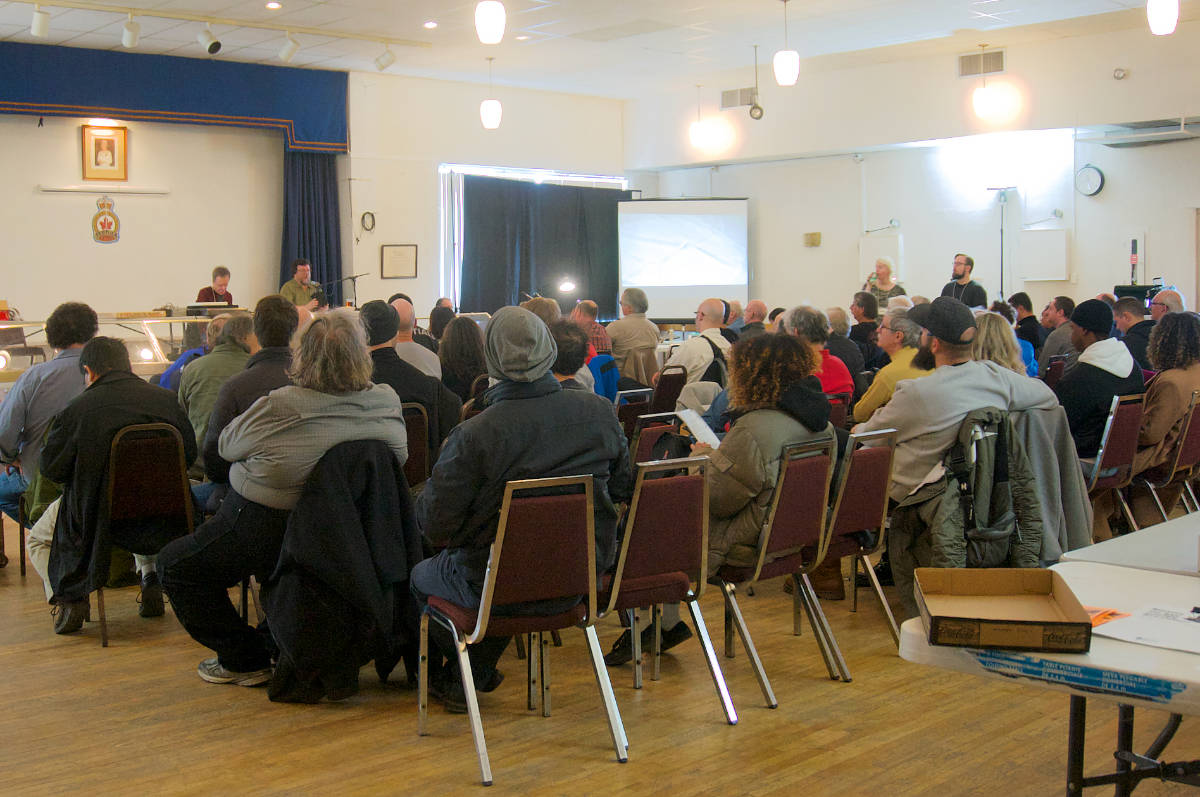
outside the legion hall in the east end before the opening of our March 2007 Auction

Toronto. Those were the days my friend when we thought COVID would never end … Apologies to Gene Raskin who wrote the English words to this old Russian song and poem.

Well COVID did end (or at least the pandemic fell so low restriction were dropped) and some of our braver souls followed our bold president Clint Hryhorijiw and held the early PHSC events in 2022 in person including the spring auction and a special two day auction – the first outside Toronto – this summer.

Now we are planning a late fall auction (tentative date is SATURDAY, December 3, 2022) IF we can garner enough volunteers. It will take place at our usual facility, the Legion 101 Hall in Long Branch (South-Western Toronto). Drop me a line at info@phsc.ca if you can help.

Keep a watch on this site or our newsletters for a firm date in a few weeks from now.

Posted in auction | Tagged , , , , , , | Comments Off on reminiscing

cheap shot

1946 ad for a PHOTO-CRAFT camera ‘kit’

Toronto. Sometimes when you can’t offer better specs, you can suggest the offering has many pieces. I fell for this gambit as a kid. I bought a “computer” from NYC which was touted as having 100s of parts. Turned out to be a true ad – BUT the parts were paper pins, washers for the pins, tiny lights, a D cell, wire, a mimeographed instruction sheet, a half dozen round masonite disks with holes for the pins, and a rectangular masonite base with rows of holes, plus some nuts and bolts to mount the disks.  Properly wired, it gave an answer to a logic question when the disks were turned.

In a way this ad for a PHOTO-CRAFT camera is similar. The popularity of the minicam a decade earlier led to some box cameras such as this one being shaped like a “candid camera”. This Bakelite marvel with a cheap lens and simple shutter came as a “kit” of the camera, three rolls of 127 film, and a camera case (likely pressed paper given the price).

The disc around the lens says ‘distributed by The March Corp’ while the order form is sent to ‘Imperial Industries’ in Chicago. I tried McKeown’s 11th edition and discovered a newer looking version of the camera with a ring stating ‘Altheimer & Baer Inc‘. Both rings say ‘Made in USA’ on the bottom. None of the companies named seem to be around today.

The viewfinder and ad copy suggest the camera took ‘half frame’ photos (16 photos per roll of 127 film).  This particular ad is from the April, 1946 issue of Popular Mechanics and is curtesy of my good friend George Dunbar.


Posted in history | Tagged , , , | Comments Off on cheap shot

book covers

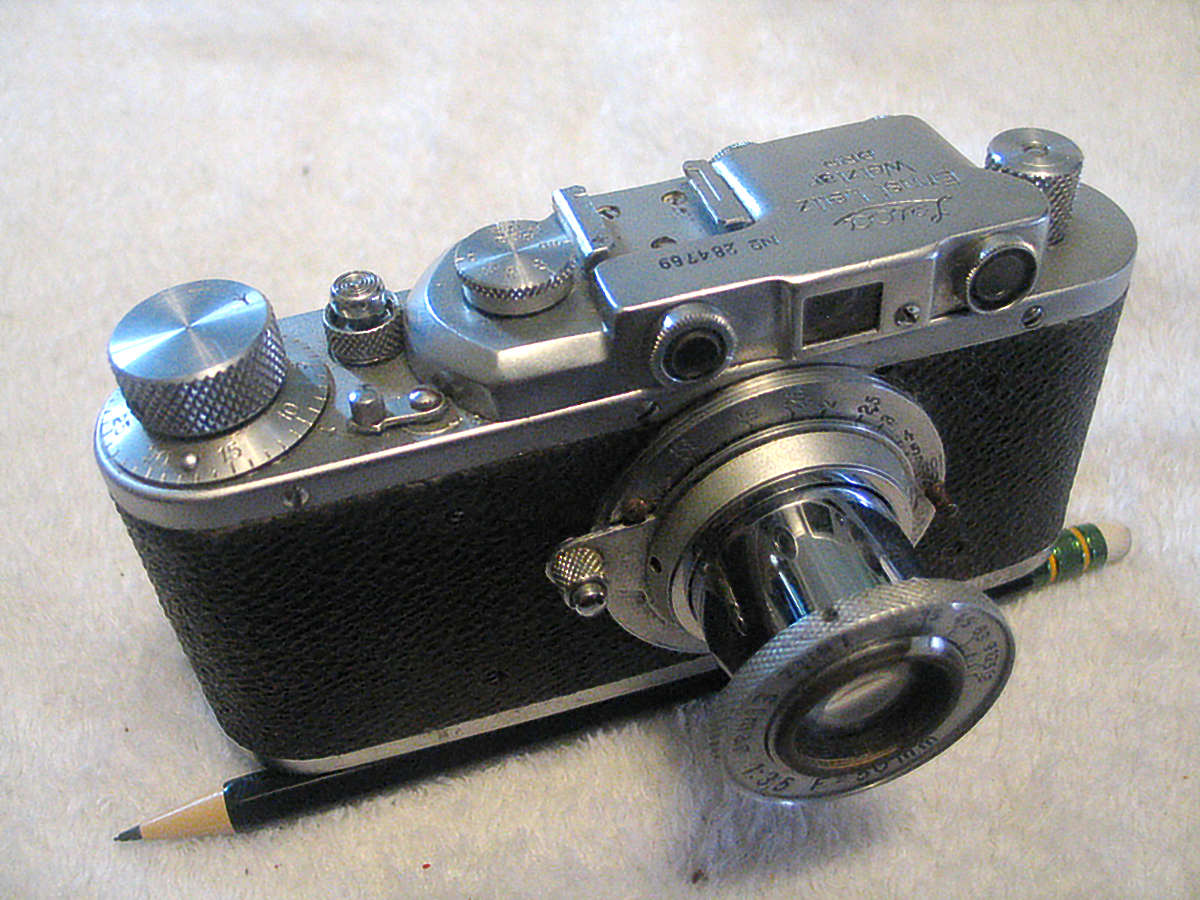
A Leica IIb c1938 from a recent auction posting

Toronto. There is a saying – you can’t tell a book by its cover. In the early days of miniature cameras, it was the same for model type. For example through-out the screw mount era, Leitz cameras were all ‘Leicas’. Only a factory serial number record showed the ‘serial number – model at manufacture’ correlation. Model numbers never appeared on the camera until the post war M series arrived (e.g. M3 – serial number).

There’s a good reason. Many older Leicas could be factory upgraded by request (i.e. from model I to II or III or model II to III), or simply changed (e.g. from the old ‘hockey stick infinity stop to the newer lens ring stop). The camera’s external controls identified a model number to those in the know. No rangefinder or slow speed dial meant a model I. Add a rangefinder and it’s a model II. add a slow speed dial as well and it’s a model III.

Any model could be bought as a I or II at a lower cost and later upgraded at the factory. When Ia, IIa, and IIIa came along, they were mainly the earlier models with an added hole in the shutter speed control disk for the faster nominal 1/000 second shutter setting. Every camera was hand assembled with the parts selected so all aspects of the cameras stayed within tight specifications.

The model IIb (as shown here from a recent auction post) was a transition model and only made for a few years. It was based on the IIIa series but had some features that appeared with the IIIc series. The IIIc series used a die cast body and shutter case – and the era of semi-mass production began.

Leitz often made subtle changes to the Leica, usually so minor that only rabid collectors showed any interest in the variations.


Posted in camera | Tagged , , , | Comments Off on book covers

the big 3 0 ZOOM meeting – highlights

Toronto. I had to miss the executive meeting this time due to my miscalculation on a personal arrangement. Fortunately David Bridge pumped out a minutes draft and mini newsletter draft in record time. Well done David!

The 30th executive meeting via ZOOM was held on on Wednesday evening October 5th. Our speaker program started up again last month. While the fall schedule was provided, it was held back due to last minute changes. I will be doing individual monthly posts as usual, so keep an eye out.

Our original new newsletter editor had to cancel to focus on her post graduate work. Now our first fall newsletter is due this month. It will be guided by David Bridge under the pseudonym “Etaoin Shrdlu”. Relax, David first took on the newsletter a few years back to ease the load on its originator, the late Bob Lansdale. As you may know, our pdf newsletter is sent to all those signed up via MailChimp. If you would like a personal copy but haven’t joined up as yet, just drop me a note at news@phsc.ca.

We are looking at another auction this fall. It will offer estate and (hopefully) member lots. Details will be posted as they are known. The tentative date is December 3rd at the usual place in Long Branch (south west Toronto).

Like I said last month, “Have a great fall and lets hope the seventh wave of COVID-19 and its restrictions are very modest at best!”.

dropping the hammer in 2019 at the Long Branch Legion Hall 101

Posted in activities | Tagged | Comments Off on the big 3 0 ZOOM meeting – highlights

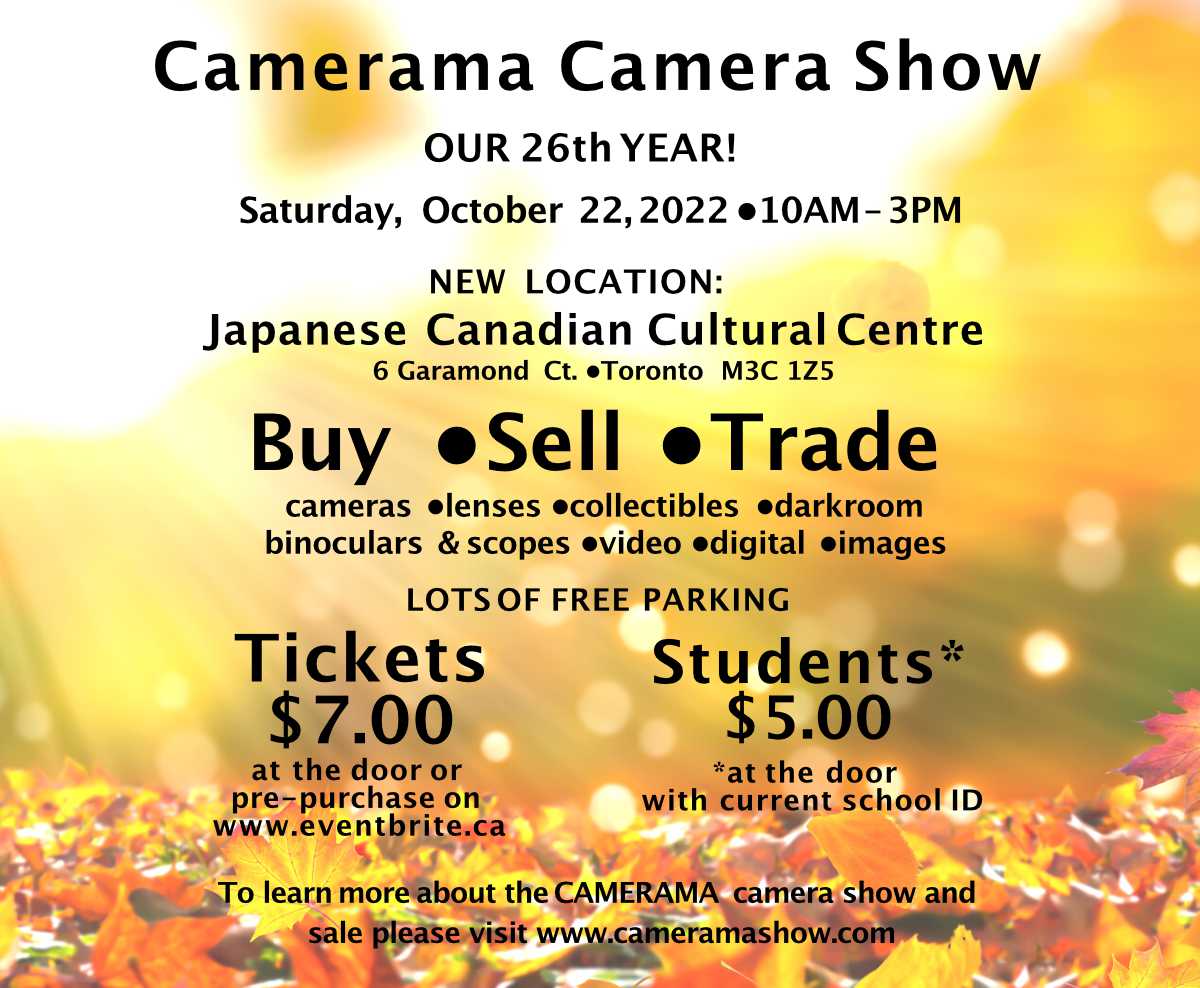
Gary does it again – Oct 22, 2022 Camerama Show

Toronto. On October 4th, Gary sent me an email. In it, he writes, “We’re finally pleased to announce our next Camerama Camera Show on Saturday, October 22nd, 2022 at a new location: Japanese Canadian Cultural Centre, 6 Garamond Ct., Toronto  M3C 1Z5 – Show Hours: 10am – 3pm. Entrance at the south side of the building.

Vendor tables are available. Contact me for information. Regards, Gary Perry, Camerama Camera Show, 905-550-7477

Posted in activities-other | Tagged , , , , , | Comments Off on Gary does it again – Oct 22, 2022 Camerama Show

O, to be in Montreal now that October’s here

Toronto. My good friend Sol Hadef in that wonderful city a few hours east of us writes, “Le Montreal Camera Show will take place Sunday, Oct 16th, 2022 between 9:30am and 2:30pm at the Marriott Courtyard Montreal Airport located at 7000 Place Robert-Joncas, Montreal, QC, H4M 2Z5.

“BUY-SELL-TRADE – Everything photographic, new or used, film and digital, cameras, lenses, flash, tripods, filters, film, accessories etc…..

“Need more information? See poster below or, ‘Please call Sol at 514-898-5351′”

NB The post title was written with apologies to poet Robert Browning for the riff on a line in his well known poem, “Home Thoughts, from Abroad“.

Posted in activities-other | Tagged , , , , | Comments Off on O, to be in Montreal now that October’s here

a fair collection

an 1888 telephone demonstration at the CNE

Toronto. In 1880, the company that became Bell Canada was founded in this city – later to move to Montreal, the major city in Canada at the time.

The site called Daily Hive has numerous photos of the CNE over the past 138 years.

The example photo at left celebrated the introduction of the telephone just 8 years after the Bell Telephone Company of Canada was established.  Those who know telephone history know Alexander Graham Bell lived summertimes  Brampton but discovered the telephone in his lab in Boston Mass. The idea of long distance was attributed to Bell at his Brampton home.

His success became the basis of the mighty AT&T in America and later spread up here. I remember hearing once that Western Union turned down Bell’s invention (or so it was said) since unlike the telegram, it left no written record of any call or its content.

We must thank our good friend, George Dunbar, once again. George found the page on the Daily Hive site and shared it with us.

Posted in history | Tagged , , | Comments Off on a fair collection

something fishy

a fisheye 110 camera sold by Lomography

Toronto. Those of you who still use film for that special feeling, remember Lomography. Ms Birgit Buchart at lomography.com recently sent me an email. The folks there are re-introducing the 110 fisheye camera. See photos of the metal version here, or the bauhaus version here.

Think you need more about the camera or film? Download a Press Kit here. Or just take the plunge and buy one of the 110 cameras here.

Posted in activities-other | Tagged , , , | Comments Off on something fishy

so near yet so far

Streetsville School c1900

Toronto. The second book in Douglas Adams‘ five volume “trilogy” – The Hitchhiker’s Guide to the Galaxy – is titled “The Restaurant at the end of the Universe“. It clarifies the difference between physical distance and temporal distance.

Similarly, while we in west Toronto are physically just next door to the photographs, time-wise we are over a century away from them. Their graininess is due entirely to the halftone process of the day that ‘transformed’ black (ink) and white (no ink) into shades of grey so photographs could be reproduced. I have books from the 1950s and earlier whose photos have a similar lack of resolution thanks to the halftone process once used.

The photographs for this post are on the Insauga [In Mississauga] web site. Take a look (caution: you will be bombarded with ads and solicitations). Once again we owe a debt to good friend and fellow photo-historian, George Dunbar, for finding and sharing this site with us. Along with the above link, George writes, “An extensive site here with hundreds of historic images of Mississauga and surrounding towns and villages”.

Posted in history | Tagged , , | Comments Off on so near yet so far