we are all amateurs in something

Thomas Bradt, Amateur Photographer – glass plates 1904-1910

Toronto. In the 1960s, my physics professor, Dr S___ came in one Monday morning with a very raspy voice. Being unfamiliar with alcohol, hangover remedies, or over the counter medication, he had picked up some Bromo-Seltzer tablets to ease a throbbing headache.

If he had followed the instructions, one of the rather large pills would have been dissolved in a glass and then the fizzy water consumed. Unfamiliar as he was, he had attempted to swallow a pill but it stuck in his throat. Unthinkingly, he quickly drank a glass of water to wash it down. The pill immediately frothed and fizzed nearly suffocating the young man. Fortunately, by the time I had my afternoon lecture, his voice and throat were back to normal and we had another great lecture.

Dr David Kenny recently wrote and published a book on  amateur photography illustrated with photos taken by Thomas W Bradt in 1904-1910. Dr Kenny writes, “It was my intention that the ebook would be available under the PHSC Press section as a free download for anyone … . I have licensed it under a Creative Commons license allowing free download, attribution, non commercial, no derivatives. This way members of other camera clubs can access it.”   

The pdf version was recently sent to our members as a free bonus. A hard copy is available directly from Blurb. If you only need an electronic version and intend to use it under the Creative Commons guidelines, download it via our  PRESS menu item above.

Posted in activities-other | Tagged , , , | Comments Off on we are all amateurs in something

to catch a spy

photography to the rescue

Toronto. During WW2, photography found many ways to be of service. This article in the January 1941 issue of Popular Mechanics shows photography making photo I.D. passes that helped separate the workers from the ‘spies’ in America during the war years.

A few decades later, a  polaroid colour setup with three differently coloured backdrops helped secure Bell’s data centres by controlling access to the computer area in the pre-internet days when physical damage was a prime threat.

Thanks to my friend and fellow PHSC member, George Dunbar,  for sharing this filler article from one of the truly popular magazines both pre-war, WW2, and post-war (I was a fan of the magazine in the 1950s).

Note: The post title is a riff on an excellent movie called, “To Catch a Thief” starring Cary Grant and Grace Kelly (before she became royalty).

Posted in history | Tagged , , , | Comments Off on to catch a spy

four flasher

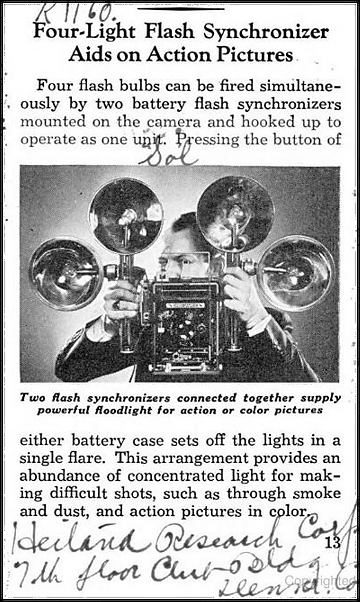
article for four flashes on a Speed Graphic camera

Toronto.  … or more than one way to skin a cat (sorry cat fanciers). In the February 1941 issue of Popular Mechanics, a filler article suggests using two  special synchronizers for a Graphic camera to quadruple the light output over a single flash unit.

This Rube Goldberg idea may have never taken off since this is the only place I saw such a gadget.

My thanks to George Dunbar for sharing this tidbit of history with us. The post title is a riff on the once common phrase “four-flusher

Posted in history | Tagged , , | Comments Off on four flasher

read da fine print, dummy

Ad for Super-XX film for easy peasy (yeah, right) indoor and night photos

Toronto. The February, 1941 issue of Popular Mechanics came out when I was a little kid still figuring out when to use a spoon (not really). Six years later, I took a bus ride with the rest of my grade 6 classmates to visit a couple of museums in villages a few miles north of home.

I took along my trusty Baby Brownie and since I was shooting some photos indoors I also bought Kodak Super-XX film which was the fastest film around back then – and Kodak said it was great indoors and at night. Boy, what a disappointment! The outdoor photos came out just fine as usual, but the indoor shots where all sadly underexposed … and like any little kid, I wondered what I did wrong. Now I know …

I didn’t read the fine print! I believed Kodak when they said any camera could take indoor and night shots as easy as outdoor shots if it could use Super XX film (just like mine). Now, seeing this ad and reading the fine print, it says in paragraph ‘B’, “Use a couple of inexpensive Mazda Photo flood lamps in Kodak handy reflectors … Kodak handy Measure included“. Hmfff! tell THAT to a kid-sized budding photographer!

Anyway, here we are over seven decades later. Water under the bridge. The ad that brought this to mind is courtesy of my good friend and fellow photo-historian, George Dunbar. It’s George’s abundant curiosity that makes the history of our art so darned  interesting.

Posted in history | Tagged , , , , , , , | Comments Off on read da fine print, dummy

when I grow too old to dream …

street photographer in Clapham Common, London, England 1877

Toronto. … I’ll have you to remember. Or so the song says. To try for memory beyond a generation or two, people relied on a photograph – then and now! George, like anyone with a curiosity – and access to the internet these days –  often discovers the unusual. In this case, George came across a tumblr website about photographic history.

When you visit the site (and tear yourself away from Muybridge’s work) you see a photograph and brief essay on an itinerant photographer in Clapham Common (England) where he earns his keep by photographing people such as babies for their nanny to take home to the parents. The photographer appears to be the proprietor of his own business.

As noted in the linked post above, when I was very young, we too were visited by an itinerant photographer – with a pony for a prop.  Thanks is due to my very good friend and fellow PHSC member, George Dunbar, for sharing his unquenchable thirst for knowledge.

Posted in history | Tagged , , , , , , , , | Comments Off on when I grow too old to dream …

the Graflex of movie cameras

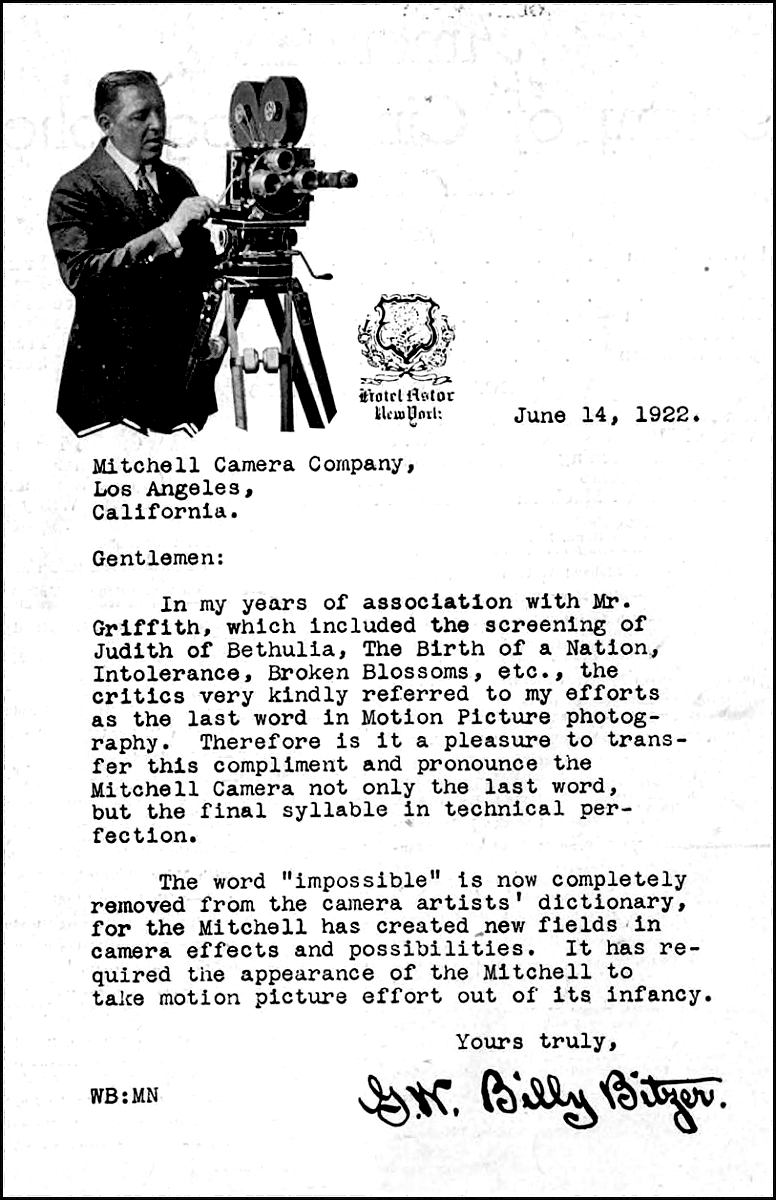
1922 ad for Mitchell cameras

Toronto. Professional camera men in Hollywood for the most part used Mitchell cameras. The Mitchell was to Hollywood cameramen like a Graflex camera was to newshounds – Fully professional and a sturdy work horse.

In 1922, when silents were still leading edge movies, Billy Bitzer took the time to write the Mitchel company and compliment their product. Decades later, well into the sound and colour era, Mitchell was still the professional’s movie camera of choice.

A heartfelt thank you to my good friend and fellow photographic history buff, George Dunbar, for sharing this advertisement from the August 1922 issue of American Cinematographer.

Posted in history | Tagged , , , , , , | Comments Off on the Graflex of movie cameras

the jig’s up

a ‘fake’ jig in 1940 to discredit the infamous

Toronto. My good friend, George Dunbar, spotted this 1947 ad by Kodak portraying Mr Hitler dancing an inappropriate jig in 1940 during the fall of France. George high-lighted one line in the advertisement which proclaimed, “with unique reality and objectivity”.

Perhaps unbeknownst to the ad editor, the picture selected and the story about the dance was based on a fake bit of artistic looping of movie film by Scottish-Canadian John Grierson in England. The story of the loop was uncovered again recently by Dr. Joseph Coohill, AKA, “Professor Buzzkill”  in a British podcast and text message called, “The Hitler Jig“.

Summing up this story, George writes,”I thought this 1947 Kodak ad in [the May] American Cinematographer was unique. Particularly in view of the propaganda manipulation that Grierson accomplished in 1940. The ad’s text is ironic … I doubt that Kodak was aware in 1947.”

Posted in history | Tagged , , , | Comments Off on the jig’s up

Don Douglas 1931-2022

A young Don Douglas at the 1980 PHSC Fair

Toronto. I was sorry to hear that Don Douglas passed away this month. His daughter Janet sent an email notifying me of the loss. Don celebrated his 90th birthday just last month. He was a continuous member of our society since first joining in the 1975/6 membership year.

Don was also very active in the PHSC for many years both as a participant in the annual fairs and on the executive. He took  over as president for the 1987-1989 membership period and chose Ev Roseborough as journal editor (Ev was one our most successful editors). Don spend some 40 years in the insurance industry. He was also an accomplished amateur photographer and an ardent collector of Ansco cameras. Prior to taking on the duties of president, Don held the positions of Program Director and then Vice-President.

His humour was low key and caught your attention. At one point, I added ‘occupation’ to the membership form thinking it would help us fill executive spots. In reaction, Don wrote “curmudgeon” on his renewal. A few years later, he described himself as “retired curmudgeon”.

We wish Don’s family and relatives all the best in this most trying of times.

Posted in people | Tagged , , | Comments Off on Don Douglas 1931-2022

gold in them thar hills …

July 4th, 1899 in Dawson City (Gold Rush days)

Toronto. Ahhh! The excitement of the  gold rush! When it hit the Yukon,  it became famous the world over. Movies were made; books were written (even poems); the centennial of the celebrated trail (Chilkoot) was recorded. Over six years ago, then PHSC member and photographer Scott Rickard, shared his slides with us. Before Scott and his wife returned to Southern Ontario, he had a studio in Dawson and captured the centennial of the famous trail on film.

Canada’s History magazine has written many articles on Dawson City and the gold rush. This is one of the images recently discovered by George Dunbar and shared with us. George writes, “I love old images of Dawson City during the ‘Gold Rush.’ These were posted recently by Canada’s History Magazine in its web site.

The image I chose to show is Front Street in Dawson on July 4th, 1899. The date is American Independence day, of course and reflects that the majority of the men who rushed to the north were out of work Americans. What a time! What a town!

Posted in history | Tagged , , , , | Comments Off on gold in them thar hills …

fuzzy focus

fuzzy focus simulation

Toronto. Modern smart phone and digital camera buffs only see fuzzy focus when they move or try using dim lighting or are just too close to the subject. No need to understand photography these days to get correct lighting. Focus and framing and white balance need more skills.

When photography began, a lot of skill was needed. The portrait artist also had to select the equipment, the location, advertise, take the images, develop them, and present them to the sitter for payment. Considerable skill and learning was necessary for success! In those early days, light sensitive media was only blue and violet sensitive as these were the stronger wave lengths. Worse, early lenses were not always colour corrected so the more visible red and green colours focussed at a different plane than the blues and violets.

A practitioner, focussing carefully on his ground glass, would cause the blue light sensitive coating to be out of focus giving a blurry image (fuzzy focus) unless he corrected his focus for the effect. As sensitive media was improved, first to orthochromatic and later panchromatic, and lenses became colour corrected, visual and actinic or chemical focus merged.

This effect is nicely described in the Large Format Forum on actinic focus. Continue reading

Posted in history | Tagged , , , , | Comments Off on fuzzy focus