1906 – a bad year for San Francisco

Arnold Genthe – San Francisco 1906

Toronto. We often feature photographers here. This time it is the German/American Arnold Genthe. He had the fortune (misfortune?) to be in San Francisco in 1906 when a devastating earthquake struck California near that city.

Genthe’s photos are available on line at many institutions, including the ARTIC in Chicago. A conservator in San Francisco plans to host an online conference on Arnold Genthe’s photos and the famous earthquake via Facebook.

Victoria Binder of the Fine Atrs Museum in that city writes,

“Hi Photo History Friends,

“Please join curator, Karin Breuer and me, April 22nd @ 3 pm, for a Legion of Honor Museum, Facebook Live discussion on resilience and Arnold Genthe’s photographs of the 1906 San Francisco Earthquake.

“Please share!

“You can find the event on the Legion of Honor Museum Facebook Page. https://www.facebook.com/events/1399514816915614/

“Best wishes,
Victoria Binder
Head of Paper Conservation
Fine Arts Museums of San Francisco
de Young \ Legion of Honor”

A big thank you to our journal editor, Bob Lansdale, for passing this information along.

Posted in history | Tagged , , , , | Comments Off on 1906 – a bad year for San Francisco

the Jack Roy of photography

Polaroid Land Camera 100 ad in LIFE

Toronto. Jack Roy used the stage name of Rodney Dangerfield. As Dangerfield, his catch phrase was, “I don’t get no respect”.  The vast majority of professional and amateur photographers viewed Polaroid in the same light. Polaroid had very innovative cameras and processes but you were locked into one media supplier and no interchangeable lenses. Later on, Polaroid backs became available allowing the use of any camera with a removable back that supported Polaroid.

The Polaroid colour material quickly shifted to 50 second processing. The camera 100 was a marvel of technology using Polaroid color packs or ASA 3000 black and white packs. Rather expensive, but showing results in under a minute. Prints could be copied to make different sizes or duplicates. Polaroid cameras were the epitome of automation. Much like today’s even simpler to use smartphone cameras.

Thanks to George Dunbar for noting this wonderful advertisement (pp65-7) in the September 20th, 1963 edition of LIFE magazine. Note: Anyone can browse many of the older magazine thanks to Google Books. Into photographic history and have no magazine back issues? Try George’s route to see the old advertisements and see how we lived last century. Of course you can attend our auctions and fairs when they resume and possibly find some old back issues.


Posted in history | Tagged , , , , , | Comments Off on the Jack Roy of photography

Yousuf Russia LIFE 1963

Krushchev by Karsh in LIFE magazine September 13, 1963

Toronto. One of our most famous portrait photographers of all time was Karsh of Ottawa. Some members strive to collect portraits taken by Karsh. One member – Shelton Chen – even wrote and published a book of Karsh Portraits.

In 1963, LIFE magazine in New York devoted an entire issue to Russia. Beginning on page 72 of this September 13, 1963 issue is the essay and portraits captured by the great man, Yousuf Karsh.

My thanks to George Dunbar for unearthing this exciting issue, fresh in 1963, just weeks before the tragic death of president John F Kennedy and his replacement by vice-president Lyndon B Johnson.

Posted in history | Tagged , , , , , | Comments Off on Yousuf Russia LIFE 1963

just before dawn

Sample Portrait using Babylon ISO 13 film

Toronto. Hard on the heels of its ISO 8 monochrome film, Lomography has announced Babylon – its ISO 13 film, another dark, moody monochrome beauty with marginally softer contrast.

If you are into film, take a close look  at what this moody film can do for you.

The title of this post is from a song by the Mommas and Poppas – Dedicated to the One I Love. It is a haunting song, like the moody portaits possible with this high contrast film.


Posted in film | Tagged , , , , | Comments Off on just before dawn

gearing up for great pix

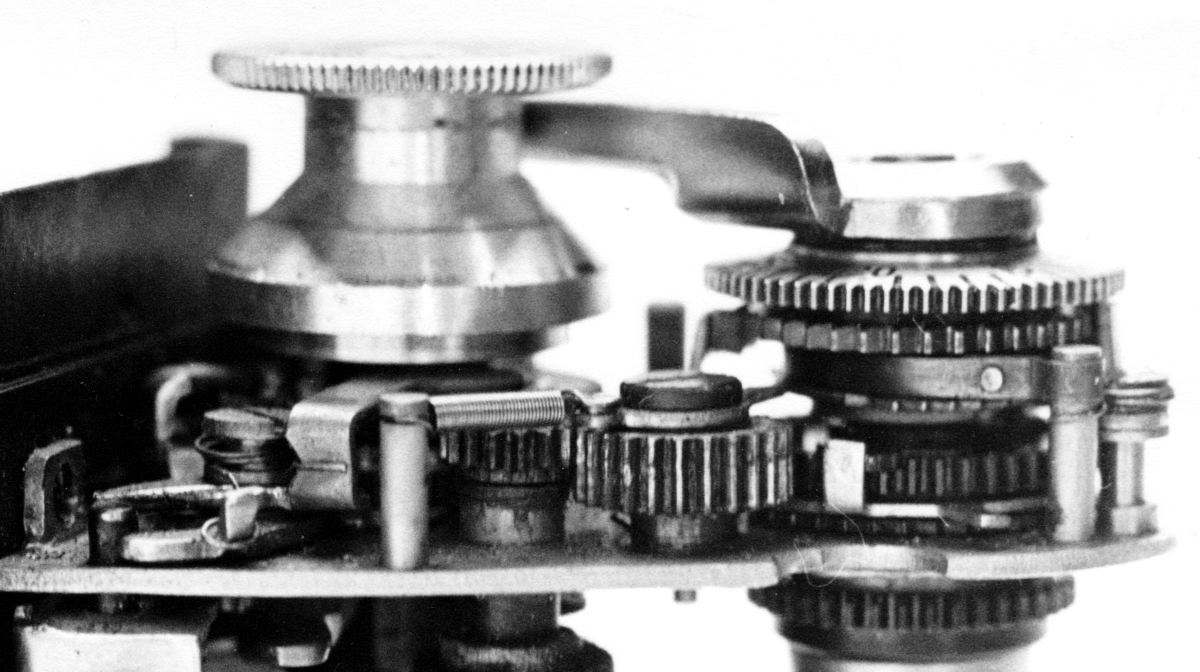
My Exakta VXIIa winding mechanism in the 1970s.

Toronto. In the early decades of photography, the media were so slow a hat or lens cap worked just fine to control exposures. Lenses were left open or used waterhouse stops inserted into a slot in the lens barrel until the thin multi-blade aperture mechanism became popular.

Until the advent of film, metal or glass plates (and later cut film) were hand changed. When dry plates  arrived and “instantaneous” exposures became possible, a simple bladed shutter could be used. For the first time plate sensitizing, exposure and processing were potentially separated by a time beyond that ever known before.

As media sensitivity increased, clock-work mechanisms were designed and sold to allow sub-second exposures. With roll film, the manually exchanged plate holders were replaced by an in-camera means to roll the film on to a new unexposed frame. By the 1930s, the mini-cam rage hit and the popular and very compact 35mm cameras were made and sold. Gears were used to ensure the film was wound as the shutter was cocked, eliminating the risk of double exposure.

Today, we see digital technology everywhere. Sensors replaced film; solid state gizmos replaced gears and the captured digital images were a very lengthy series of zeros and ones saved to RAW and Jpeg files which could be “developed” in the device or downloaded to a computer for correction before electronic printing. Now, even the digital cameras are disappearing, replaced by smartphones. Always close-by, smartphones all have cameras now and their resolution and technology continues to evolve. As they say, the best camera is the one you have ready to take the photograph.


Posted in history | Tagged , , , , , | Comments Off on gearing up for great pix

the last picture show

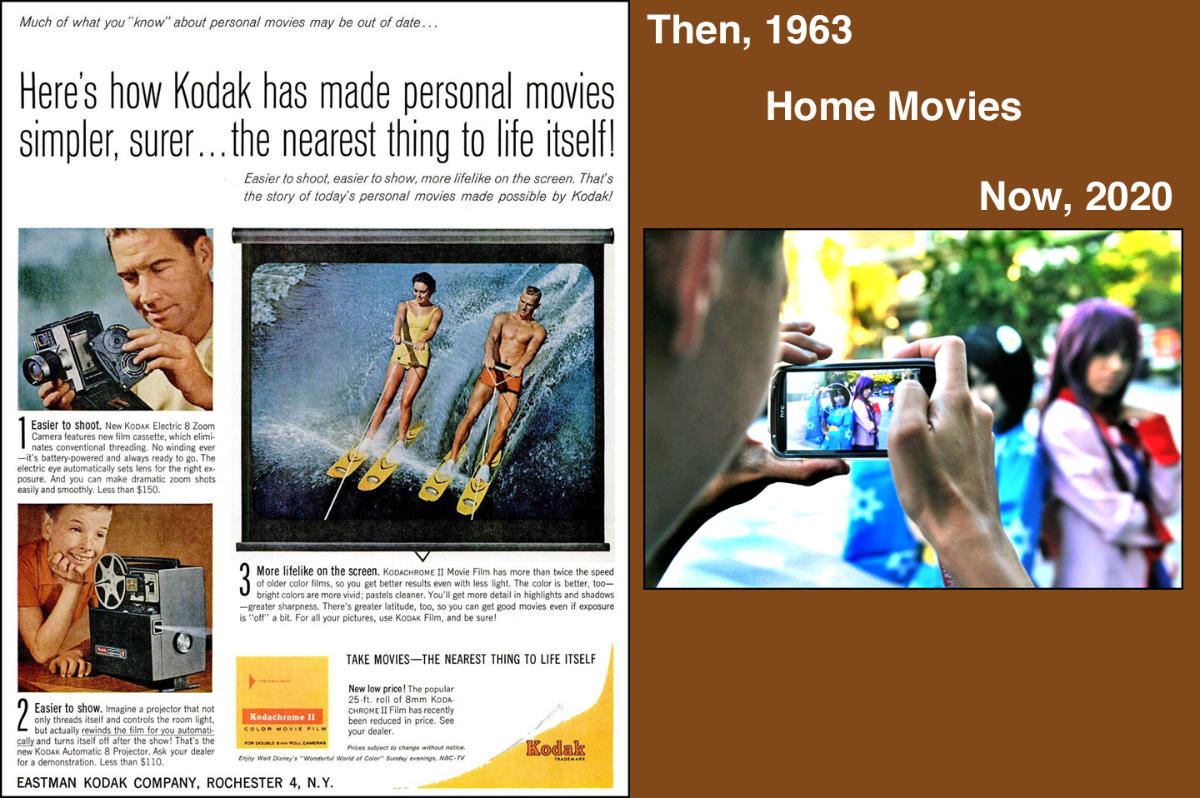
ads for evolution of home movies

Toronto. Over a century ago, it was discovered that a rapid sequence of still images would seem to show motion. This phenomenon was based on human  “persistence of vision” which neatly fills in the brief gap between images.

This concept required a long strip of film and special machinery to record and project the “movie”. Special movie theatres sprung up to house an audience in a darkened auditorium to view the latest “movie”. An entire industry flourished to create and distribute “movies”. As technology improved, movies evolved from jerky black and white silent films to smooth black and white, to sound and to colour films.  Pre war, home movies were the purview of those with deep pockets. Post war, there was a strong push for low resolution amateur colour silent and occasionally sound films for consumption at home. Meantime, commercial films experimented with 3D, Cinerama, Cinemascope, I-Max, etc. to enhance the audiences experience.

In the days of dim black and white TV and squinty resolution, commercial films blossomed. Today, this tiny resolution has evolved to 4 time the data (HD) and 16 times (4K), soon to be the even higher resolution of 8K televisions. Movies can now be viewed at home with friends at a decent resolution. We are no longer prisoners to blaring half hours of advertisements, sticky floors, and rigid schedules. Movie theatres are rapidly be coming redundant.

Technically, television sets have evolved from massive, power hungry CRT and vacuum tube beasts to slim solid state colour machines that can be wall hung and controlled by a hand held battery operated device.  Films can be piped in via fibre technology to offer many more options. Films can be streamed or recorded locally for later viewing (and skipping the inevitable inane commercials) freeing everyone from the tyranny of schedules.

Amateur movies became passé with the advent of digital cameras and smartphones. Modern models even sport 4K resolution and are seen recording events and photo ops for TV! My thanks to George Dunbar for suggesting this topic. The post title is from the 1971 movie of the same name.

Posted in history | Tagged , , , , , , | Comments Off on the last picture show

diversions

Claudia by Columbian Photographer Karen Paulina Biswell

Toronto. We all need a bit of diversion just now in light of the pandemic that has all us law abiding folk house-bound. Photographic Canadiana editor Bob Lansdale sent along a suggestion that we visit a French site with oodles of short videos and stills.

Bob writes, “Don’t know whether this would be interesting to keep members occupied and entertained while quarantined….”. The site “The Rencontres d’Arles at Home #44” was sent to Bob by Bruno Chalifour, secretary of the PHS across the lake in Rochester NY.

For those of us who cannot read French – try the right hand column …

Posted in activities-other | Tagged , , , | Comments Off on diversions

binocular vision

Toronto Camera on Church

Toronto. My first visit to Toronto Camera was in 1960 when they were on Church Street. I remember buying a Hansa Enlarger and Braun slide projector plus some chemicals and paper. I also picked up a copy of their July 1960 news letter touting how to choose binoculars – and they just happened to have a sale on Binoculars.

This was the major store for cameras at the time. Henry’s was an upstart but when they bought out a camera store in Chicago, they immediately became a power house later adding branches throughout Ontario. Toronto Camera later moved to a multi story store on Yonge Street which I visited many times, especially when I moved to Toronto or visited the city.


Posted in history | Tagged , , , | Comments Off on binocular vision

plus ça change

Old ad for Zeiss Sonnar lenses in the book “Zeiss and Photography”

Toronto. It is said that the more things change, the more they are the same. Like the Zeiss Sonnar lens for example. Larry Gubas in his massive text “Zeiss and Photography” shows the Sonnar as it was initially sold in 1932 and the more modern version in 2007. The initials ZM mean that the lens will fit a Leica M-mount (ZM is Zeiss M).

Larry writes, “To the left is a pictorial comparison between the 1932 and 2007 f/1.5 Sonnar 50 mm lenses. They are remarkably similar for being more than 75 years apart”. Elsewhere he notes that the normal lens for the Contarex was the f/2 50mm Planar or f/1.4 55 (58) mm Planar and not the far more popular Sonnar design from the days of the Contax.

The name “Planar” was coined by Dr Rudolph in the late 1890s for his “double-Gauss” lens design. It surfaced once again in the late 1950s as the normal lens for the Contarex SLR. The old Planar design was changed to a modified double-guass design to make the lens “retro focus” allowing it to stay in front of the mirror even at infinity.  My Exakta uses a beautiful f/1.8 58mm Steinheil lens for the same reason. My 28mm Angenieux lens does the same with horrible geometric distortion. The Contarex SLR uses an even wider 21mm lens BUT with the mirror locked up and a separate viewer. Note: Much of the Planar data is from Kingslake’s “A History of the Photographic Lens”. Rudolf Kingslake was a Londoner by birth. He emmigrated to the States to teach at Rochester University and head up Kodak’s lens design department.

Posted in lens | Tagged , , , , , , , , , | Comments Off on plus ça change

really, really, retro …

Click above to see Haida Gwaii in infra-red by Remy Olivier

Toronto. Years ago I abandoned Kodak B&W products for Ilford. By then everything was panchromatic and ortho was but a bad dream and weird filters were no longer necessary.

The world moved on to digital a decade or so ago but a voluble niche group of photographers rigidly stuck with film. Now Ilford is bravely touting a”new” film especially for the cognoscenti of weird colour transformations to monochrome – an orthochromatic black and white film!

This news comes from a link in Snapshots by the PHS of NE via our famous journal (Photographic Canadiana) editor and professional photographer in his own right, Robert Lansdale. If you are one of the small population of film fanatics, be sure to visit the Film Photography Project! Michael Raso posted this article about the new Ilford Ortho Plus film last year on October 29th on FPP.

NB. About 17 years ago on a trip west, with my youngest, we saw the rock shown in this wonderful IR shot by Remy Olivier. It was long after sundown and rapidly getting dark, but that’s another story.


Posted in film | Tagged , , , , | Comments Off on really, really, retro …