easel come, easel go

example easels from a fall 2013 Auction

Toronto. When film photography was a popular hobby last century, amateurs used a darkroom and enlarger to crop and adjust the final print size.

To focus the enlarger, and hold the photographic paper flat, the photographer would often use an easel.

While very few people consider these devices as collectibles, they often appear at our auctions, fairs and sales and are quickly snapped up by niche film enthusiasts. Of course the average digital photographer needs neither easels nor a  darkroom.

Note: The title here is a riff on the expression, “easy come, easy go”. Here it is as a song sung by George Strait.

Posted in history | Tagged , , | Comments Off on easel come, easel go

cheap is how I feel

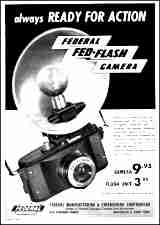
Ad for Fed-Flash camera in summer of 1948

Toronto. Post war, the camera industry exploded with pent-up demand. Federal in Brooklyn was mainly known in photographic circles for their enlargers (I had one). Their enlargers were cheaply made and cheaply sold.

Around 1948, the company decided to do cameras too. This model took advantage of the enthusiasm for flash. Made of Bakelite, it was just a box camera (uses 127 film) tarted up as a 35mm with flash capability. Enthusiasts could buy a cheap camera and pretend it was a real minicam!

The company has since disappear into the mists of time. Their camera venture lasted a bit less than a decade, but the company lasted longer.

We owe a big thank you to my good friend and fellow PHSC member, George Dunbar, for sharing with us this August, 1948 advertisement (page 41) from Popular Photography.

Note: The title of this post is from a song sung by Margo Timmins of the Cowboy Junkies called, “Cause Cheap Is How I Feel” from their 1990 album Caution Horses. I’ve been a fan of the Junkies since I heard them live with songs from their album, “The Trinity Session” on radio. The Junkies sang in the old Trinity Church tucked in beside the Bell Building at 483 Bay just above Queen Street here in the Big Smoke. Michael and Margo are from Montreal. Margo never sang professionally before she joined her brother’s group.


Posted in history | Tagged , , , , , | Comments Off on cheap is how I feel

darker dags

Ambrotype portrait from an African American studio

Toronto. The NYT article is headlined, “Smithsonian Acquires Rare Photographs From the First African American Studios“. The example Ambrotype image shown here was augmented by a few dashes of colour painted in by hand before the glass plate was carefully placed in the union case, after being bound between a glass front and a dark backing material.

Here in North America, we often see Ambrotype and Daguerreotype portraits by Caucasians taken in studios from about 1839 to the 1870s or so. We rarely see such portraits (of African Americans or any other races) taken by African American photographers. This NYT article by Aruna  D’Souza on August 17th of this year (2021) covers the subset of the photograph collection by Larry West acquired by the Smithsonian.

Thanks to my good friend and fellow photography historian, George Dunbar, for sharing this find.

Posted in history | Tagged , , , , | Comments Off on darker dags

get outta Dodge …

poster for the 1939 movie ‘Dodge City’, Kansas

Toronto. … or burn! Photographers of a certain age will recognize these two words as darkroom techniques to compensate for faulty camera exposure, wrong paper grade, or to add some pizzazz to a print. There is a video here that covers basic darkroom technique for dodging and burning.

The idea behind burning is to locally increase contrast by adjusting the H&D curve. More light in a shadow area can darken the shadow and bring out details, if any exist.

Similarly, holding back light by dodging a highlight area can lighten the area and bring out detail. If there is no detail, the highlight area is just monotone and looks a bit phoney.

Modern digital images can be similarly adjusted using Photoshop, Affinity Photo, or similar image editing software to tweak the H&D curve. Specific tools and layers can also help.

Note: The title of this post is based on a c1939 movie called ‘Dodge City‘.

Posted in history | Tagged , , , , , | Comments Off on get outta Dodge …

Trunk Sale, this Sunday, August 22, 2021

Toronto. Our Annual Outdoor Trunk Sale at Trident Hall is this Sunday, August 22, 2021 from 8am until Noon. Customers free admission. Vendors pay a small fee – call Clint (see post) to reserve a spot! Need more information? Email fair@phsc.caor info@phsc.ca! Use this old  map on the Big One Bookmark for TTC and parking (sorry, no snack bar).

This Sunday, August 22nd, 2021 – Trunk Sale

Posted in fair | Tagged , , , , , , | Comments Off on Trunk Sale, this Sunday, August 22, 2021

keeping an eye out for colour

ad for Curtis colour cameras fall of 1948

Toronto. The earliest photographic processes captured only a monochrome image – usually black and white – of the luminance values of the subject. Over the ensuing decades, many efforts were expended to create natural colour from the effects of light on the subject.

The best ideas imitated the action of the human eye. In 1802, Thomas Young had devised a theory of colour vision later revised by Helmholtz. Most successful ideas to capture colour from nature stem from the application of the Young-Helmholtz theory. Basically, it suggests that the eye has three different kinds of cones each sensitive to a narrow band of the visible spectrum, plus rods which are sensitive to the intensity of light across the visible spectrum.

One such scheme was to use a single lens/shutter and split the light in three, passing the beams through filters to a panchromatic media. This idea resulted in the Curtis cameras which are depicted in this advertisement from the October, 1948 issue of Popular Photography. The registration of three transparencies to create a colour photo was somewhat fussy. Defender offered another solution using its Chromatone process as described in the December 1938 Popular Photography and recorded on the above Curtis cameras link for the reader’s convenience.

A big thanks to my good friend George Dunbar for suggesting the October 1948 advertisement as part of photographic history.

Posted in history | Tagged , , , , , , , | Comments Off on keeping an eye out for colour

dear old golden rule days

School portrait in early to mid 1940s. Sweater was green.

Toronto. As photography expanded, an increasing number of photographers specialized in various areas. Some went into school photography with group shots of the pupils and staff sometimes complemented with individual student portraits. Occasionally a panorama view took the entire student body and staff in one photograph –  I have one such panorama of my mother and her younger sister taken around 1928 when just the two of them were of school age.

Some photographers resorted to taking individual classrooms of students and teacher, perhaps accompanied by a portrait of each student. Purchases were always optional, and families chose the item and number of prints each.

Poorer families could ill-afford the modest fee. For other families, the photos were the only ones taken of their children. A family heirloom to add to a shoe-box for safety!

Posted in history | Tagged , , , , | Comments Off on dear old golden rule days

for the record

1940s automobile wreck

Toronto. In the beginning, photography recorded mostly portraits and landscapes. Workplace and workers came along later – perhaps the best known are the dead combatants in the American civil war photos taken by Matthew Brady. Newspapers and books benefitted from the art as photography slowly replaced the line drawings (first as references, then as half tones).

Photography became a record keeper for wars, government, retail firms, police (crime scenes, criminals), real estate sales (I have a Leica engraved on the base with the name and address of a local realtor firm), insurance claims, etc.

The picture taken here of a 1940s automobile was recorded by my father with a Kodak folder on the rather grainy film of the day in glorious black and white. The detail was enough to be an inventory of a wrecked vehicle or even proof for an insurance claim.

Posted in history | Tagged , , , , , | Comments Off on for the record

what’s up doc?

c1847 daguerreotype of a famous operation in Boston – first use of anesthetic.

Toronto. .. as that wascally wabbit from Brooklyn said to Elmer Fudd in the movie cartoons of yesteryear. From its very beginning, photography has been a huge asset for medicine and dentistry.

This Southworth and Hawes plate at left shows a Boston operating room c1847/8 (Massachusetts General Hospital). It is a period recreation of the first “etherization” of a patient undergoing surgery on his jaw. This image and information is courtesy of the 1976 book, “The Spirit of Fact“. I bought my hard cover copy September 2, 1976. Only a few thousand were ever printed as far as I know. A Dover reprint is available but the plates are shown smaller and not as clear and accurate as  resolution and colour.

When the minicam craze hit, dentists made use of the 35mm cameras and accessories as shown by this c1935 Leica set up by dentist A L  Dunn of Santa Barbara California and featured in many editions of  the Leica Manual.

Over the years, other machines using the basis of photography came into use as diagnostic devices such as the x-ray machine to determine organ defects (highlighted by a dye injection). And the massive and noisy MRI machines used to analyze soft tissue issues (some without use of dye injections, some with) shown here are neck blood vessels. What’s up indeed!

Posted in history | Tagged , , , , , , , , , , , | Comments Off on what’s up doc?

pet shop boys

Pete and Rusty return from a winter break (Feb 1982)

Toronto. One niche area in photography is pet photography which has grown in popularity. You can also read this article dated May 26, 2015 in The Guardian or this one on historic photos of dogs dated April 2, 2015 in the  Fauna and Flora blog. Pets being like children, they are nearly in constant motion and pay little attention.

Pets  also appeared in advertisements for cameras like the Exakta and Hasselblad as cover shots for brochures and magazines. The two shown here examples of the opposite ends of the pet spectrum. The fox terrier, Pete, was thrown out at a nearby school when he was a pup and followed one of my children home. The Sheltie is a pedigree animal. registered and bought from a kennel. He was sold as he grew taller than acceptable for the breed and was about the size of a border collie,

The photo was taken with a Leica on transparency film  – most likely Kodachrome. The post name is a British musical duet formed in 1981 and active to date.

Posted in history | Tagged , , , , | Comments Off on pet shop boys