ZOOM EXEC #18 September 2021

Toronto. Who would have thought a year and a half ago that COVID would still be a threat;  that a FOURTH wave would be here; and that we would still be resorting to ZOOM? Mind you, online has its own virtue – executive (or presenter, or audience) can be anywhere with no travel issues/costs. Have computer, will travel to paraphrase an old TV show.

Our ZOOM host Celio tested out some new backgrounds like the one shown below but we ended up going the traditional route. A few major changes again this month. Our fairs and shows are moving to SATURDAY now that there is no longer a need to use SUNDAY. And the indoor FALL FAIR this October is in jeopardy so we decided to go outdoors with a new OUTDOOR FALL FAIR at the same location as last month’s Trunk Sale – Trident Hall lawn and parking area on SATURDAY, OCTOBER 2nd, 2021. We expect to have both food and beverages this time.

a new backdrop tried out this time
Posted in activities | Tagged , , , , , | Comments Off on ZOOM EXEC #18 September 2021

having a heat wave

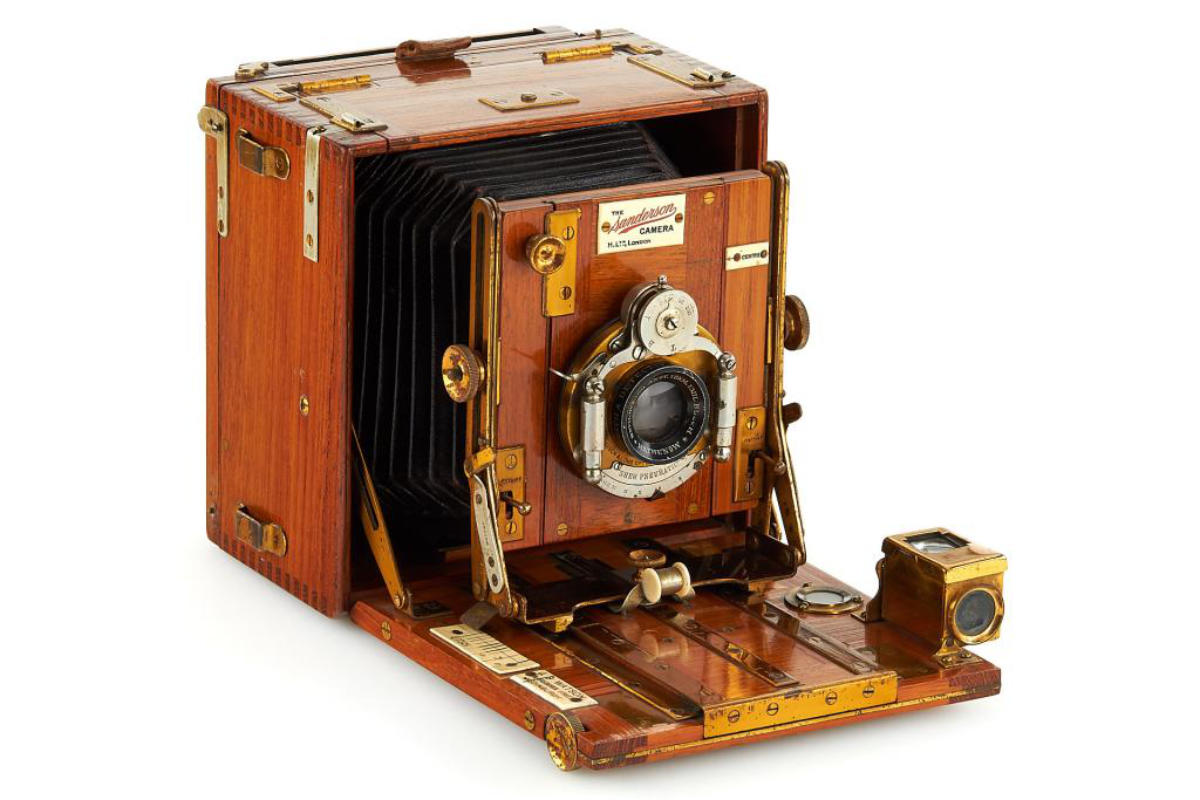
Sanderson Tropical Camera c1920 – image courtesy of Leica Camera Classics GmbH

Toronto. Sometimes at our fairs, shows and auctions, you see a plate or roll film camera made of varnished wood and may think the leather or leatherette material had been removed. Well, that may not be the case. Cameras for use in the tropics must survive high heat, humidity, bugs, mould, dirt etc.

Metal parts must be non rusting; the tiniest cracks and holes sealed; and mould and moisture proof materials used. Anything less is a walking disaster! It was found that leather/leatherette easily succumbed to moisture mould so cameras were simply varnished wood- preferably teak or mahogany. All metals parts were made of brass and often coated too. Metal and plastic cameras could be used if designed for tropical climates.

I once met  a fellow who spent months on an installation in the heart of South America. He used an Exakta with a Biotar lens. He told me the climate there was merciless on his camera. Frequent cleaning of the lens front element to remove moisture before a photo was taken had resulted in the lens being so frosted that I was surprised it even worked!

The camera shown above is featured in  Leica Camera Classics GmbH in Vienna. The price asked shows just how desirable these “tropicals” are today if in decent condition. Click on the link to see what this high end shop features – you may want to augment your collection!

Note: the post title is a line from Irving Berlin’s 1933 song “Heat Wave”. Here it is sung by Ethel Waters back in 1933.

Posted in camera | Tagged , , , , , , | Comments Off on having a heat wave

cat’s eye

Ad for the Ermanox camera with a 100mm f/2 Ernostar lens c 1924 or 5

Toronto. Nearly a century ago, there was a race on to create a faster lens. Such a lens would allow photos  indoors and at night using natural light.

In 1924 Ernemann announced the Ermanox plate camera (4.5×6 cm) with a 100mm f/2 Ernostar lens. Two years later the company was merged into Zeiss-Ikon and the camera was rebadged as a Zeiss-Ikon. Shortly after introduction, the camera was offered with a slightly shorter focal length lens about 1/6th stop faster, the 85mm f/1.8 Ernostar.

The camera was made famous by Dr Erich Solomon a few years later. He became Germany’s first ‘photojournalist’. He later moved on to a Leica. You can see one here with a roll film back attached.

A tip of my hat to good friend and fellow photo historian, George Dunbar, for showing us this amazing advertisement. Today, you may wonder why all the fuss about an f/2 or f/1.8 lens. That is, until you realize how pathetically slow the media (glass plate or film) was at that time when ASA 100, the lowest ASA/ISO these days, was considered incredibly fast!

Posted in history | Tagged , , , , , , | Comments Off on cat’s eye

eye of the storm

BJA 1938 ad for Contax Cameras

Toronto. It was ‘the best of times and the worst of times‘ between the world wars. After the first war, pent-up demand blossomed into unprecedented wealth in the first decade, followed by the worst depression ever in the next (world wide). By the time this ad appeared in the 1938 BJA, the mighty German camera industry which reorganized as Zeiss Ikon in 1926 (plus a handful of high end companies making Leica and Rollei, etc. camera models) was just over a decade old and known throughout the world for value, quality, and design.

The end of the first war saw the rise in Germany of a far right political party that evolved into the notorious Nazi Party. The dirty ’30s depression was an opportunity for Germany to resist the reviled Treaty of Versailles. Germany elected Adolf Hitler as its chancellor in January, 1933. Six years later, Hitler led his country into war against the rest of Europe (Western front) and later against Russia as well (Eastern front).

Many books cover world history last century such as Erik Larson’s 2020 epic on Churchill and the WW2 years called, “The Splendid and the Vile“. The books often offer theories as to the causes of the two world wars which touched almost all of humanity.

For the camera collector, a wealth of books were also published in the late 20th and early 21st centuries. The books documented the various camera manufactures and their products. An example is the massive 2015 book by Larry Gubas of Zeiss Historica fame called, “Zeiss and Photography“. At roughly seven pounds and 890 pages, this hard cover heavy weight was published in a limited edition of 400 copies by Friesens in Manitoba, Canada. Out of print and hard to find today, it is a worthy addition to any collector’s library.

Posted in history | Tagged , , , , , , , , | Comments Off on eye of the storm

Japan c1908 in photos

Street scene in c1908 Japan by Arnold Genthe

Toronto. Our President, Lewko Hryhorijiw, sent me this link from Helen Teager. The photographs are a selection of the work by the German-American photographer, Arnold Genthe, held in the Library of Congress.

The photos were taken when Genthe spent a six month period in Japan in 1908. His seminal efforts were written up on May 12, 2016 by Ms Kristine Mitchell for the My Modern Met website.

Posted in history | Tagged , , , , , | Comments Off on Japan c1908 in photos

I shot an arrow up in the sky …

Kodak ad from December, 1948 Popular Photography magazine

Toronto. WW2 had ended three years earlier and the world was getting back to normal. Just a year before this December 1948 ad appeared, Ansel Adams took a photograph of mountain climbers on  the top of Yosemite Park’s famous ‘Lost Arrow’ peak.

Kodak used their ad to tout the virtues of its then super fast Super-XX B&W film which allowed Adams to take the shot at a modest (for him) f/22 with a good depth of field (Super-XX was about ASA/ISO 200. The grainy Super-XX was replaced by Tri-X which was ASA 320, then ASA 400. With finer grain than Super-XX, Tri-X was open to push development increasing the film speed a stop or so.

Thank you to George Dunbar for his diligence in recognizing the historical significance of Kodak’s advertisement in choosing this challenging photograph taken by Adams for its ad on Super-XX film. I used a roll as a kid indoors at about f/16 and 1/25th – all my shots were terribly under exposed.

Note: The post title is a riff on the first line of Longfellow’s poem, “The Arrow and the Song“.

Posted in history | Tagged , , , , , , | Comments Off on I shot an arrow up in the sky …

one born every minute …

Bolex ads before it merged with Paillard and after

Toronto. … or so Barnum is supposed to have said.  The Bolex was the Leica or Contax of the amateur movie crowd. It was a high end camera made in Switzerland by Paillard. Interestingly, Bolex was originally not a Paillard product, but a design by its inventor and made by others. Both Bolex and Paillard were Swiss companies.

In the late 1920s/early 1930s the company was sold to Paillard and the designer, Jacques Bogopolsky, agreed to be a consultant on movie cameras to Paillard. Apparently Paillard found the original Bolex and its patents flawed necessitating a complete redesign. The designer of the original Bolex was then considered as an unwelcome individual at the Paillard company. In the end, out of the merger, only the name ‘Bolex’ was used by Paillard.

The Paillard-designed Bolex cameras are superficially similar to the original camera in external appearance. Paillard spun off the Bolex division to Eumig in 1980. Bolex moved from one company to another over the years and faded away. Today, the Bolex company no longer manufactures cameras but instead repairs Bolex cameras by special request. Note that the 1938 ad may be politically unacceptable today, touting the Bolex as a ‘man’s camera‘.

My thanks to George Dunbar who discovered the ads shown here for Bolex (c 1927) and Paillard (BJA 1938) which I merged into one image.

Posted in history | Tagged , , , , | Comments Off on one born every minute …

going ’round the bend

Don’t try this at home!

Toronto. This digital image was recently posted to instagram and shows a ‘selfie’ taken by someone hanging onto the back of a TTC Subway train.  Very dangerous! The photographer could have fallen on the third rail or fallen and been too confused to get out of the way of a following train. A potentially fatal situation in either case.

Decades ago I met an Electrician called Alex who was missing a middle finger on one hand. As a youth he had worked on an industrial crane and accidentally brushed a live 500 volt DC line. The only thing that saved him was that he was atop a tall ladder and the shock caused him to fall breaking the connection before he was killed.

Thanks to my good friend George Dunbar for spotting this photo on instagram.

Posted in photos | Tagged , , , , | Comments Off on going ’round the bend

it’s a bird, it’s a plane … it’s a camera?

novelty Pentax digital c2011 camera

Toronto. Some collectors specialize in novelty cameras such as this old Pentax RS1500 with the Superman skin (image posted by Andy Khouri April 14, 2011 and once seen on the ‘Comics Alliance‘ website.

Since digital photography has been around well over three decades, digital cameras are becoming collectibles. Pentax participated back in 2011 with their Optio RS 1500 camera and ten skins that could be easily applied to ‘customize’ this model.

The compact digital cameras have disappeared now, overtaken by the ubiquitous smart phones with their built-in cameras (getting better all the time). Sometimes you can see the RS1500  and other early digitals at our shows and auctions. The prices are reasonable so you can get in at the ‘ground floor’ on these cameras now delegated to  history and collectors.

Note: The post title is a riff on the now famous Superman mantra. It was brought to mind by the marvellous bass voice of Brad Roberts singing his “Superman’s Song” on the Crash Test Dummies’ CD called, “The Ghosts That Haunt Me”.

Posted in history | Tagged , , , , | Comments Off on it’s a bird, it’s a plane … it’s a camera?

way way back focus

cover of Back Focus #76 from March 2010.

Toronto. When COVID-19 arrived in Toronto the spring of 2020, we closed down daily person to person venues as demanded by the city. Our editor at the time, the late Bob Lansdale, felt we needed to get something out to members so they had reason to renew even if the mailed copy of our journal was not sent, and in person Toronto meetings were suspended.

Bob elected to get approval from selected exchange members to post their material to members-only in pdf form, along with copies of our journal (Photographic Canadiana). Further, a decision was reached to distribute these pdf files via MailChimp, with new material send out to members at least monthly. Included were some specials like the Amalgamated Newsletters, the ‘All About’ series, etc. Our treasurer and PHSC Press volunteer, John Morden, did the scanning; our archivist, David Bridge, mailed out the pdf files via MailChimp; and I added and administered a ‘member’ tag in our MailChimp list.

Not to leave our ‘Luddite‘ members in the lurch. Bob asked that we determine who had membership but no email address. This came down to less than a dozen members. A decision was made to email/mail all members to request an email address, and ask if a hard copy was desired. A selection of articles published in volume 46 of the journal was readied as an annual and then printed and distributed to those members who had no email address or requested a hard copy for various reasons.

My thanks to PHSC member and good friend, George Dunbar, for suggesting this cover shot of an early issue of Back Focus from our exchange organization in Australia. The post title is a riff on the internet archive, the WayBack Machine whose logo can be seen down the right sidebar.

Posted in activities | Tagged , , , | Comments Off on way way back focus