a wonderful view

View camera with Thornton- Pickard shutter and brass lens

Toronto. Throughout the 1800s and into the early 1900s, the view camera was a popular camera design. Everyone knew a wooden box and bellows on a tripod meant a photographer was at work!

The view camera was rather simple in concept. A wooden box separated the sensitive media from the lens focussing a subject sharply at ‘infinity’ (usually much closer in reality, depending on the lens and aperture chosen).

A means of focussing even closer was added between lens and media. Some times a second wooden box was used, or quite often a bellows (often tapered to fit the media box at one end and the lens board at the other). Ground glass substituted in the focal plane for the media served to set the point of sharpest focus and choose how the subject would be framed on the media.

This kind of camera worked very well but took time for set up, framing, focussing and capturing the image (capturing itself usually took a few seconds even in bright sunlight). And until dry plates became common sometime after the 1870s the media had to be prepared and developed on location.

By the way, the camera shown here was a lot in our spring estate auction. Visit our Photographica-fair this fall and you may find one for your collection too!

Note. The title of this post is a play on Noel Coward’s delightful 1928 song called, “A Room With a View“.


Posted in history | Tagged , , , , , | Comments Off on a wonderful view

see anyone you know?

‘instant ancestors’

Toronto. In the late 1960s and early 1970s when camera collecting took off, a subset of collectors included photos in their collection. I think it was a bit random at the beginning, then collectors realized cased images like daguerreotypes and ambrotypes were one off. And more complicated to create. As a result collectors considered such old prints far more valuable.

With glass plate and later film negatives, many prints could be made from one negative  giving credence to the saying, ‘cheaper by the dozen’. In time collectors realized that good clear prints were worth more than faded prints. Prints of famous people or by famous studios (eg Notman, Southworth & Hawes, etc) were more valuable. Size and rarity also added value.

The vast majority of prints were studio portraits so work scenes and outdoor scenes became more valuable than a run of the mill portrait. Some collectors chose only certain processes like the beautiful (even today) carbo process with its rich blacks, or well taken and printed stereo cards.

The folks in the photo at upper left are from a lot in the recent Port Colborne auction. A few decades ago, we used to joke that people buying such portraits could gain some ‘instant ancestors’. Today we know better and value these photos as a snap shot into history.

Posted in history | Tagged , , , , | Comments Off on see anyone you know?

the perfect bid

a very rare, most expensive ever camera – courtesy Leitz Photographica Auction

Toronto. This post is courtesy of Sonja Pushchak. It involves a bid in an Austrian auction reported in a British society’s newsletter (Tailboard). The post title is a riff on the movie, “The  Perfect Storm” were the forces of mother nature come together with an  exciting effect.

Similarly, the bid for Oskar Barnack’s Leica resulted in the tiny marvel becoming the most highly priced camera ever (so far). Provenance, rarity, fame, (very) deep pockets, great desire and a feisty audience (both live and via phone) culminated in this 12 million Euro bid for Leica null series camera 105 – Barnack’s personal camera!

When you think back to the modest original cost of this Leica, the bid is astonishing. Few collectors can afford the bid++ price of this one piece. Leica series 0, number 105 – often photographed, seldom passed from one home to another.


Posted in auction | Tagged , , , , , | Comments Off on the perfect bid

puppy love

prize winning photo taken by a Graflex camera (1939 ad)

Toronto. In the 1930s when this ad was displayed (May, 1939 issue of Popular Mechanics) Graflex was a stand alone company once again and worked hard to gain access to the amateur photographers in America. The company ran photo contests and published the winners such as the photo at top left (called Puppy Love).

Folmer Graflex was the darling of the newspaper fraternity in America. It was a common sight to spot a mighty Speed Graphic 4×5 camera, complete with a large flash gun mounted on one side, in the hands of a news photographer – especially in the days when printed media refused to use smaller negatives.

Like all great marketing copy, the writers of this ad attribute the photo to the camera, not the photographer – suggesting you too can take a photo like this with a ‘Prize-Winning Camera’ made in America by Folmer Graflex Corp! They do name the photographer in a small cut line under the photo – William D. Barkley.

Another tip of the hat goes to my good friend George Dunbar for sharing this whimsical bit of photographic history with us. These days, I often see electronic companies like Epson (printers) running contests. And TV stations offering to ‘display’ great photos – for free – just send them in and hope.


Posted in history | Tagged , , , , | Comments Off on puppy love

not all bad

Ad for a new Kodak camera factory opened in 1939

Toronto. The great depression was a nightmare for most folks, culminating in the second world war. A sliver of silver lining in the gloomy clouds of depression was the fall in most retail prices. By June of 1939, even the mighty Kodak took out an advertisement to say they were building a factory addition that would reduce the cost of their cameras to ‘new low prices’.

Up here, Kodak Canada was the cluster of buildings at Eglinton and what is now Black Creek drive. Sadly the Rochester campus and that in Mount Denis fell to the wrecker’s ball when film was replaced by electronic sensors and digital technology. Bob Burley of Ryerson spoke on the loss of the Mount Denis campus in February, 2007.

Once again, we are indebted to our good friend and able researcher, George Dunbar, for both sourcing and sharing this bit of photographic memorabilia from Popular Mechanics on the eve of WW2 up here and in much of Europe. Well done, George.

Posted in history | Tagged , , | Comments Off on not all bad

before we had polaroid cameras

an early ‘instant photograph’ “studio” described in a June, 1939 issue of Popular Mechanics

Toronto.  George Dunbar in his search of old magazines for ads and articles relevant to photography often finds unusual stories and cameras. For example, the June, 1939 Popular Mechanics magazine had a filler article called, “Two-Minute Photo Printed in Portable Studio“.

The “studio” in question was a small tripod mounted camera that created round button-sized photos suitable for seasides or other family attractions. The little gizmo creates a print that is ready in 2 minutes – almost a decade later (1948), Edwin Land announced his famous “Picture in a Minute” camera down in NYC.

A big thanks to my good friend for sharing this article with us.

Posted in history | Tagged , , , , | Comments Off on before we had polaroid cameras

Communications courageous

communicating in the 1950s

Toronto. When photography was first announced back in January, 1839, the world was ecstatic. Samuel F. B. Morse, inventor of the telegraph, was visiting France that year and brought the Daguerreotype process back home with him to America.

It was an exciting time to be alive. Technological inventions rapidly followed one another – telephones, automobiles, movies, airplanes, radio, radar, television, transistors, lasers, computers, integrated circuits, smart phones and many more – and this was just in communications!

In our industry, an important part of communications, things moved in leaps and bounds. media resolution improved, media speed improved, practical colour arrived along with flexibility and simplicity (to the user). Camera design, glass design, and lens design, kept pace with media to improve the final result (photographs). Then film, glass plates, and chemistry faded as digital technology became the primary means to photograph everything from bacteria to bugs to people to stars. 

A modern user has no need to learn the skills so necessary for success in the days past. The slightest touch can take a full colour, technically perfect image on a smart phone and another few finger presses can sent it off to anywhere in the world. So simple. So complex.

The lady shown here in her kitchen holding the telephone was taken over sixty years ago. She couldn’t even predict how the world would change for her grandchildren and their grandchildren.

NB. The title of this post is from a book titled ’Captains Courageous’ written by Rudyard Kipling in 1897 – two years before the lady pictured above was even born. 

Posted in history | Tagged , , , , , , | Comments Off on Communications courageous

8mm to the rescue

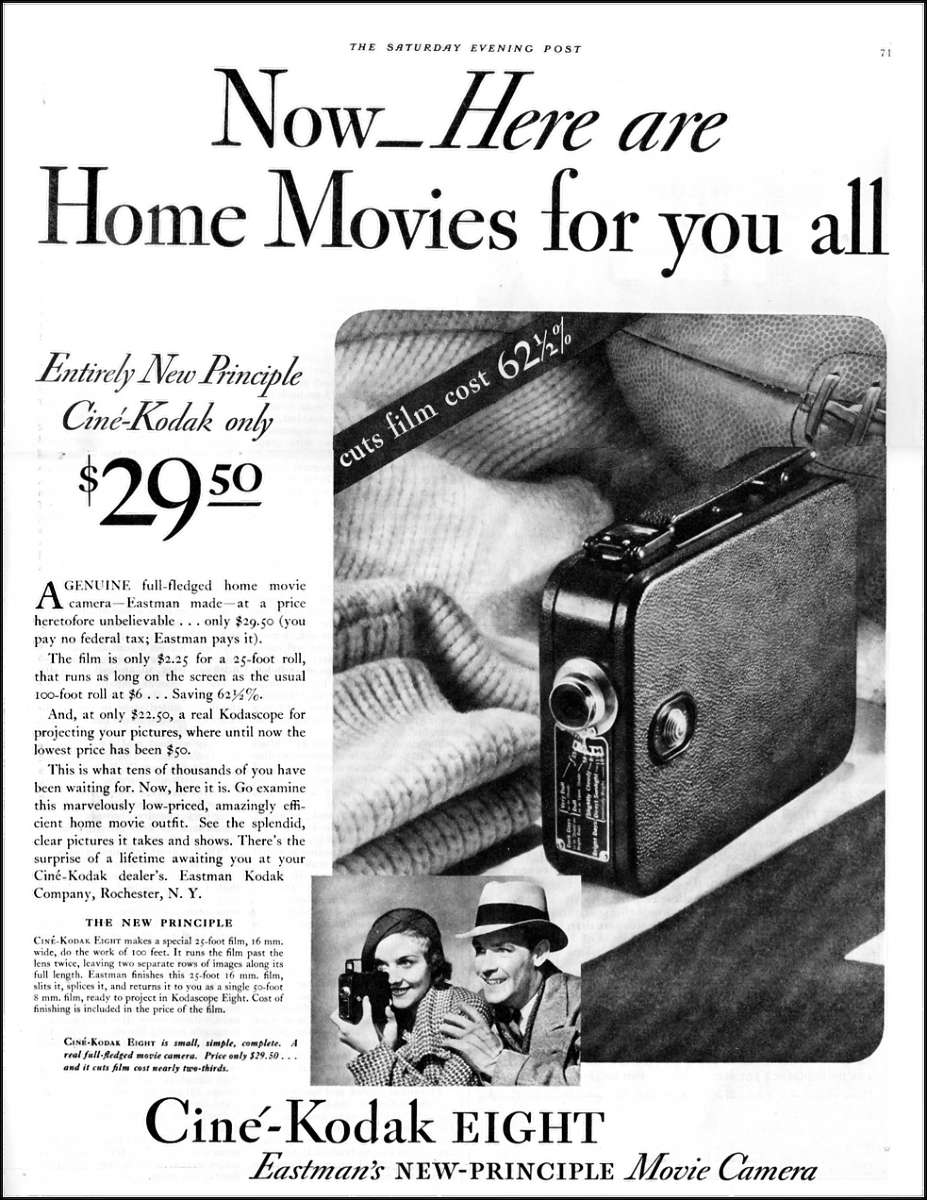
fall 1932 ad for a new movie size for economic home movies

Toronto. By 1932, the world’s worst ever depression was well underway. Jobs were lost in droves. Fortunes disappeared literally overnight. Buying on margin became an instant pariah. Photo industry companies used novel ideas kept some of the amateur photographers active.

For example, to keep customers in this belt-tightening time, Kodak came up with the 8mm concept for home movies: use ’16mm’ film but get 100 feet equivalent projection time by splitting a special ’16mm’ spool of film in two – and selling it in 25 foot rolls (vs. 100 foot for 16mm). Along with the new film size were new cameras and projectors – all at less cost than 16mm films and gear.

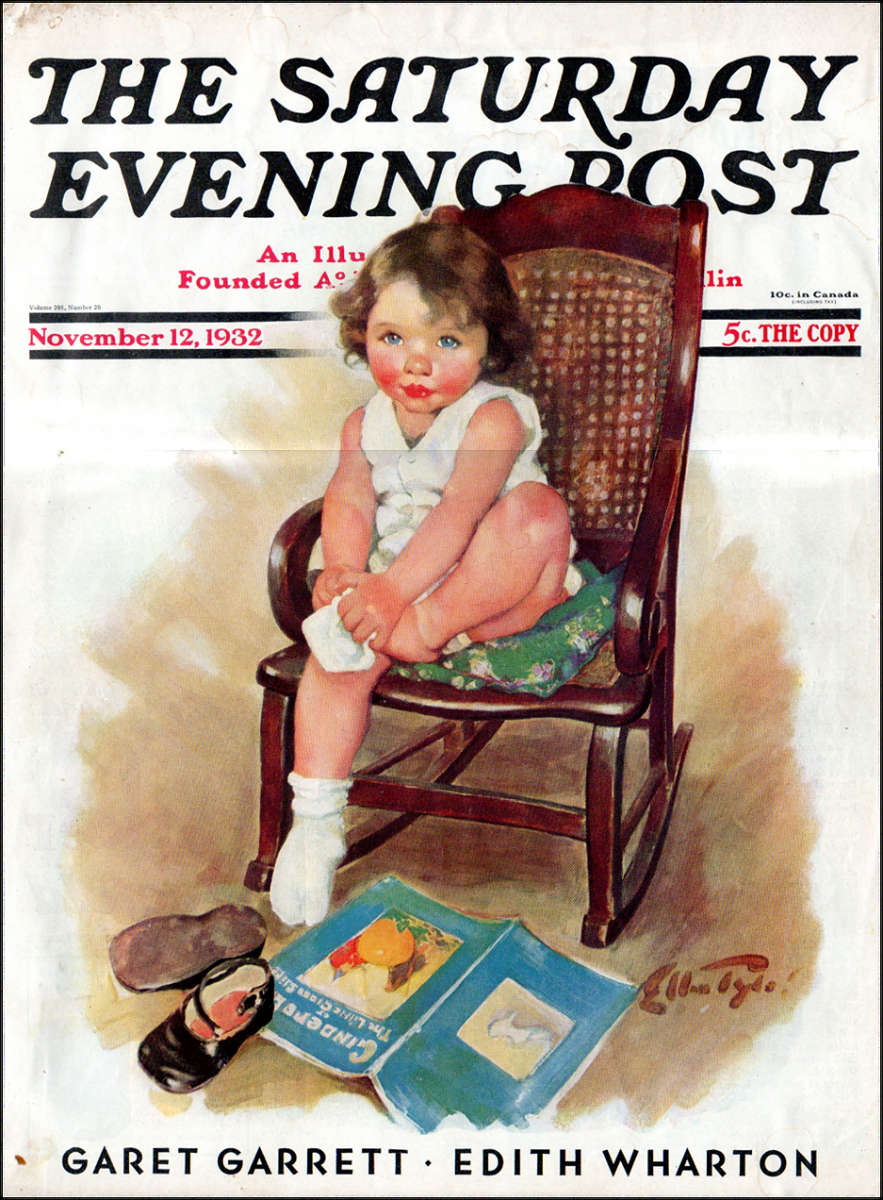
The ad shown here appeared in the November 12, 1932 issue of the Saturday Evening Post (a magazine published every Saturday)! Weekly publication lasted into the 1960s. Today it is published about six times a year … .

My thanks to good friend and photo historian, George Dunbar. I remember the ‘post from reading copies in Nels Magee’s barbershop (back of the local drug store) as a kid in for my bi-weekly hair cut.

Posted in history | Tagged , , , | Comments Off on 8mm to the rescue

more than one way to skin a cat …

how to capture a tenderfoot on a wild horse – 1939 style

Toronto. …. or ride a frisky horse. The May, 1939 article from Popular Mechanics shows how a stuffed horse could simulate a bucking broncho in a photo taken for the folks back home!

Notice how the professional photographer uses a view camera and tripod to capture the event. Typical media of the day would be a trifle slow, even in bright sunlight. The snappers of today with their digital cameras or smart phones have super sensitive sensors (and possibly optical stabilizers) and no need for a tripod – even indoors in the daytime.

A nod to my good friend and erstwhile seeker of photo history as recorded in magazines nearly a  century ago, George Dunbar, for sharing this clever ‘studio prop’ to dazzle the home-bodies.

Posted in history | Tagged , , , , , | Comments Off on more than one way to skin a cat …

before there was Virtual Reality ….

VR future> curtesy of How-to-Geek

Toronto.  … there was Stereo. After all, Virtual Reality (VR) is just Stereo on steroids – i.e. interactive video in stereo. Modern day VR is experimenting with various techniques such as projecting directly on the human retina.

In the PHSC, for many years we had two very skilled experts in stereo – the late Dr Robert Wilson and Stan White. Bob was a geologist by trade and a stereo enthusiast by preference. Stan was a long time professional photographer and teacher. Both also belonged to the National Stereoscopic Association (NSA) in the states. Stan introduced the series of September Stereo sessions presenting his own work and that of the NSA.

We also had the pleasure of a couple of stereo presentations by a member of the PHSC in Buffalo – Paul Pasquarello. For the June, 2008 presentation, Paul brought his own projection set up and showed his own work which was wide view stereo. A second presentation by Paul was at  the October 2010 meeting.

We first saw Virtual Reality in action when we visited the DME lab at Ryerson University here in September, 2016.

A few individuals like Bob and Stan could ‘free view’ stereo stills and see the 3D effect (I didn’t cover the many folk who can see the once popular drawings in soft cover books that  could be ‘free viewed’ as well). For the rest of us or viewing projected stereo stills, stereo movies, VR, etc. some form of eye ware is essential to ensure images appear only to the correct eye. The two images – still or movie – are combined by our brain to create the 3D image.

Even today, TV or VR need eye waree to see the 3D effect. Rather unwieldily head gear for a VR experience.


Posted in history | Tagged , , , | Comments Off on before there was Virtual Reality ….