miracle projector

1949 ad for a so called ‘miracle’ projector

Toronto. The toy advertised back in November, 1949 was hardly a new invention since opaque projectors had been around for decades. This dinky little box sat on a picture about 3×4 inches and  projected it on a screen a few feet away. A light reflecting off the picture etc was bounced up and though a lens.

Professional projectors of this type  had cooling fans and very high wattage bulbs. A book page or picture was bounced through a much larger lens on to a screen further away. The far brighter image was used by educators and institutions. Even fancier machines called epidiascopes could project both opaque subjects and glass slides.

A thanks to George Dunbar for spotting the ad and sharing it. Brings back memories of the decades before cheap scanners and computers when both the cheap toys and the far heavier and expensive professional models saw much use.

Posted in history | Tagged , , | Comments Off on miracle projector

PHSC News newsletter for January 2023

a San Francisco camera obscura from the 1970s

Toronto. The Camera Obscura shown here is from the right top of page 1 in this month’s PHSC News newsletter. The ‘Giant Camera’ once in San Francisco, California, was coloured like a huge Ektachrome box.

What do you know? It’s January, 2023 already. Most COVID rules have disappeared but the pandemic is still around – much diminished by vaccines and sensible practices.

Our interim editor, Etaoin Shrdlu, and team have produced a great  issue of PHSC News for you.  PHSC News (22-01) has the usual bunch of articles – short, crisp, and ripe for argument. Take a few moments and read them and feel inspired (or irritated) once again.

BORN TO BE WILD on page 1 touches on a motorcycle from the great war (WW1) and its photo. Page 2 is a blatant request for volunteers to augment the PHSC executive – time on your hands? – contact us! Page 3 & 4,  under NEGATIVE REINFORCEMENT and MORE NEGATIVES looks at lost negatives discovered by our staff. Page 5 is the poster advertising our January talk by Lorne Shields. In David’s EQUIPMENT REVIEW (upbeat and cheeky as usual) he looks at repurposing your film enlarger in this digital era. Page 8 covers OTHER FUN EVENTS. And as usual, we wrap up this issue on page 9 with our editor’s, ‘THE BACK PAGE‘ compilation of shows and wanted ads of interest to collectors & photographers everywhere.

P.S. As usual, every link shown in the newsletter is a hot link just waiting for your click!

P.P.S. You can visit this issue by clicking here, or by g0ing to the menu item NEWSLETTER at the top of the page. There is a drop down menu that takes you to older issues dating back a couple of decades to the very beginning.

Posted in newsletter | Tagged , , , , | Comments Off on PHSC News newsletter for January 2023

pixilated

1949 ad for the Pixie 16mm film cassette camera made in Hollywood

Toronto. Can you imagine a “fine precision camera” for only $6.25 US including a roll of colour film, shipping and all taxes? No? I can’t either, but that is what the makers claimed in this  July, 1949 ad.

The cheap plastic “wrist” camera was actually a box camera with a special film cassette that made “Big 4 x 5 inch prints”. The Pixie in McKeown’s 11th edition price guide was sold by Whittaker down in L.A. and valued at about 10x the original price without the 16mm cassette of colour film. It was sold around 1950.

Our thanks goes to my good friend George Dunbar for  sourcing and sharing this advertisement

Posted in history | Tagged , , , , | Comments Off on pixilated

Amazing!

announcing the tiny Raspberry Pi camera module 3

Toronto. As collectors, we think of film and plate cameras as from well known makers with sizes from the Minox (sub-miniature) up. When digital came along, most digital cameras emulated their minicam film brethren in size and style.

This changed with smart phone cameras. A camera module was tucked into almost every smart phone, whether wanted or not. The module with lens and sensor was downright tiny. In many cases the price point and size took precedent over name.

My iPod Touch has a relatively old 8 MPX sensor and a lens equivalent to a 35mm focal length in angle of view (about 54 degrees horizontally). Recently Raspberry Pi announced its tiny camera module 3 with nearly a 12 MPX sensor and autofocus for $25 US up. The image at left is courtesy of ZDNET (ZD stands for Ziff Davis, who published magazines when I was a kid).

With smart phones, we no longer fuss over adequate lighting, camera make, lens design, etc. Instead we shoot and send the beautiful colour images world wide. The tiny camera shoots and combines multiple images for a good (steady, correct lighting) shot, often in HDR. Amazing!

Posted in camera | Tagged , , | Comments Off on Amazing!

a brighter view

Ad for a Kodak Reflex II camera in April, 1949

Toronto. One issue that Kodak likely had with its folders and box cameras was tiny, dim, viewers. Kodak solved this problem in many ways. One was advertised in the April, 1949 issue of Popular Mechanics – a TLR with a fresnel lens behind the ground glass.

The fresnel lens is like a plano- convex or bi-convex lens smashed down to make it light (often made of plastic – you likely saw the letter size plastic sheet magnifiers that use a fresnel lens to make the magnifier flat and light – they were popular a few years ago).

Kodak called its TLR camera the ‘Kodak Reflex II Camera’  It was basically the original Reflex with a built-in ‘Ektalite Field Lens’ or fresnel lens under the original ground glass. The model II was offered from 1948-1954 according to McKeown’s guide.

Posted in history | Tagged , , , , , | Comments Off on a brighter view

Alfred the editor

cover photo of the 1901 Camera Notes issued by the NYC Camera Club

Toronto. Any photo historian worth his salt knows about the great American photographer Alfred Stieglitz. In the late 1800s Stieglitz returned from Europe and settled again in NYC. He combined the two existing camera clubs in NYC and took over as editor of their magazine, Camera Notes to make the issues more relevant and to bring awareness to ‘fine art photography’.

There are many fine articles and fine art photographs in issues of this magazine after Stieglitz took it over. Take a look.

Our resident photo historian, George Dunbar writes, “Some interesting old photo publications here. [links to the same site as in the earlier post – repeated in this post for your convenience].

“This one [issue] has a note regarding Steichen’s early days…and some advertising from 1901.”

If you haven’t researched the original stories and ads, here is a great place to begin. Enjoy!


Posted in history | Tagged , , , , | Comments Off on Alfred the editor

APS – Jan 16th – Tintype demos

Tintype demos 7-9pm Jan 16, 2023

Toronto. Horst Herget spoke with us at a  monthly meeting before COVID-19 hit (September, 2019). And I recently received an email from him. In it, Horst writes:

January’s ALTERNATIVE PROCESS Social: Tintype demonstrations

“FEATURE: Horst will be demonstrating the wet plate process, from start to finish. His studio will be transformed into an open-air darkroom, allowing those in attendance to appreciate the intricacies of this photographic art.

“ALTERNATIVE PROCESS SOCIAL – APS: A get together to talk, ask questions, and share all things relating to alt photographic processes. All are welcomed.

“WHEN: Monday – January 16th, from 7 to 9pm.

“LOCATION: Daylight Studio @daylight_studio_toronto in Toronto: 28 Industrial Street (off Laird, south of Eglinton), M4G 1Y9, unit 222. The building is painted white, and the main entrance is located at the EAST end (look for the very large ENTRANCE SIGN on the corner of the building) with free parking available in the lot in front.

“TO ATTEND: All are welcome. Please RSVP. A $10 contribution is greatly appreciated.

“CORRESPONDENCE AND UPDATES: If you have question, please contact Horst at horst@horsth.ca or on Instagram @horst.wetplate.portrait.studio.

“FUTURE MEETUPS: APS is held on the third Monday of the month. [Please note that all future Instagram updates about APS will be posted to @horst.wetplate.portrait.studio.]

“ABOUT HORST: Horst Herget is a wet plate photographer based in Toronto. He has been working with this alternative process for over ten years. His day job is working as corporate photographer www.horstherget.com and is owner & operator of Daylight Studio Toronto, @daylight_studio_toronto.”

Posted in activities-other | Tagged , | Comments Off on APS – Jan 16th – Tintype demos

down to the life size

A Leitz BEOON for screw mount or bayonet (M) mount cameras and either a 5cm Elmar or 5cm Summicron

Toronto. Most 35mm film cameras limited close up subjects to a metre. The Leica M series with a Summicron could focus down to 20 inches. Most cameras used extension tubes or auxiliary lenses to capture subjects closer than a metre. Various frames were used to centre the subject and gauge the area in the photo.

When Leitz made the massive post war shift from the old screw mount cameras to the new bayonet mount series (M) they had a dilemma – how to accommodate both versions of camera during the transition period. For the spider legs, they simply made two versions of the extension tubes/leg supports.

Going 1:3 down to 1:1 (life size) Leitz came up with a very sturdy option using the Elmar bayonet (every Elmar had a bayonet to let the lens collapse). A special extension tube would let one use the lens head of either version of the 5cm Summicron lens. Viewing was done with the LVFOO 5x magnifier. Either camera would fit in place of the LVFOO (using the special 1mm ring adapter for the M series). The column height of the stand was adjusted to accommodate the various ratios.

The BEOON was carried in its catalogue from 1959 to 1970 before disappearing from the catalogue although still for sale for a few years. SLR cameras came along making such well engineered and elaborate accessories unnecessary.

Note. The title of the post is a riff on a line in Masefield’s poem, “Sea-Fever“.

Posted in camera | Tagged , , , , | Comments Off on down to the life size

PHSC presentation, January 18, 2023 – History of the Bicycle

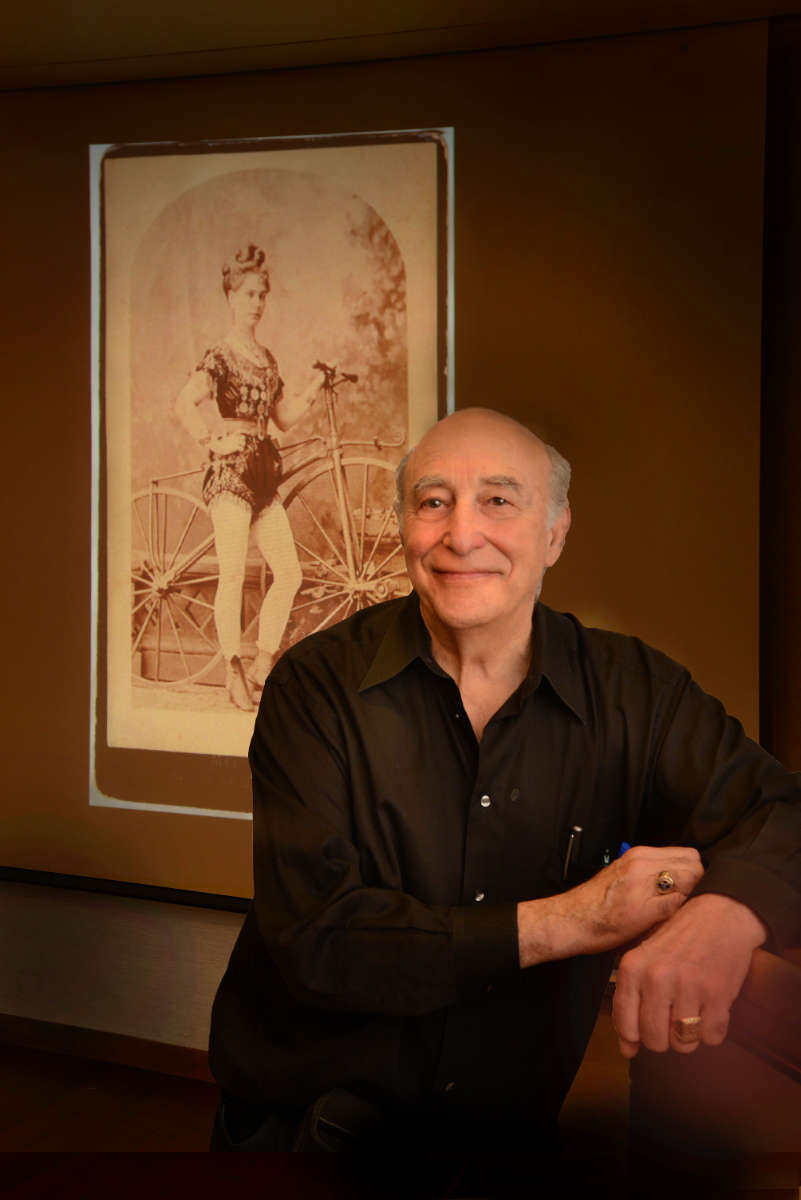
Lorne Shields on Bicycle History in photographs – photograph by the late Robert Lansdale

Toronto.Our January 18, 2023 presentation on ZOOM features member Lorne Shields on the History of the Bicycle – 1st 100 years, We welcome this experienced speaker and expert on bicycle history.

Lorne describes his talk as, “100 YEARS OF CYCLING’S HISTORY FROM 1820 TO 1920 AS CAPTURED THROUGH THE LENS OF THE CAMERA.

“SET OUT IN A CHRONOLOGICAL ORDER WHICH LED UP TO TODAY’S MODERN BICYCLE AS WE KNOW IT.

“SELECTED FROM HIS MOST RARE. HISTORIC, INTERESTING, IMPORTANT AND GRAPHICALLY APPEALING IMAGES.”

If you have’t heard Lorne before, you are in for a pleasant surprise. Here is a bit of background info.:”Lorne Shields, of Thornhill Ontario has been an avid collector and researcher of early bicycling history for some 55 years.  

Some of his collection has been displayed at such organizations as the Smithsonian Institution, the Royal Ontario Museum, Ingenium (Canada’s Science & Technology Museum), Cité des Sciences et de l’Industrie (museum) in St. Etienne, France.  His collection includes virtually every facet of early cycling photographica, ephemera and memorabilia as well as the cycles themselves.  

“Lorne’s specialty and passion is historic cycling photography.  He has given talks on early cycling photographica at various museums, historical societies, universities and symposia in Europe and North America.  A sampling of these venues include The Photographic Historical Society (America) at George Eastman House in Rochester, NY, the Photographic Historical Society of Canada on multiple occasions, the Michigan Photographic Society, the Bicycle Museum of America, Victoria College at the University of Toronto, The Ephemera Society of American in Greenwich Connecticut, Velorama at Nijmegen in The Netherlands and at Guildhall in the City of London, England. 

“His presentations are always crafted to the intended audience. This presentation will cover the history & development of the bicycle from 1820 to 1920. The images have been selected from the most historic, rarest, interesting, important and graphically appealing photographs in his collection.”

If you have any questions, please contact our programme director, Celio Barreto at program@phsc.ca.Reserve your space today at Eventbrite for this ONLINE presentation!.  Note: use the links in the text above, not in the jpeg of the poster (no live links in this jpeg).

Posted in program | Tagged , , | Comments Off on PHSC presentation, January 18, 2023 – History of the Bicycle

Gary is at it again …

Toronto. Our good friend, Gary Perry, sent a note the other day.

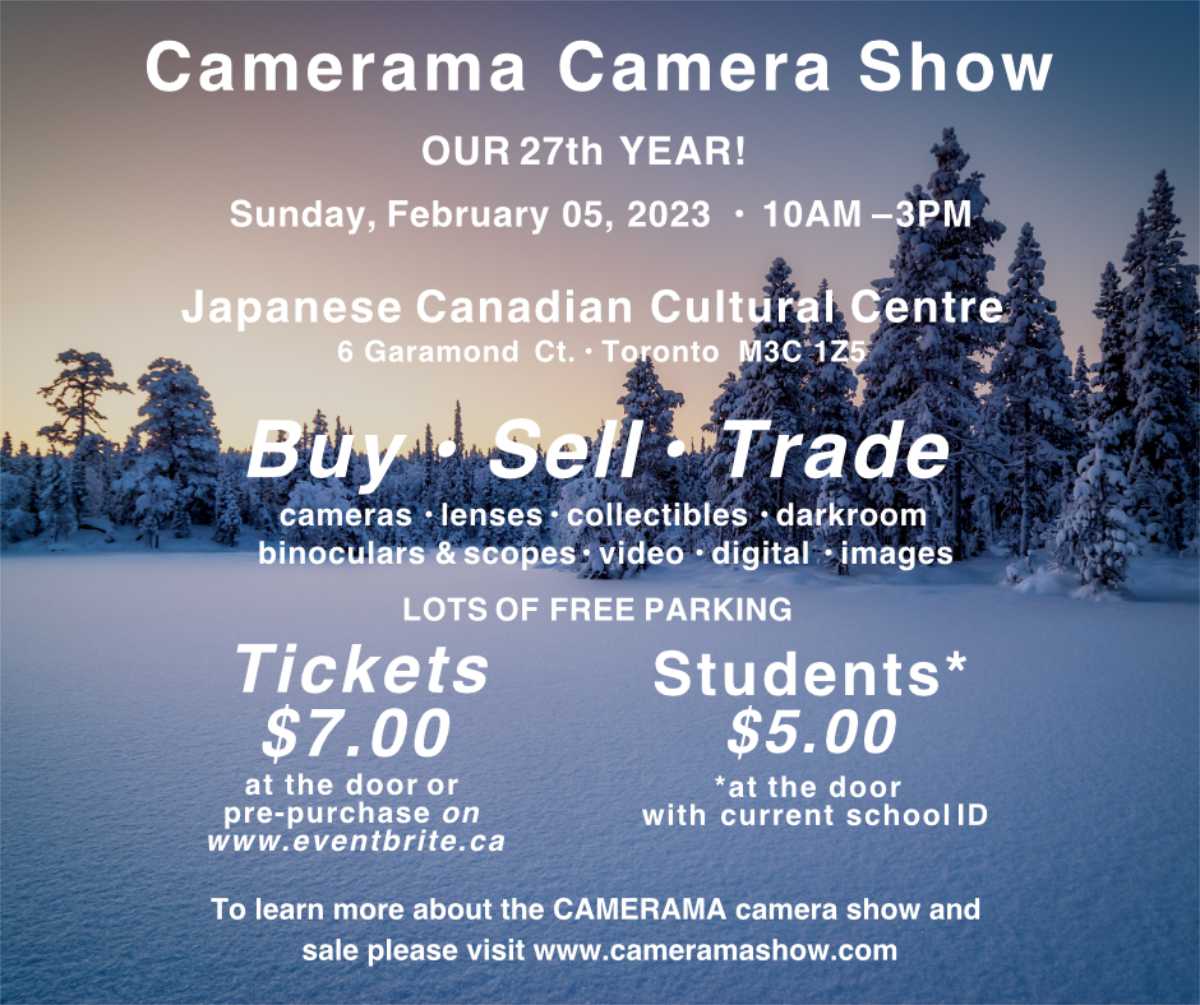
In the note Gary says, “Happy New Year! We are happy to announce our next Camerama Camera Show!

“Camerama Camera Show
“Sunday February 05th 2023
“Japanese Canadian Cultural Centre
6 Garamond Ct. Toronto  M3C 1Z5
Show Hours: 10am – 3pm
Entrance at the south side of the building.

“Vendor tables are available. Contact me for information.

“Regards, Gary Perry
Camerama Camera Show
905-550-7477”

CAMERAMA SHOW February 5, 2023

Note: See the post for October 29,2020 to see the source of the title.

Posted in activities-other | Tagged , , , , , , | Comments Off on Gary is at it again …