Architecture in Photography Exhibitions 1858 – 1861.

Natalie Banaszak

PHSC Meeting, Wednesday, October 18, 2017
Architecture in Photography Exhibitions
Natalie Banaszak, B.A., M.A.

Natalie will present her award winning research on the participation of photographic societies in the promotion, marketing and sale of architectural photography as art and a symbol of national identity.

Ms Banaszak has a BA in Art History from the University of Guelph and an MA in photographic preservation and collections mgmt  from Ryerson. She has spent a few months on the job at the Centre Canadian d’Architecture in Montreal and at the AGO here in Toronto as a Collections Intern for both institutes. She served as a Teaching Assistant at Ryerson, and a Graduate Intern at the Museum of Fine Arts in Houston, Texas.

A second speaker, Ms Dolores Gubasta, Toronto photo editor and owner of KlixPix,  speaks on her intimate involvement with the Don Newlands Archive. Newlands, a well respected Canadian photographer, shot for Maclean’s, Black Star and Paris Match. He was a consummate purist who rejected an industry increasingly reliant on the staged journalistic subject.

Join us at 7:30pm on October 18th in the Gold Room of Memorial Hall, in the basement of 5120 Yonge. The public is always welcome. Go to our Programs page for directions.

Posted in program | Tagged , , , , , , | Comments Off on Architecture in Photography Exhibitions 1858 – 1861.

PHSC Newsletter 2017-10

PHSC News for October 2017.

Toronto. Editor Sonja Pushchak issues another yummy episode of her delightful newsletter, this time a scary Halloween special!

The issue begins with Ralph Meatyard’s photo of subjects wearing cheap latex halloween masks, followed by a poster for our annual fall fair featuring all things photographic and featuring those wonderful old cameras of yesteryear.

Next, a page is devoted to our October speakers, and then a mix of articles and columns – Monster Math on the del Toro exhibit at the AGO, the Minox binoculars adaptor, choosing a Brownie, web links, and more. A dozen wonderful pages in total! Click the icon at left or here to read and print this tasty edition of your favourite newsletter!

Posted in newsletter | Tagged , , , , , , , , | Comments Off on PHSC Newsletter 2017-10

Outta da ooze

OOZAB Sliding Focusing Stage or Focoslide c 1955 shown upside down.

Toronto. Willard Morgan’s nifty Sliding Focusing Stage must have been selling well because in 1938 Leitz Wetzlar began to make and market the accessory which by this time had a spring-loaded clamping bar to hold the camera both in the NYC and in the Wetzlar versions.

The Wetzlar stamped accessory was given a new code as well – OOZAB. The OOZAB and the NYC version were both made and sold through 1951 when the NYC accessory was dropped. The OOZAB was modified at that time to an H shaped clamping bar to clear the flash socket of the IIIf.

I picked up my c1955 example from Dave DeShon in September 1978. This version of the Focoslide which used the camera lenses was made through 1957.

Posted in camera | Tagged , , , , , | Comments Off on Outta da ooze

those where the days …

December 1948 Popular Photography Ad for Graflex

Toronto. I think George Dunbar has special spot in his heart for the once illustrious staples of the news photographer –  the Graphic and Graflex cameras. George often finds these unusual ads and passes them to a few of the PHSC members and to Ken Metcalf in  North Carolina. Ken is an editor of and the publisher of the Graflex Journal.

This ad (at left) ran in the December 1948 issue of Popular Photography suggesting ways you could celebrate Christmas by giving your favourite (favorite?) shutter-bug a new Speed Graphic product. As a kid of 11 in 1948, Christmas was special to me, but all the gifts combined in our home did not match the cost of one new Speed Graphic or Graflex camera!

Even to this day the reflex cameras look very old and cumbersome in design – much older than 1948 suggests.

Posted in camera, Uncategorized | Tagged , , | Comments Off on those where the days …

Stephen Wilkes Exhibit in Paris

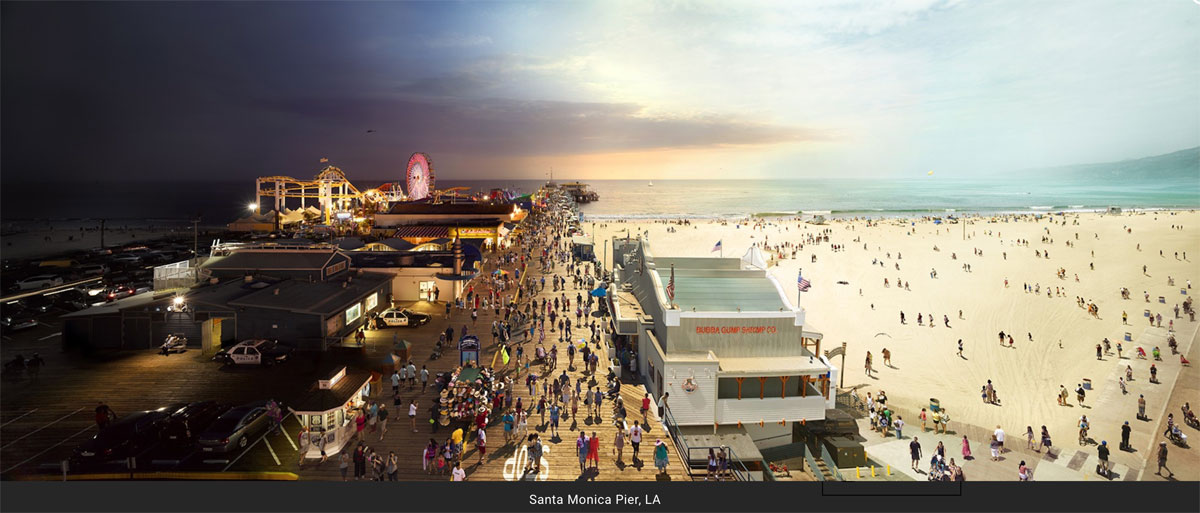
Santa Monica Pier, LA by Stephen Wilkes

Toronto. Galerie GADCOLLECTION in Paris, France is featuring an exhibition called “Day to Night“. The exhibit runs from October 12 to November 5th. The images in this exhibition are the work of Stephen Wilkes.

The following words (edited) are from the GADCOLLECTION web site:

American Stephen WILKES was born in 1957. He began to photograph when he was 12 years old, a passion which never left him. WILKES studied at Syracuse University’s S.I. Newhouse School of Public Communications. He graduated with a bachelor of science in photography. Specialized in communication, the school allowed him to develop a deep understanding of the media’s history and uses. He opened his studio in New York City in 1983 and has kept on photographing to this day.

WILKES photographs for commercials, publishers, himself and above all for others. His photos are made to be shown to the largest audience possible. They testify to a high degree of self-abnegation, so much so that he does not hesitate to dedicate his time and effort to photographic projects which he feels are important; works able to change our perception of the world; to provoke reactions. In 1998, a one-day assignment to the south side of Ellis Island led to a 5-year photographic project. This project resulted in a 2006 book called  Ghosts of Freedom. He did a photo and video study about this abandoned place – medical wards where immigrants were detained (they underwent tests there and were quarantined before being allowed to enter America). Broadly speaking, Stephen WILKES’ photos helped to move the lines. Thanks to his work, $6 million were provided to restore the south side of the island.

In a different approach, the recent series Day to night started in 2009. The work gathers in a single photograph the images captured during an entire day. A long and difficult work, each finished image sublimates landscapes and architectures, carefully chosen by Stephen WILKES. Each image in  this  tour de force requires a digital treatment of an average of 100 photos during a shooting session of over 24 hours. Some 1400 photos in all were taken for this project.

Posted in photos | Tagged , , , , | Comments Off on Stephen Wilkes Exhibit in Paris

Close-Up for nerds

Good Close-Up Reference

Toronto. Almost two decades later, in 1979, Lester Lefkowitz of NYC published this profusely illustrated soft cover text on the art of close-up photography. Lefkowitz has a masters degree in optics and is a practicing photographer. When he published this comprehensive AMPHOTO book, he was the Associate Director of Education at the International Center of Photography in New York City.  Even today you can visit his macro website and learn the about the techniques he uses.

A decade after it was published, I loaned it to our then editor, Ev Roseborough, himself a commercial photograph and owner of ER Associates Studio. In returning it to me, Ev included a brief note of thanks.

Ev said, ” Thank you! Very technical book, good reference. Some interesting sections”.

Like Otto Croy’s 1960 book, this one too is quite relevant in many ways in this digital era for those of us who relish closeup photography with a good technical understanding of the art.

Posted in book | Tagged , , , , , , | Comments Off on Close-Up for nerds

Keep your eye on the ball

How to use your Camera Close Up – O. R. Croy, The Focal Press 1961

Toronto. With a growing interest in close-up photography, in July of 1979 I bought a used copy of Dr Otto Croy’s  book Camera Close-up originally published in England and America by Focal Press of England in 1961. L. A. Mannheim translated the 1960 German book for the Focal Press.

This small book with its line drawings and monochrome plates gives excellent advice and guidance for the aspiring close-up photographer.

Much of the advice is still relevant in today’s digital world. When published the majority of book illustrations and photographs were monochrome.

Posted in book | Tagged , , , , , | Comments Off on Keep your eye on the ball

Between a rock and a hard place…

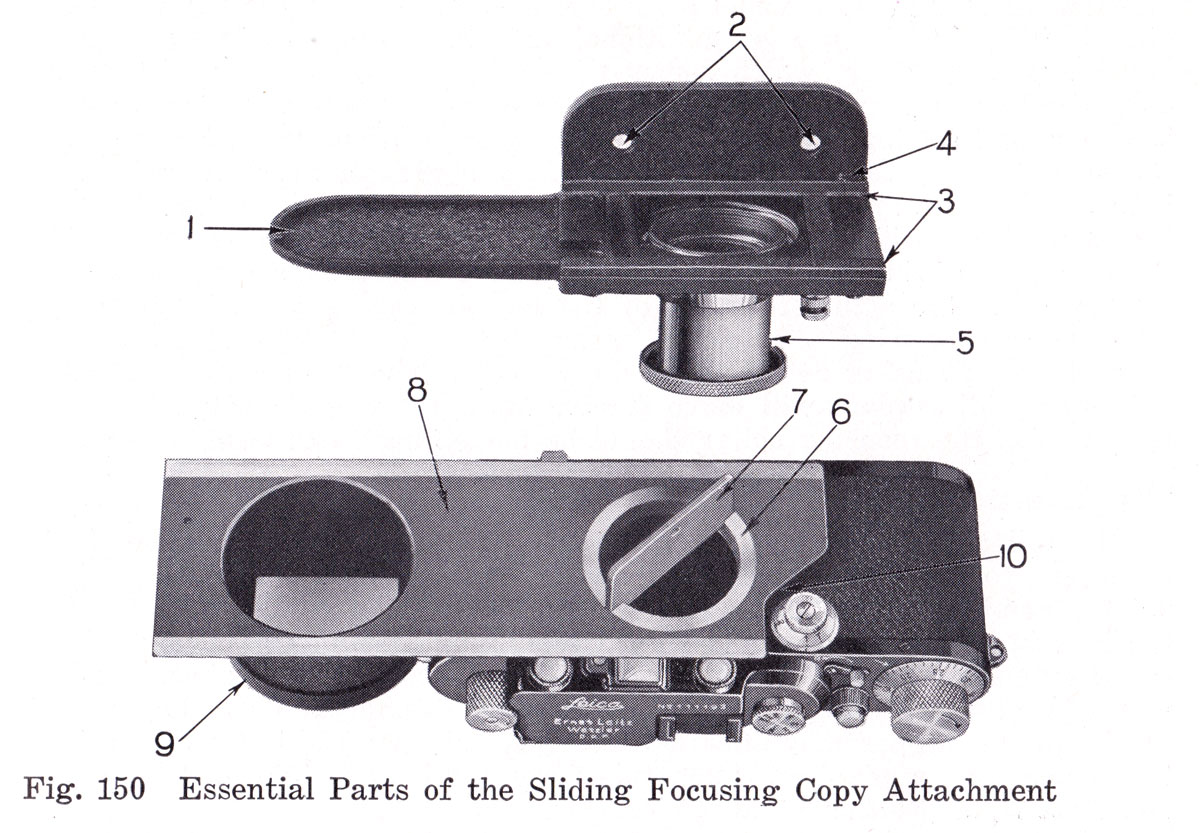
FULDY from Leica Manual 3rd Edition – 1938-9. Bottom slide shown upside down

Toronto. Close-up photography was generally used to close the gap between close photography – say a metre – and a low power microscope. On the 35mm frame the object was about 1/4 to 1/1  life size.

In the early 20th century, companies made technical cameras – ones with “double extension” bellows. With ground glass and glass plates or cut film, the photographer could successfully focus on a close-up subject and snap the image, using a good tripod or other stand, of course. I have one such camera made by Nagel before the company was bought out by Kodak in 1932 to make the famous Retina cameras.

In 1930, Leitz announced a model of the Leica with interchangeable lenses. This prompted Willard Morgan to consider ways to equip this interchangeable lens Leica with a ground glass for focusing. Metal extension tubes allowed the little Elmar lens to get closer to the subject.

He came up with a “Sliding Focusing Copy Attachment”, shortly thereafter made and marketed by Leitz NY as the FULDY. You can read about it here in the free pdf versions of the 2nd and 3rd editions of the Leica Manual.

I picked up my example of Willard’s marvellous FULDY on June 14, 1980 at the spring PHSC fair – a two day event, held at the Park Plaza II in Toronto, from Czaba Martoni of Ann Arbor MI. Some later models had a different code name.  A spring loaded arm became common to hold the camera in place (instead of the original’s lens ring).

Posted in camera | Tagged , , , , , , , , | Comments Off on Between a rock and a hard place…

Tree planting in BC

Among Wild Horses – tree planting in British Columbia

Toronto. The previous post noted an exhibit at the Stephen Bulger Gallery which struck a chord with me. Apparently it did with George Dunbar too.

George writes, “Your latest item certainly caught my attention, Bob.

“My grandson Kyle, has been planting in BC for the last 3 years.

“He sent us this photo…………among wild horses”

As you may be aware, George is a retired industrial photographer for the mighty IBM and a frequent contributor to both this site and Urban Toronto. For urbantoronto.ca, George provides many current images he has taken around the city.

Posted in photos | Tagged , , , , | Comments Off on Tree planting in BC

The Tree Planters at Stephen Bulger Gallery

Rita Leistner exhibit at Stephen Bulger Gallery

Toronto. Stephen Bulger, long a force in this city, announced the latest exhibit at his gallery.

The announcement states, “The Stephen Bulger Gallery is pleased to present ‘The Tree Planters’, our first solo exhibition of work by Canadian artist Rita Leistner.

“RITA LEISTNER
“The Tree Planters

Exhibition Dates: October 21 – November 18, 2017
Reception for the Artist: Saturday, October 21, 6-9pm
Online Preview: beginning October 14 at ffotoimage.com
Panel Discussion: Wednesday November 8, 6-7:30pm (RSVP)
To RSVP please email info@bulgergallery.com or call the gallery at 416.504.0575

“Having planted over a half a million trees between 1983 and 1992, Leistner perceives this series as an homage of sorts, to all the Canadian tree planters; past, present, and future. Canadian tree planting is unique in the world and is entering its third generation. It has become an indelible part of our national identity, changing not only the geographic landscape of Canada, but also its cultural mindset. It is an essential contributor to Canada being the world leader in sustainable forest management, which all our futures depend on.”

The concept strikes a chord with me. In the spring of 1951 or 2 I spent my easter holidays as a tree planter of sorts. A bunch of us went to Minesing, near Springwater park to pull and tie pine seedlings to be planted nearby to replace trees cut down. This was part of a government reforestation project.

Posted in activities-other, events, photos | Tagged , , , , | Comments Off on The Tree Planters at Stephen Bulger Gallery