more than one way …

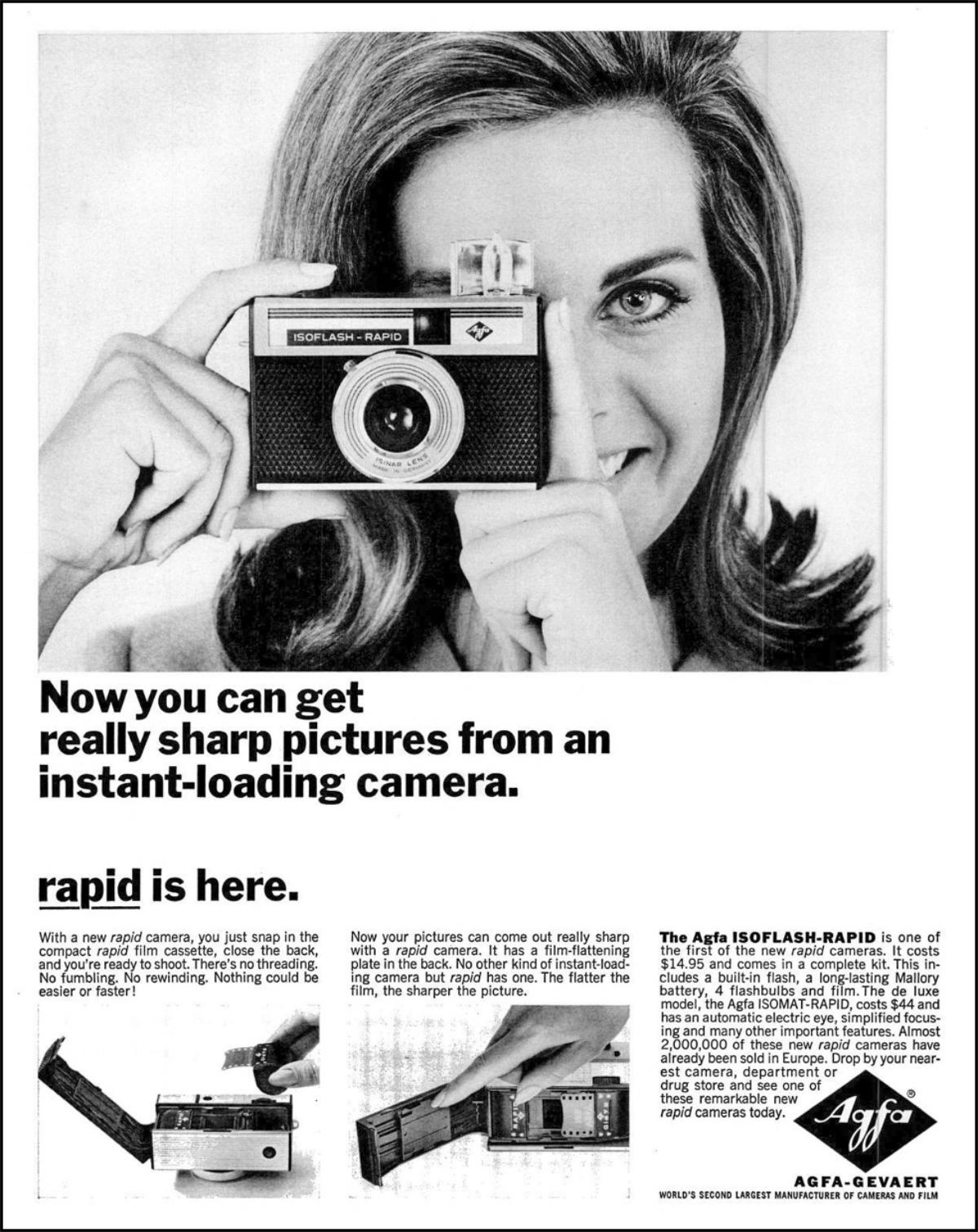
Ivan the Terrible – click him to see the LIFE 1965 ad for the Agfa Rapid 35mm film system

Toronto. … to skin a cat, as the old saying goes. Film was no different. Kodak touted its 126 film size (35mm sans traditional sprocket holes and paper backed) Kodapak for its instamatic cameras eliminating the “klutzy” confusion of loading and rewinding a seldom used film camera.

A short time later, Agfa came along with their version of auto-loading 35mm film using a battery. The traditional camera film plate was used to flatten the film instead of the less precise Kodapak. Their Rapid system used a simple technique – the film tongue was slightly concave, not the long skinny lop-sided 35mm film leader in use for decades as an homage to the then old screw mount Leicas.

The old Leicas loaded through their base plate and a weird cam inside the base plate opened the brass film cassette Leitz sold so the film was free of any risk of scratches (retail cassettes with spools and a felt light trap could also be used).

The Rapid system eschewed the spool. The unexposed film slipped frame by frame into an empty Rapid cassette making rewinding unnecessary. Sadly, the Rapid system was overwhelmed in the market place by the instamatic Kodapak and disappeared in the early 1970s. Ironically the odd-ball APS system produced by a consortium of camera makers near the end of the days of film attempted to modernize information capture closer to the EXIF data of today and usurp the traditional 35mm system in amateur cameras, but it was just too little, too late.

My thanks to George Dunbar for reminding me of this bit of photographic history. The ad you see, when you click Ivan, originally appeared in the August 27, 1965 issue of LIFE on page 16.
Posted in film | Tagged , , , , , , , , , | Comments Off on more than one way …

coping with COVID

Wet Plate Guy – original steel cut of the PHSC Logo

Toronto. The pandemic that swept the world this year caused a seismic change in photographic historical societies. The societies reacted in various ways. Our group (PHSC) took advantage of our MailChimp account used to disseminate our newsletter “PHSC News” by adding a MEMBER tag to separate out member emails. Using the tag, we were able to send pdf copies of our journal “Photographic Canadiana” to all members with an email address on file (just over 4/5 of the members).

Since the monthly meetings were cancelled by decree, we elected to compile other material in pdf files ready to send to members IF they supplied an email address AND had a fast enough internet connection to receive the 2mb or so pdf files. A number of files are ready and will go out beginning next month (or late this month).

Others have elected to produce free short online videos (Michigan Photographic Historical Society) or even hold weekly lectures open to members (and others) who pay a modest fee (Daguerreian Society).

Posted in events | Tagged , , | Comments Off on coping with COVID

we lost Mike Mitchell at 76

Two publications of “Monsters” by the late Michael Mitchell

Toronto. I received very sad news on June 16th from our treasurer, John Morden.  John came across an AGO article written just yesterday (June 16th) announcing the death of Michael Mitchell in Hamilton on May 18, 2020.

The article was written by Maia Sutnik (retired from the AGO), another popular speaker at the PHSC. Mike gave two talks to us on his collection of Eisenmann photos, first in 1979 or the early 1980s, with a new release, new publisher (ECW),  and further details on October of 2003.

A fine mind and a fine photographer. Michael will be missed by us all.


Posted in people | Tagged , , , , | Comments Off on we lost Mike Mitchell at 76

ghosties and ghoulies …

a double exposure

Toronto. … and things that go bump in the night. An old saying to scare children silly in the days before electrical lighting. In the 19th century, few people understood exactly how photography worked. These folk often fell victim to those claiming to photograph spirits or ghosts.

In time, people discovered such things were simply double exposures either on the positive (print) or negative. In camera was easy especially when glass plates and cut film was used (or early roll film cameras). 20th  century roll film cameras touted double exposure prevention as a perk.

By under exposing the “ghost” it would appear to be more realistic. The above image was taken with a Leica which had double exposure prevention provided the photographer did not reuse a previously exposed roll of film (my bad)! In later times I tore a notch in the film or wrote on the leader to avoid such unintended results.

Posted in history | Tagged , , , | Comments Off on ghosties and ghoulies …

the iconic SX-70

SX-70 – by Thomas Backa from Turku, Finland via wikipedia

Toronto. Expensive media may have been needed for Polaroid cameras, but the cameras themselves where technical marvels. Typical of this genre of camera was the iconic SX-70 introduced in 1972. The media used in this camera is still available today!

To solve user forgetfulness, each film/print pack came complete with a flat dimensioned 6 volt battery to power both camera and flash. Be sure to watch the ten minute video announcing this camera on the above page (1972 link) courtesy of Open Culture.

This SLR camera was amazing in 1972 and remains a collectible today reflecting the technical wizardry of Edwin Land and his company. Sadly, like film, Polaroid has been made redundant with rare exception by the onslaught of digital technology in general and smart phones in particular. The exception? Those brave souls who want to capture the charm and colours of authentic picture in a minute materials.

Thank you and kudos to my friend George Dunbar who spotted the original SX-70 ad on the Open Culture website.

Posted in camera | Tagged , , | Comments Off on the iconic SX-70

PHRC Conference 2020 De Montfort University

PHRC Conference is online in 2020 (June 15, 16)

Toronto. Our Programme co-ordinator, Celio Barreto, is joining this prestigious conference on photographic history in Leicester U.K. tomorrow and Tuesday (June 15, 16). Everything (including registration) will be online in this time of COVID-19.

The full title of the conference  at De Montfort University is: Camera Education
Photographic Histories of Visual Literacy, Schooling, and the Imagination

Celio writes in part, “I’m on Day Two, Panel 6: Social and Political Propaganda, chaired by Gil Pasternak.
“I am very happy, thrilled and nervous, and just wanted to share this update with you!”

You may recall that in addition to teaching at Seneca and handling our programmes, Celio has spoken twice at our Toronto monthly meetings on his area of expertise – Japanese photography in the 1800s.

Posted in events | Tagged , | Comments Off on PHRC Conference 2020 De Montfort University

PHSC News for June 2020

c1940 war time ROSS HK-7 camera by Victor Hasselblad

Toronto. My, it’s June 2020 already and the infamous COVID-19 pandemic is in decline (or is it waiting to re-emerge even deadlier this winter, like the 1918 Spanish Flu did in late 1918 and early 1919?).

Meantime, our editor extraordinaire, Sonja Pushchak, has composed the final issue of PHSC News (20-02 – June 2020) before our summer break.

Page 1 reflects the assistance our country gave to our eastern long term care (LTC) homes; followed by page 2 and a virtual rendering of notes in place of the usual PHSC Presents. Page 3 tackles the idiosyncrasies of policies to avoid COVID-19; while page 4 discusses attempts to rewrite history by erasing photos. Page 5 presents Sarah Cooper and her take on the silly advice emanating from American president Trump on avoiding infection. Filters are reviewed by David, followed by his web links helping partner Louise (NB my copy of Kodak’s print guide uses both a white and a black model, each to great effect).

Page 8 covers alternatives for our monthly meetings plus a note from Celio, our programme coordinator. On page 9, Vi and Dot discuss the Dutch Bob hair cut and the impact of some famous folk who wore it including Louise Brooks (my favourite silent movie actress). This issue wraps up with the classifieds on page 10. If you do nothing else this month, check out Randy Rainbow and his parodies of G&S songs using strange utterances by the Donald himself.

You can visit this issue by clicking on the camera above, or g0ing to the menu item NEWSLETTER. There is a drop down menu to take you to older issues dating back a couple of decades to the very beginning of newsletters.

Posted in newsletter | Tagged , , , , , , | Comments Off on PHSC News for June 2020

idiot proofing film loading

Argus goes Instamatic in May 1965 LIFE ad

Toronto. The giant Kodak corporation of mid last century dictated film sizes and packaging. One of their extensive studies showed that amateurs had a difficult time changing film. To simplify this task, Kodak invented the instamatic film pack. This 126 roll film Kodapak fitted in the camera one way only. There was no need to insert an end and roll to a number, rewind, set film speed, etc. It was all automatic.

Critics said higher end cameras with faster lenses using the format were not worth buying since the pack’s film would not stay flat along the focal plane. However, for the amateur and family snap shooters, it was a blessing.

The film took off with the Kodak cameras that used it. Other makers like Argus (in the ad at left from p. 18 of the May 21, 1965 issue of LIFE magazine) also chose to design cameras using instamatic film to leap on the 126 bandwagon. Thanks to fellow PHSC member George Dunbar for highlighting this bit of pre-digital history.

Posted in history | Tagged , , , , | Comments Off on idiot proofing film loading

far far away

Photo by  Jonn Leffmann, CC BY 3.0, https://commons.wikimedia.org/w/index.php?curid=79524496

Toronto. Star Wars movies always began with a scroll beginning … in a galaxy far, far, away … . We often call any lens that brings in distant objects closer and compress the perspective a telephoto lens.

But the actual lens can be either a long focus or a telephoto. So what’s the difference? Basically, at infinity any long focus lens focusses about the same distance back to the camera as its focal length while a telephoto lens has a distance physically back to the camera that is shorter than its focal length.

For example, the 13.5cm Elmar or Hector is a long focus lens while the more compact Tele-Elmar 13.5cm lens is  a true tele-photo lens design. Either design makes for a great lens but the more compact tele design is easier to use/carry.

NB. While I was thinking of Star Wars when I named this post, Slade have a song of the same name…

Posted in camera | Tagged , , , | Comments Off on far far away

by the light …

Full moon. earth eclipse takes place around 1 am tomorrow. Used tripod and remote control.

Toronto. … of the silvery moon. said the old song long long ago.  On the night of December 20, 2010 we were on the eve of an eclipse. Tripod in hand, I took this image with a Leitz Telyt 20cm lens attached to a Sony NEX-5 camera. The resulting image was adjusted (cropped, etc.) in Photoshop.

The lighting of the full moon is reminiscent of the northern light with its soft shadows. Of course the overall light intensity of a full moon is far too dim to substitute for a northern exposure in the early days of photography and the ultra slow emulsions of the 1800s. In studio, northern exposure daylight was best with side lighting to model the facial features to a more “plastic” and pleasing look rather than the flat effect of head-on lighting (or worse with flash, burned out highlights on the face and dark shadows behind).

Professional photographers made their most memorable shots by capturing the essence  of their subject with complementary lighting and framing.  If flash was used, it took a large soft-box or bounce from a light-coloured wall to properly illuminate the subject in a pleasing manner. Not the kind of approach used by many of the amateur snap-shooters of the day (with or without flash).

Posted in history | Tagged , , , | Comments Off on by the light …
