noir et blanc

Photo courtesy of PhotoEd magazine.

Toronto. My good friend and our PHSC treasurer, John Morden, also collaborates with wife Sonja Pushchak on the very successful PHSC News monthly pdf newsletter.

John writes, “Below is a link to a competition that Rita is having in her magazine [PhotoEd]. I would normally put this in the next issue of the classifies in the NEWS but the deadline date is before the next issue. What about a post on the website?”

For those of you who are digitally challenged, the twitter link is here.

Posted in activities-other | Tagged , , , | Comments Off on noir et blanc

fast photo prints in 1924

fast printing at Black’s. Click for the 1924 process.

Toronto. In the days before the end of the broad popularity of film, you could take your exposed colour rolls to a fast film service outlet like Black’s or Japan Camera and see the prints in an hour. In the 1950s, the local drugstore could sent your black and white rolls to a service like Chas. Abel here in the city and have them back the following week with a set of prints for each roll.

In 1924, automated bulk processing of prints was a novel idea. This article in the March 1924 issue of Science and Invention illustrates one set of machines that significantly cut the number of people needed to process film. The article suggests that the negatives are pre-35mm and can be contact printed. The article doesn’t mention any film size criteria, just that the negatives are “wooden framed”.

Perhaps there was enough volume for runs of different size negatives. Wooden frames suggest glass plate or cut film although roll film had been manufactured and sold  for decades.

Posted in history | Tagged , , , , , | Comments Off on fast photo prints in 1924

ya got mail

Exchange Journals

Toronto. Any group or society needs to have a list of its members, including photo historical societies. Our society was founded in late 1974 and began to issue a regular newsletter/journal in March 1975.

Most members are paying members. That, plus events like annual fairs, fund the society. Late in May 0f 1983 we recorded our first exchange member, the Pennsylvania PHS. Exchange members are similar groups who have agreed to swap newsletters or journals in lieu of paying the annual membership fee. In 1984, under the guidance of the late Bill Belier, exchange membership grew to 22 (the PPHS dropped out after the first year of exchange).

By the late 1990s, we had about 47 exchange members which has dwindled to 20 by this year for many reasons (mostly changing interests). Exchange newsletters are reviewed and the review is sent out with the journal. The newsletters are then filed in our library and available on request to any current member.

When the pandemic hit and social contact was discouraged, editor Bob Lansdale led a few other members to send a set of exchange newsletters via pdf to all current members. Bob arranged permission for those newsletters used in the pdf release. He then grouped each set as a magazine supplement. If you are a current member and haven’t seen the newsletter supplements, drop me a note at info@phsc.ca.

Posted in history | Tagged , , , , , , , | Comments Off on ya got mail

photographica c1925

f/2 camera and bright projector of film stris c1924

Toronto. The magazine Science & Industry addressed the wide audience of tinkers and experimenters (mostly boys and youths) and as such it included a wide range of things. In this example article, a camera is shown, but unnamed. The take home was that it had an f/2 lens and could snap theatre and street scenes at night under the existing light in those environments.

The second article covers a unique projector. Again unnamed, this machine uses an “ordinary car headlight bulb” and a resistance to run on house current. Since such a bulb in 1925 took 6 volts and house current was 115 volts, the resistor would run quite hot.  The bulb is like a point source illumination so the result would be a very contrasty light. Prints were photographed on movie film and each frame could be shown separately.

A rather tedious conversion to save the size and weight of a stereopticon projector. We had a more sophisticated projector (by SVC) when I was a kid that showed both slides and film strips like the film used in the 1925 projector. A thank you is in order for friend George Dunbar who offered this tidbit of photographic history.

Posted in history | Tagged , , , , | Comments Off on photographica c1925

who swiped my photo?

Image courtesy of BBC News and Nell Mackenzie

Toronto. Today, people are uploading their photographs in droves. Sadly, while this offers a far wider audience over the internet, it exposes the excellent and unusual to easier copyright violation.

The BBC News via a column written on the 18th of September by Nell Mackenzie titled, ” ‘They used my picture and I should’ve got paid for it’ ” tells the cautionary tale of Sean Heavey who one evening found one of his storm shots used in a Netflix video.

So as a precaution, realize your work can be easily “borrowed” and reused commercially if it’s uploaded to the internet these days. Back when low resolution prints or books were copied, it wasn’t worth the time and effort to duplicate the material. Generally, as copying falls in cost and increases in quality, copyright violation grows too. Just think of all the fraud or nuisance phone calls you get now that long distance is so cheap for you to call friends and family far away.

Since we (PHSC) are an educational not for profit group, we do occasionally use an image from the ‘net, but we always try to give credit to the organization or photographer. Thanks to my friend Russ Forfar for sharing this piece of BBC News with me.

Posted in events | Tagged , , , , | Comments Off on who swiped my photo?

making it better

Ad in LIFE c1967 for the Perma-Cube electronic flash

Toronto. Flashcubes had four tiny flash bulbs and allowed four flash shots by rotating 90 degrees after each shot. Magic cubes looked the same but were ignited by mechanical energy instead of batteries. In 1967, Honeywell made two flashcube alternatives for five of the popular Kodak Instamatic camera line models.

They were both plug in replacements for the flashcube. The cheaper version used four AA size batteries for “up to 100” snaps while the pricier version used rechargeable batteries and included an AC charger for about 25% more and took about 30 snaps per charge.

Of course modern day smartphone users needn’t even think of flash. It’s all automated. Just use the internal digital camera and the flash goes off automatically when needed (unless you have it set to off ).

Once again my thanks to George Dunbar for sharing this bit of photographic history with me. You can see the ad in the November 17, 1967 edition of LIFE on page R7 just after page 103.

Posted in history | Tagged , , , , | Comments Off on making it better

a dash of flash

Ad for Honeywell Strobonar 660

Toronto. In the early days of flash, these high speed demons  emulated flash bulbs – you set the aperture, and shutter based on subject to camera distance, film speed rating and shutter syncronization maximum speed. All this changed with Honeywell’s iconic Strobonar 660 (if you used battery power). The elegantly designed flash series used automation to control  the amount of light hitting the subject, stopping when the right amount was detected – whether on camera and directed at the subject or bounced off a light wall or ceiling to give a softer modelling light.

This was a terrific accessory for most cameras, allowing good exposure both at night and indoors. An ad from the November 10, 1967 issue of LIFE (page below page 80) illustrates this beautiful flash. I had an Ultrablitz Reporter IIa with a large reflector and lots of power but no automated control so subject to camera distance always had to be calculated and the aperture adjusted to control the light intensity. Most 35 mm cameras with focal plane shutters would only synchronize to flash at or below 1/25 or 1/50 second, sometimes leading to ghost images from natural lighting. So called focal plane flash bulbs (not electronic flash) allowed for faster shutter speeds by staying illuminated for a bit longer than normal flash bulbs.

My thanks to good friend and PHSC member, George Dunbar, for sharing this bit of photographic history and thanks to Mike Butkus for the flash manual. Be sure to check out Mike’s site for any photographic manual – both pdf downloads and paper copies.


Posted in history | Tagged , , , , | Comments Off on a dash of flash

follow da money

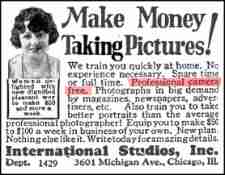
A free professional camera …

Toronto. When I was a kid, magazines were rife with ads offering ways to get rich. These ads made it seem so easy.

The ad at left, was aimed at wishful future photographers. The ad even promised a free “professional camera”, whatever that was. In 1925, when International Studios, Inc of Chicago ran this ad, $50 to $100 a week was a fortune earned by very few. In fact, three decades later, I made less than $25 a week in a small Ontario town (fresh out of school and with an amateur radio licence in hand). In the early years of the 1900s, Chicago was well known for its studios – all be it movie studios – giving credence to this advertisement.

Nothing is free. Companies like this made their money by selling the naive and gullible wanna be’s instructions. In this ad, the make and details of the free “professional camera” were purposely left unstated so the reader could  dream about this potential bargain. Sadly, the profession of photography took (and takes) SKILL, especially in 1925. A very intelligent person could learn the art free by visiting his local library and borrowing the photography books of the day. He would still need to have good salesmanship and business acumen to succeed – tough to get by answering an ad.

The money saved by the aspiring photographer was better spent on a good camera of his choice. Studio and darkroom could be set up at home initially and later moved to a more promising location once the business began to prosper.

A big thank you to friend and PHSC member (as well as photography historian), George Dunbar, for sharing this tidbit of history with me. Today such ads have been replaced with telemarketers and unsolicited emails – some valid, many crooked to put it mildly (I am a sceptic by nature).

Posted in history | Tagged , , , | Comments Off on follow da money

another dimension

c1925 article on how we see stereo and how to take photos in stereo

Toronto. Paintings and regular photos are done in two dimensions. Careful use of shadows (lighting for photos) give a more modelled view of the subject.

Most humans have two eyes 2 to 3 inches apart giving two images of any view at two slightly different angles of view. The human brain fuses these two images to give a three dimensional (stereo) view.

This article in the May 1925 issue of Science and Invention magazine explains stereo and how to take and correctly align stereo photos taken with these inexpensive box cameras. The stereo fad seems to wax and wan. Every half century or so stereo interest peaks once again. c1900 stereo cards are popular collectible items again. Fake stereo cards exist. The same photo is used on both left and right making the result totally flat when viewed correctly.

In the 1950s stereo popularity rose again with special stereo attachments and cameras. The stereo fad seems to fade because, like movies, special care had to be taken and on top of that few people could “free view” stereo so special viewers were needed. Anaglyphs using two different colour allowed both images to be printed on one sheet.

Special books of stereo drawings using repeated symbols could be bought late last century and free viewed by many people but only crude drawings could be viewed. For a short time so called lenticular views could be taken with a four lens camera and special processing of the prints.

Posted in history | Tagged , , | Comments Off on another dimension

the dark slide of the room

Dark Slide partly open in film holder

Toronto. Plate holders and later film holders became common in the later 1800s and early 1900s to protect sensitized emulsions from unexpected exposure to light. These clever gadgets, which came with a dark slide that could be removed for exposure through the lens, were mounted on the back of the camera (room, etc in Latin). These holders held sensitized glass plates or cut film allowing the photographer to take many exposures by simply removing and exchanging the entire holder.

The dark slide could be removed for exposure, then flipped and reinserted to remind the photographer that the protected sensitized medium had been exposed in the camera. The  holder could contain one plate or two depending on construction. Once roll film took off  the holders and their dark slides disappeared.

The remaining outpost for many years were the venerable cameras like the Graphic and Graflex lines that continued to use plate holder backs long after roll film was common place.

NB. The post title is a riff on the epic 1973 album by Pink Floyd called, “Dark Side of the Moon“.

Posted in Uncategorized | Tagged , , , | Comments Off on the dark slide of the room
