who ya gonna call – II?

Fotron 828 roll film camera from a LIFE ad

Toronto. Who ya gonna call when you want people in middle class America to know about your fresh egg and do some digging? LIFE magazine, that’s who! In the March 8, 1969 issue, a full page ad on page 19 touted this odd camera – sans price – and advised readers to send in the postage-free card, or if missing, send the ad’s coupon to Triad  Corp down in sunny California for details.

Never heard of the camera? I had’t either. Turns out the features advertised were rather pricy. The camera was sold by door to door “salesmen” for “$150 to $300 and up” according to an old paper edition of McKeown’s price guide (nearing two decades old now).

The plastic camera used the 828 film in special cartridges to make one inch square negatives or transparencies. The camera was somewhat clunky and ugly looking but had fully automated workings, electronic flash, rechargeable batteries, etc. To many photographers, the fact that it was sold outside camera shops at wildly varying prices, and by cold calling door-to-door salesmen, marked the camera’s ill fated sales campaign as “the greatest photographic ‘rip-off’ of the century” – again quoting my old copy of McKeown’s. Today, internet information is just as unkind to this camera.

The title of this post is from Ghostbusters, a favourite film of mine, and was first used a couple of months back in a post on this site that talked about information sources for collectors of photographica.

Posted in history | Tagged , , , , , , | Comments Off on who ya gonna call – II?

something to sit upon

Photographic Canadiana Special Supplement Vol 1-4

Toronto. Well, what do you know? Here is another special members-only supplement (vol 1-4). This one is on posing chairs of all things. In a more leisurely era, a studio portrait took a few seconds of absolute stillness to capture. To make it easier for the subject(s), firm props like chairs, were available to hold (or sit upon).

Vol 1-4 was sent out last Friday afternoon to all current members with an email address. If you did NOT get a copy, please email me at info@phsc.ca and I will send you a copy after verification of your membership. Not YET a member? well, for heaven’s sake! Grab your plastic and register via PayPal on the upper right of this page!

This is a reprint of a 1994 publication in California. The preamble inside the front cover states, “The advertisements and illustrations in this supplement originally appeared in The Photographist, number 101, the journal of the Western Photographic Collectors Association (WPCA) in 1994. The WPCA was affiliated with the University of California Museum of Photography and stopped publishing circa 1996, going into dissolution in 2001. For the story of the history of the WPCA, see the article in Special Supplement Vol. 1 No. 1.

“In an effort to make this material available to collectors, historians and those interested in the history of photography, this content was digitized by the Photographic Historical Society of Canada (PHSC) and Milan Zahorcak in 2019 and 2020 for distribution to PHSC members as a seven part series. The first instalments were about magic lanterns (two parts), and shutters . Subsequent issues of the series, forthcoming in the following months, are, flash lamps and two parts covering early enlargers. If you have any questions or would like higher resolution scans of any of the images, please contact the PHSC at info@phsc.ca.”

Posted in history | Tagged , , , | Comments Off on something to sit upon

PhotoEd Online Fall 2020

Black and white in colour by Joel Yagi in Ottawa courtesy of PhotoEd magazine

Toronto. Rita has another great issue of PhotoEd magazine online. Have a look at all the great portraits and more! And remember, the print edition of PhotoEd is different than the online issue.

We heard about the new issue when Rita sent this message out via MailChimp. By subscribing you support Photography in Canada as well as getting an edgy well designed magazine each time.

You are here because pf an interest in photographic history or collecting. Be sure you visit Rita Godlevskis at PhotoEd too!

Posted in Uncategorized | Tagged , , , , , | Comments Off on PhotoEd Online Fall 2020

don’t let the light get in

Zeiss Box Camera from Engles auction May 2010

Toronto. Cameras are all the same in one sense whether they cost pennies or thousands of dollars: they are a light tight box separating a light sensitive medium from a lens so that any object at infinity is in focus on the medium. The light sensitive medium can be coated on to metal, glass, paper or plastic.

A shutter at the focal plane or in the lens is set to determine the duration of the exposure while an aperture in the lens establishes the depth of field and aids the shutter in deciding the quantity of light hitting the sensitive medium.

In the late 1800s and most of the 1900s, during the time of film material, a shutter was essential for successful exposure. Before dry plates, exposure was in seconds or longer and a lens cap, hat, etc. served instead of a shutter. A bellows or other mechanism allowed the camera to focus on objects closer than infinity.

NB. The title of this post is a riff on the song, “Don’t Let the Rain Come Down“, a 1964 song based on the much older English nursery rhyme, “Crooked Little Man” (which delighted me as a child). This is the calypso version sung by the Serendipity Singers.

Posted in history | Tagged , , , , , | Comments Off on don’t let the light get in

faster than a speeding bullet

Edgerton cutting the card

Toronto. When photography was invented, exposures were measured in minutes. Between then and the end of film’s popularity something happened: Speed. The light sensitive media and lenses through research and innovation became much faster. In fact, after dry plates arrived, shutters became a necessity.

For decades, minicams attained a top exposure speed of 1/1,000 second with their tiny focal plane shutters moving an open slit across the medium at 1/20th to 1/125th second. By the end of the film era, the top shutter “speeds” on a few retail cameras  reached 1/4,000 second or faster. Beyond that, electronic flash as shown here by Dr Harold Edgerton of MIT took over.

Modern digital SLRs have even faster electronic shutters to accommodate the far higher ISO they are capable of reaching. And with all the automation, most photographers (especially smartphone users) simply ignore shutter speeds provided they can stop any blur/jiggle, and the image is relatively noise free.

The title of this post was one of the Superman tags from last century. I grew up reading comic books about Superman and the other super heros. The Canadian band, “Crash Test Dummies” immortalized the flying hero with their song about Superman.

Posted in history | Tagged , , , , | Comments Off on faster than a speeding bullet

slow train

slow speed shutter dial

Toronto. In the early years of the minicam, leaf shutters were often used to allow for slow speeds. The early focal plane shutter Leicas had speeds from about   1/500 second down to about 1/20th second when both curtains were open.

To allow slower speeds with the focal plane shutter, the release of the second curtain had to be delayed. Leitz accomplished this by using a gear train that delayed the closing of the second curtain by up to 1 second giving the little camera slow speeds from 1/20th to 1 second while still using the focal plane shutter.

This clever idea allowed interchangeable lenses to be used without recourse to leaf shutters or forgoing timed slow speeds. A Leica model B used a leaf shutter but was limited to the 5cm lens. The camera was an unsuccessful model when it was released (1926 to 1930 using two kinds of leaf shutters). Today, it is a very rare Leica model.

The title of this post is from the song of the same name as sung by Michael Flanders with Donald Swann. The song is featured on their LP record, “At the Drop of Another Hat“. Both “At the Drop of a Hat” and “At the Drop of Another Hat” were theatre revues by Flanders and Swann. A subset of the songs appear on each LP (I have both and much enjoyed them).

Posted in history | Tagged , , | Comments Off on slow train

Okey-Bokehy

Red IBM Selectric with star sparkles in background

Toronto. A recent post on depth of field prompted a note from my friend George Dunbar along with a photo for a red IBM  Selectric typewriter (remember those machines with the flying golf balls of interchangeable typefaces?).

For the ad, George used crinkled aluminum foil as a background and a star cutout on the lens to create the sparkly stars behind the typewriter and model. While George took the photograph with the foil background long before Photoshop arrived on the scene, modern day photographers with smarts on using layers in Photoshop or its layer savvy competitors (like Affinity Photo which I use) can make a similar background using any desired filter cutout to create the desired “sparkle” and then merge it with a layer containing the original photo.

It’s a piece of cake nowadays to add all sorts of fancy backgrounds to what were once pedestrian shots.

Posted in history | Tagged , , , | Comments Off on Okey-Bokehy

you move too fast

sub-second shutter speeds

Toronto. Once dry plates were in common use, shutters became a necessity to make reproducible second and sub-second exposures. If “you move too fast“, you are blurry even though the shutter is set to ‘I’ for instantaneous. As years went by, light sensitive media and photographic lenses increased in speed, making truly fast shutters mandatory.

By mid last century, only two basic shutter designs were important: the leaf shutter and the focal-plane shutter. Leaf shutters allowed flash to operate correctly at any setting. Their downfall was the need to have one per lens since the most efficient location was between two groups of lens elements. Leaf shutters are both very complex, and limited by physics in their top speed. A few cameras placed the shutter right behind the lens so one shutter would work with all interchangeable lenses. The larger leaf size necessary to allow for fast aperture lenses, makes the shutter mechanism bulky and limited in its fastest speed.

Focal-plane shutters must be integral to the camera body. The curtain(s) move across the sensitive media at a rather slow speed. Since the first curtain has to be fully open and the second curtain not yet in motion for successful flash operation, flash synchronization is relatively slow (about 1/50th to 1/125th second tops).

In action, the first curtain is released across the focal plane followed at various times by the second curtain resulting in a variable slit. The slit width and spring mechanism determine the exposure. Old Graflex cameras used a single long curtain with various slits cut in it. Spring strength and slit choice were made following a table on the camera to create the desired shutter speed. Clumsy. Minicams that used a focal-plane shutter usually had two curtains and an automatic self capping function when winding the shutter and returning the curtains across the sensitive media.

Like the post on “Slow Down“, I used words from that Simon and Garfunkel song to title this post too. Of course in this digital age, and especially with digital cameras in smartphones, no one gives a hoot about shutter design any more.

Posted in history | Tagged , , , , , | Comments Off on you move too fast

the invention of movies

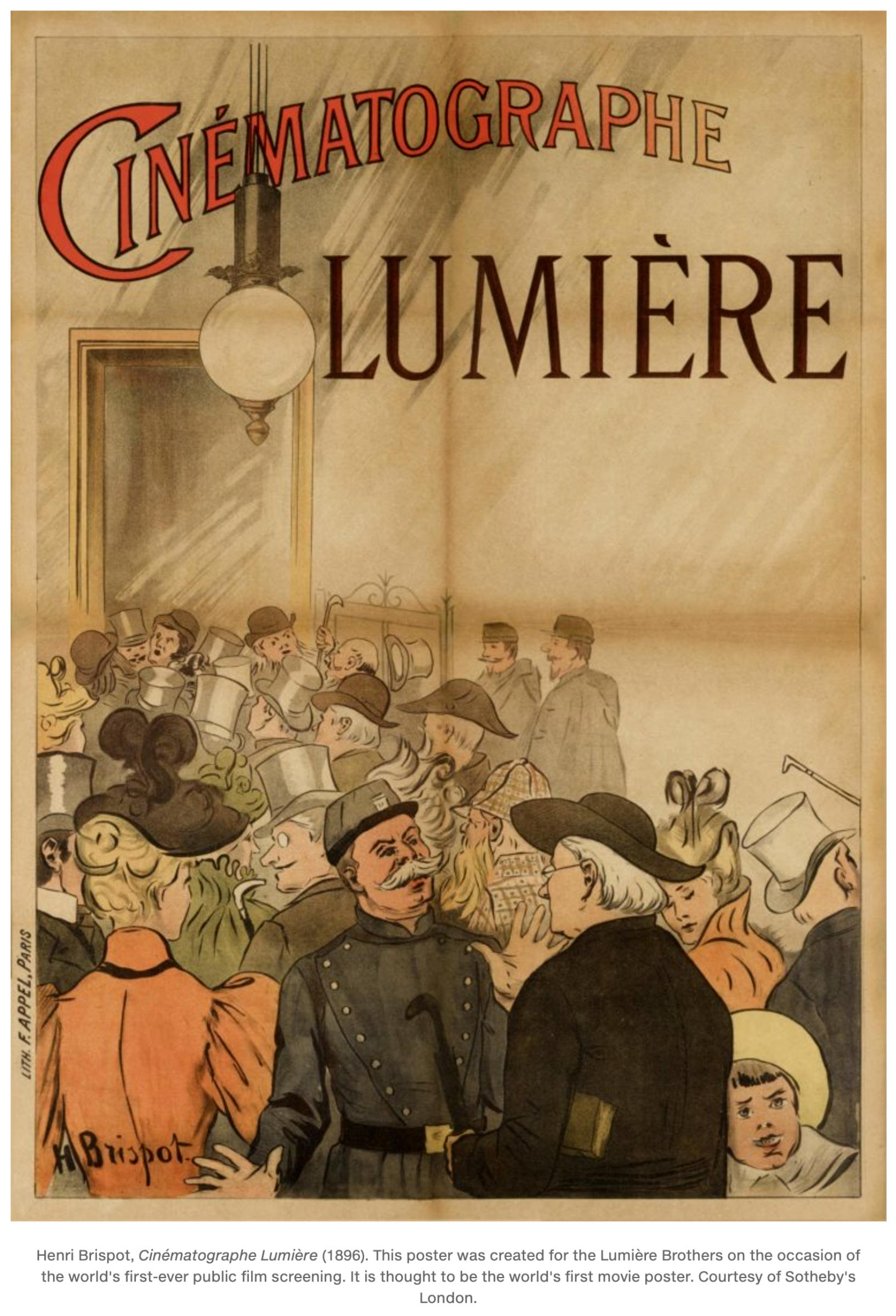
First Movie Poster – 1896

Toronto. In North America, we usually think of Thomas Edison when considering that aspect of history. In Europe, credit is usually given to the Lumière brothers of France (of Autochrome fame).

Actual work on motion predates photography when mechanical devices were designed to show motion. The first use of photography to study motion is attributed to Eadweard Muybridge, an English photographer.

Today, we seldom think about the impact of movies on society given the internet, smartphone videos, and television. However, the grammar of movies was created last century based on the even earlier grammar of live plays. As motion pictures evolved, their  grammar has infused television. Movies rapidly ate up plays, books, short stories and ideas as weekly fodder to generate the material demanded by theatre audiences.

The illustration above is the very first known movie poster (1896) created for a presentation that almost no one attended. Today, thanks to institutions like Ted Turner’s Turner Classic Movies (TCM), the rich production of California’s Hollywood last century can be viewed and assessed for its realism vis-a-vis the source material and modern day television serials.

My thanks to good friend George Dunbar for sharing this piece of photographic history with me.

Posted in history | Tagged , , , , , | Comments Off on the invention of movies

controlling depth of field

a 9 leaf iris diaphragm c1970

Toronto. As a general rule, the longer the focal length of a lens, the smaller its maximum possible f/stop and the less its depth of field. Conversely, the shorter the focal length, the greater the depth of field and the larger its maximum possible f/stop can be. The human eye has a relatively short focal length and a very wide depth of field making almost everything you see in focus – especially in sunlight when the iris closes to help limit the light intensity hitting the retina.

Smartphone cameras also have short focal lengths. My older smartphone has a camera lens of 3.3mm f/2.4 (equivalent to a 35mm lens in angle of view). Newer models have a lens equivalent to a 28mm lens and its wider angle of view and even greater depth of field.

Once photographic lenses increased in speed, a fixed Waterhouse stop was generally used to increase the depth of field (and reduce the light hitting the sensitive media). A slot in the lens barrel was used to slip the Waterhouse stop between the lens elements. Different Waterhouse stops were made available to adjust depth of field.

When iris diaphragms became common place, Waterhouse stops disappeared and the issue was the number of leaves used. The more leaves that were used, the more expensive the diaphragm was to make and the rounder the tiny aperture became. Aperture shape  affected the bokeh of the lens.

Posted in history | Tagged , , , | Comments Off on controlling depth of field