and who might you be?

Who is She?

Toronto, … asked my wife’s 90+ year old aunt many years ago.  The image at left was recently developed. It was from an exposed roll of film (from a bulk roll) exposed in the 1930s Leica IIIa. The film was in a Leitz brass cassette that was likely purchased some years ago, possibly with the IIIa.

As the BBC recently stated, “Camera collector William Fagan obtained a number of film cassettes some years ago, when he bought a Leica IIIa.” Assuming the photo was taken in Europe before WW2, the lady would be over 100 years old today. Perhaps she became a mother and grandmother, then her children or grandchildren may recognize her.

Visit the BBC site for the story and more photos of the trip to Switzerland and Italy. Let us know at info@phsc.ca if you do recognize the photo – no reward, just the satisfaction of helping solve a mystery.

My thanks to two friends and PHSC members – George Dunbar and Russ Forfar. They both took the time to alert me about this story.
 

Posted in history | Tagged , , , , | Comments Off on and who might you be?

amping it up

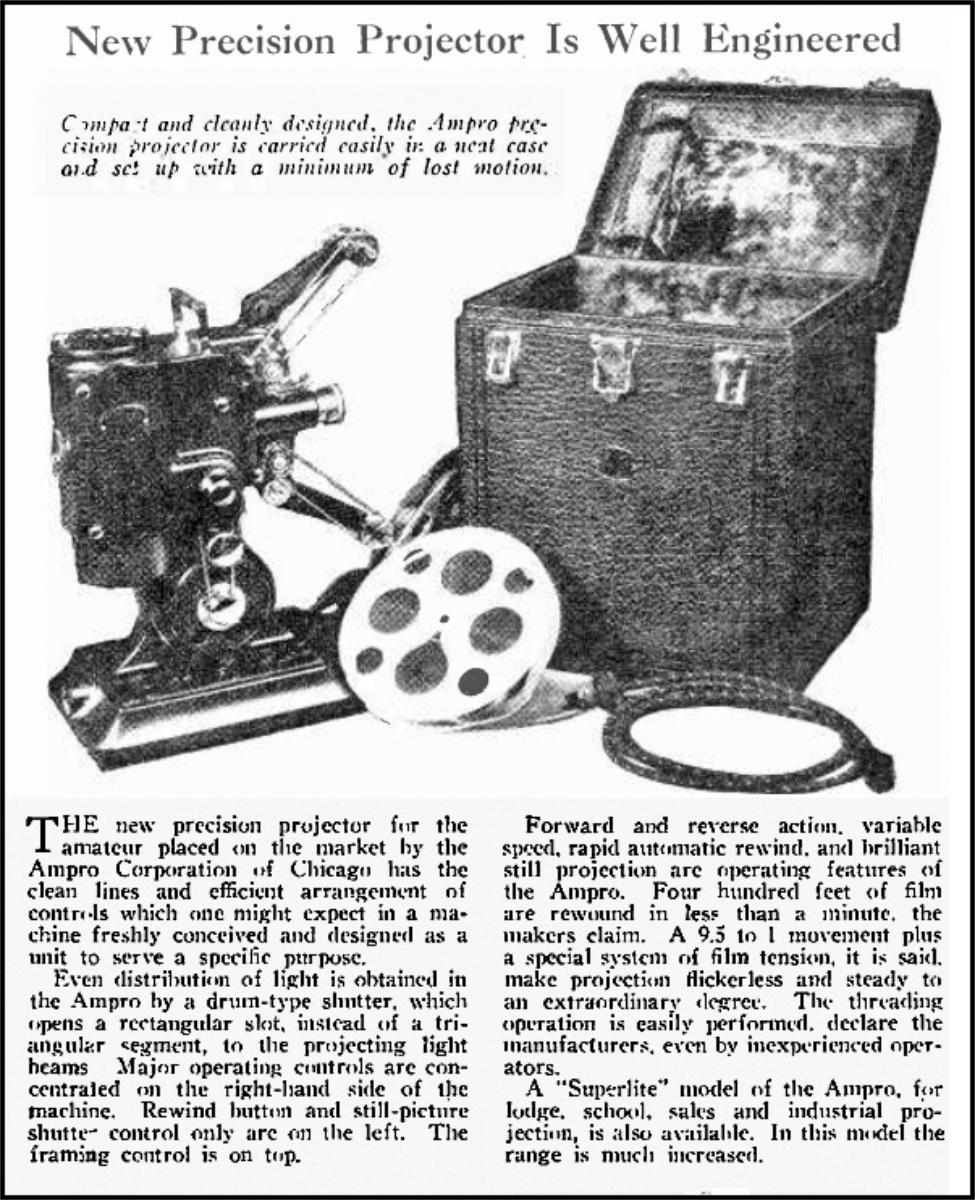
1930 article on an Ampro projector

Toronto. When I was a school kid in grades 7 and 8 a few years after WW2, I was also an occasional  projectionist for junior classes. We showed 16mm educational movies on (to me) a massive Ampro 20 sound projector.

To my delight, I received a note from my good friend George Dunbar that included an article from the August 1930 Science and Industry magazine on an Ampro projector.

Reading it, I was thrilled to recall my experiences as a kid showing junior classes the B&W sound educational movies of the day. I remember once turning the projector’s lens out so far it dropped into my hand and from there to the concrete floor, cracking one element.

A few weeks later, a rather annoyed school principal (he was also my grade 8 teacher) showed me the repair bill for the lens – $10. While a pittance today, it was a sum representing a few days pay in those post war years.

Posted in history | Tagged , , , , , , , | Comments Off on amping it up

quite a mouthful

Stubner mouth operated cable release. MQUOO – 14084 Leitz cable code

Toronto. In the 1950s, the German company Stubner (or Stuber – did he work for Leitz?) made these cable releases. When sold by Leitz for the Leica, they were signed Leitz on the raised button and a 10 inch cable release for screw mount cameras was included. The Leitz cable code for this mouth release and the associated shutter release cable was MQUOO and later 14084. The tiny accessory allows one to snap a shot off by mouth, freeing up a hand. It was intended to stabilize exposures but proved helpful to the handicapped as well.

In April of 1982, Alex Thomas gave me the piece shown, as a gift. “The Leica version is marked as Leitz”, he said. “This one has no markings but appears identical to the marked version”. Actually, the earlier ones were signed Leitz and had rounded/pointed ends instead of flat ends. At the time I knew Alex, he was both a PHSC member and a fair attendee. He had a store in nearby Orchard Park, NY.

According to Hove, the MQUOO was made in 1954. Jim Lager also states it was made in 1954. Both my 1960 catalogue and my 1955-58 catalogue reprint by Hove list it while my 1933 and 1936 catalogue reprints do not. It is mentioned as for the screw mount cameras yet it was sold when the M3 arrived. Morgan and Lester’s Leica Manual (13th edition, 1955) mentions it as for all but the M3 (page 33 photo) but it isn’t in the index. Stuber/Stubner seems to have disappeared as far as the internet is concerned.

Posted in history | Tagged , , , , | Comments Off on quite a mouthful

silver and glass

Silver and Glass – click on photo to see article

Toronto. George Dunbar came across this article on Kodak’s work on films and lenses. It appeared as the article “Brains of Sliver — Eyes of Glass” in the April 1930 edition of Science and Invention magazine.

The article covers Kodak’s research into film and lenses and its contribution to Kodak’s famous little VP cameras. The film is the now notorious Nitrate (nitro-cellulose) based film while the huge lens is said to be the largest ever ground in the USA. The lens, for the Army Air service, was likely for use on  an aerial camera, perhaps used to map enemy terrain just over a decade later in WW2.

Posted in history | Tagged , , , , , | Comments Off on silver and glass

Photographic Canadiana Vol 46-4

Gundlach Shutter in PC Vol 46-4 pdf version

Toronto.I hope you have enjoyed the coolish evenings this fall (November was mixed cold and windy to spring-like). Yesterday, members WITH an email address received another delightful magazine via pdf. It  is  the Photographic Canadiana 46-4 dated December 2020 – January 2021.

This is another 26 page delight in full colour as  envisioned by editor Bob Lansdale to help create the excitement we all feel as we await an end to the rotten  pandemic which has dragged its heels all year. As this is definitely a weird year we are doing more than 4 issues. Editor Lansdale is working with our printers to print and package the entire Vol 46 for those few members sans an email on record or wishing to have a hard copy.

Drop me a line at info@phsc.ca if you are a member and haven’t received this special pdf edition. Not a member? Easy-peasy, just break out your plastic (VISA, MasterCard, etc.), follow the rules at the upper right of this page and sign up via PayPal (no PayPal account needed – we will pay the modest fee). Membership is an incredible bargain. Period!

Posted in journal | Tagged , , , , , | Comments Off on Photographic Canadiana Vol 46-4

every one should have one …

Leitz CEYOO (left) and CTOOM in original Leitz boxes

Toronto. … said the late Ted Shepherd. So I agreed to buy his flash gun (CEYOO) with its folding plastic base (CTOOM) at our November 21, 1978 meeting in the NorthYork Public Library. A few days later, I sent a cheque for $7.50 off in the mail. At the time of the sale, Ted was president of the Toronto chapter of the PHSC.

Later on, I bought other flash guns and brackets, including the boxes and test light shown here. The CTOOM held the flash to the side of a Leica. The CEYOO flash took #5 bulbs (or smaller with an adaptor). A folding metal “fan” reflector was removable to make the flash more compact when not in use. The CEYOO was sold before inexpensive electronic flash became common-place. The synchronized shutter speed was slow with regular bulbs. Special FP (focal plane shutter) bulbs had a longer burn period and allowed a faster speed to be used.

Both flash and bracket are well made and solid – typical Leitz. The CEYOO used a 22.5v battery (modern batteries are a bit too thick apparently) and a capacitor  (replacement was once available from Leitz) allowing shots even with a nearly exhausted battery. In later years the CTOOM was metal, not plastic. The CEYOO flash was sold throughout the 1950s while the bracket was sold a few years later and lasted to about 1963 in the retail shops. Without a bracket, the flash was mounted on top of the Leica in its accessory shoe.

The photo (and those of many earlier posts) was taken with an Apple iPod Touch (8 mp) equivalent to a 35mm lens under a wide spectrum LED light.

Posted in history | Tagged , , , | Comments Off on every one should have one …

what’s in YOUR collection?

PHSC member interest form

Toronto. When the PHSC was established back in 1974 the majority of members were camera (and lens) collectors.

While many collectors had an eclectic taste, others collected by maker (eg. Leica, Zeiss, Ernemann, Kodak, etc.), or by date or price or style, etc. Truly devoted collectors rose early each weekend to browse garage sales, bought tables at fairs, attended photographic auctions and societies. Once cherished items were sold when ones in better condition were discovered, or interest in an item waned.

To write articles and select speakers of interest to most members,  an interest form was prepared and later modified (the modified form is shown here).

Two decades later, about 15% of our members collected images. Today this has grown even more. Members also collect ephemera, books, studio items etc. Many current members are actively interested in photographic history, especially Canadian which tends to get overwhelmed by far louder interests in our world.

With the advent of digital, collecting cameras (other than truly rare, high end, etc.) has fallen by the wayside. Today, our members tend towards professionals in the industry, historians, students of photography, and collectors of images. Attendees at fairs look for vintage gear, things to expand a growing interest in film, things to furnish studios and augment user equipment – especially lenses and useable but older digital cameras.

NB. The title of this post is a riff on the very popular tag line “What’s in your Wallet?” used by the American company, Capital One, to flog credit cards in the States  and Canada.

Posted in history | Tagged , , , , , , , | Comments Off on what’s in YOUR collection?

what the deuce is a duex?

Kodak Duex c1940

Toronto. In the days of film, Kodak was well known for its many inexpensive cameras. Kodak made its money by the sale of film and other materials. The cheap but sturdy cameras were great film burners! This inexpensive camera was only made in 1940-42. By swapping a front plate it could say “MADE IN U.S.A.” or “MADE IN CANADA” as this one does.

The Duex uses 620 film and has an f/11 doublet lens mounted in a bakelite helical telescoping front. This example is courtesy of member Mark Singer, who collects cameras badged as Kodak Canada, and as made in Canada or Toronto. Mark brought this one – complete with its original box – to our 2019 Show and Tell meeting last December (before this nasty pandemic hit us in full force closing the Memorial Hall).

The little Kodak was also mentioned in our Journal Vol 38-2 when it was part of a story of Stan White and his collection.

Posted in camera | Tagged , , , , | Comments Off on what the deuce is a duex?

when photography was deadly

Kodak Safety Film

Toronto. Have you ever wondered why the historic old movie films were so hard to find? And why archives like the Turner Classic Movies (TCM) preface really old films as “remastered” from pieces found at various other archives?

At the beginning of the last century, the base for film material – movie and still – was the dangerous Nitrate film. It was attractive for its high optical quality and clarity. Unfortunately, this film proved highly unstable in archives and tended to ignite by spontaneous combustion. Fortunately it gave off a strong acetic acid (vinegar) smell as it disintegrated before bursting into flames and burning with highly toxic fumes.

Mid last century a shift was made to so called safety or Cellulose acetate film which didn’t suddenly burst into flames. Since old films were shot on Nitrate film, it was less costly to abandon them rather than remaster them on safety stock. Some WW2 surplus film was Nitrate too and would slowly disintegrate and give off a strong odour of vinegar warning any would be photographer.

During the pursuit of film history, my friend George Dunbar came across this article in the August 1929 issue of Science and Invention. The article recounts a disaster at a Cleveland Hospital in May of 1929 where x-ray film caused a fire with toxic fumes killing members of both the patient body and staff.

Posted in Uncategorized | Tagged , , , , , , | Comments Off on when photography was deadly

Amalgamated Photo History Newsletters

Amalgamated Photo History Newsletters 1-6

Toronto. We issued the 6th in our series of exchange newsletters recently (since we are unable to hold our regular monthly meetings, members received this pdf version of the amalgamated newsletters from our exchange members who gave their blessing for inclusion in this venture. In this case it is the “Re-Union Issue of Cascade Panorama”.

“In October 2010, editor Ralph London of the Cascade Photographic Historical Society assembled a Re-Union Issue of his Cascade Panorama newsletter which had last published in December 2003. It was a most interesting issue bringing together great authors and stories that needed to be told.”

I hinted these packages were coming for members, ” … we elected to compile other material in pdf files ready to send to members IF they supplied an email address AND had a fast enough internet connection to receive the 2 – 10 mb or so pdf files. …”.

Well, the Volume 1-6 file (4.8 MB) went out last Saturday, November 21. If you didn’t get it but you do get our newsletters, drop me a note (news@phsc.ca). I will verify you are a 2020/2021 member and send off a copy. If you are a current member and didn’t see a copy, please check your junk folder. This and all other specials will only be sent to paid members. Not one yet? No big deal – pull your plastic and use the PayPal set up at the top right of this web page. Note that we will continue to send our PHSC News to all who are on our MailChimp list – PHSC member or not.

Posted in activities | Tagged , , , | Comments Off on Amalgamated Photo History Newsletters