
About the Posts
ABOUT THE POSTS
While we try to follow the Society (PHSC) mandate and by-laws, the opinions of each post reflect those of the writer and not necessarily that of the Society (PHSC) or its executive.MONTHLY MEETINGS
Usually 3rd Wed – Sept through June by ZOOM/EventbriteMAIL ADDRESS
666 Burnhamthorpe Road Box 11703
Etobicoke ON Canada M9C 2Z0
Social Media


EVENTS
-
Membership - Join or Renew! OR DONATE
-
Membership - January 1st to December 31st.
Annual General Meeting (AGM) is each December Meeting. -
Select "Join Annual $35" for all addresses
Select "Join 3 Year $100" for a three year membership to any address.Select "Renew Annual $35 for all addresses
Select "Renew 3 Year $100" for a three year membership to any address.Use the blue bar if you have a PayPal account. Use the black bar with a debit or credit card
Please go to MEMBERSHIP above for forms and state if your membership is NEW or RENEW
- Other Amount
-
-
DONATION: Donate $50 or $100 or any other amount (please specify in the Other Amount: box above).
-
-
DONATION: Skip PayPal and go right to us on the Canada Helps website - just follow the instructions.
-
… or use this MAIL IN form to join/renew/donate!
 Click the above icon to download the form and mail a copy with your cheque. You can include your donation with the join/renew form too.
Free PHSC News
Would you like our free newsletter in PDF format every month? Just send your email address to info@phsc.ca using the subject “news” and we will add you to our MailChimp list.
D-Day Anniversary UPDATED – PASS IT ON
Editor Lansdale has done much research on the D-Day Landing movies. He first published his results in the Photographic Canadiana issue 43-2. He has since expanded the material. Click here to download a PDF version and feel free to share it with friends and news media.
PHSC EVENTS
January (February) Auction (HELD)
February 15th (Sunday) 2026
Legion Hall #101
3850 Lake Shore Bl West
Toronto ON M8W 1R3
May Auction
May 3rd (Sunday) 2026
Legion Hall #101
3850 Lake Shore Bl West
Toronto ON M8W 1R3
Spring Fair
MAY 24th (Sunday) 2026
(week AFTER Victoria Day)
Trident Hall
145 Evans Ave
Toronto ON M8Z 5X8
Trunk Sale
JULY 13th (Sunday) 2025 (HELD)
Outdoors
Trident Hall
145 Evans Ave
Toronto ON M8Z 5X8
Fall Auction
NOVEMBER 9, (Sunday) 2025 (DONE)
Legion Hall #101
3850 Lake Shore Bl West
Toronto ON M8W 1R3
Fall Fair
OCTOBER 19th (Sunday) 2025 (DONE)
Trident Hall
145 Evans Ave
Toronto ON M8Z 5X8
-
Recent Posts
Recent Comments
Archives
- May 2026
- April 2026
- March 2026
- February 2026
- January 2026
- December 2025
- November 2025
- October 2025
- September 2025
- August 2025
- July 2025
- June 2025
- May 2025
- April 2025
- March 2025
- February 2025
- January 2025
- December 2024
- November 2024
- October 2024
- September 2024
- August 2024
- July 2024
- June 2024
- May 2024
- April 2024
- March 2024
- February 2024
- January 2024
- December 2023
- November 2023
- October 2023
- September 2023
- August 2023
- July 2023
- June 2023
- May 2023
- April 2023
- March 2023
- February 2023
- January 2023
- December 2022
- November 2022
- October 2022
- September 2022
- August 2022
- July 2022
- June 2022
- May 2022
- April 2022
- March 2022
- February 2022
- January 2022
- December 2021
- November 2021
- October 2021
- September 2021
- August 2021
- July 2021
- June 2021
- May 2021
- April 2021
- March 2021
- February 2021
- January 2021
- December 2020
- November 2020
- October 2020
- September 2020
- August 2020
- July 2020
- June 2020
- May 2020
- April 2020
- March 2020
- February 2020
- January 2020
- December 2019
- November 2019
- October 2019
- September 2019
- August 2019
- July 2019
- June 2019
- May 2019
- April 2019
- March 2019
- February 2019
- January 2019
- December 2018
- November 2018
- October 2018
- September 2018
- August 2018
- July 2018
- June 2018
- May 2018
- April 2018
- March 2018
- February 2018
- January 2018
- December 2017
- November 2017
- October 2017
- September 2017
- August 2017
- July 2017
- June 2017
- May 2017
- April 2017
- March 2017
- February 2017
- January 2017
- December 2016
- November 2016
- October 2016
- September 2016
- August 2016
- July 2016
- June 2016
- May 2016
- April 2016
- March 2016
- February 2016
- January 2016
- December 2015
- November 2015
- October 2015
- September 2015
- August 2015
- July 2015
- June 2015
- May 2015
- April 2015
- March 2015
- February 2015
- January 2015
- December 2014
- November 2014
- October 2014
- September 2014
- August 2014
- July 2014
- June 2014
- May 2014
- April 2014
- March 2014
- February 2014
- January 2014
- December 2013
- November 2013
- October 2013
- September 2013
- August 2013
- July 2013
- June 2013
- May 2013
- April 2013
- March 2013
- February 2013
- January 2013
- December 2012
- November 2012
- October 2012
- September 2012
- July 2012
- June 2012
- May 2012
- April 2012
- March 2012
- February 2012
- January 2012
- December 2011
- November 2011
- October 2011
- September 2011
- August 2011
- July 2011
- June 2011
- May 2011
- April 2011
- March 2011
- February 2011
- December 2010
- October 2010
- September 2010
- February 2009
- August 2008
Categories
Meta
Links of Interest
 Stan White – Poems & Photos


 Mise Au Point – sur la photographie Quebecois
PHSC News for December 2020
its show and tell time!

ring a bell?
Toronto. The PHSC has two events at its December 2020 meeting via ZOOM. First is a brief status report at the AGM by our president Clint. This will be followed by a Show and Tell which is traditional for December.
Details are all in our PHSC News newsletter for December. If you aren’t on the list (and just why not?) then we will have it up on this site early Saturday. If you want to join us as an attendee (it’s free) then use this Eventbrite link.
We have some contributors now, but would like to have more. Check out the latest December newsletter for details. I will forward all messages on to Celio who will be organizing the list.
Bert Hoferichter 1939 – 2020

The late Bert Hoferichter by Robert Lansdale
Toronto. I was sad to hear that Mr Hoferichter of Mississauga died recently in Alliston where he last lived. Bert owned and ran a studio for decades down in Port Credit (Mississauga). He joined Humber College some years ago, teaching our current president amongst others.
Photographer Norbert Bert Hoferichter died this past Sunday, December 6th. You can join in on a ZOOM tribute this coming Saturday. Details are included in his obituary at the Drury Funeral Centre.
Bert was also a member of the PPOC and was the subject of one of the late Marg Lansdale’s columns which was included in her 1997 book. A copy of that column is shown here courtesy of our journal editor, Bob Lansdale. My special thanks to both friends – PHSC president Lewko (Clint) Hryhorijiw and journal editor Bob Lansdale for their contribution to this post.
typewriters and cameras? really?

LIFE magazine ad for a typewriter and camera
Toronto. When I was a kid, a popular saying was that “a picture is worth a thousand words“. In the late 1960s, there were two big ideas in amateur cameras: Super 8 home movies, and 16mm sub-miniature cameras. By then colour photos were a growing portion of films and prints. Film resolution had improved to the point that both super 8 for movies and 16mm rolls for stills were both practical and desirable.
To attract a wider clientele for its portable typewriters, Smith-Corona offered a huge discount on a camera when one bought their electric or manual model. This pp18-19 June 27, 1969 ad in LIFE is typical of the strategy manufacturers of the day used to gain market share: link your product to a non competitive but desirable product at a deep discount. In this case, buy a Smith-Corona typewriter for your student and get a cheap (low end) movie or still camera for a few dollars more.
Within two decades, the typewriter was dead or dying – replaced by the ubiquitous computer. In business, the word processing system replaced typing pools. At home, the computers and printers of the day replaced the personal typewriter. Such is history.
Thanks to my old friend George Dunbar for sharing this ad with me. George spotted it while researching photographic history.
it’s complicated

Ad for Polaroid Colorpak II in Life Magazine
Toronto. Photographic product makers worked hard at besting one another to capture a larger segment of the ever growing amateur photography market. Typical of the strategy was this May 1969 ad in LIFE magazine touting Polaroid.
The ad emphasizes its inexpensive, technically complex, and super easy to use colour camera! While a Polaroid camera may look complex, most cameras of the era – or any era – are just a shutter, an aperture device, a means to focus, a lens, a sensitive media, and a light tight box to keep the sensitive media and the lens the right distance apart.
As Lipinski says in his 1955 book “Miniature and Precision Cameras” about Leitz’s famous camera, “It can safely be said that the Leica mechanism has evolved around its focal plane shutter. There is hardly anything more in it — there is indeed remarkably little inside a Leica anyway.”
My thanks to my good friend and fellow photographic history buff, George Dunbar, for showing me this ad from the May 30, 1969 issue of LIFE magazine.
professional photographer

Daring do of the News Photographer
Toronto. From the very beginning of the art we had studio and landscape photographers. As the art evolved, becoming faster in exposure, simpler in execution, and growing in popularity, the professional focus rapidly diversified.
An example is this 1913 article from “Popular Electricity and World’s Advance”, showing a news photographer taking to the air in an aircraft whose technology was barely a decade old. Scary stuff showing the daredevils of news photography who will take great risks to make a photo for their newspaper.
This post is based on an article emailed to me by my good friend and fellow PHSC member, George Dunbar.
the gang’s all here

Family Photos
Toronto. When Kodak invented their first camera and began marketing it in 1888, for the first time amateurs could take snaps on a roll film and send them elsewhere for processing. In this case sending the exposed film still in the camera and the camera back to Kodak where the roll of film was replaced, the previous roll developed and printed, and prints and camera returned.
By making picture taking easier, the audience for photographic products was expanded and the snapshot phenomenon took hold. Brian Coe wrote a book called “The Snapshot Photograph – The rise of popular photography 1888-1939”. Over time the snaps became more than just a recording of family events and history, but a means to illustrate the evolution of technology, fashion, and even humanity. Today, Facebook considers the most commonly used camera of all is that in the ubiquitous smart phone.
This photograph, thanks to a note from my good friend George Dunbar, is from a 2012 article on the Canada’s History website by Paul Jones titled, “Roots: Understanding Family Photos“. Click on the article link and read what Mr Jones has to say about the family snapshot.
The title of this post is from a 1940s movie of the same name.
All About Enlargers – Part A

All About Enlargers – Part A
Toronto. What do you do when a photograph negative is too small? Enlarge it! You may be surprised to learn that enlarging apparatus came along well before the minicam revolution of the 1930s. In this special members-only supplement (vol 1-6) Part A shows the various devices available to enlarge the existing sensitive materials.
Vol 1-6 was sent out last Friday afternoon to all current members with an email address. If you did NOT get a copy, please email me at info@phsc.ca and I will send you a copy after verification of your membership. Not YET a member? well, for heaven’s sake! Grab your plastic and register via PayPal on the upper right of this page!
Stated in the supplement, “The advertisements and illustrations in this supplement originally appeared in the The Photographist numbers 109 and 110, the journal of the Western Photographic Collectors Association (WPCA) in 1996. The WPCA was affiliated with the University of California Museum of Photography and stopped publishing circa 1996, going into dissolution in 2001. For the story of the history of the WPCA, see the article in Special Supplement Vol. 1 No. 1.
“In an effort to make this material available to collectors, historians and those interested in the history of photography, this content was digitized by the Photographic Historical Society of Canada (PHSC) and Milan Zahorcak from the U.S. in 2019 and 2020 for distribution to PHSC members as a seven part series. The first instalments were about magic lanterns, posing chairs, flash lamps and the last will finish a two-part presentation on early enlargers. If you have any questions or would like higher resolution scans of any of the images, please contact the PHSC at info@phsc.ca.”
THINK … small

micro-ipso without the cable release or 10x eye piece
Toronto. Decades ago, people said that to get ahead, one had to think big! IBM even had a catch phrase – THINK. Years later when I worked in a data centre, IBM folk could get these IBM signs in capital white sans-serif letters on a blue background.
One of the earliest applications of photography was in the scientific laboratory. Scientists used the art to capture the powerfully magnified images they saw in the eye piece of the microscope. Jabez Hogg who wrote a massive primer on microscopy (15 editions from about 1850 – 1900) eulogized its virtues – until he learned a fee was charged to use daguerreotype technology in England (Daguerreotypes had the best resolution available at the time).
Later, microscope makers sold small field cameras and supports to record these amazing highly magnified images. Decades later when minicams became popular, camera makers made accessories to connect their products to microscopes. Leitz brought out a line of accessories called “micro-ipso”. This series of adaptors used a funnel-shaped tube to adjust the camera type and distance. A leaf shutter was included to avoid the motion effect of focal plane shutters on highly magnified images. A tiny telescope ensured both camera and microscope were in sharp focus simultaneously. A double cable release moved the focussing prism out of the way before the shutter operated.
The adaptors connected still and small movie cameras to a microscope. Leitz included a 10X periplan (flat field) eye piece to fit the microscope. Nowadays video cameras and monitors replace all this gadgetry. Scientists and audiences can view the monitor and focus, move, or even change the 1×3 inch glass slides holding thin layers or complete specimens.
niner, niner, this is ZOOM
Toronto. We held our nineth COVID-19 inspired exec meeting via ZOOM (This is beginning to feel like normal). Thank you Celio for arranging the meeting once again. Key changes are shown below. Toronto is in RED (Lockdown) at present as we see the second wave of COVID-19. ALL live events are cancelled at least until 2021. Our monthly meeting venue (North York Memorial Hall) is closed to events by the city until at least December 31, 2020. We now hope to do meetings beginning December 16 via video. Stayed tuned.
PHSC News goes out shortly for December. Sign up at news@phsc.ca for a free pdf copy. Members get specials plus the journal via pdf. Contact me if you are a member and HAVE NOT seen the pdfs. Some members have unsubscribed to MailChimp; some emails are invalid; and others have no email on file with the society. Any questions? Just drop me a note at info@phsc.ca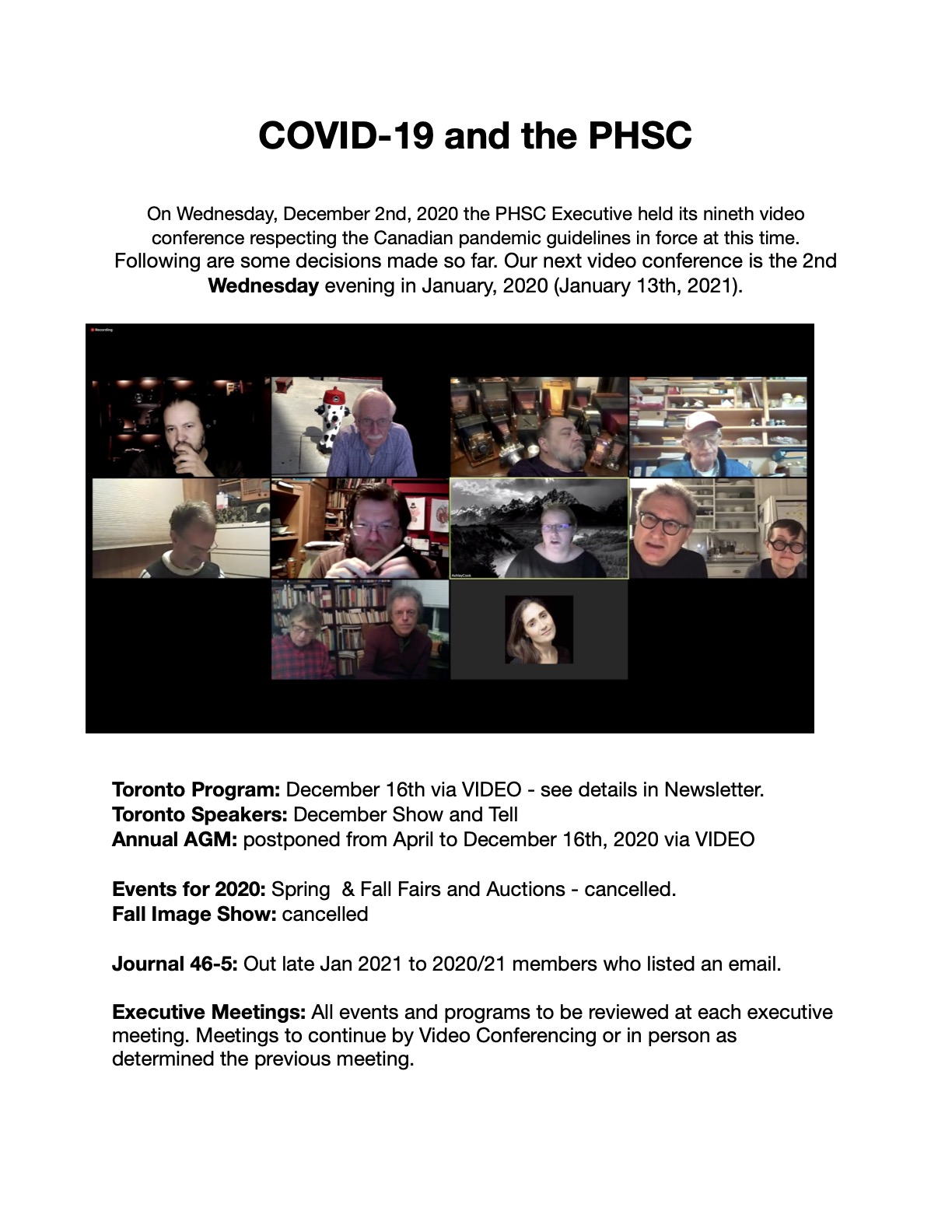

better stick with pen making …
Toronto. Parker Pen decided to branch out to the subminiature camera manufacturing. Never heard of a Parker camera? I’m nor surprised. It’s featured on page 1 of our newsletter this month (top right).
Is this really the last month in 2020 ? The year began with a positive note (in spite of the blustering Mr Trump) but soon became very chilly and ominous with the onslaught of COVID-19. Potential vaccine this month brings a bit of sunshine.
Meantime, our editor extraordinaire, Sonja Pushchak, and her team have composed this latest issue of PHSC News (20-06 – December 2020). Take a moment to read these articles and ease your troubles and cares!
Page 1 riffs on an early Hemingway article with the piece titled.”Canada’s Roof” about the photography of Michelle Valberg. This is followed by a brief tale of the mythical Lilith and the exhibition in the UK in place of the usual PHSC Presents. Page 3 remembers Eaton’s; while page 4 explains the Faraday shield. Page 5 discusses the recent pushback on Toronto’s COVID-19 rules by Adam Skelly in Etobicoke and the potential repercussions. Then David takes a shot at period Nikon SLRs in his Equipment Review, followed by a page with a nickel’s-worth of his web links, this time on WorldPress Photos, animals, and pets.
Page 8 features a poster on the impact of the pandemic and asks for participants to our December S&T via ZOOM. Email me at info@phsc.ca with Virtual Show and Tell 2020 on the subject line, and I’ll pass it on to Celio to include you in his lineup. On page 9, Ivy & Izzy are back, this time to talk about a Mies van der Rohe designed house. And as usual, we wrap up with the ever popular classifieds on page 10. P.S. Every link shown in the newsletter is a hot link just waiting for you to click!
P.P.S. You can visit this issue by clicking here, or by g0ing to the menu item NEWSLETTER at the top of the page. There is a drop down menu that takes you to older issues dating back a couple of decades to the very beginning.