that Kodak girl again …

a new twist on the Kodak girl – a LIFE ad for colour film …

Toronto. early last century, Kodak used the popular concept of sex to sell – in this case Kodak cameras. It was the rather wholesome ‘Kodak Girl‘ who became the central person in the  Kodak ads of the era. She illustrated how women could succeed in photography simply by using Kodak products, especially the Kodak camera.

Decades later, this ad was used to promote Kodak Kodacolor-X negative color film in  the Instamatic format. The famous Kodak Girl seems to be a doll sitting on a tiny chair showing the subtle colour shades and picture detail obtained with Kodak products.

My thanks to good friend George Dunbar who spotted this unique Kodak ad on page 9 of the LIFE 1970’s special Christmas issue while busy sourcing items of photographic history as represented by advertisements and articles in LIFE magazine..

P.S. That same issue includes winning photos from the LIFE photo contest of 1970 – take a peek.

Posted in history | Tagged , , , , , , , , , | Comments Off on that Kodak girl again …

premo-nition

Glencoe B camera

Toronto. Around 1979, the late Jack Addison sold me a 4×5 woodie missing its name plate. He thought it might be a POCO camera. Perhaps it was a PREMO? In May or June of 1984, founder and first president of the PHSC (known as PHSoC at the time) published an article on Canadian Camera Manufactures (Photographic Canadiana 10-1).

Recently Brian Hudson, PHSC member and President of the Edmonton club began searching for information on his Glencoe B camera labelled as Made in Montreal by the Canadian Camera Company.

The question is whether the Canadian Camera Company manufactured the camera or imported it from Rochester and re-branded it as a Glencoe B? The photos show a camera remarkably similar to my mysterious 4×5 down to the side plate holder storage door. The late Bill Belier, our president in 1984, and at one time president of a Canadian Photography Import company, mentioned to me that Canadian tariffs made it economically practical to import partly assembled products and finish assembly here. These items were often labelled as “Made in Canada”although the design and parts manufacture were elsewhere. Continue reading

Posted in camera | Tagged , , , , , , , | Comments Off on premo-nition

sad lady, sad song

Evelyn Nesbit 1906 by an unknown photographer

Toronto. Such a pretty portrait; such a tragic situation. The girl is Evelyn Nesbit who saw her husband, Railway scion Harry Thaw, shoot and kill her lover, architect Stanford White, in the Big Apple on June 25, 1906. This portrait, taken about 1903 by an unknown photographer, shows Nesbit in all her beauty at about 19.

Nesbit was born around 1885 and died years after the tragedy in early 1967. She seems to have had a wild and varied life and careers both before and after 1906!

While the name of the photographer has been lost in the mists of time, Nesbit’s photograph is well known. In this example, it  appeared as one of three in the Gallery (pp 7, 8, 9) of the October 16, 1970 edition of LIFE magazine.

My thanks to good friend George Dunbar for bringing this photograph to my attention. George is busy investigating various magazine photos, stories and ads in his pursuit of photographic history.


Posted in history | Tagged , , , , | Comments Off on sad lady, sad song

what’s supp?

PHSC Supplement Vol 2-1 February 2021

Toronto. Did you ever hear of stamp cameras? The PHSA? Northlight? Then you must have started collecting photographic gear and photos after the 1970s. As a member of the PHSC you received a supplement Friday, the 4th on American Postage Stamp cameras.

Vol 2-1 was sent out yesterday afternoon to all current members with an email address. If you did NOT get a copy, please email me at info@phsc.ca and I will send you a copy after verification of your membership. Not YET a member? well, for heaven’s sake! Grab your plastic and register via PayPal on the upper right of this page! And you can donate to the society the same way via PayPal, or go to our Canada Helps entry on the link below the PAY NOW button.

As stated in this supplement, “The NORTHLIGHT was the Journal of the Photographic Historical Society of America (PHSA), once published quarterly. The Photographic Historical Society of America became a formal reality in November, 1973, and the first issue of their journal came out in the spring of 1974 with John S. Craig as editor. Eaton S. Lothrop Jr, Matthew R. Isenberg and Nathan R. Skipper Jr. functioned as the advisory board. Several other societies were involved in the publication: The Ohio Camera Collectors Society, Midwest Photographic Historical Society, Chesapeake Antiquarian Photographic Society and the Western Camera Collectors Association.

“In their first issue, John Craig stated that NORTHLIGHT was destined to become the magazine of photographic collectors and historians everywhere. As the journal of the Photographic Historical Society of America, it was to report in each issue on the activities of affiliated and participating societies in the PHSA and was to provide a calendar of events for these societies around the country.

“Following in this PDF are NORTHLIGHT issues Vol. 6 No. 1, Spring 1979 and Vol. 6 No. 2, Summer 1979. At this time John Dobran was Executive Editor.

“In an effort to make this material available to collectors, historians and those interested in the history of photography, this content was digitized by the Photographic Historical Society of Canada (PHSC) and Milan Zahorcak in 2019 and 2020 for distribution to PHSC members. If you have any questions or would like higher resolution scans of any of the images, please contact the PHSC at info@phsc.ca.

Posted in history | Tagged , , , | Comments Off on what’s supp?

onze or ounce?

Toronto. It could be an ounce of prevention, but it is onze, or eleven in English. We held our 11th ZOOM exec meeting Wednesday evening (its feeling like normal now). Celio deserves a  big thank you for arranging it in spite of his busy teaching schedule at post secondary institutes. We were pleased to have member Brian Hudson, president of the Edmonton Photo Historical Society, briefly attend from Edmonton, Alberta.

Toronto is still in total lockdown once again but daily new COVID-19 cases are falling. ALL live events are still cancelled. Our monthly meeting venue (North York Memorial Hall) remains closed (even to our archivist). We now use ZOOM and EventBrite for Toronto meetings and may continue using them combined with in-person sessions at Memorial Hall when it opens again.

The February issue of our newsletter, ‘PHSC News’,  goes out a week Friday to nearly 1,900  addresses. Sign up at news@phsc.ca for your free pdf copy. Members also get specials plus the journal via pdf. (contact me if you are a member and HAVE NOT seen the pdfs. Some members have unsubscribed to MailChimp; some emails are invalid; and others have no email on file with the society or MailChimp). Any questions? Just drop me a note at info@phsc.ca

The February 2021 executive meeting via ZOOM and some decisions.

Posted in activities | Tagged , , | Comments Off on onze or ounce?

old way of doing it

Synchronex film process ad in LIFE magazine Oct 9 1970

Toronto. In the late 1960s to early 1970s a company called Synchronex Corporation in the Big Apple sold super 8 movie cameras, audio recorders and movie projectors with a twist. Home movie buffs using their products could record sound on a tape recorder while shooting a home movie. The finished film and tape was then sent to Sychronex in NYC were the sound was added to the film in synchronization and the finished super 8 film could be projected on a super 8 projector with sound and the sound and filmed scene would be in perfect sync “just like it’s done in Hollywood”.

This elaborate process disappeared a few years later when sound on super 8 film became common place eliminating the need for a tape recording and the process of synchronization of tape and film. A big thanks and tip of the hat to good friend George Dunbar for spotting this bit of photographic history.

Posted in history | Tagged , , , , , | Comments Off on old way of doing it

you think you have it tough ….

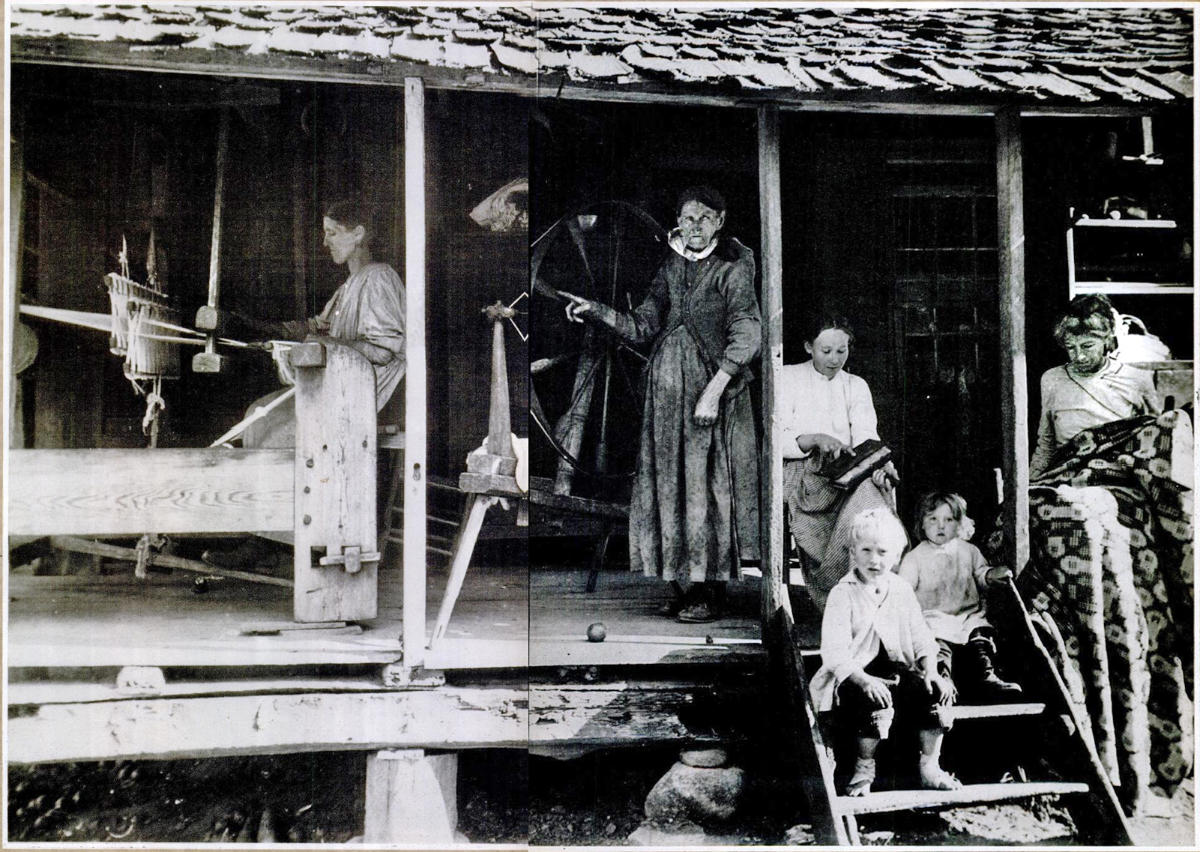
Drudgery of poor women in America c 1914. Photo by William Barnhill via LIFE magazine

. This photograph was taken in Appalachia way back in 1914 by William Barnhill. It shows impoverished women forced to be household drudges and field hands, aging to old hags within a few short years of the heavy labour. To do mundane tasks like converting wool to clothing and linen, they worked with primitive manual machines.

Barnhill did these photographs decades before the FSA undertook the investigation of poverty during the dirty thirties. It appeared in the Gallery (pp8, 9) of the October 16, 1970 edition of LIFE magazine.

My thanks once again to good friend George Dunbar for bringing this photograph to my attention while he continues to investigate various magazine representations pertinent to photographic history.

Posted in history | Tagged , , , , , , | Comments Off on you think you have it tough ….

flowers in the attic

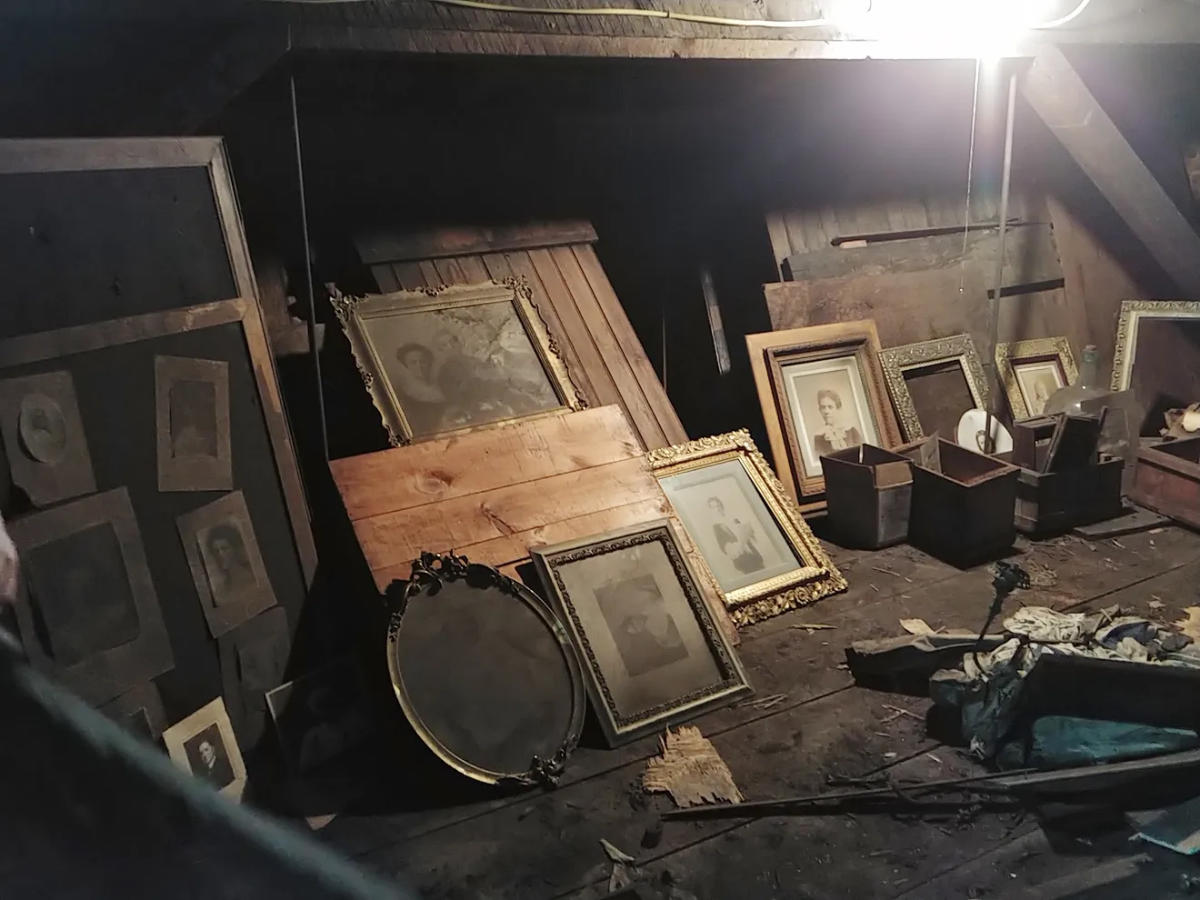
Attic Treasure. Photo courtesy of David Whitcomb via the Daily Messenger.

Toronto. We often (at least I do) think about discovering historic artifacts during renovations, This happened just south of here at Geneva NY. Lawyer David Whitcomb discovered an old photographic studio during renovations to a commercial building he planned to use as his office.

Victoria Freile of the Rochester Democrat and Chronicle reported this exiting find in the Daily Messenger under the title, “Man renovating building in Geneva finds historical treasure in attic“. Or view it here on Artnet courtesy of Harold Staats.

Have a read and think about  possible finds here! Meantime, a big thank you is owed by us to Russ Forfar, a good friend to both me and the PHSC. The title of this post is V C Andrews first book in her Dollanganger series. Note three people have suggested this article to me since it was first published and picked up by other “newspapers” – Russ Forfar, Clint Hryhorijiw, and most recently Harold Staats.

Posted in history | Tagged , , , , | Comments Off on flowers in the attic

a tap in time

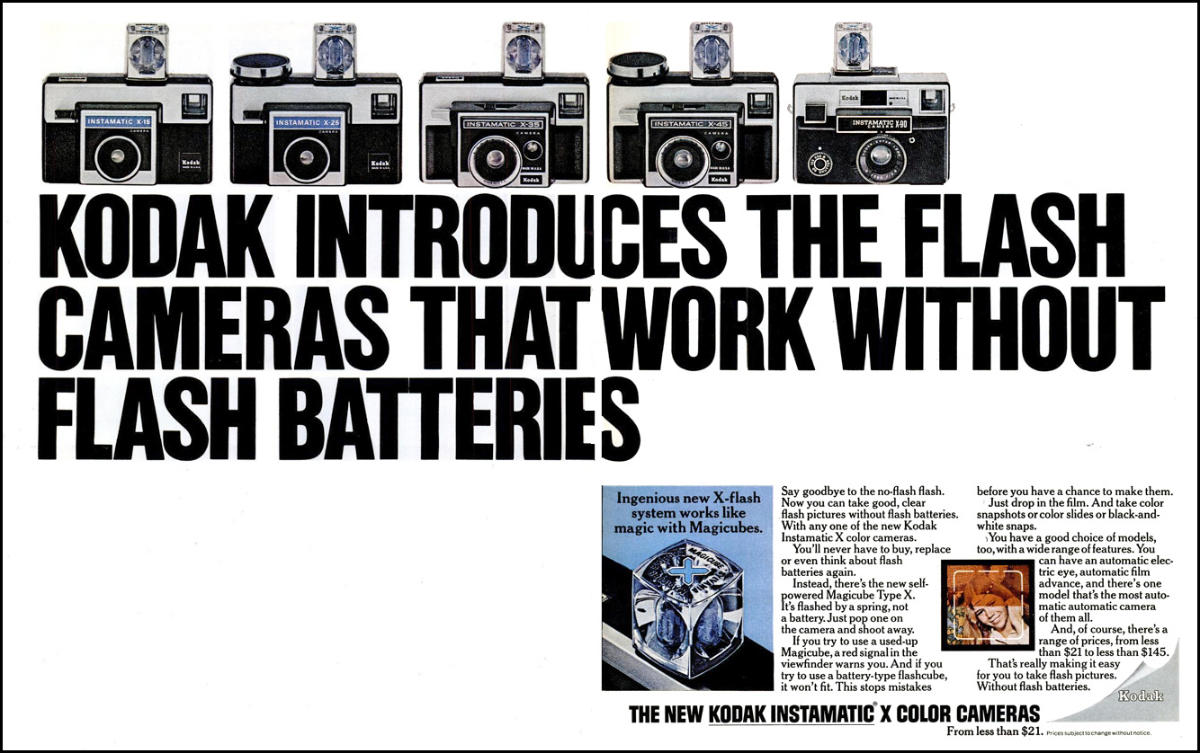
A tap in time saves the snapshot

Toronto. The old Kodak excelled at deciding what problems affected their customers and how to solve them. Ads like this LIFE ad in the issue of September 25, 1970 addressed one problem and silently showed how two others were solved. Drop-in Instamatic film solved the film loading issue while tiny flash cubes meant fewer flash bulbs to carry and customers were able to shoot four fames before changing bulbs.

This ad shows the problem of flash batteries dying while the camera was set aside and how it was resolved. Instead of battery power, the shutter triggered a tiny spring loaded wire that tapped a piezoelectric crystal transforming mechanical power to electrical power and igniting the flash bulb.

Thanks to George Dunbar who suggested this ad showing a revolutionary means to solve the customer’s dead flash battery problem. The title is a riff on that old saying, “a stitch in time saves nine“.

Posted in history | Tagged , , , , , | Comments Off on a tap in time

how about photos in ten minutes?

Taking fast photos before polaroid and smartphones

Toronto. 1941, war-time, and as the lawyers say, “time is of the essence”. Traditional photography took hours or days between the taking and the viewing of the results. But how do you get the results taken, and then viewed many many miles away just in a few minutes?

Trust the Americans to figure out a way! This article in the May, 1941 issue of Electronics magazine shows how a combination of military aircraft, high speed processing, special paper and radio facsimile combine to take and transmit military images to far away control centres in just a few minutes.

This was long before digital technology in smartphones made sub second transmission of high resolution colour images next door or around the world so simple a child could (and often does) do it. Ah! tempus fugit (as the Romans once said)!

And thanks to friend, PHSC member, photo historian, and very active retired industrial photographer and videographer, George Dunbar for sharing this remarkable bit of sleuthing.

Posted in history | Tagged , , , , , | Comments Off on how about photos in ten minutes?