enough already!

a surprise in contest entries

Toronto. Do you remember the days of photograph contests? Pictures were snapped on film, prints carefully made, and the hopeful shutter-bug mailed his/her pride and joy(s) to an address for assessment by a professional photographer – or a committee of them.  I think most photo contests at the time attracted enough entries. to satisfy the judge(s).

In the very late 1960s, I entered one such contest and won twice – first for a portrait and third for animals. The prize money bought me a new exposure meter back when CdS cells were the big event allowing exposure meters to be made that could read very dim light settings for those with a tripod.

However; in 1971 when LIFE magazine ran its latest contest, it was overwhelmed with entries and had to announce on page 3 of the April 16, 1971 issue that entries (over 100,000) were at least triple the estimate and this would result in the delayed announcement of winners, but they would still be published in 1971 (and the winners were published in a ‘double’ issue on the very last day of 1971).

My thanks to good friend and associate for spotting this item while researching magazine articles and advertisements for items of historical interest.

Posted in history | Tagged , , , , | Comments Off on enough already!

the power of networks

Canadian Camera Company ad

Toronto. To be a successful editor, one needs many talents – originality, devotion to subject, willingness to share, open to ideas from others, good English, and networks. Fortunately, our own editor, Bob Lansdale has all these talents including a world-wide network of like minded souls willing to assist Bob on all difficult issues.

On February 6th, Edmonton member Brian Hudson had questions on the company that built/sold his Glencoe camera and asked us for help. Bob Lansdale did a vigorous search but lacked access to Montreal street guides so he threw out a wide call across his network via the internet.

The result was an astonishing amount of information. Member Dr Irwin Reichstein up in Ottawa provided a detailed look at the company when first incorporated in Montreal, then relocated to Toronto and later filed for bankruptcy. Others noted they had such cameras in their collections. David Mattison in BC sent along a link to a site called antiquephotographica.info which included this bit on US Patent 684221.

This added information on the Canadian Camera Company resulted from Bob’s use of his network – enough for an article in our journal, hopefully. (Who knew that the June 1899 “Rod and Gun in Canada” had an Amateur Photography section [pp146, 7] and especially that the magazine devoted a few paragraphs to the move of the Canadian Camera Company to Toronto? Fortunately Dr Reichstein discovered this and shared it. Well done, Irwin!)

Posted in activities | Tagged , , , , , , | Comments Off on the power of networks

customer focus

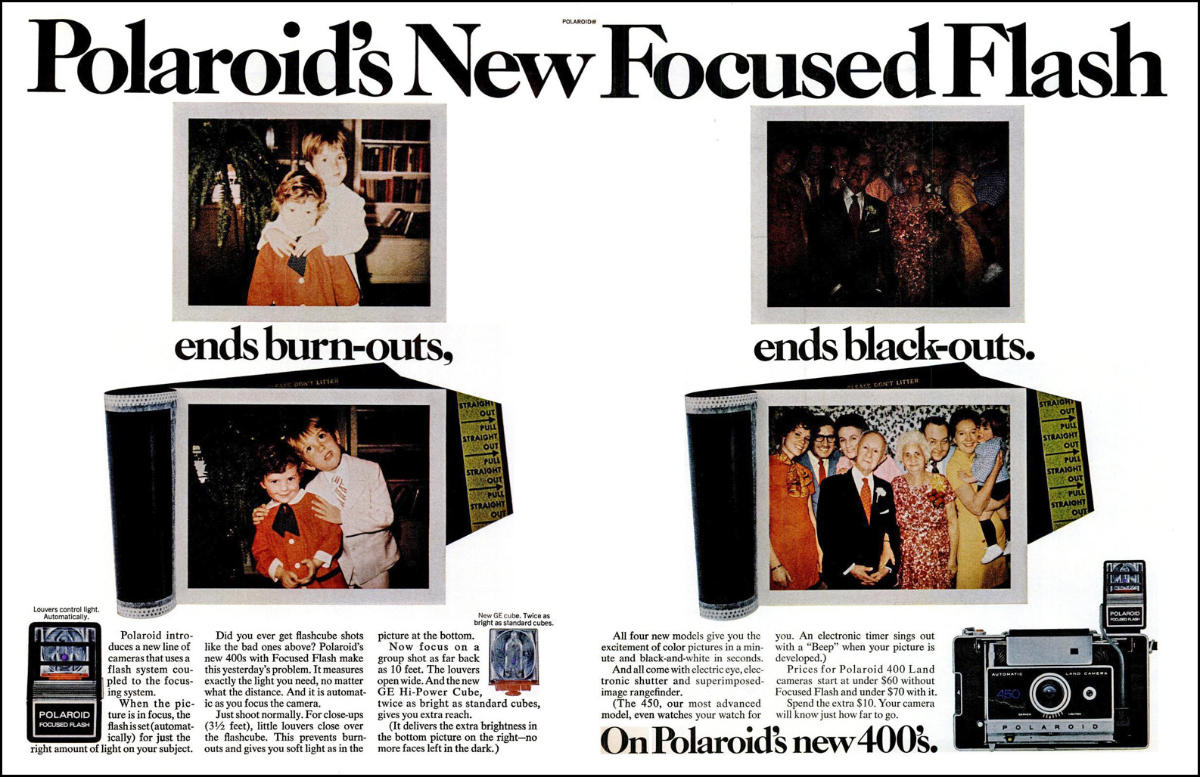
April 2, 1971 LIFE ad showing Polaroid’s solution in its 400 series cameras

Toronto. Successful companies in any industry make changes based on customer focus. That is, how do we change our products to solve pressing customer issues? Polaroid was one such company as shown in this April 2nd, 1971 spread on pages 32 and 33 in LIFE magazine.

Polaroid cameras were famous for their combination of technology and simplicity. The cameras used Polaroid film which fuelled its profits. Customers (hopefully) bought dozens of film packs for every camera bought.

In spite of its technology and simplicity, flash prints by average customers showed blown out highlights in moderate close-ups and deep dark shadows in more distant shots. The solution was two fold. First, work with companies like GE to make brighter flash cubes and second, control the amount of light hitting the subject.

To do this, Polaroid developed a camera series that used a venetian blind style shutter over the active face of the flash cube, and linked it to the focus scale so the closer the subject the more the ‘blind slats’ closed reducing the amount of illumination. And at the low end of the line one model had no flash bulb shutter for those who  felt such detail was unnecessary.

Thank you, George Dunbar, friend and fellow PHSC member for showing me this innovative bit of photographic history.

Posted in history | Tagged , , , , , , | Comments Off on customer focus

have camera, will travel

Rollei 4X4 Replica courtesy of Collectors Weekly

Toronto. A collector down in Sao Paulo, Brazil, Mcheconi, wrote about his find some eight or so years ago – a giant baby Rollei.  The oversize camera served as a promotional object and advertisement for the famous Rollei brand. Mcheconi’s article, “1930’s Giant Baby Rolleiflex 4×4 Promotional Replica” appears on the Collectors Weekly website.

For years it had a place of preference in a store window of a camera store in Rio de Janeiro. The writer tells of its construction and history, from manufacture by Rollei in Germany to its home in Brazil.

If you happened to have visited our Show and Tell back in December 2006, you may remember seeing Shelton Chen’s display of dummy cameras and cut-aways. Shelton owns Hit Camera here in the big smoke. At one time giant replica’s were a way to flog camera models.

Thanks to friend and fellow PHSC member, Russ Forfar, for suggesting this item and showing me the article link. Note that the title of the post is a riff on the 1950/60 TV and radio series, “Have Gun, Will Travel“, featuring Richard Boone on the TV version as Paladin.

Posted in history | Tagged , , , , , , | Comments Off on have camera, will travel

fakin’ it for profit

Left Mr Donly and wife in St Thomas Ontario. Right fake of Mrs Donly purported to be taken in Scotland. Both courtesy of member Lorne Shields

Toronto. You may have noticed that when any communication channel, article, etc. falls markedly in cost, the con artists and spammers leap in to make a profit. In the USA, when postage was cheap, con artists could afford to swamp the country with fake claims and offers. The gullible few who sent money more than covered postage and printing costs. That is, until the government imposed fines for inter-state mail fraud that were so high devious enterprises disappeared.

The same thing happened with long distance and the internet. Fraudulent operators flooded both services with phoney calls, spam, phishing stunts, etc. but this time internationally and usually beyond the long arm of the law in the country attacked.

We saw this with cameras when certain rare models became highly valued and far cheaper models could be bought and tarted up for resale as the more exotic models.  When I joined the PHSC over 4 decades ago, any 1800s photograph was worth just a few dollars at most. Now photos by certain studios or with famous personages, or with rare devices shown are worth far more than similar more pedestrian photos.

Many of these fakes find their way to auctions, antique shops, trade tables at fairs, and even on the internet at Ebay, etc. With photos, a source photo can be copies, attached to an authentic card or inserted in an old case and like magic the “photograph” multiplies in value.

The above photos, courtesy of Lorne Shields illustrate how a known rare photograph can suddenly appear for sale. Lorne writes, ” … A vendor was selling the counterfeit with what was purportedly a photograph taken in Scotland.

“My photo (on the left) is from the family album of H. B. Donley of Simcoe Ontario.  The image is of Mr. Donley and his wife in a St. Thomas, Ont. photographic studio.  Notice the backdrop, bike, lady and her clothing are the same person in the same studio (albeit reversed images).   What someone has done is take a fairly rare image of the lady (albeit not able to ride in this position) on a High Wheel bicycle.  No doubt the original image exists of the right side image in some public or private collection or posted somewhere on the internet but it is impossible for that image to be on a Scottish mount as offered on eBay.  In looking at other counterfeit images the vendor has sold they were all posted in a slightly blurry definition.”

The old saying ‘Caveat Emptor‘ still applies, especially to selected old photographs now worth considerable amounts. If you would like further information on historic bicycles or cycling photographica, tell me at  info@phsc.ca and I will forward your request to Lorne.

Posted in history | Tagged , , | Comments Off on fakin’ it for profit

February 2021 Toronto Speaker Information

Posted in activities | Tagged , , , , , , , | Comments Off on February 2021 Toronto Speaker Information

PHSC News for February 2021 (Vol 20-08)

Spartus Press camera. Press? Really?

Toronto. In the upper right of page 1 in this issue is the Spartus Press camera – believed to be the first with built-in flash! But Press? A box camera and rudimentary lens?

As the second month of 2021 is rapidly fading, the energetic rollout of COVID-19 vaccines has hit a bit of a speed bump up here while COVID-19 variations are beginning to surface. Nevertheless, close adherence to common sense guidelines brings a bit of sunshine and hope that all the COVID related restrictions will end sometime this year so we can get on with life.

In any case, our editor extraordinaire, Sonja Pushchak, and her team have composed this latest issue of PHSC News (20-08). As shown on page one we are celebrating Black History month with pix from the Jazz greats of the last century. Take a moment now to read the articles in this issue and ease your personal troubles and cares!

Page 1 features photos of Jazz greats of the 1930s in the article, “This Sweet Jam“. Next, in place of the usual PHSC Presents article on this month’s speaker, is the essay, “A Valentine Ode to Memory and Italian Grandmothers“. Page 3 in the column PHOTO BOOK 101, has an essay titled, “When Harry met Eleanor“; while page 4 explains how Alberta’s Time Machine is Broken in the column called, “THE CROSS-PROVINCE FILE”.

Page 5 discusses The Two Contradictory Faces of Shirley in the “STREAMABLES” column. David does his tongue-in-cheek Equipment Review, on gear for a VLOG in “Zoom and the Art of Self-Image Maintenance“. Hilarious. followed by a page of links to BBC Newses’ Haunting images of America’s painful past; how to see the RPS Archive free online; and Canon’s celebration of the making of its 150-millionth lens! Wow.

Not to be overlooked, Page 8 features a poster on our forth-coming ZOOM event – Jamie Day Fleck’s movie on the Armenian Photographer known as KIRK. On page 9, Ivy & Izzy banter again, this time about a “Love Letter to a Stranger“. And  we wrap up with the ever popular classifieds on page 10.

P.S. As usual, every link shown in the newsletter is a hot link just waiting for your click!

P.P.S. You can visit this issue by clicking here, or by g0ing to the menu item NEWSLETTER at the top of the page. There is a drop down menu that takes you to older issues dating back a couple of decades to the very beginning.

Posted in newsletter | Tagged , , , , , , , , , | Comments Off on PHSC News for February 2021 (Vol 20-08)

antique digital

Sending photo silhouettes digitally by wire in the Victorian era

Toronto. Anyone born this century likely thinks digital is normal – smartphones , television, streaming (voice, music and videos), photography, etc. Over a century ago, some technologies like telegraph or radio were digital – messages send at a distance over wires or the air using a binary code.

Photography, radio, records, telephone, etc embraced analogue technologies to create images, voice, and music. With personal computers we entered a digital world once again. Television switched to digital over the air or by fibre optics. Cameras moved to sensors and digital technology as did smartphones (no land line needed). Streaming replaced CD’s (just as the digital CD replaced the analogue record). Movies went digital both over the air and streaming via fibre.

An interesting article titled “Digital pictures in the Victorian age“appeared back on April 24th, 2020  in the series “The first digital photos, from Victorian technology to the internet” via the internet site for the National Science and Media Museum in Bradford, UK.

We as photographers think of the early digital camera made by Kodak in the 1970s as the beginning of digital technology, but seldom think of telegraphy etc back in the Victorian era as digital. After you read the above article, you may have to change your mind!

Thanks once again to my good friend and fellow PHSC member, George Dunbar, for sharing this unusual bit of photographic history with me.


Posted in history | Tagged , , , | Comments Off on antique digital

readin, writing and ‘rithmetic

using movies and filmstrips to teach over a half century ago

Toronto  I can remember filmstrips and educational 16mm movies when I was kid. The filmstrips were shown with a tiny SVC projector and rather than a recording, a teacher spoke about each frame’s meaning. How did I know? I ran the machines for my grade school teachers until a new principal put an end to my budding career when I entered grade 8.

Today, film has disappeared into history for the most part. It seems computers have replaced movies and filmstrips as aids to teachers. In fact, with the current COVID-19 situation, many students whether grade school or higher go partly or fully on-line for their lessons.

In the July 1943 issue of Electronics magazine, Lyne Metcalfe did a brief article on how the American military used these tools to show or supplement new teaching techniques for engineers pressed into teaching duties. Have a read.

Thanks to my good friend, George Dunbar, for sharing this tidbit of photographic history with me.

Posted in history | Tagged , , , , | Comments Off on readin, writing and ‘rithmetic

cleaning up with Polaroid & Tide

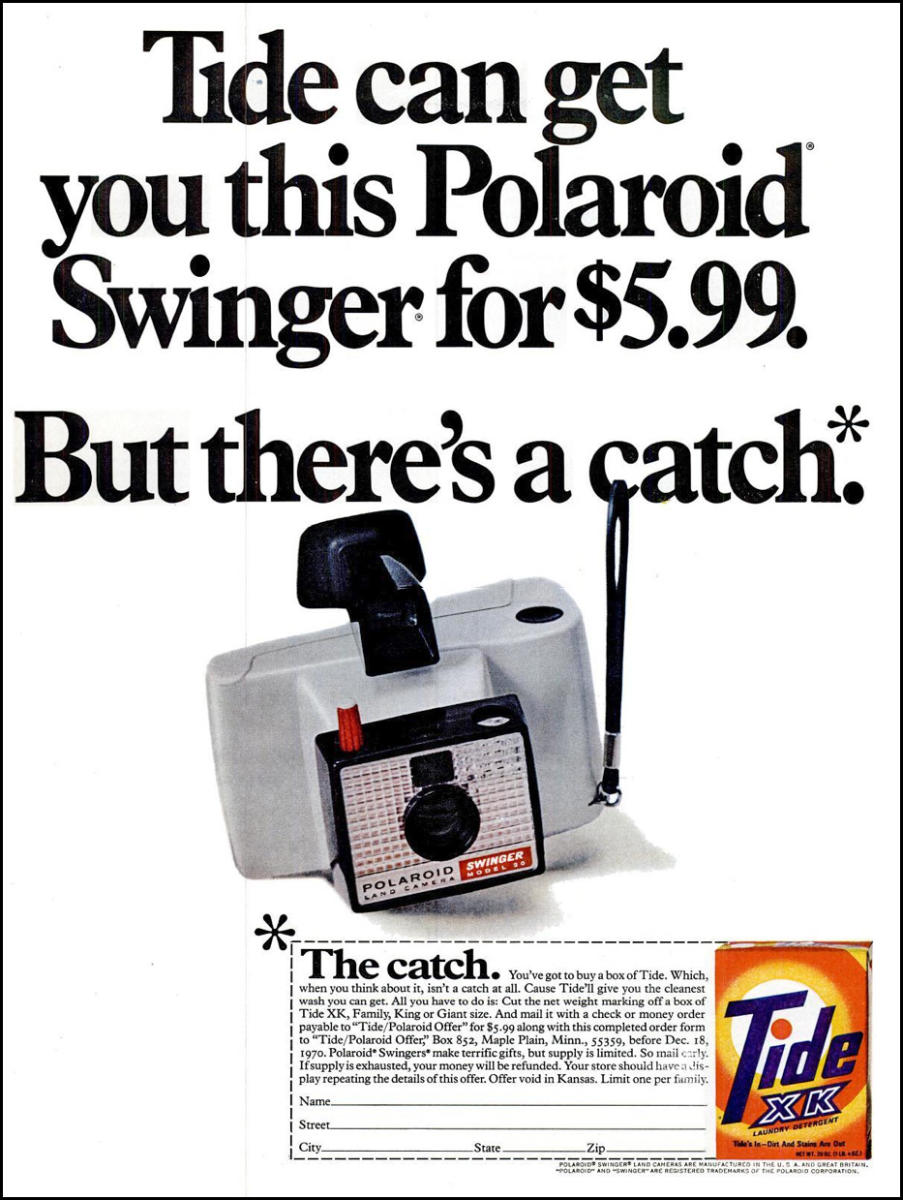
Want a Swinger 51 years ago?

Toronto. As I mentioned in a few posts, advertising costs could be reduced by joining forces with a non-competitor. An example is the Polaroid-Tide ad in the November 29, 1970 issue of LIFE magazine.

Enthusiasts – or anyone who saw the ad – could simply buy the requisite size box of Tide detergent before the offer ended and send the net weight marking as proof of purchase plus $5.99USD to the special deal address listed in the ad and receive a Polaroid Swinger in return.

The ad touted a deal on a popular camera if you bought a larger size box of Tide Laundry Detergent. Everyone back then used laundry detergent so you could buy this gift while helping Tide increase its market share.

My thanks to my good friend and diligent history researcher, George Dunbar, for discovering and sharing this example of advertising collaboration between two non-competitors some five decades ago when film, and magazines were every day items.

Posted in history | Tagged , , , , , | Comments Off on cleaning up with Polaroid & Tide