an eclectic collection

rare Velocigraphe as photographed by our late VP John Kantymir

Toronto. Some collectors seem to buy everything in sight. Others are very selective. Our past president, the late Bill Kantymir did both. Bill had a ‘bucket list’ – a list of every camera he wanted to own before he left this bag of dirt. One such camera was a Dr Krugener Simplex that he showed at our 2013 ‘Show and Tell’ session.

Another is this rare Velocigraphe show above. The photos are from a page in our journal, ‘Photographic Canadiana‘ (hard copy issue 46-5 pp 20-1). Many things not on his list were sold at our fairs or auctions. Things that were better than he had already, he bought and freed up the less attractive item, like the Posographe he sold to me years ago. In summary, you can be a collector of specific makes, manufactures, everything, or keep a list like Bill.

Regardless of your predilection, visit our fairs, auctions, shows, and other events and you may well be able to add that special item to your collection – or upgrade the quality of what you happen to have on hand!

Posted in camera | Tagged , , , , , , , , | Comments Off on an eclectic collection

where there’s a will …

Willowbys ad for the Hasselblad – summer 1951

Toronto. … there’s a way. This old chestnut came to mind when I saw George’s email showing the famous NYC store, Willowbys, advertising the anvailability of Hasselblad cameras.

A couple of words of explanation: Willowbys was a block-long 5th ave landmark in the Big Apple last century when film was the ‘big man on campus’. This ad was released when the store was on 31st and 32 street. The 1950s photo of Willowby’s  is from Pinterest courtesy of the website “Vintage Everyday“. Willowby’s is still around, but now on 36th street and with an apostrophe ‘s’.

The Hasselblad, made in Sweden was a “cube with a lens” SLR design using Kodak, then  Zeiss lenses, focal plane shutters and interchangeable backs. Victor Hasselblad designed the camera after WW2 to further his birdwatching skills. Read the above link for a view of the histyory of the man and his camera, and the link to both Kodak and arial cameras .

Unlike earlier similar designs, the Hasselblad was both high-end and an exceptional roll film camera becoming the camera favoured for studio work. After film crashed in favour of digital cameras, collectors still coveted Hasselblad models. If you want some Hassy gear for your collection, come to our fairs, sales, and auctions (hopefully indoors once the COVID situation settles down).

Thanks to the efforts of my friend and fellow photographic historian, we are able to see once again (at least in historic ads) the wonderful combination of a high quality camera and store! The ad appeared on page 99 of the May 1951 Popular Photography magazine. Note that the magazine link is repeated here as a courtesy to our readers and that the same ad was the subject of a post back on January 12, 2018.

Posted in history | Tagged , , , , , , , , | Comments Off on where there’s a will …

an inspiration for the Hassy?

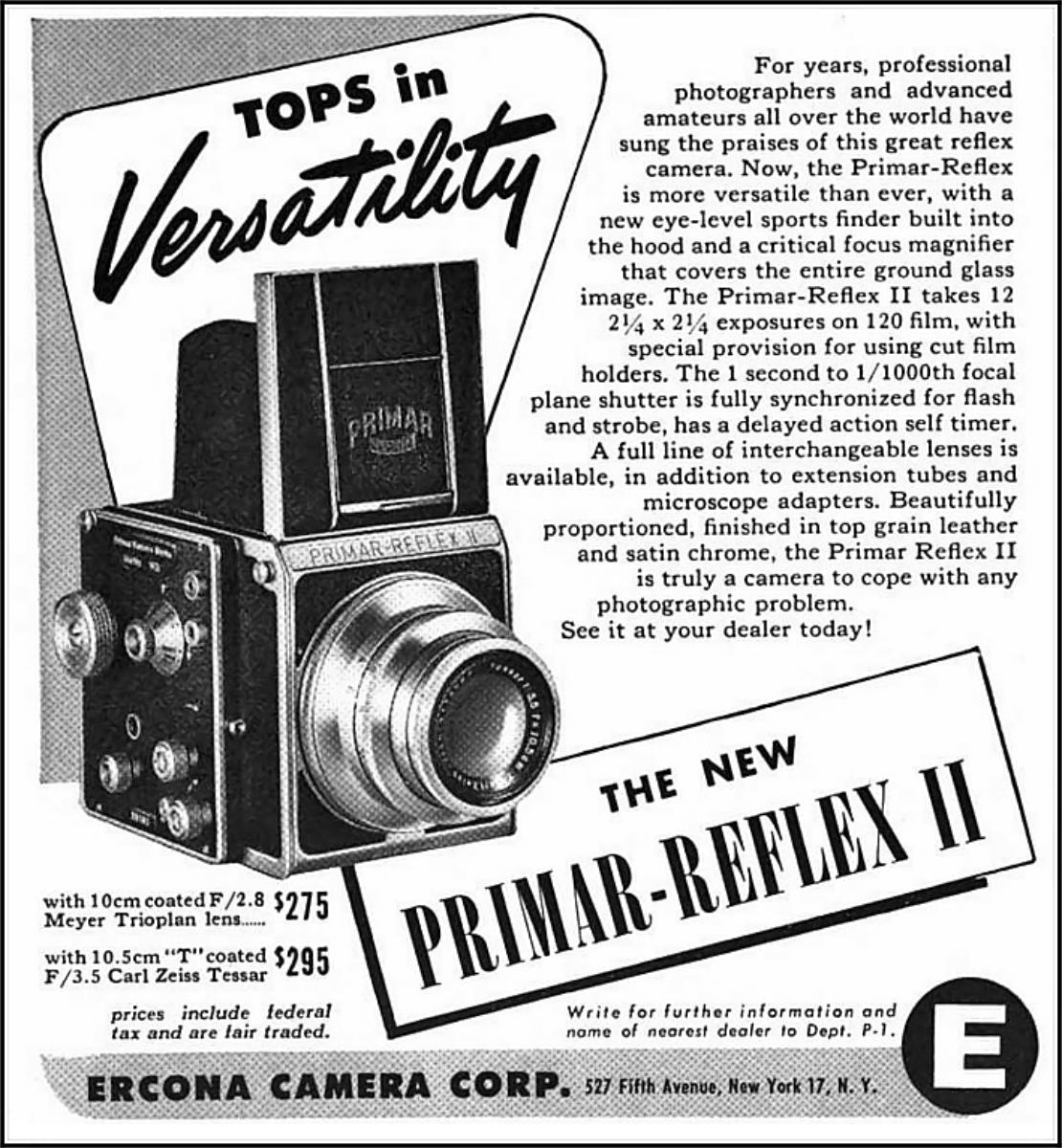
A May, 1951 ad for the cube shaped Primar Reflex II camera

Toronto. Bentzin made cameras in Görlitz, Germany beginning in the late 1800s. The firm collaborated with Zeiss over in Jena to make high end cameras to use Zeiss lens designs. Sadly, both Jena and Gorlitz fell in the Soviet sector after WW2. The Bentzin operation eventually became part of the Russian VEB Feinoptisches Werk and as such, part of Zeiss.

Around 1935, Bentzin developed the “cube with a lens” idea as a roll film SLR called the Primarflex. After 18 years, only about 12,000 cameras were made. The line was dropped in 1953. During production the camera had many names depending in part on the distributor, and numerous redesigns. This ad shows about the last redesign when the marque was updated after WW2. By this time, in appearance at least, the camera looked like an early Hasselblad.

The SLR used a focal plane shutter which was its Achilles heel – shutter problems affected the camera throughout its lifetime. The American importer as shown in this ad was ERCONA on 5th Avenue in the Big Apple.

Many thanks to our resident historian and good friend, George Dunbar, who wanted to share this discovery with us. (I wonder if ERCONA ever imported top line marques?) Oh, yes. I meant to mention that the ad appears in the May, 1951 issue of Popular Photography on page 158. The link is also available in an earlier (recent) post. It is repeated here as a courtesy to our readers.


Posted in history | Tagged , , , , , , , , , | Comments Off on an inspiration for the Hassy?

an unusual roll film camera from Germany

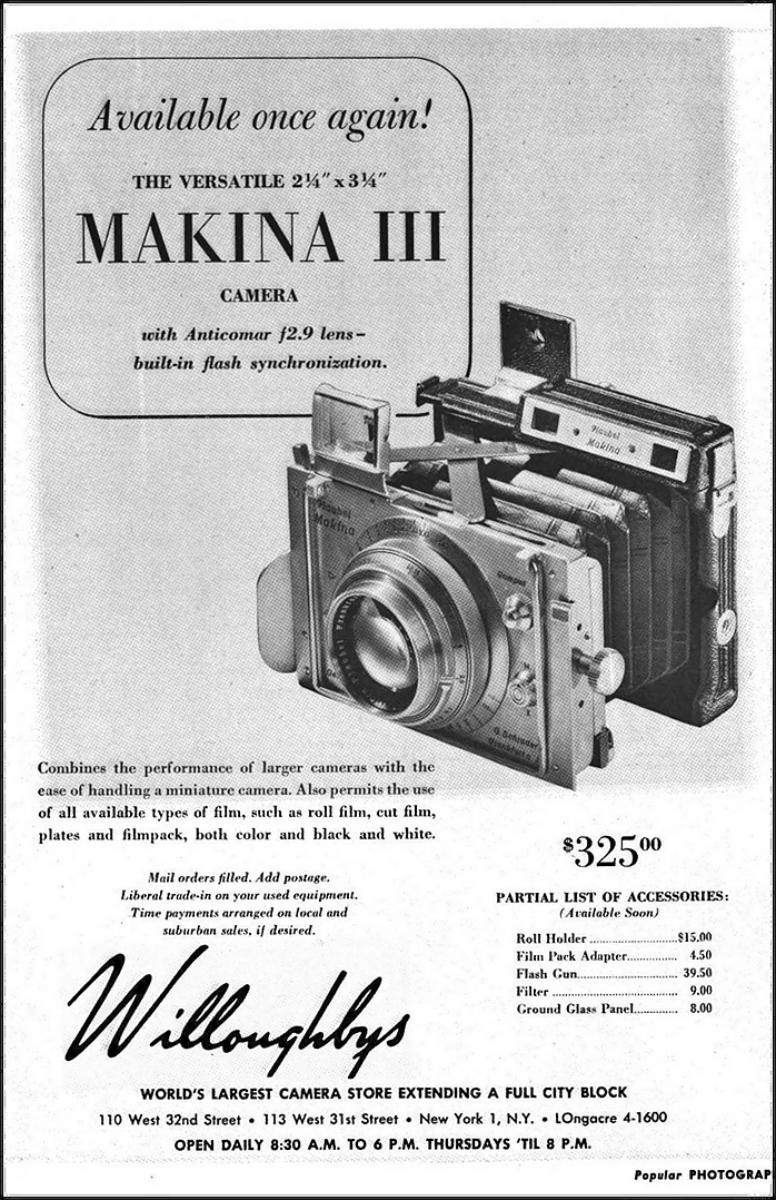
summer 1951 ad for the newly available Plaubel Makina III

Toronto. Have you ever heard about or seen a strange camera from the 1930s called a Makina III? Originally designed pre WW2 (one may have been auctioned off last May in Ohio), sales and manufacture were interrupted by WW2.

The ad, on page 6, in the June, 1951 issue of Popular Photography (the link from a recent post is repeated here for convenience), is by the block-long NYC retail shop Willoughbys. It announces that the Makina III is, “Available once again!”, and promises accessories (like the 120 roll film back!) will be available soon!

The camera sports a leaf shutter behind the lens making it possible to use interchangeable lenses and allows flash bulb synchronization at all speeds. The down side, of course is that the shutter’s physical size limits its top speed (1/200th) – far slower than that common for a focal plane shutter.

A grateful thank you goes to that fine gentleman and enthusiastic photo historian, George Dunbar, for sharing this find with us. If you want one for your collection (or a user for the folks who still use film) visit one of our fairs, auctions, shows, or sales.


Posted in history | Tagged , , , | Comments Off on an unusual roll film camera from Germany

when is a brick not a brick?

June, 1951 ad for Argus C-4 camera

Toronto. When its an Argus C-4! The Argus C-3 was an awkward rectangular weighty thing loved by all. In 1951, Argus took a shot at replacing it with a C-4 camera but the C-3 lived on.

This ad on page 19 in the June, 1951 issue of Popular Photography introduced the C-4. A similar ad in LIFE was the subject of an earlier post, (the power of marketing). Note that the C-4 was also badged C-four on its lens ring. It went through many iterations including as a C-44 which gave back the interchangeable lenses common to the C-3 (somewhere I read the C-3’s rangefinder drifted and the camera needed to be opened for adjustment then closed to test – this article suggests a port in the top plate allows a simple adjustment to be made).

Thanks to my good friend and photo historian for sharing this advertisement with us. If you feel a need to add a C-4 (or indeed anything else) to your collection, drop in on one of our fairs, auctions, sales, or other events! You can even simply browse and see what our ancestors (or old coots like me) did to get decent photos.

Posted in history | Tagged , , , , , , , | Comments Off on when is a brick not a brick?

going for gold – a Kodak moment

Box Cover for c1937 Kodak Junior SIX-20 folder camera

Toronto. The late Jack Addison and wife Marge were very active in the society, especially in the 1970s, 80s, and 90s. Jack was president, journal editor, CNE Exhibits coordinator, curator, etc. while wife Marge was membership secretary when I joined in late 1975 when the society was just over a year old (75/76 membership year). He held down two jobs as well – an EMS (ambulance) driver/attendant, and a professional photographer doing weddings. He introduced the long running back page spread of antique Kodak ads as Journal editor.

As a collector, Jack considered all things Kodak. Items made by others he sold off for the most part. Jack enjoyed collecting Kodak items of any kind. He was an active collector and a great asset to the society. Like Don Douglas, Jack enjoyed collecting inexpensive products and cameras, in his case made by Kodak both here and in Rochester.

Jack and Marge later moved to Eastern Ontario as he neared retirement. Any one interested in Kodak products should attend our fairs, auctions, and shows where such items frequently appear.

Posted in history | Tagged , , , , , , , | Comments Off on going for gold – a Kodak moment

a photographer’s magnifier

c1951 Elmar enlarger lens by Leitz. Click it to see an ad for the 1c enlarger of the same period.

Toronto. Anyone wanting to see a magnified view of a small object would likely use a simple magnifying glass – just like Sherlock Holmes in the many Conan Doyle stories. Predating photography, a projector (magic lantern) projected an enlarged view of a glass plate’s drawing on a screen or wall for all to see.

Initially (and for much of the 1800s) a photographer chose his camera and lens to create the desired size of print. In an effort to enlarge images taken with a smaller camera, some people invented devices that used the sun as a light source and projected the negative on the rather slow photographic paper using what today would be a slow lens.

When Eastman began touting roll film in the later 1880s, a means to make decent enlargements became useful. And mid 1930s when the minicam craze blossomed, enlargers became mandatory. Negatives were often as tiny as 1 by 1.5 inches! Enlargers could increase the size of the final print by 10x magnification, and sometimes even more.

My good friend, George Dunbar, shared this advertisement for a Leitz 1c enlarger from page 20 of the October 1950 Popular Photography magazine. I did another post about the 1c back in January 2018 when the same ad appeared about a year later ( before the world was rocked by COVID-19).

The 1c’s basic design was often copied. Other enlargers like many Durst models automatically retained focus as the print magnification was changed. Durst used a pillar and fixed arm to also keep the print centred on the base board.

Of course, in the old days of view cameras and ground glass to focus, a nifty brass stand held a magnifying lens the correct distance from the  ground glass to allow the photographer to move his lens and put the scene in sharp focus.


Posted in history | Tagged , , , , , , , | Comments Off on a photographer’s magnifier

out of the blue

Nikon S ad May, 1951 – when Nikon was first imported into USA

Toronto. Journalists reporting battles in the Korean War came across a very high quality, professional camera made in Japan. A well known maker of microscopes in Japan, Nippon Kogaku, expanded into cameras post war and were selling them under the Nikon name.

The journalists were so pleased that in 1951, the Nikon S was imported by the USA as shown in the ad (click the camera icon at left).  A few years later, the iconic Nikon F SLR was manufactured in Japan and imported into North America.

You can learn more about Nikon rangefinder cameras in the Hove Foto Book (1981), “Nikon Rangefinder Camera”, by Robert Rotoloni. You can also go to his web site, “Nikon Historical Society“,  or his new Facebook page for the NHS.

My thanks to good friend George Dunbar for sharing this pivotal ad on the first Nikon rangefinder model to be imported to North America. The ad is from the May, 1951 issue of Popular Photography.

Today, both Nikon and Canon digital SLR cameras are mainstays of the professional. Some of our members who are also practicing professionals use some models of these famous cameras. Leica has become a very expensive niche camera while both Zeiss and Leitz continue to design and market lenses. Some German marques like Voigtlander are still around but made in the orient. The Leica M-mount and lens style seem to be used by many companies.

Posted in history | Tagged , , , , , , , , | Comments Off on out of the blue

PHSC News newsletter for October 2021

Demon Detective Camera

Toronto. At right top of page 1 in the latest PHSC News newsletter is another British camera This one, c1889 was made by the American Camera Company of London, England.

October, 2021 is well underway, and our editor, Sonja and her team, have produced a Halloween special for you as the COVID-19 fourth wave seems to be winding down for us up here, driven mostly by our vaccination levels and close adherence to common sense guidelines.

This latest issue of PHSC News (21-04) has many thought provoking articles – short, crisp, and provocative. Take a few moments and read them to ease your virus avoidance lethargy.  Page 1 under “Shining Example” covers a hotel used by Stephen King for his scary 1977 novel.  Page 2 in “PHSC PRESENTS (virtually)” covers the movie takes on scary characters.The article is titled, “Medical Malpractice Leads to Lupine Self-Loathing“. On page 3, under PHOTO BOOK 101 is, “We Might not See Them but They See Us“,  about King’s preface to a book on Gargoyles. Continuing on with scary stuff, STREAMables has the article, “Haunting can be Daunting at Bly Manor“; while page 5 speaks to the untimely death of a young Rockefeller in the article, “The Foreshortened Life and Times of Michael Rockefeller“.

Page 6 addresses “The Kenney, Pallister and Moe of Nikon Lenses” in David’s EQUIPMENT REVIEW (about some dreadful Nikon lenses). John Morden once again  steps in to select the trio of WEB LINKS shown on page 7.

And, page 8 features a poster on our forth-coming ZOOM event  “Generation Homeless: Impact of the Unhoused Crises(WARNING: We goofed on the date and link! Go here on the web instead – we swapped two presentations but apparently our page layout software had a mind of its own …). On page 9, our friends, Ivy & Izzy, trade quips on “A Time Warp of Rocky Horror Canadiana” followed by John’s compilation page of shows, events, and exhibitions of interest to PHSC members and photographers everywhere.

P.S. As usual, every link shown in the newsletter is a hot link just waiting for your click!

P.P.S. You can visit this issue by clicking here, or by g0ing to the menu item NEWSLETTER at the top of the page. There is a drop down menu that takes you to older issues dating back a couple of decades to the very beginning.

Posted in newsletter | Tagged , , , , , | Comments Off on PHSC News newsletter for October 2021

si si d, doctor B

Dr Willard Boyle in 2009 courtesy of Wikipedia

Toronto. Years ago, I discovered Bell Labs via the journal, Bell Systems Technical Journal. One issue in particular impressed me since it included a cardboard 78 rpm record of a computer singing, ‘A Bicycle Built for Two’!  Now-a-days computers are passé. Even smartphones have computers and cameras built-in. In fact, most of us use the camera on our smartphone without a thought to its complexity. It is actually a technological marvel with its camera owing a debt to the Bell System and the telephone for the workings of some of its components. How, you may ask? Well, since you ask …

For the camera, a lens composed of various glass elements is still needed, but the complexities of white balance, exposure, aperture, ISO, file structure, etc., are handled by a nifty little computer. And the modern sensor, based on CMOS solid state technology, has replaced the somewhat temperamental ‘film’ and its light sensitive coating.

This is where the Labs came in. In the early days of sensors, high-end imaging required so called a CCD or charge coupled device. Such devices were invented at Bell System Laboratories (Bell Labs) jointly owned at the time by AT&T and Western Electric. The fruits of the Labs were shared by telephone companies belonging to the Bell System throughout North America (including Bell Canada). Around 1969, Willard Boyle (born in Nova Scotia) and George Smith, working in one of the laboratories (perhaps at Murray Hill,  New Jersey) on MOS solid state devices came up with the CCD concept for which they shared the Nobel Prize in physics in 2009.

So the next time you whip out that smartphone to capture a photo, think of its ancestors, the old telephones, the late Drs Boyle & Smith and the CCD, all of which led to the replacement of ‘film’ decades later.

PS. Thanks to good friend and PHSC member, George Dunbar for suggesting the CCD topic and the part played by Dr Boyle.

Posted in history | Tagged , , , , , | Comments Off on si si d, doctor B