the alpha and the omega of enlarging

1951 ad for an Omega D-2 enlarger and soft illumination head

Toronto. I first enlarged negatives when in high school. A few years later in Northern Quebec I bought my first enlarger – a very cheap affair labelled as a Federal. The small town I was in had only contact printing paper at the time. Each negative took five minutes or more exposure by the enlarger. Glacially slow! Another line I looked at enviously was that of Durst in Italy.

Magazines and books encouraged me to dream of a better quality enlarger. I had looked long and hard at the Omega line. This all came back to me when George sent me the ad shown here for an Omega D-2 and soft light head. Back home in Southern Ontario, I tried enlarging colour negatives. A friend and I decided to make a soft head for my cheap enlarger. A fluorescent tube became the light source, while two suitable-sized aluminum pans (the top one inverted; the bottom one with a central opening) served as a reflector/lamp housing.

The results were satisfactory but took a painfully long time as we did color balance and exposure to get a decent print. Cheap filters didn’t help with speedy results …. My thanks to George Dunbar for sharing his find from page 142 (last page) of the July 1951 issue of Popular Photography. Years later, after marriage and a move to Montreal, I  ended up with a used Durst M35 35mm negative colour enlarger which turned out to be Gilbert Durst’s flagship machine embodying all his innovative design concepts.

A truly wonderful enlarger matching the quality of my M4 camera and Leitz lenses.

Posted in history | Tagged , , , , , , , , | Comments Off on the alpha and the omega of enlarging

Photographic Canadiana Vol 47-3

Photographic Canadiana 47-3 in PDF format

Toronto. Sadly, we lost our editor,  Bob Lansdale, this past summer. Bob left much of this material to help our interim editors, David Bridge and Louise Freyburger who ably stepped up to the challenge of producing this issue.

Members WITH an email address received this informative 20 page magazine via pdf. It  is  the Photographic Canadiana 47-3 dated September-October-November  2021.

This is another colourful issue envisioned by our late editor Lansdale and assembled, augmented, and produced by interim editors Bridge and Freyburger  to create the excitement we all felt reading Bob’s issues – all 100+ of them. Like last year, we plan on doing at least five issues.

Drop me a line at info@phsc.ca if you are a member and haven’t received this special pdf edition. Not a member? Easy-peasy, just break out your plastic (VISA, MasterCard, etc.), follow the rules at the upper right of this page and sign up via PayPal (no PayPal account needed – we will pay the modest fee). Membership is an incredible bargain. Period!

Posted in journal | Tagged , , , , , , | Comments Off on Photographic Canadiana Vol 47-3

a film darkroom really can be green

Making the Darkroom Greener

Toronto. The great editor of our favourite magazine, Rita Godlevskis of PhotoEd, is thrilled to announce a ZOOM presentation this Wednesday coming (November 3rd).

Rita says in part, “We’re gettn’ ready for our event next week and we’re really excited about this hot topic, ‘Can analog photography be less toxic?’. Three creative Canadians have invented a modern dry darkroom that’s eco friendly, and we can’t wait to share their results (as seen in print in the Fall 2021 “Eco issue”).

“I’m hoping you’ll join us for the conversation + that you might have some space to SHARE this announcement in your social media/email newsletter communications in the next few days?

“Tix are $5+ fees/ PWYC or if you’re a friend of AUARTS or a PhotoED Patron – it’s FREE!
[use this Evetbrite link to buy/get tickets/Tix].

“If there are students or community members with financial barriers – please let me know – happy to help with a free registration.

“THANK YOU so very much for your continued support!”

So those of you who delight in using film, hit the ZOOM session next Wednesday and learn how to make the processing in the darkroom less toxic and more green!

Posted in activities-other | Tagged , , , | Comments Off on a film darkroom really can be green

a look in the future to see in the past

Hologram Image in Laboratory

Toronto. Russ Forfar is a science nerd as well as once repairing film cameras in the days before electronics took over. Russ sent me a link to this intriguing article in Science Daily. The article, “Need for larger space telescope inspires lightweight flexible holographic lens” appeared in its October 22nd edition and was reprinted from Rensselaer Polytechnic Institute, where the original article was written by Mary L. Martialay.

The article covers a means to create a lens in future that will allow a telescope to “see” exoplanets instead of light points twinkling as stars in the night sky.  You can consider such experiments in lens technology as ‘future history’ …

Posted in history | Tagged , , , , | Comments Off on a look in the future to see in the past

in da frame

portrait of a couple taken last century in a Barrie Studio

Toronto. There are camera collectors and there are camera collectors. Over a couple of decades ago,  I analyzed the interests of our members so we could reflect the appropriate topics in our journal, and program material. At the time, about 15% of us collected images, some exclusively; some with other things like cameras, accessories, etc.

I am in the last category. Mainly cameras, but also some books, ads, and photographs. The one shown here is a studio photograph taken in Barrie, early last century (by Frank Jackson) and includes an embossed cardboard frame.

Some of our members like certain processes, others collect cased photos such as daguerreotypes or ambrotypes. Some members collect photographs by a famous photographer like Karsh or Notman. Others search for portraits of the famous. Or the strange ‘monsters’ seen in the circus sideshows of yesteryear. There are even those members who collect and research stereo cards.

Regardless, photos often pop up at our fairs, auctions and sales (only outdoor fairs and sales these days). In fact, we even have an Image Show held downtown on Elm Street at the Arts & Letters club. We hope the positive COVID situation will let us hold an Image Show once again before year-end. Watch our newsletter and this web site!


Posted in history | Tagged , , , , | Comments Off on in da frame

an Exakta in my future

Pierre Dozois in Drummondville QC sold us the Exaktas

Toronto. After a few months in Labrador, a few of us decided to buy a top quality camera. Many nights were spent discussing the pros and cons of various German makes, especially Exakta and Leica. A visitor had a IIIf Leica and spoke highly of its handling and features. Another technician and a visitor had Exaktas.

We had no idea that Exakta in Dresden fell into the Russian sphere as part of East Germany. Nor were we aware that there was some doubt about Russian quality. A decision was made to go for Exakta cameras and select lenses. The best deal came from the Drummondville, Quebec shop of Pierre Dozois. I was elected to pay for the entire order. The cameras were great but had a thin leather covering, not the thick gutta percha covering on the IIIf. Their speed range far exceeded the tiny Leica with its squinty viewfinder/rangefinder. The Exakta also had many other features like film winding cassette to cassette, built-in knife, etc.

The lenses from Zeiss, Steinheil, and Angenieux were much larger than the tiny Elmar, but as beautifully finished. The SLR view was also bright and large. Extension tubes opened up the ability to take close-up photographs. The 58mm and 135mm Steinheil lenses made beautiful photos. The 28mm Angenieux was something else. It suffered from severe geometric distortion.

The film pressure plate caused scratches and the camera was returned to the distributer to be polished (and left shiny …).  Later the mirror return lever failed to engage and for the rest of the time it was in use, I removed the lens and reset the mirror by hand.

Years later, I discovered more evidence of cheap internal construction.  A shutter test showed my camera’s shutter to be erratic in movement, not smooth as expected. Disassembly showed thin gears and brass ‘sawdust’ as a shutter stop was nearly broken off. I set the camera aside and bought an older model that still seems to work today. My next step was a Leica.

Posted in history | Tagged , , , , , , , | Comments Off on an Exakta in my future

Montreal, Minolta, Marvellous

Simon’s Camera in Montreal

Toronto. Before heading north to Labrador, I spent a few months training in the old Salada Tea Building on St Lawrence in Montreal. To an Ontario boy, Montreal discounts were exciting. The best camera deals were said to be at Simon’s on Craig near St Lawrence.

Money burning a hole in my pocket, I set out for the old tiny shop on Craig. Inside, over the door was a gorgeous poster extolling the virtues of the Exakta as a nature/scientific camera. It was just too rich for me at the time. Along the narrow glass counters, Simon’s displayed the latest camera gear from mostly German and Japanese makers.

I ended up choosing a Japanese Minolta Super A camera and light meter. In those days, Japanese cameras were considered second rate copies. I was surprised at the quality of the camera, especially its 50mm Rokkor lens. Of course, the manual was something else. It seemed to be written in pidgin-English by someone just learning the language. I wondered how a mirror box could be added for close-ups, unaware that Leica, Contax, etc had just such a device and had had one since before the WW2.

Up north less than a year later, I sold the Minolta to a fellow technician and invested in my Exakta, but I didn’t see any jump in photo quality, just a decision to buy added lenses since the Exakta could use a any lenses by many makers while the Minolta had a behind the lens leaf shutter and used a very limited number of Minolta lenses to make it a modest wide angle or telephoto.

Over the years, Craig was renamed St Antoine as it was just an extention of that street. After moving back to Toronto, every time I had a meeting in Montreal, I tried to squeeze in a visit to Simon’s – this time to buy used Leica accessories. I spent many a pleasant time in the old, narrow shop on Craig/St Antoine.

Posted in history | Tagged , , , , , | Comments Off on Montreal, Minolta, Marvellous

those were the days

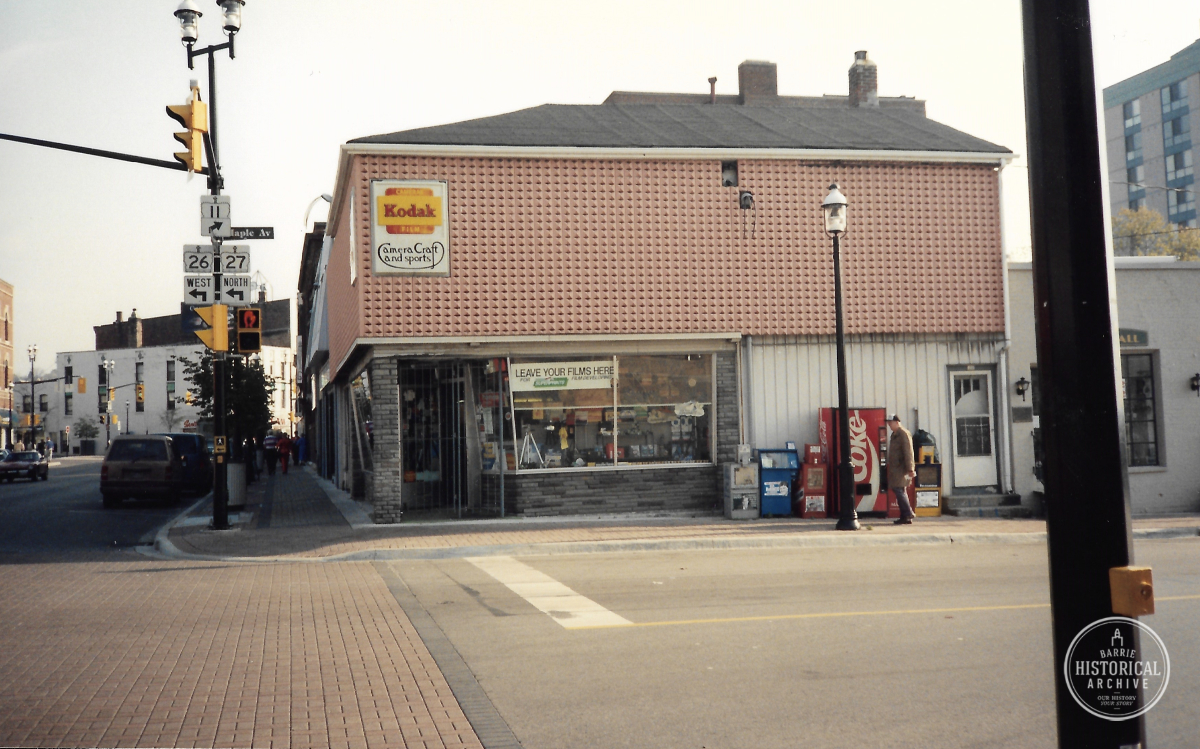
Camera Craft Barrie – Barb Provan collection, Barrie Historical Archive

Toronto. As a kid I bounced between radio and photography. The first ‘real’ camera shop I ever entered was Vi and Joe Waterer’s CameraCraft in Barrie. The store was at one end of a long block. I had  joined the telephone company near the other end of the block. At the time it was on street called Elizabeth Street which later changed its name to Dunlop Street as it was that street’s extension west of the five points.

My buddy and I were both in our teens. He had recently bought a 35mm Paxette II camera from Joe and wanted me to see if I could get as good or better deal. Nope. I was still content with a Kodak box camera using 620 roll film. I never moved to 35mm until the late 1950s when I bought an Exakta VXIIa.

After I used the Exakta for a while, I decided a larger negative would give better resolution.  With that in mind I went off to see Joe and ended up buying a Rittreck set. It was like a Graflex but with a far easier to set shutter.  I saw Joe a bit earlier just after getting my Exakta. Curious about the Braun Hobby electronic flash, I went to discuss the pros and cons with Joe and ended up with a used Ultrablitz Reporter II electronic flash. It had two flash guns, and an auxiliary condenser to double the watt-second capacity. Plus a lousy battery which I replaced a bit later with a cheap lead-acid 6 volt battery that fit the Ultrablitz case.

Years later, after Joe died, his wife and daughters took a table at our fair to sell off the remaining goods from CameraCraft.

The photo of the store at Maple and Dunlop was taken in 1991, nearly 40 years after my first visit. The photo is part of the Barb Provan collection at the Barrie Historical Archive. Joe expanded his store to sell sporting goods, special high fidelity LP records, camera books, etc. And for a brief time he had a second store run by a son-in-law. It was further to the east near the old Barrie Railway Station.

This post was named after the 1968 Mary Hopkins song.


Posted in history | Tagged , , , | Comments Off on those were the days

an eclectic collection

rare Velocigraphe as photographed by our late VP John Kantymir

Toronto. Some collectors seem to buy everything in sight. Others are very selective. Our past president, the late Bill Kantymir did both. Bill had a ‘bucket list’ – a list of every camera he wanted to own before he left this bag of dirt. One such camera was a Dr Krugener Simplex that he showed at our 2013 ‘Show and Tell’ session.

Another is this rare Velocigraphe show above. The photos are from a page in our journal, ‘Photographic Canadiana‘ (hard copy issue 46-5 pp 20-1). Many things not on his list were sold at our fairs or auctions. Things that were better than he had already, he bought and freed up the less attractive item, like the Posographe he sold to me years ago. In summary, you can be a collector of specific makes, manufactures, everything, or keep a list like Bill.

Regardless of your predilection, visit our fairs, auctions, shows, and other events and you may well be able to add that special item to your collection – or upgrade the quality of what you happen to have on hand!

Posted in camera | Tagged , , , , , , , , | Comments Off on an eclectic collection

where there’s a will …

Willowbys ad for the Hasselblad – summer 1951

Toronto. … there’s a way. This old chestnut came to mind when I saw George’s email showing the famous NYC store, Willowbys, advertising the anvailability of Hasselblad cameras.

A couple of words of explanation: Willowbys was a block-long 5th ave landmark in the Big Apple last century when film was the ‘big man on campus’. This ad was released when the store was on 31st and 32 street. The 1950s photo of Willowby’s  is from Pinterest courtesy of the website “Vintage Everyday“. Willowby’s is still around, but now on 36th street and with an apostrophe ‘s’.

The Hasselblad, made in Sweden was a “cube with a lens” SLR design using Kodak, then  Zeiss lenses, focal plane shutters and interchangeable backs. Victor Hasselblad designed the camera after WW2 to further his birdwatching skills. Read the above link for a view of the histyory of the man and his camera, and the link to both Kodak and arial cameras .

Unlike earlier similar designs, the Hasselblad was both high-end and an exceptional roll film camera becoming the camera favoured for studio work. After film crashed in favour of digital cameras, collectors still coveted Hasselblad models. If you want some Hassy gear for your collection, come to our fairs, sales, and auctions (hopefully indoors once the COVID situation settles down).

Thanks to the efforts of my friend and fellow photographic historian, we are able to see once again (at least in historic ads) the wonderful combination of a high quality camera and store! The ad appeared on page 99 of the May 1951 Popular Photography magazine. Note that the magazine link is repeated here as a courtesy to our readers and that the same ad was the subject of a post back on January 12, 2018.

Posted in history | Tagged , , , , , , , , | Comments Off on where there’s a will …