a silent salute to Hell’s Angels …

Glenn Kershner’s comic on the photographing of Hell’s Angels in 1927/8

Toronto. We have all heard of the Howard Hughes (he of Spruce Goose fame) epic film, Hell’s Angels. But I wonder just how many folk knew it was basically a silent film with sound effects etc. and rewrites/shoots before its 1930 release. Since the movie spanned the silent/talkies period, it began life as a silent movie and ended up as a sound production. Started in October, 1927, it took 15 months just to reach the editing stage. Some B&W scenes were tinted and one was in the full  colour of the period.

The film was noted in the IATSE house journal (see yesterday’s post for the link) for the astonishing number of cinematographers needed to film the epic.

Cartoonist Glenn Kershner, ASC, sketched the whimsical comic shown here nearly a century ago to lampoon the photographers assigned from this local. By the way, remember the minute of silence today at 11 am to honour those last century who gave their lives for us!

A thanks to good friend and fellow PHSC member for sharing this tidbit of cinematic history!

Posted in history | Tagged , , , , | Comments Off on a silent salute to Hell’s Angels …

lessons from the movies

TIP March 1929 cover Volume 1, issue 2

Toronto. Just picture the late 1920s. Movies were well established as silent entertainment media complete with musical accompaniment from piano to orchestra and all in-between. In 1928, the silents used body language and text slides to convey meaning. Actors could work in the USA or Europe, regardless of language skills.

Then suddenly the “Talkies” came along and a whole new kind of language and dialogue had to be learned. Actors were limited to the USA or England unless language skills allowed for work in Europe. As shown earlier, various colour techniques were invented before the talkies and used to bring more realism to the screen, These were expensive alternatives to orthochromatic B&W film. Even panchromatic when available was rather costly.

In the year 1929, a new magazine emerged, “The International Photographer“. The magazine is the house organ of the  IATSE, local 659. This readable copy is courtesy of archive.org, the internet archive. Linked on this site (lower right) as the WayBackMachine).

A nod and thanks to my good friend and retired cinematographer, George Dunbar, who discovered this gem. Have a read if you want to learn about movie technology and the transition from silent to talkies. After all, these were the behind the scenes folk that made the movies both silent and not.

Posted in history | Tagged , , , , | Comments Off on lessons from the movies

a kokopelli camera

Butcher’s 1/4 plate Midg camera c 1917 courtesy of Creative Commons Attribution-NonCommercial-NoDerivs 4.0 Licence

Toronto. Before science burst the bubble, many gullible souls believed in ghosts, seances, and fairies This past summer, I did the above post linked to ‘fairies’ covering the infamous ‘Cottingley Fairies’ saga. Many well educated folk like Dr Arthur Conan Doyle, believed in the supernatural since science at the time could not explain things beyond the grave; beyond human vision. In c1817 a couple of kids set up and photographed ‘fairies’ in a garden. The mother of one child discovered the prints; talked to self proclaimed experts et voilà! history was made.

The camera said to have set this all in motion was a quarter plate camera made by W Butcher & Sons of London, England in 1902-1920. The model was called the ‘Midg’.  Like so many events and cameras, these have passed on into history.

The “Science Museum Group” explains, ” ‘Midg’ Camera Used to Make the First Two `Cottingley fairies’ Photographs in 1917. 1998-5138Science Museum Group Collection Online.

My thanks to that good friend of me and the society, George Dunbar, for sharing this find with us. Note that the title stems from the mischievous ‘Kokopelli‘ character well known throughout history. It was a feature of the beliefs of some Southwestern American Indian tribes where I first read about the little guy. Kokopelli’s silhouette also appeared on some cotton fabrics we once sold.


Posted in history | Tagged , , , , , , , | Comments Off on a kokopelli camera

an apple you say

a tasty camera from 2017

Toronto. Wow, when I saw George’s email, I thought of the Apple digital camera. Opening the email, I saw it was a BBC article from November 9, 2017 on making a pinhole camera from an eating apple. I had a copy of ‘The Hole Thing‘ many years ago. I bought it new for a few dollars.

“Derek Man used apples as pinhole cameras to capture the harvest at some of the dwindling number of orchards in London. Man worked with The Orchard Project, which is committed to the restoration and celebration of community orchards [in the UK].”

A tasty camera all in all …

A tip of my hat (tuque these days, brrrr) to my good friend and fellow PHSC member for sharing this odd bit of info on the pinhole camera.

Posted in activities-other | Tagged , , , , | Comments Off on an apple you say

transistor radios, TVs, trinitron, walkmans, and more …

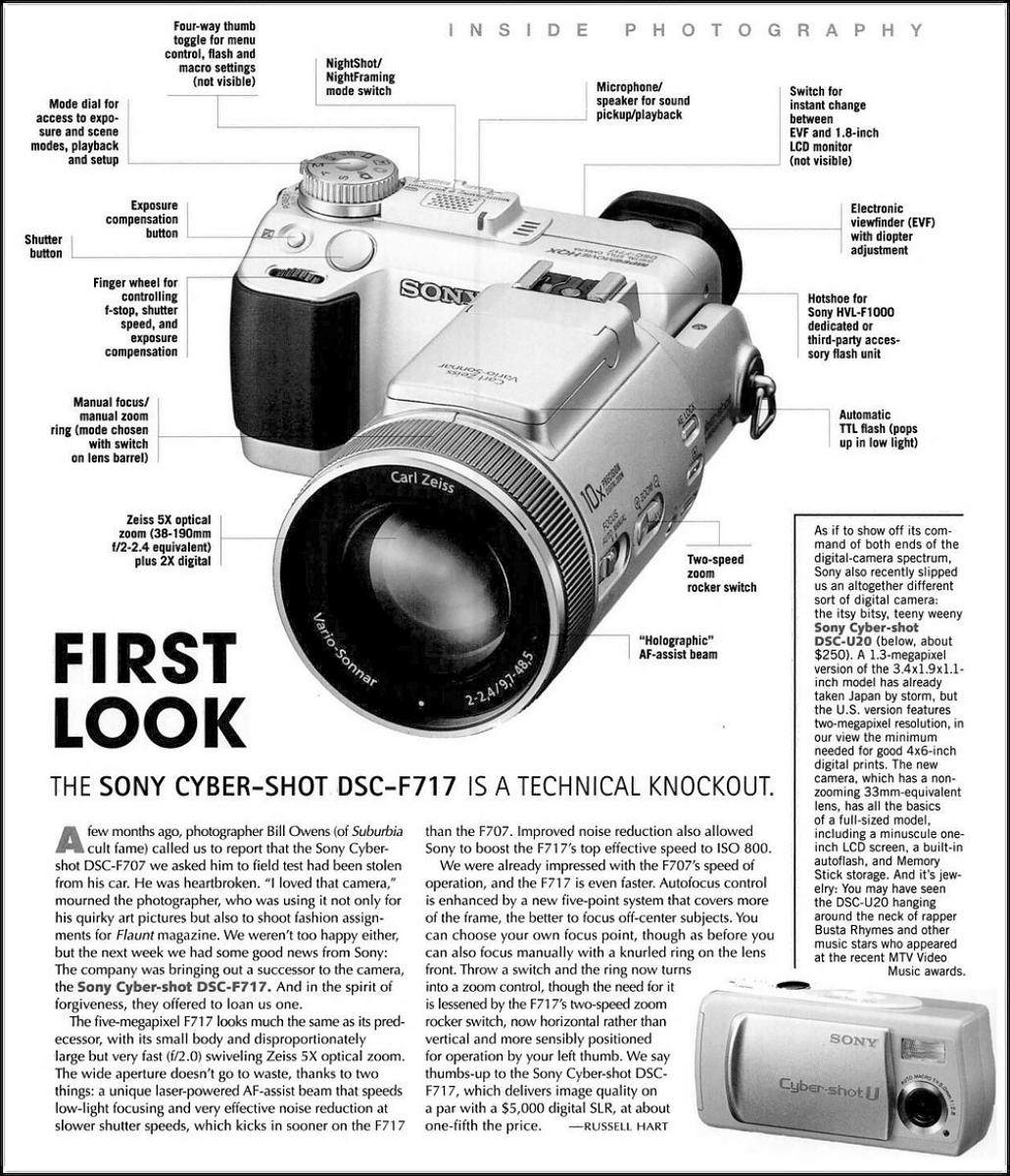
Late 2002 advertisement for the Sony DSC-F717

Toronto. Today we usually think of Sony as a TV and camera maker. They made their name in North America with a transistor radio and later the fabulous line of television sets and walkman portable tape players. When digital technology swept over the photographic industry, Sony moved on to cameras.

Their high end professional line was represented by the DSC-F717 and its replacements (like the DSC-F828 that I bought at the end of its availability retail and now use as my back -up camera for my NEX-6). When it became evident that other camera makers embraced the DSLR design for high end products, Sony dealt with Konica and bought its Minolta line with its A-mount and SLR mirror box design.

The advertisement above is thanks to my good friend and fellow photo enthusiast, George Dunbar. It comes from page 16 of the American Photo magazine for Nov/Dec 2002. This massive coffee table size magazine seems to be patterned after a European Fine Arts magazine called Zoom. Browse the American Photo link to see its many excellent photos and articles as well as advertisements. Well worth a read (selected issues are hosted by Google Books and can be read page by page).

Posted in history | Tagged , , , , | Comments Off on transistor radios, TVs, trinitron, walkmans, and more …

in Quebec we say nombre vingt

Toronto. and the English say ‘number 20’ – our twentieth executive session via ZOOM. It’s over a year and a half now and COVID is still dragging on. Collectively, we have pretty well avoided the FOURTH wave effect by resorting to very limited outdoor events plus distancing, masks, and an excellent response to vaccines. Nevertheless, our stats keep fluctuating and federally we are pushing a limited series of third shots now. Being online has had its own virtue – executive (or presenter, or audience) can be anywhere with no travel issues/costs. And Zoom functionality (or our very able coordinator) seem to keep getting better – with a downside – older computers falling by the wayside in terms of support by Zoom.

It was another month of few changes. Celio continues to do a super job in the Programs, Instagram, and Zoom departments. Clint continues to show why he is president. And David Bridge and Louise Freyburger have stepped up to the challenge as our joint temporary Photographic Canadiana editors. The late Bob Lansdale’s leg work has left files and contacts for the current and at least the forthcoming journal issue next January. Of course the other executive, also show enthusiasm and competence in keeping the society afloat and thriving.

Posted in activities | Tagged , , , , , , | Comments Off on in Quebec we say nombre vingt

one ringy-dingy

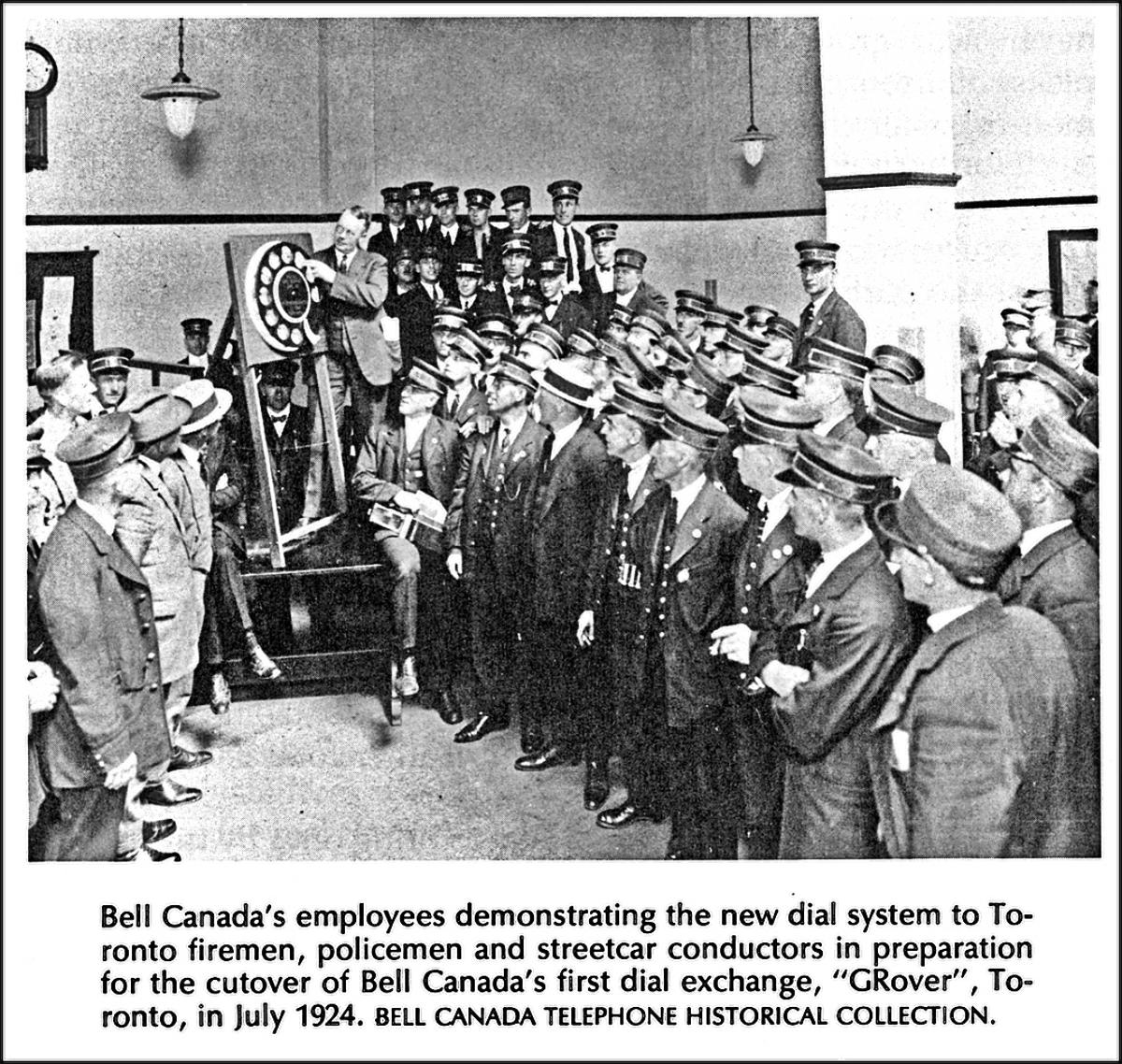
Toronto’s first dial exchange (1924) making local calls easier

Toronto. Most of us remember Lily Tomlin and her hilarious nasal rendering of an officious telephone operator. Today, few can even remember the time when we had party lines and local calls were connected by an operator. Today’s smart phone set take direct dialling of any ‘phone number for granted.

The photo here, curtesy of our own keen historian, George Dunbar, shows an example of how photography can and does record history. The written word can capture events through any printed media, or nowadays via the internet. Photos say so much more to the observant eye.

When Direct Distance Dialling for long distance calls was introduced in the late 1950s, shortly followed by 7 digit local numbers, a similar mock-up was used to show how to make a long distance call at home via the 7 digit telephone number preceded  by the area code (eg 416) and the digit “1”. (1+area code+exchange code+last four digits making each number unique).

Behind the scenes changes ensured all long distance calls had the same volume regardless of the chain of offices used to connect the caller and called party. Each central office had a coordinator to ensure amplifiers, carrier channels, etc in that office had the correct volume level.


Posted in history | Tagged , , , , | Comments Off on one ringy-dingy

all aboard the gravy train

Fall 1951 ad for SVE’s Skyline slide projectors

Toronto. In the post WW2 years, photography grew in leaps and bounds: new amateurs, colour, slides, movies, etc. and all with easier, better ways to succeed as a photographer. The Chicago company, SVE, too wanted to profit from the enthusiasm for photography and took this ad out in the fall of 1951 to promote its new line of slide projectors called “Skyline“.

We owe my good friend and fellow PHSC member, George Dunbar, a big ‘thank you’ for sharing this slice of photographic history with us. The ad comes from the October, 1951 issue of Popular Photography to which I added a link in the previous post.

Posted in history | Tagged , , , | Comments Off on all aboard the gravy train

a linhofty objective

late 1951 ad for Linhof cameras by Kling in NYC

Toronto. I dream about the last century when I used film and had a darkroom. I was sold on 35mm back then, but still dreamed of larger format media and cameras. For many years, I wanted to own and use a Linhof Technika and when George sent me the ad you see here, I already had fond memories of Linhof in spite of the complexity of these cameras in use.

A big thanks to my good friend George Dunbar for finding and sharing this ad from page 26 of the October, 1951 issue of Popular Photography. A linhofty (lofty) objective for sure in the days of cut film. I actually built darkrooms in four different communities before digital technology came along and made such rooms quaint (I am writing this from my last darkroom, now a home office and computer room).


Posted in history | Tagged , , , , , | Comments Off on a linhofty objective

really, David? a Realist?

Summer, 1951 ad exstolling the lenses of the Realist camera

Toronto. The Stereo craze ebbs and flows reaching a peak about every 50 years. In the later 1800s and early 1900s it was stereo cards. A basket of cards plus a Holmes viewer took the place of television or movies back then. In the 1950s and 1960s, 3D popped up again with stereo attachments, stereo cameras and movies all purporting to show things as they really were.

In the 2000s, much improved stereo movies appeared again plus stereo televisions. A lack of content finished the TV craze just as it started. I saw one 3D cartoon movie. Glasses were still needed, but the technology was far better than in the mid last century. And the 3D effect was far more natural than the 1950s branches and spears that threatened to poke out a viewers’ eye! A current form of 3D is called Virtual Reality (VR). A computer, control sticks, and a head band with built-in technology or a smart phone allows the wearer to move in 3D space and experience the intended effects. I tried things out at Ryerson a few years back.

This advertisement from page 31 of the July, 1951 issue of Popular Photography ( see my previous post for the correct link) features David White’s Realist camera, one of the better made cameras of the time although an expensive one. While these camera can simulate nature, they are not equipt for interchangeable lenses. Also the scene captured must have  both subject and foreground/background material  to demonstrate 3D. The above ad is courtesy of my good friend and fellow photographic historian, George Dunbar, who shared his find with us.

Posted in history | Tagged , , , , , , | Comments Off on really, David? a Realist?