something to think about

December 1923 ad for a Bell and Howell electric 35mm movie camera

Toronto. We are all movie/video/TV fans at heart. But consider this – movies  preceded the minicams of the day (and the smartphones of today). We often think of great movies, but seldom of the equipment used to make them.

While we occasionally think of late Bell and Howell  company post war, the company was the most successful  movie camera maker in the pre Mitchell days of movies (one of our presidents – the late Bill Belier – was once a salesman for B&H).

Movie makers either switched to Bell & Howell’s 35mm standard or used inferior equipment; Bell & Howell led the way to transitioning from wood to metal for their cameras; and Bell & Howell shifted from hand powered cameras to electric to make the cameras steadier, and the frame rate more consistent allowing the cinematographer to concentrate on other issues.

We in the minicam stills era were often blessed by these Bell and Howell movie based innovations.

My thanks to that retired industrial stills and movies expert, my good friend George Dunbar for sourcing this article (and advertisement) and sharing it with us.


Posted in history | Tagged , , | Comments Off on something to think about

hi-yo kinamo

1923 ad for the famous ICA Kinamo 35mm movie camera introduced in 1924

Toronto. In April, 1923 this ad appeared in the American Cinematographer. ICA in Germany announced its 35mm (standard film) Kinamo camera – the smallest movie camera of the time. The Kinamo was designed for both professionals and (advanced) amateurs, hence its use of a strip of 35mm film.

The camera used the famous Zeiss Tessar lens calculated at f/3.5 and 4cm focal length. The lens would be slightly long focus for a single frame camera such as the Kinamo (still 35mm cameras to come a decade later would use a double frame making a 4cm lens slightly wide-angle)

This was on the eve of the formation of Zeiss Ikon which folded in many German camera makers including ICA. Zeiss Ikon was given the task of rationalizing the mighty German camera industry which had begun to cannibalize its retail sales (too may cameras of similar design chasing too few customers).

Thanks to good friend and fellow PHSC member, George Dunbar, for sourcing and sharing this advertisement from nearly a century ago when such cameras as the Kinamo were high quality mechanical marvels.

The name of this post is a riff on the famous call of “Hi-Yo Silver” by the Lone Ranger. I used to listen to a radio broadcast with my friend at his house after school.

Posted in history | Tagged , , , , , , | Comments Off on hi-yo kinamo

lucky seven

ad for the little SEPT in 1923

Toronto. We occasionally see a SEPT camera offered at one of our events. The ad at left is from the January 1923 edition of the American Cinematographer. While the little Sept is described as a ‘movie camera’ in this ad, it could also do stills on the small roll of 35mm film and, shades of Robot, even a burst of rapid sequence shots.

Made by Debrie in Paris, France, special cartridges were used. Manufactured  from about 1922 to about 1927 it was apparently sold into 1940. The tiny marvel offered an owner seven distinct functions, hence the name Sept (seven en Français).

A big thank you goes to George Dunbar for sharing this advertisement with us.

Posted in history | Tagged , , , , , , | Comments Off on lucky seven

for the birds …

article on wartime avian photographers

Toronto. Some ideas work; some don’t. In 1942, the third Reich experimented with pigeon photographers according to this article in the September, 1942 issue of Popular Mechanics . Cameras were attached to pigeons and set for automatic operation over a period of time. Released over Russia, I guess the Nazis hoped the photographs would offer cheaper aerial surveillance.

War time brought out many new ideas and experiments, but as I suggested, some worked; some didn’t.

Thanks to my good friend, George Dunbar, for finding this article and sharing it with us, Was it a spoof? was it true? Don’t know. Both sides tend to diss the other in any war. WW2 was no different.

Posted in history | Tagged , , , , , | Comments Off on for the birds …

at the push of a button …

1942 article on an electric
push button camera

Toronto. An article in the April, 1942 issue of Popular Mechanics touts that, “Pictures can be taken at the rate of one each second with an electric studio-type camera”.  A casual read suggests that the camera predates Edward Land by a few years, but not so.

Photographs are caught as usual on a wide roll of ordinary film requiring the usual negative processing then printing each frame to get the positive print.

Oh, well. Thanks to that inveterate photography historian, George Dunbar, for finding and sharing this tasty tale of an electric ‘push button’ camera. Great for taking pass photographs to protect factory operations during the war (ww2).

Posted in history | Tagged , , | Comments Off on at the push of a button …

the thrill of movies

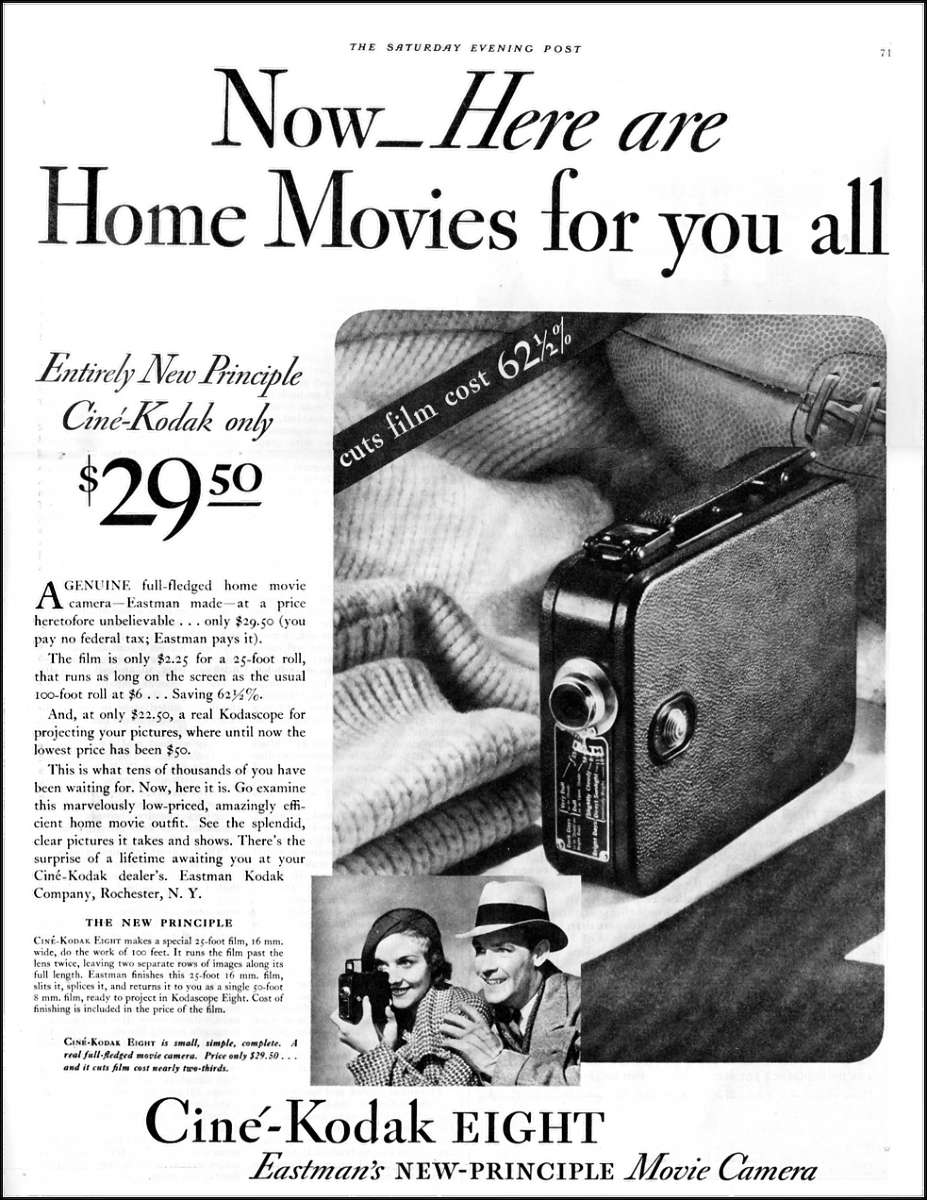
December 1937 advertisement for Ciné-Kodak cameras

Toronto. Kodak got into movie cameras and projectors in the 1920s to sell its amateur movie films. This ad from the December, 1937 edition of International Photographer shows a sampling of Kodak’s line-up of both 8 and 16mm cameras.

Kodak also offered processing including a bleaching bath so the original negative film came out positive and ready to view (with a Kodak projector, of course).

A thanks goes to my good friend, George Dunbar, for sharing this interesting Kodak ad from over 80 years ago.


Posted in history | Tagged , , , , | Comments Off on the thrill of movies

camera is cheap and a film for free

ad for remaindered Twin Flex in 1942

Toronto. The Univex Corp set out to capture the low end photographic market in the States. The war in Europe caused a hiccup in their film supply. Univex used a custom style core on its “00” roll film with the film manufactured in Belgium.

Univex (Universal Camera Company) survived this situation after a near death experience. This ad claims the Twin Flex is, “A GENUINE PROFESSIONAL TYPE REFLEX CAMERA AT A LOW PRICE THAT YOU NEVER DREAMED POSSIBLE”. Even before the remaindered price of “$2.98 – film free), the retail price was a mighty $5.50 for “… The Type Camera
That News Photographers Use”. Skillful words that attracted the gullible in thousands.

This particular advertisement appeared in the July, 1942 issue of Popular Mechanics magazine. In 1940, near bankruptcy, the company found an American film supplier just before America leapt into WW2 as well – out of the frying pan and all that … A nod to my good friend and fellow PHSC member, George Dunbar for sharing this ad with us. And a thank you for the information in McKeown’s 11th edition regarding the Universal Camera Company.

Note, the title is a riff on the delightful Dire Straits song, “Money for Nothing“.

Posted in history | Tagged , , , | Comments Off on camera is cheap and a film for free

in the briny deep

Ambrotype recoved from a downed ship after some 165 year in the sea

Toronto.  The BBC News for March 26, 2022 has a story titled. “SS Central America: Haunting photos recovered [in] the ‘ship of gold’ wreck on ocean floor”. The photographs that that survived the watery grave were all cased images with well made cases and seals.

The BBC states, “It was a hurricane that sealed the fate for 425 people returning to the US east coast … .

” … some passengers were also carrying something of more personal value – photographs.

“Salvaged from the ship’s wreckage in 2014 were daguerreotypes, the first successful commercial form of photography – a one-off picture held on a metal plate – and ambrotypes, a type of glass plate photography.”

Visit the BBC site to see and read about the discovery. Thank you to my good friend, George Dunbar, for bringing this story to my attention!

Posted in history | Tagged , , , | Comments Off on in the briny deep

if you can’t beat them …

1937 ad for new smaller cheaper model Speed Graphic camera

Toronto. Two events likely resulted in this version of the famous Speed Graphic. First the continuing depression and the need to economize; and secondly the success of the minicam and enlarging making smaller cameras very popular.

As advertised in the December, 1937 issue of the International Photographer, a new version of the Speed Graphic by the Folmer Graflex Corp in Rochester was advertised as featuring  “economy and versatility”. The film size was reduced to 2-1/4 x 3-11/4 while the camera offered interchangeable lenses, a built-in focal plane shutter and ability to add leaf shutter/lens combinations, some with flash capability.

The basic camera was sold with the focal plane shutter but no lens. My thanks to fellow PHSC member and avid photo historian, my good friend George Dunbar, for sharing this ad with us.

Posted in history | Tagged , , | Comments Off on if you can’t beat them …

Canada, eh?

A Canadian story in the September, 1938 issue of American Cinematographer

Toronto. America is well known for its rather insular approach to us small fry. But occasionally the mighty country to the south goes out of its way to feature an article on a Canadian event.

This article, called, “Canadians Pack Sports Arena to see Duncan Little’s Film of Race” tells the story of a film shown in the new sports arena in the town of Shawinigan Falls, Quebec by New Yorker Duncan Little. The projector was the Bell and Howell model 130, designed for auditoriums. The projector used the then new 1,200 watt lamp.

A big ‘thank you’ goes out to our good friend and retiree, George Dunbar for sourcing and sharing this rare Canadian story in an American magazine, in this case the September, 1938 American Cinematography magazine.

Posted in history | Tagged , , , , | Comments Off on Canada, eh?