and the winner is …

Edison’s publicity photo of his Kinetoscope.

Toronto. Like many of the inventions in the 1800s, more than one person came up with the same idea. Take the electric light. Edison is credited with the invention over here, but at the same time Swan in  England is given the credit. Both were very aggressive but decided a merger in England was cheaper than litigation so the bulbs in England were made by Ediswan.

I always thought Edison was the inventor of the movie here and the Lumiere Brothers in France. The article from American Cinematographer cites Marey in France and Edison  in America, plus inventors in other countries (although sources disagree who made the first movie, usually Edison or his staff is mentioned).

So sit back and enjoy the flick, no matter who came up with the idea first! And as you enjoy, think of my good friend George Dunbar. George found and shared this magazine article with us.

Posted in history | Tagged , , , , , , | Comments Off on and the winner is …

latest PhotoEd out now

PhotoEd magazine
Fall of 2022

Toronto. My favourite editor, Rita Godlevskis, sent me an email yesterday announcing that her latest issue of PhotoEd magazine has just hit the newsstands.

It discusses the role of photography in activism.

Have a look.

Posted in activities-other | Tagged , , | Comments Off on latest PhotoEd out now

cars and photos – a natural combination

a car rally c1918 from the collection housed in the VPL

Toronto. The photo at left is from the VPL (a PHSC member). The cut line reads, ” 100 years ago US and Canadian auto clubs met in Blaine, WA.  Photo, Stuart Thomson January 26, 1918 – Vancouver Public Library”.

A big thanks to my good friend, George Dunbar, for sharing this photo from the VPL historical photos collection  with us. My father grew up with automobiles. Repairing these machines over the years kept him and his family housed, fed, and clothed.

Unlike today and the astonishing costs of housing, anyone of my father’s age, with a bit of patience and care could eventually own a house. As George Dunbar says in his email on this photo, “Photography is truly a ‘Time Machine’, allowing us to visit and experience the past.”  Browse the VPL’s photos for more engaging images of days past.

Posted in history | Tagged , , | Comments Off on cars and photos – a natural combination

today’s worthless junk …

once an FSA outtake in the 1930s, this shot is now a rare historical document …

Toronto. … tomorrow’s rare historical artifact. In the 1930’s the FSA photographers recorded farm and rural life as affected by drought and depression. To be sure only chosen images were printed, all outtakes were uniquely marked as rejects.

George Dunbar writes, “An example of the unfortunate editing technique once used by the US Farm Security Administration (1935-42), during its mandate to document American farm life and workers. Holes were punched in negatives to indicate photos that were not to be printed.

“However and fortunately, many of these historic negatives remain available in US government archives.”

Times change and what were once of no historical value less than a century later become an historical document for an entirely different reason! My thanks to good friend, George Dunbar, for sharing this FSA image with us. George is also mentioned in both of the earlier posts about the FSA photographic team.

Posted in history | Tagged , , , , , | Comments Off on today’s worthless junk …

Kodak can be very professional

1955 ad for the Kodak K-100 16mm movie camera

Toronto. Over the years, Kodak has covered a wide range of photographers – from absolute greenhorns to the very professional folk. As a youth I learned that Kodak even reserved selected items to be sold to their ‘professional’ stores. At the time I had ordered chemistry through my local druggist. He informed me that certain things I wanted he could not order because his business was not a ‘professional’ shop as defined by Kodak at the time.

This movie camera ad is from American Cinematographer magazine in April of 1955. The camera, a Kodak K-100 appears to be beautifully and professionally made. The ad suggests it is for the professional (news) or advanced amateur (in competition with Bolex, perhaps).

In any case, it is a fine instrument. My thanks goes out to my good friend (and fellow photo history enthusiast), George Dunbar. George is always pleased to share many of his discoveries with others.

Posted in history | Tagged , , , , | Comments Off on Kodak can be very professional

refuge from the bright light brigade

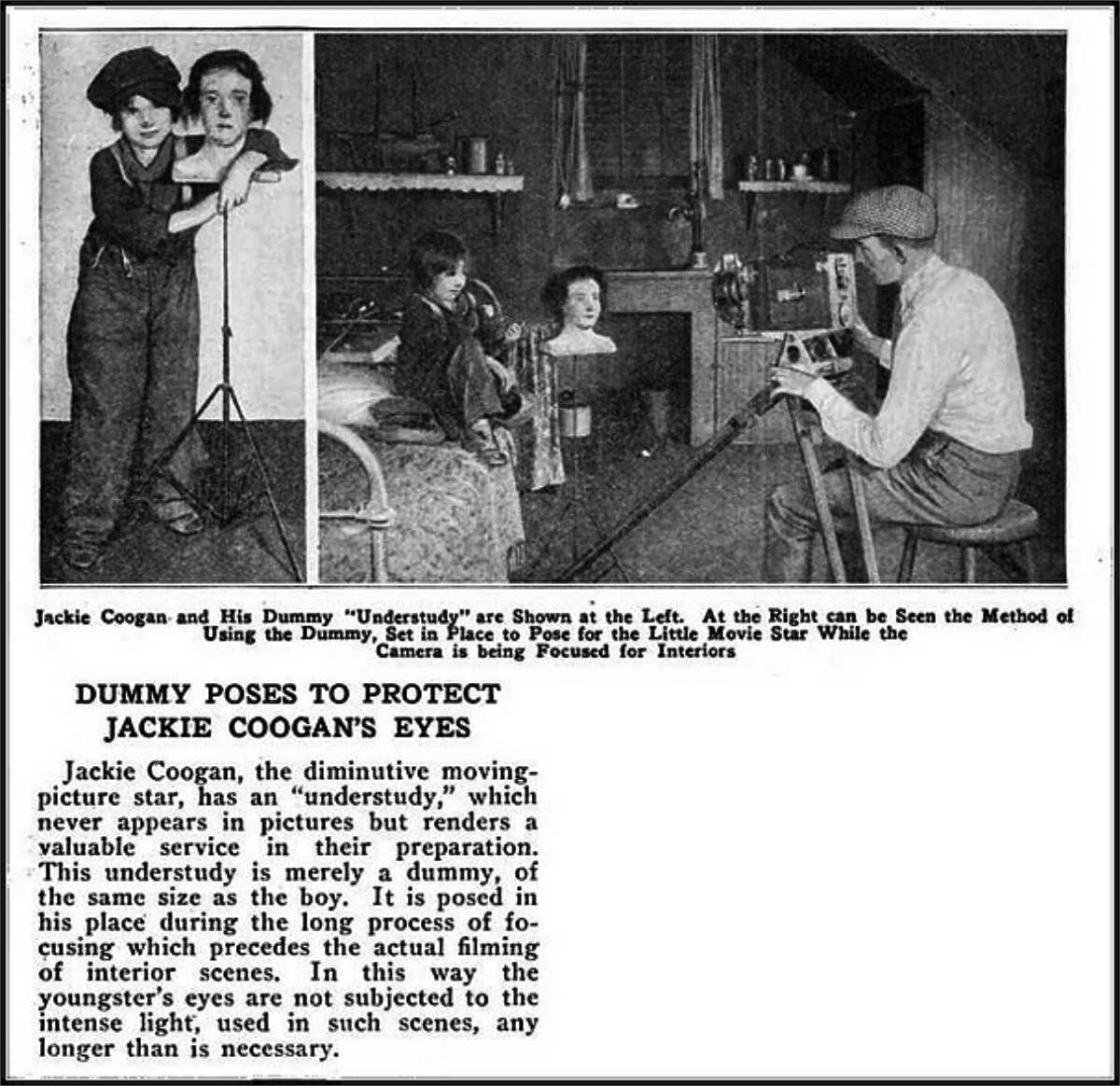
swapping a dummy for a kid to get the job done

Toronto. A December, 1921 article in Popular Mechanics shows how movie processes were performed while delicate eyes were protected from the bright lights so necessary back then when both lenses and media were pathetically slow.

Before each scene, a cameraman carefully focussed his camera under the very bright interior lighting of the day. To save the delicate eye-sight of young movie stars, a dummy stand-in was used. The example shown is little Jackie Coogan and his substitute.

A a youngster going to movies (certainly not back to the 1920s) I was unaware of the various workarounds so necessary back then to balance great results with minimum risk to the movie ‘stars’.

My thanks once again must go to my good friend, George Dunbar, for finding and sharing this article with us.

Posted in history | Tagged , , , | Comments Off on refuge from the bright light brigade

bellows, bellows, everywhere

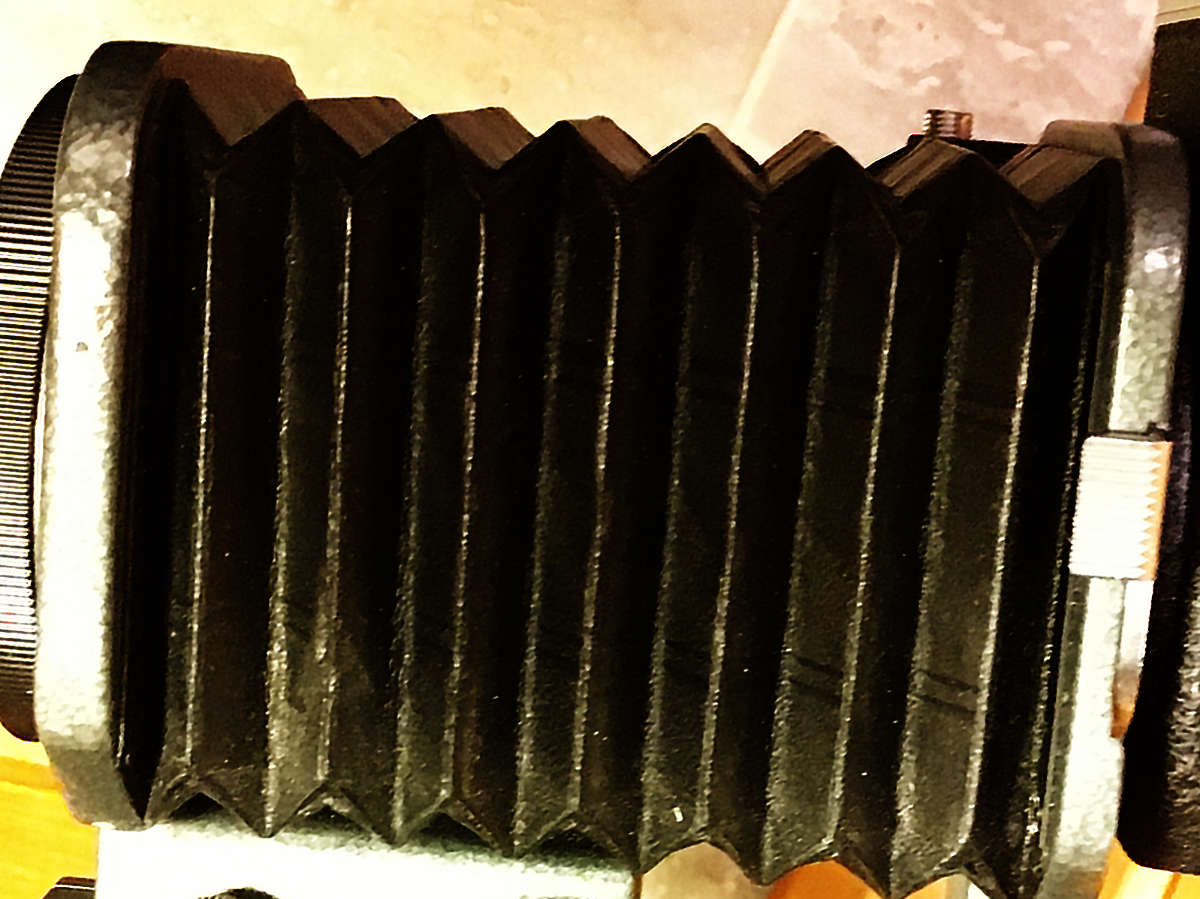
Leitz Bellows II

Toronto. A bellows is synonymous with film photography. For decades, a bellows was one means used to adjust the focal distance between lens and sensitive media so the camera could accommodate any subject distance from say a metre or two to infinity.

Also a bellows could be made very flat. Kodak used a bellows on its folders to allow the camera to be both focussed and ‘folded’ to make it more compact for carrying.

When the minicam craze hit, cameras became smaller and a metal helical device often served as a focussing device. Bellows continued on as a pricier alternative to extension tubes to flexibly separate the camera body and lens for macro photography.

And most enlargers use a bellows to adjust the distance from negative to lens so the projected image on the easel can be made sharp and adjusted over an infinite range of sizes within the capacity of the particular enlarge/lens combination.

NB. The title is a riff on the old saying, “water, water, everywhere” which Samuel Taylor Coleridge used in his poem, “The Rime of the Ancient Mariner“.

Posted in history | Tagged , , | Comments Off on bellows, bellows, everywhere

watching you

ad for American military binoculars made by Universal Camera Corp

Toronto. The premiere binoculars pre WW2 were brands like Leitz or Zeiss or Ross. When the war broke out export of the binoculars ceased and they became military assets.

This left the US struggling with its locally made products. Fortunately, when WW2 hit them, the mighty American industry quickly switched from consumers to military. A contract for binoculars was established with the Universal Camera Corporation  as shown in the above summer 1943 ad that ran in Popular Mechanics. Before and after WW2, Universal were best known for their some what quirky cameras like the 1/2 frame 35mm Mercury still camera.

A big thank you goes to my good friend, George Dunbar, for finding and sharing this interesting piece of photographic history. Drop in to our Saturday, October 1, 2022 fair (Photographica-fair) at the Trident centre on Evans at Islington – who knows, you might even find a Mercury for your collection.

The name of this post is from a Hall and Oates song called Private Eyes. I first heard the song as a theme for the excellent Toronto based detective program of the same name featuring Cindy Sampson and Jason Priestley as the two ‘private eyes’.

Posted in history | Tagged , , , , | Comments Off on watching you

a screwy standard

combination 1/4 and 3/8 screw from Leitz large ball and socket head 14121

Toronto. Standards mean repairs can be made outside the factory. They also mean third parties can make accessories that will fit products from many makers. This applies to photography too. You can usually mount a camera to any tripod. Accessories including electronic flash can be mounted on any camera with an accessory shoe. You can even buy lenses made by others that fit your camera. This is all thanks to standards.

Having said that, you may have seen a camera or accessory at one of our events (next fall fair is Saturday, October 1st) with what looks like an oversize threaded tripod socket.  That is because tripod screws and sockets have two  standards. A 1/4-20 screw and socket is pretty much universal for smaller cameras. A larger 3/8-16 was intended for large (i.e. professional) cameras. These standards were set a few decades after the dawn of the art by the Royal Photographic Society. (Initially there was a third standard – a 3/16-24 thread which is smaller than the 1/4-20 that became universal for small cameras.)

An adaptor with a 3/8-16 outer thread and a 1/4-20 inner thread converts a camera with the larger socket to the smaller tripod screw. Some firms like Leitz used a clever design to provide both standards on one device (like my 14121 Large Ball and Socket head). Alternatively a separate code was used for an accessory provided in either thread size (eg older ball and socket heads).

Posted in history | Tagged , , , | Comments Off on a screwy standard

bravely optimistic

An Argus ad mid 1943 looks optimistically to the future

Toronto. The summer of 1943 found America at war on two fronts: in Europe against the onslaught of Hitler and in the Pacific against Hirohito and the Japanese. At this time, native American industries swung over to war production with an eye to actions post war. The American photographic and optical industries made a strong case for replacing the German photographic and optical industries after the war.

With much chest thumping like that of Argus, the American industries expected to take over the market occupied pre war by the mighty German industry, but sadly it was not to be. America and Germany battled head to head and the Americans and Allies were successful in defeating the Germans in Europe and the Japanese in the Pacific.

Briefly the sun shone post war on the American industries, but soon the Germans took over once again and to the shock of both countries, Japanese industries thrashed them where it hurt – in retail sales! Typical of the war time optimism is that of Argus and International Industries as shown in this ad from Popular Mechanics, displayed here thanks the generosity of George Dunbar and his curiosity. Well done, George!

Posted in history | Tagged , , , , | Comments Off on bravely optimistic