a TLR box camera

1940 ad for the Kodak Brownie Reflex camera

Toronto. In July, 1940, Kodak placed an ad in Popular Mechanics announcing its new “TLR” Brownie. The camera was short lived (1940-41) but did last a decade longer as a synchronized version taking flash bulbs. Aside from the bight full-size viewfinder with its own lens, the camera has all the hallmarks of a box camera – inexpensive, fixed focus, two shutter speeds (one is ‘bulb’), etc.

The camera uses 127 film and recommends a ‘standard’ enlargement of each print (about a 2x enlargement).

The ad suggests you “take your Kodak” if a planned visit to the NY World’s Fair is in your calendar.

Thanks again to my good friend, George Dunbar, for sharing this advertisement of a rather short lived Kodak Brownie camera that used the very professional and finely engineered TLR of the day as a roll model.


Posted in history | Tagged , , , , | Comments Off on a TLR box camera

going full circle …

1940 article on a 360 degree panorama camera

Toronto. … often meant starting over as perhaps the designer of this odd panorama camera did. The article in the December, 1940 issue of Popular Mechanics describes a clock-work camera that records a full 360 degree image in fifteen seconds on just six inches of 35mm film.

The camera is suggested as an alternative for the multi-snapshots taken by police at a crime scene. While the printing of the panorama is not mentioned, I imagine a full plate or 8×10 enlarger could handle the job.

I don’t recall ever seeing such a camera, although there were many practical cameras like the Cirkut series. Perhaps the resolution was an issue when using a half foot strip of 35mm film compared to those ‘snap-shots’ likely taken on far larger negative material using a flash gun on a Speed Graphic or similar camera.

As a youth I read such ideas in various Mechanics magazines. The ideas seldom appeared in stores as marketable concepts translated into actual items for purchase. While Popular Mechanics articles usually described workable concepts, Mechanics Illustrated was notorious for using implausible filler articles. One idea I recall was a means to ‘move’ the plane of focus into the film to ‘correct’ the focus after the photo was taken and processed. In that case the film was in a movie projector…

My sincere thanks to my good friend, George Dunbar, for sharing his research with us, especially on these ‘dog days’ of summer.

Posted in history | Tagged , , , , | Comments Off on going full circle …

Duex Redux

Deux Duex cameras from a 1940 ad

Toronto. The ad in the August, 1940 issue of Popular Mechanics brought to mind the camera Mark Singer presented at our Show and Tell meeting a couple of years back. The little inexpensive camera was only marketed in 1940-1942.

Kodak, no stranger to collapsible, compact cameras, used the fact this camera had a lens that could be collapsed into the body (shades of Leica) as a key pitch in its advertisement. The camera was introduced months before America was dragged into WW2 and taken off market months after America joined the Allies.

The ad shown above is courtesy of my good friend and fellow PHSC member, George Dunbar. We are very grateful that George shares some of his photo history research with others.

Posted in history | Tagged , , | Comments Off on Duex Redux

projecting a colourful 3D display

Viewing in 3D dual transparencies projected in colour – one view for each eye. in colour

Toronto. This article appeared in the September, 1940 issue of Popular Mechanics just a few years after Kodachrome arrived for 35mm transparencies created by an ordinary 35mm camera. Now these slides could be taken ready for 3D and projected so a room of people could experience the slides at once.

We in the PHSC thought nothing about using polaroid glasses in cardboard frames to view 3D slides presented by members Stan White or Paul Pasquarello. But in 1940 they were very special since prior to that time slides were black and white, or drawings viewed by one person at a time with a special hand-held viewer.

A thank you to my good friend and photo history researcher for sharing this article with us.


Posted in history | Tagged , , , , , | Comments Off on projecting a colourful 3D display

see you in Montreal October 16th

Toronto. Montrealer and friend Sol Hadef sent me a note with this poster. Pre COVID, Sol was a regular table holder at our fairs and a member of the PHSC. Montreal is a beautiful city in the fall. I went to University there and my children were born there. Have a look at the poster for details and enjoy La Montreal, even if you stay in the west end where the show will be held. Details? Table? drop Sol at note at solhadef@gmail.com

Montreal Camera Show – October 16, 2022


Posted in activities-other | Tagged , , , , | Comments Off on see you in Montreal October 16th

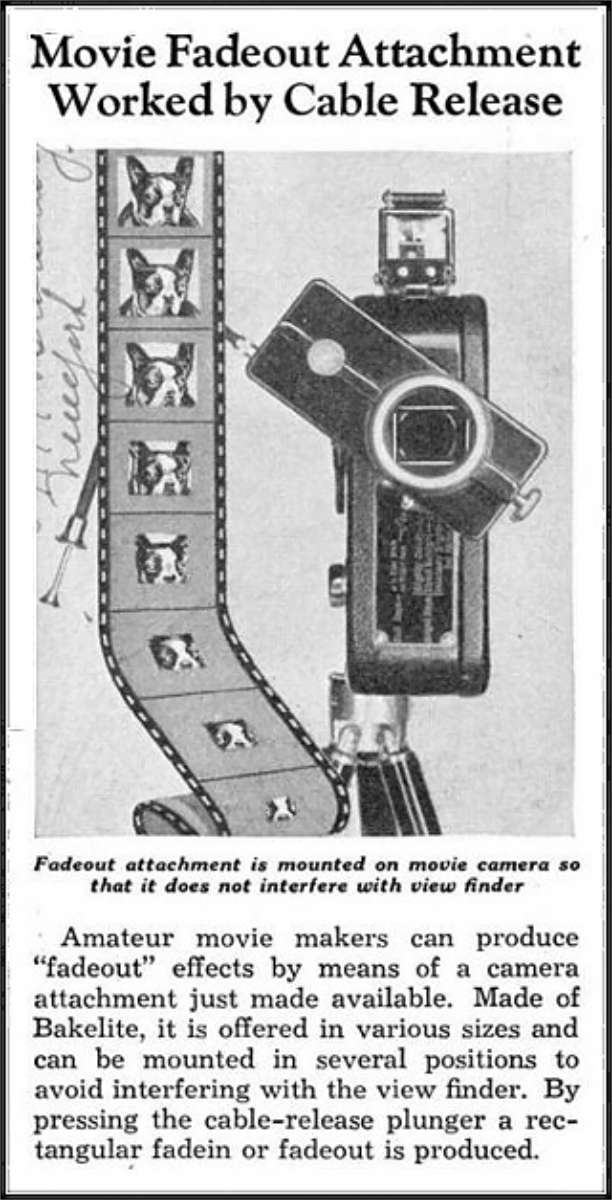
faking a fading light

asccessory for clever fades between scenes

Toronto. Earlier this year we discussed movie fades in relation to a polarizing filter set that could be affixed to many movie lenses for 8mm or 16mm cameras (a May 1940 article). A few month earlier, in October, 1939 another device was announced for use on most movie cameras. This gizmo was slowly closed with a cable release to do a fadein and reversed by slowly easing the release.

This allowed the amateur to ape the professional by using fades to end/begin a scene. The ad itself is a bit confusing since the film strip next to the gadget shows a sharp vignette,  – something perhaps not possible with such an attachment. The idea is certainly of interest and our thanks to my good friend, George Dunbar for once again sharing some of the results of his research.

Posted in history | Tagged , , | Comments Off on faking a fading light

it pays to advertise (again) …

Dec 1939 article on a unique photography retailer’s store front

Toronto. … or so they say. There are many innovative ways to advertise and this article found by my good friend, George Dunbar, who shared it here with us, shows oner example.

In the December, 1939 issue of Popular Mechanics, an article described how a Los Angeles camera retailer created a store front modelled after a miniature camera. While I don’t recall photo shops with fancy fronts,  I can remember a place on Decarie Boulevard above Queen Mary Road in Montreal that was shaped and coloured like a giant orange. The retailer sold Orange Juleps! With its shape and colour, it was hard to miss even though it was on the ‘wrong’ side of Decarie.

We have seen older automobiles or trucks driven around with what appears to be a giant camera to advertise a photographer/photo service. And  years earlier store signs were often shaped to identify the main business conducted therein. Some stores carry on this tradition even today – remember barber poles, pawn shop balls, etc.

Posted in history | Tagged , , | Comments Off on it pays to advertise (again) …

what goes around …

What a clever idea – but already done nearly a century ago using glass plates by C P Stirn

Toronto. … comes around. Or so the old saying goes. And to prove a point, the November, 1939 issue of Popular Mechanics carried this article about an unnamed American ‘inventor’ who came up with the idea of a circular film, camera, and enlarger to take a dozen tiny negatives on the circular piece of film. It was claimed the negatives could be enlarged up to 8×10 inches. (My thanks to good friend and fellow photo enthusiast, George Dunbar, for this thought provoking article from the mists of history.)

Interesting idea, but C P Stirn of New York and Berlin actually sold and advertised such a camera in the late 18880s! Two models are known. 6 or 4 circular  negatives could be recorded by the camera on a small round glass plate. The camera described in the 1939 article seems to have never been made. Perhaps it fell victim to the war, since WW2 started a couple of months before.

In 1982, Kodak introduced a line of disc camera that used a tiny film disc and made 15 tiny colour negatives on each disc. Kodak said enlargements up to 8×10 inches were still sharp. The idea was relatively short lived before the whole concept fizzled. Perhaps independent processors didn’t bother with Kodak’s level of careful sharp focus including special higher resolution lenses – even regular size prints were fuzzy. A Canadian Kodak marketing representative, the late Dennis Canon was a PHSC member at the time and gave us a personal and exciting talk in the old Memorial Hall when the Disc camera line was first introduced.

Today we have digital technology and smart phone cameras making the concept of so few ‘shots’ on a tiny disc of film (and waiting for processing) rather quaint to all but the tiny niche of film buffs who join collectors to haunt our events (P.S. our Photographica-fair is the next event – on October 1, 2022).

Posted in history | Tagged , , , , , , , , | Comments Off on what goes around …

better than a clockwork camera

ad for an electrically driven 8mm amateur movie camera

Toronto. In May of 1939, Popular Mechanics did an article on a nameless camera that used an electric motor rather than the usual spring wound affair. Its ‘fresh egg’ was allowing a full 25 foot spool of film to be exposed in a single run and still have power left over.

The makers must have felt that frequent winding to expose even 25 feet of film in short spurts limited an amateur’s creativity. To compete on price, the rest of the camera was rather basic – a fixed f/2.5 lens, single 16 frame per second shutter, etc.

I was unable to track down the maker – or country of manufacture. My thanks to good friend, George Dunbar for suggesting this article on the burgeoning amateur movie business in early 1939. This along with many other great ideas suddenly stopped when WW2 began that fall.

The title of this post is a riff on the futuristic book (1962) and film (1971), “A Clockwork Orange“.


Posted in history | Tagged , , | Comments Off on better than a clockwork camera

Kamloops in the news

Kamloops Residential School? © Amber Bracken, Kanada, for the New York Times

Toronto. Over the past few years we have seen and heard about the horrific discoveries that began at the  the Kamloops Residential School. These shocking stories culminated in a visit by Indigenous Canadian delegates to the Vatican, an apology by the Pope, and a visit here by the Pope.

Each year, there is a World Press Photo series and this year it includes one showing the graves unearthed at the Kamloops Residential School as photographed by Amber Bracken of Edmonton and published in the prestigious newspaper, The New York Times. This entry is accompanied by the following caption and story:

“Caption:  Red dresses hung on crosses along a roadside commemorate children who died at the Kamloops Indian Residential School, an institution created to assimilate Indigenous children, following the detection of as many as 215 unmarked graves in Kamloops, British Columbia.

“Story: The hanging of red dresses as a visual response to the disproportionate violence faced by women with an Indigenous heritage began in Winnipeg, Manitoba, in 2011; orange shirts are also used, specifically to acknowledge suffering caused to children by the residential school system in Canada.

“Residential schools began operating in the 19th century as part of a policy of assimilating people from various Indigenous communities into Western, and predominantly Christian culture.

“Students were removed from their homes and parents – frequently by force – and often forbidden to communicate in their own languages. Their hair was cut short, and they had to wear uniforms, rather than traditional clothing, were given Euro?Christian names in place of their own, and were subject to physical and sometimes sexual abuse.

“Supreme Court Chief Justice Beverley McLachlin claimed Canada used the institutions to commit cultural genocide.”

Our thanks to Westlicht in Vienna, Austria for emailing the World Press Photo  notice to the PHSC.

Posted in activities-other | Tagged , , , , | Comments Off on Kamloops in the news