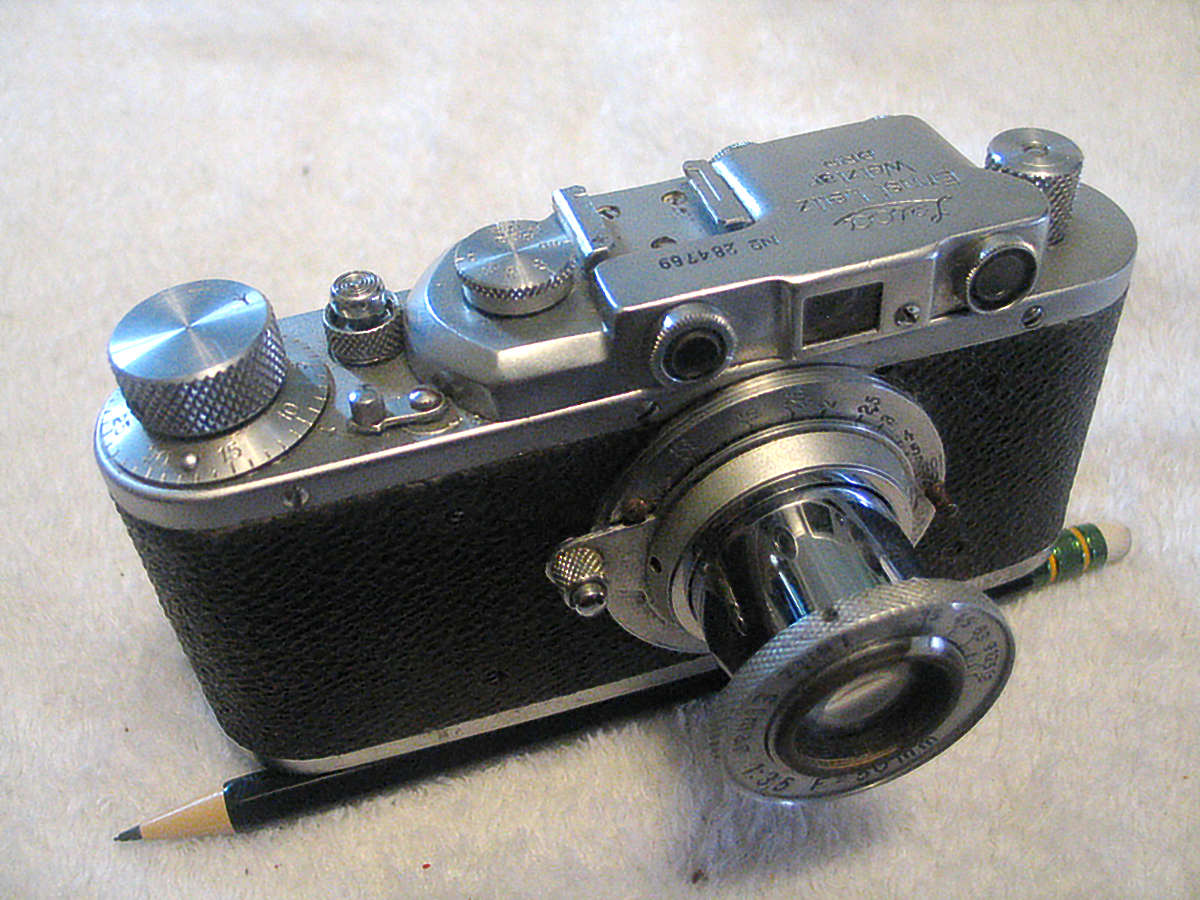
A Leica IIb c1938 from a recent auction posting
Toronto. There is a saying – you can’t tell a book by its cover. In the early days of miniature cameras, it was the same for model type. For example through-out the screw mount era, Leitz cameras were all ‘Leicas’. Only a factory serial number record showed the ‘serial number – model at manufacture’ correlation. Model numbers never appeared on the camera until the post war M series arrived (e.g. M3 – serial number).
There’s a good reason. Many older Leicas could be factory upgraded by request (i.e. from model I to II or III or model II to III), or simply changed (e.g. from the old ‘hockey stick infinity stop to the newer lens ring stop). The camera’s external controls identified a model number to those in the know. No rangefinder or slow speed dial meant a model I. Add a rangefinder and it’s a model II. add a slow speed dial as well and it’s a model III.
Any model could be bought as a I or II at a lower cost and later upgraded at the factory. When Ia, IIa, and IIIa came along, they were mainly the earlier models with an added hole in the shutter speed control disk for the faster nominal 1/000 second shutter setting. Every camera was hand assembled with the parts selected so all aspects of the cameras stayed within tight specifications.
The model IIb (as shown here from a recent auction post) was a transition model and only made for a few years. It was based on the IIIa series but had some features that appeared with the IIIc series. The IIIc series used a die cast body and shutter case – and the era of semi-mass production began.
Leitz often made subtle changes to the Leica, usually so minor that only rabid collectors showed any interest in the variations.