will that be matt or glossy?

Old Spaghetti Factory, Toronto c1979

Toronto. In the early 1950s I was a member of our high school camera club. At the time we could buy a single sheet of 8×10 double weight Kodak photographic paper for a dime. If we washed and dried the paper (after exposure from the enlarger of course) the surface was matt and the contrast a bit soft.

If we placed it face down on a ferrotype plate (not to be confused with an 1800s ferrotype/tintype image), rolled/squeegeed the back, and put the sheet on a heater (held there by a canvas and metal rod affair) until dry, the print would be glossy and the contrast sparkling. The chrome plated iron sheet flatted the paper’s surface and made it appear to have a glossy shine. Any spots not rolled enough would form a blister on the surface and affect the print.

Drying and ferrotyping prints were the final steps in the old film darkroom days of printing negative under the light of an enlarger.

When black and white was king, the surface and tone of the paper was wide so one could choose surface, weight, grade, maker, etc. in a confusing array of choices. Print and processing labs chose a particular brand and simply offered matt or glossy finish. Early colour prints were such poor resolution that they often came from the lab with an embossed pattern. While the black and white films and papers allowed a wide range of artistic choices, the best one could do with colour was to just ‘get it right’.

Note: The post title is a riff on the old pre-VISA credit card days slogan, “Will That be Cash or Chargex?“.

Posted in history | Tagged , , , , | Comments Off on will that be matt or glossy?

to hell and back

first TH&B train to arrive at Dundas, Ontario Station (1895) – courtesy of Hamilton Public Library Archives

Toronto. In the heady days of railway travel there were many railroads operating. On such railroad was the Toronto, Hamilton and Buffalo Railroad with headquarters in Hamilton. My friend’s grandfather and father called it the “To Hell and Back” railroad. His grandfather was a tinsmith working for the Grand Trunk/ Canadian National Railroad, a competitor to the mighty CPR which absorbed TH&B.  I met him as a little kid and like all grandfathers, he was a font of fascinating stories.

In pursuit of Canadian photographic history, George Dunbar came across the Hamilton Public Library Archives and this photograph of the little Canadian TH&B railroad line showing the first train in the Dundas (just by Hamilton) station in 1895.

In pursuing photographic history, be sure to check out your local archives, museums, and libraries as well as this wonderful resource in nearby Hamilton.

Posted in history | Tagged , , , | Comments Off on to hell and back

I met a camera that wasn’t there …

Mathieu Stern’s example of a ‘fake’ camera photo (courtesy of PetaPixel website)

Toronto. We have all (well some of us) heard about artificial intelligence (AI) tools and the amazing job they can do to create a photo. They can also create photos of cameras that were never made!

The PetaPixel site shows  some examples: “Mathieu Stern tells PetaPixel that he generated the fantasy cameras using Midjourney before working on them in Photoshop.” Have a look at the article, “Photographer Fools the Internet With AI-Generated Cameras That Don’t Exist“.

Our enthusiastic photo historian and good friend, George Dunbar, came across this article and shared it. I also received an email from Russ Forfar on  the same article. Thanks guys! The article shows how modern technology interacts with the art of photography raising a concern once again on whether or not “the ‘camera’ or a ‘print’ lies”.

Note: Post title is a riff on a line in the amusing poem called Antigonish [anti gone ish] by Hughes Mearns. The poem also became part of a 1960s British war movie called, “The man who never was“.

Posted in history | Tagged , , , | Comments Off on I met a camera that wasn’t there …

Christmas a century ago

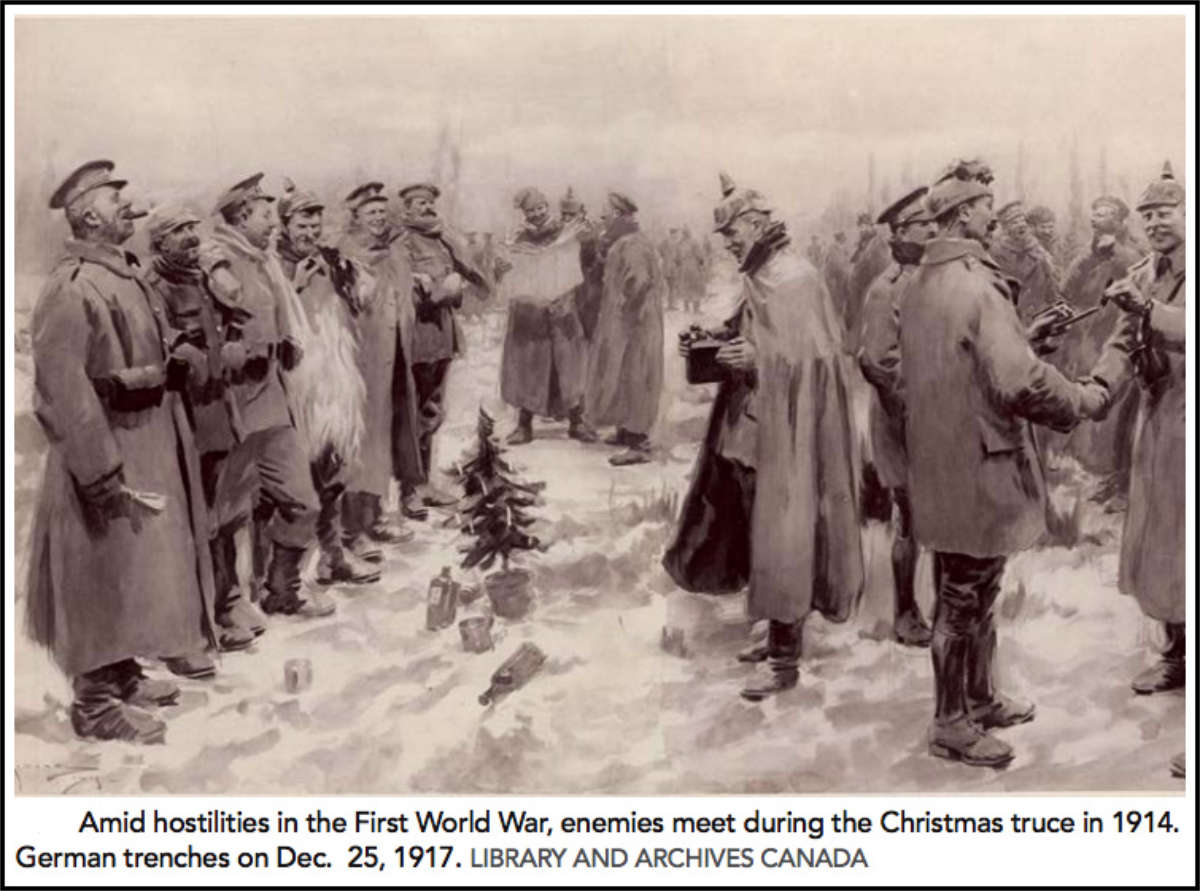
Enemies taking a break at Christmas

Toronto. Our erstwhile historian and good friend, George Dunbar, discovered this photo from the LAC in ‘The Lake Report‘ and shared it with us.

It shows the two sides in WW1 taking a break and celebrating Christmas together. One soldier is taking a photo of friends and the opposition troops.

As George writes, “This item tells me that we (and soldiers, too) were more civilized 100 years ago (from “The Lake Report,” a weekly in Niagara-on-the-Lake).

Posted in history | Tagged , , , , , | Comments Off on Christmas a century ago

just another ad for the Beacon II

a 1948 ad for the Beacon II with synchronized flash

Toronto. George Dunbar came across this ad in Popular Mechanics for July 1948 and shared it with us. I did a couple of posts on this typical box camera and its predecessor (both dressed up to look like the popular minicams). The post on the Beacon is from a November, 1947 ad in Popular Mechanics, while this post shows the Beacon II from a May 1951 ad in LIFE magazine.

As mentioned earlier, the camera really is a simple box camera. Whitehouse, the maker, goes to great lengths in these ads to portray its cameras as more sophisticated minicams at far more reasonable prices.

Browse the previous two posts for more information on these rather simple plastic box cameras and see how the ads emphasize the good qualities while down playing or outright ignoring the not so good qualities. This was before the days of “Truth in Advertising”. Note that these ads simply omit the downside and infer the quality as a bargain at the price. Grey area?

Posted in history | Tagged , , , , , | Comments Off on just another ad for the Beacon II

our AGM and December Great Finds Show and Tell

Toronto. Come out and see what members bring from their collection. We will have a brief Annual General Meeting (AGM) hosted by Clint followed by the traditional Show and Tell with selected members showing items and briefly describing them (or asking for more information).

If you have any questions, please contact our programme director, Celio Barreto at program@phsc.ca. Reserve your space today at Eventbrite for this ONLINE presentation!.  Note: use the links in the text above, not in the jpeg of the poster (no live links in this jpeg).

Our December, 21 2022 AGM and S&T meeting


Posted in program | Tagged , | Comments Off on our AGM and December Great Finds Show and Tell

Edward and the Giant Camera

Casa de Vecindad, D.F. 1926 from the Aperture book.

Toronto. Edward Weston was an iconic American photographer. In 1973 Aperture printed a massive coffee table size book called, “Edward Weston: Fifty Years” with many of his famous prints plus a biography by Ben Maddox. You may be able to see a copy via your local library.

I bought my copy a year later in the summer of 1974 while living in Quebec. At the time, I was learning about the many great photographers. In terms of population, we were a rather small country with history dating back a century or two. At the time, I knew of few Canadian photographers.

This wonderful book shows the beautiful works of Weston, started when photography itself was less than a century old.

Note.The title of this post is a riff on a children’s book by Roald Dahl. “James and the Giant Peach“. I read this book – and others by Dahl – to my children when they were young.

Posted in history | Tagged , , , , , | Comments Off on Edward and the Giant Camera

taking its measure

Spring 1948 ad for a GE PR-1 hand held light meter

Toronto. While browsing for photo history material, George Dunbar spotted this May 1948 ad for a GE PR-1 selenium exposure meter and shared it with us. To separate the GE meter from others, it was advertised as having a ‘memory’ long before solid state memories existed. The meter likely trapped the exposure needle when the activation button was released.

Until glass plate and film media became sufficiently sensitive to demand accurate sub-second exposures, photographers managed with experience and notes relating plates, cameras, and light.

When ‘instantaneous’ exposures became common, various ‘calculators‘ and extinction meters were offered. The first true exposure meters were those using a selenium cell to detect the light and convert the light photons into a tiny current. This current usually gave a meaningful number which a calculator could translate into camera settings for a given plate or film sensitivity. The results usually displayed combinations of shutter speed and f/ stop.

Unfortunately, selenium cell light meters were useless after the evening began or to measure ordinary indoor light level. The arrival of CdS cells (which required a battery) solved this short coming. The incorporation of a meter in the camera spelt the end of the hand held meters. And today even translation to camera readings is automatic! That’s the meaning of ‘program’, ‘aperture priority’, and ‘speed priority’ settings on digital cameras.

Note. The title is from a common expression.

Posted in history | Tagged , , , , , | Comments Off on taking its measure

Auction this Saturday December 17, 2022

poster for our estate auction

Toronto.  Winter is in the air and we are holding our INDOOR AUCTION on SATURDAY, December 17, 2022 down in the Long Branch area of Toronto at the usual venue – free parking and free admission.

This Estate Only Auction will feature – rare items and  user items for both film and digital folk – photographs, cameras, lenses, accessories, books, and more. Come out and enjoy this event while adding to your collection or user gear! Click on the AUCTION tab here or in the menu bar above for directions.

Everybody is welcome. Sorry, no consignment lots at the door.  All lots are ESTATE Lots – really good items, many very rare. First come first serve.

We owe a big thanks to Clint for photographing the lot examples shown here (samples have been added each day including today). Click on the photo below, then on the beautiful Leica 21mm lens, and then on any lot icon to see it larger. Your left/right arrows will work to move from one enlarged photo to another. Enjoy!

Posted in auction | Tagged , , , , | Comments Off on Auction this Saturday December 17, 2022

the man from T.M.K.

Fan Ho – approaching shadow, 1954.

Toronto. While searching for photographic historica, George Dunbar came across the works of a Chinese (Hong Kong) photographer, Fan Ho on the South Korean website called, “Public Delivery“.

George writes, “Some wonderful ‘street photography’ in China  by Fan Ho. He has been compared to Henri Cartier-Bresson. I certainly appreciate this amazing talent, will you?”

I have been a fan of Cartier Bresson and Paul Strand for many years. When I first saw this image by Fan Ho, it reminded me of Paul Strand’s arresting 1915 photograph titled, “Wall Street“.

Note. The title is a riff on the mid 1960s TV series, “The Man From U.N.C.L.E.”. At one time Hong Kong was a British colony and later a protectorate. After the 99 year lease, in 1997, it reverted to China. And China is sometimes called, “The Middle Kingdom” as I discovered in my days of reading The Globe and Mail.

Posted in history | Tagged , , | Comments Off on the man from T.M.K.