grainy days

Robert James Wallace – Plate VII from “The Silver ‘Grain’ in Photography” by Robert James Wallace, The Astrophysical Journal, Vol. XX, No. 2, Sept. 1904, pp. 113–122, Chicago.

Toronto. In film photography, grain is the ‘clumping’ of metallic silver created by the development of exposed silver halides. Large clumps were not a great issue when the sensitivity of glass plates was relatively slow and the plates and cameras so big. However, it became an issue when the minicams, 35mm films and 120 films took over the market in the 1930s.

Generally speaking, the greater the film sensitivity, the greater the grain, the lower the resolution and the softer the contrast. before and after WW2 great effort was spent in the darkroom to increase film speed a stop or two and reduce the grain. So called fine grain developers became popular for B&W film (I eventually settled on microdol-x  and microphen).

Copy film was very slow but contrasty with high resolution and little visible grain. At the other end of the scale were HP4, and Tri-X, etc. films – relatively fast, soft in contrast (more pleasing) with lower resolution and more visible grain.

When colour film arrived the ‘grain’ was the smallest ‘dot’ of colour dye created by the developed silver halides. In today’s digital cameras, grain doesn’t exist at all (no film). A comparable effect is pixels – the more there are, the better the resolution, etc.

Note: The title of this post is a riff on a Carpenters song called, “Rainy Days and Mondays“, a song I have always enjoyed.

Posted in history | Tagged , , , | Comments Off on grainy days

MiPHS journal -The Photogram

A Kinnear plate camera c1860s from the Niederman collection

Toronto. MiPHS is a photo collecting organization in Michigan. They  publish a quarterly journal (The Photogram) available to all MiPHS members in pdf file or hard copy versions. Please note that The Photogram is copyright 2022 by MiPHS as its official newsletter.

The current issue (and their website) contains instructions on how to join.  Consider joining this fine group of camera and image collectors. We have seen some folks from MiPHS at our meetings (pre-COVID) and some of our members are also MiPHS members. On occasion our editors have collaborated to share articles.


Posted in activities-other | Tagged , , | Comments Off on MiPHS journal -The Photogram

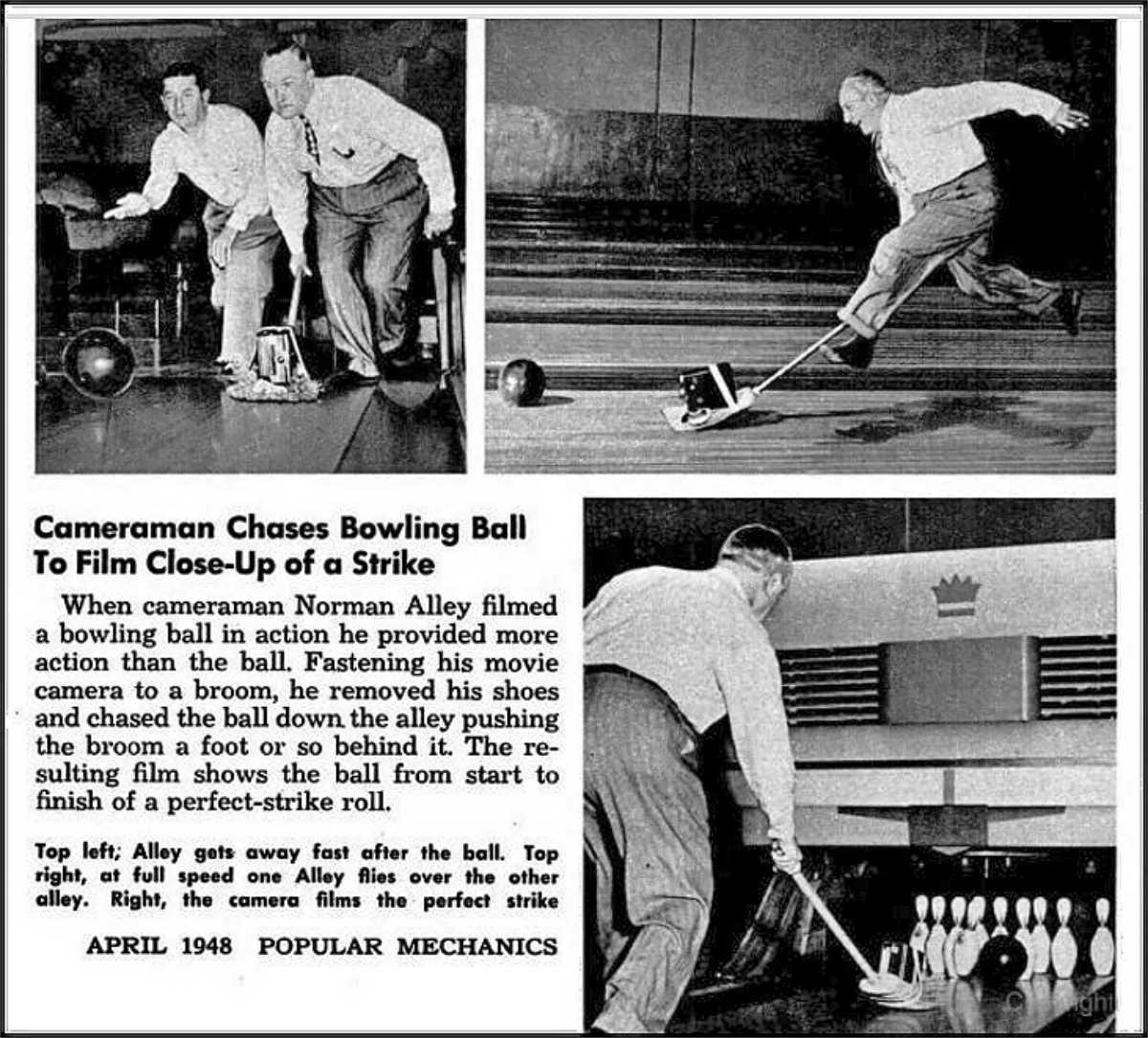
bowl on

a still shot from an article in the April, 1948 Popular Mechanics magazine

Toronto. Here’s one way to take a neat video of a bowling strike. The technique can be used in other sports too. George Dunbar, a retired cameraman for IBM here in the Big Smoke, used this technique (totally unrelated to the Popular Mechanics article) to capture a curling sweep.

George has been a movie/video photographer ever since he was a kid. He writes, “Here’s an inventive cameraman filming a strike at a bowling alley in 1948.

“Twelve years later, 1960 (having never seen this magazine item), I made a similar 16mm film-shot at a curling rink.Running on the ice was a treacherous experience, however the film ended with a perfect stone to the house.

“The short clip was sold to the newly-opened CFTO-TV station’s sports Dept. – my one & only film sale to TV!”

Note. The title of this post came to mind when I recalled the song “Roll On Mississippi”, sung here by Charlie Pride.

Posted in history | Tagged , , , | Comments Off on bowl on

calling all cameras

article about a camera and a portable radio combination

Toronto. Anther faux pas in North American camera sales. An article in the April 1948 issue of Popular Mechanics touted a case that carried a small camera plus a ‘portable’ battery powered radio.

Smart phone users may relate to this story but the battery was non chargeable and the camera and radio were separate entities. Modern smart phones use rechargeable lithium-ion cells (light and powerful), connect to cell towers via radio at a far higher frequency, and have a teeny digital camera built in.

The article mentions a ‘superheterodyne’ receiver which was the norm even earlier. The vast majority of radios used this kind of circuit as did early TVs  – TV video used AM (actually vestigial side band) while TV sound used the relatively new FM for better sound quality.   The over the air signals were usually amplified and then transformed to intermediate frequencies (IF) and further amplified before being detected and sent on to the audio amplifiers, etc..

This article was found my my good friend, George Dunbar, who shared it with us. It was possibly a good idea since minicams and portable radios were popular post war, but alas, it seemed to be a non starter where it counts – in retail sales.

Note. The post title is a riff on, ‘Calling All Cars’ which was a popular catch phrase last century (police alerts, radio programs, board games, video games, etc.).

Posted in history | Tagged , | Comments Off on calling all cameras

32 Boo Boo by Zoom

Toronto. a small meeting this time. Celio was tied up with Christmas grades so Clint organized our 32nd executive meeting via ZOOM  on Wednesday evening, December 7th.

Our March 2017 Spring Auction was held here in Long Branch

Please note, the PHSC Newsletter still needs an editor. Nevertheless, if you would like a personal copy but haven’t joined up as yet, just drop me a note at news@phsc.ca.

Our membership secretary summarized membership as little changed since the  October report. We are still checking out an alternative meeting locale with faster, more reliable internet so we can offer joint in person and ZOOM meetings. However, as we rush towards the year end holidays, some things such as investigating a new locale had to be delayed.

The monthly meeting this month (December) will be a Show and Tell. While Clint has pencilled in over a half dozen names already, we can always use some more. If you have an interesting item and would like your few minutes of glory, drop me a note at info@phsc.ca and I will pass it along. Our January 2023 speaker is Cassie Stiles who will discuss the contents of her award winning MTU thesis.

You may have noticed above, the sign outside our auction site in Long Branch.  This is to alert you to our latest auction will be held this month on December 17th. The legion hall is in Long Branch (south-west Toronto). It will offer estate lots. Details and photos will be posted here before the 17th.

Our next journal will be out before year end according to the editors (it is nearly finished).

Like I have said many times, “Have a great fall/winter and let’s hope the seventh wave of COVID-19 and its restrictions are very modest at best!”. Note: The Late Premier of Quebec, Robert Bourassa, was fondly called ‘Boo Boo’.

Posted in activities | Tagged , , | Comments Off on 32 Boo Boo by Zoom

a few of my favourite things

from the August 2022 article by in The GALA Herald (Hamilton)

Toronto. Photo books and coffee – what’s not to love? Many of my books are about photography: its history, its cameras, its technology (film), etc. And we begin each morning with a cuppa.

After visiting Hamilton (the west end of our ‘golden horseshoe around Lake Ontario), George Dunbar writes, “Here’s an interesting new idea in Canadian photography: A photography enthusiast in Hamilton has opened a coffee shop that specializes in photography books along with coffee and cookies.

“On a recent trip to Hamilton I visited Katie Sadie at Rooney’s, a pleasant place for photographers, book lovers, conversation and coffee.

“The attached article recently appeared in a local community newspaper, the GALA Herald.

“Here’s wishing Katie great success with her fine entrepreneurial venture.”

Note: The title of this post is a line in a song from, “The Sound of Music” sung so well by Julie Andrews.

Posted in activities-other | Tagged , , , | Comments Off on a few of my favourite things

a portrait for peanuts

1986 portrait of Chas. Schulz by Karsh – now in the NPG, Washington

Toronto. A portrait captures not only the subject, but the ‘essence’ of the subject. It is a rare attribute for a photographer. Yousuf Karsh in Ottawa was one such photographer known world wide for his arresting portraits of the famous, including iconic cartoonist Charles Schulz in the late 1980s.

Cartoonists with well recognized cartoon strips had two choices when they grew too old or weak to continue on. They could ‘sell’ the strip and its characters to other skilled artists or they could elect to end the strip. Charles Schulz, the creator of the strip ‘Peanuts’ chose to end his strip.

When Schulz was diagnosed with a terminal condition, he announced in late 1999 that he would end his strip (Peanuts). A few months later he died. Ironically, over a dozen years earlier, in 1986 Karsh took his portrait. That portrait now resides in the collection of the National Portrait Gallery (USA). A fitting tribute to both the photographer and his subject!

My thanks once again to good friend George Dunbar for sourcing and sharing this portrait of Schulz  by Karsh.


Posted in history | Tagged , , | Comments Off on a portrait for peanuts

bridging the gap

Samuel Dixon walking over the gorge on a tight rope c1890 courtesy of Brock University Archives

Toronto. Niagara Falls has always been an attraction – one way or the other. InFebruary, 2011, we were enchanted by a talk on Niagara given by Dr Norman Ball. His talk was titled, “Niagara Falls: A Story of Crazies, Improbabilities and Photographers. His talk covered the history of the Falls including the daredevils who crossed the Falls on a tight rope.

Brock University now has an archive of Niagara Falls Stereo Cards. This online service gives you an idea of the many people attracted to the Falls and prepared to best them.  Shown at left is an 1890 stereo card in the archive. The cut line says, “In 1890, Samuel Dixon crossed the River over the gorge near Queen Victoria Park.  In 1891, he walked over the River again, this time between the Cantilever Railway Bridge and Railway Suspension Bridge.”

I remember Red Hill and his daring ride over the Falls in a barrel in the late 1940s – before such stunts were banned.

My thanks to good friend, George Dunbar, who found the Brock University Archive of Niagara Falls Stereos and shared the photo and link with us.


Posted in history | Tagged , , , , | Comments Off on bridging the gap

the sky is falling …

1906 article re Wollensak’s solution to media insensitivity to blue light

Toronto. … or so said Chicken Little in the Children’s fable (I learnt the English version … ). For many years film and glass plates were basically insensitive to blue light (orthochromatic) so clouds and sky exposed for the landscape came out as white (ie. severely underexposed). Some filters solved the problem with a half clear bottom and a yellow top.

Wollensak, in this article from the Amateur Photographer for January, 1906, came up with a novel shutter solution. Its ‘Skyshade’ shutter slowly exposed the sky at a varying speed while the landscape was exposed at an adjustable ‘fast’ speed. This was all done with the shutter mounted in front of the lens and the camera securely mounted on a tripod.

Our thanks to my good friend, George Dunbar, for sharing this historic article with us.

Posted in history | Tagged , , , , , | Comments Off on the sky is falling …

dancing with mr stanhope

an array of Stanhopes courtesy of the Collectors Weekly website

Toronto. Did you know that microfilm images have been around since the beginning of photography? The role of John Dancer is recorded on the Collectors Weekly website under an article called, “Royalty, Espionage, and Erotica: Secrets of the World’s Tiniest Photographs (the image to illustrate this post is courtesy of their website).

The source of the name ‘Stanhope’ is for the type of lens used to view these tiny marvels instead of a much more expensive microscope.

The role of the Stanhope lens is also noted there and in a Wikipedia article. A few of our members collected “Stanhopes” which came in many guises. All used a Stanhope lens and a tiny positive image viewed by holding the lens between the eye and a bright light source.

NB. The title is a riff on the book “Mr Standfast” by one of my favourite authors – John Buchan  – also known as Lord Tweedsmuir (and governor-general of Canada back in the day). At least one of his books – “The Thirty-Nine Steps” written in 1915 – was adapted for a movie of the same name.

Posted in history | Tagged , , , , , | Comments Off on dancing with mr stanhope