faster than a speeding bullet

Edgerton cutting the card

Toronto. When photography was invented, exposures were measured in minutes. Between then and the end of film’s popularity something happened: Speed. The light sensitive media and lenses through research and innovation became much faster. In fact, after dry plates arrived, shutters became a necessity.

For decades, minicams attained a top exposure speed of 1/1,000 second with their tiny focal plane shutters moving an open slit across the medium at 1/20th to 1/125th second. By the end of the film era, the top shutter “speeds” on a few retail cameras  reached 1/4,000 second or faster. Beyond that, electronic flash as shown here by Dr Harold Edgerton of MIT took over.

Modern digital SLRs have even faster electronic shutters to accommodate the far higher ISO they are capable of reaching. And with all the automation, most photographers (especially smartphone users) simply ignore shutter speeds provided they can stop any blur/jiggle, and the image is relatively noise free.

The title of this post was one of the Superman tags from last century. I grew up reading comic books about Superman and the other super heros. The Canadian band, “Crash Test Dummies” immortalized the flying hero with their song about Superman.

Posted in history | Tagged , , , , | Comments Off on faster than a speeding bullet

slow train

slow speed shutter dial

Toronto. In the early years of the minicam, leaf shutters were often used to allow for slow speeds. The early focal plane shutter Leicas had speeds from about   1/500 second down to about 1/20th second when both curtains were open.

To allow slower speeds with the focal plane shutter, the release of the second curtain had to be delayed. Leitz accomplished this by using a gear train that delayed the closing of the second curtain by up to 1 second giving the little camera slow speeds from 1/20th to 1 second while still using the focal plane shutter.

This clever idea allowed interchangeable lenses to be used without recourse to leaf shutters or forgoing timed slow speeds. A Leica model B used a leaf shutter but was limited to the 5cm lens. The camera was an unsuccessful model when it was released (1926 to 1930 using two kinds of leaf shutters). Today, it is a very rare Leica model.

The title of this post is from the song of the same name as sung by Michael Flanders with Donald Swann. The song is featured on their LP record, “At the Drop of Another Hat“. Both “At the Drop of a Hat” and “At the Drop of Another Hat” were theatre revues by Flanders and Swann. A subset of the songs appear on each LP (I have both and much enjoyed them).

Posted in history | Tagged , , | Comments Off on slow train

Okey-Bokehy

Red IBM Selectric with star sparkles in background

Toronto. A recent post on depth of field prompted a note from my friend George Dunbar along with a photo for a red IBM  Selectric typewriter (remember those machines with the flying golf balls of interchangeable typefaces?).

For the ad, George used crinkled aluminum foil as a background and a star cutout on the lens to create the sparkly stars behind the typewriter and model. While George took the photograph with the foil background long before Photoshop arrived on the scene, modern day photographers with smarts on using layers in Photoshop or its layer savvy competitors (like Affinity Photo which I use) can make a similar background using any desired filter cutout to create the desired “sparkle” and then merge it with a layer containing the original photo.

It’s a piece of cake nowadays to add all sorts of fancy backgrounds to what were once pedestrian shots.

Posted in history | Tagged , , , | Comments Off on Okey-Bokehy

you move too fast

sub-second shutter speeds

Toronto. Once dry plates were in common use, shutters became a necessity to make reproducible second and sub-second exposures. If “you move too fast“, you are blurry even though the shutter is set to ‘I’ for instantaneous. As years went by, light sensitive media and photographic lenses increased in speed, making truly fast shutters mandatory.

By mid last century, only two basic shutter designs were important: the leaf shutter and the focal-plane shutter. Leaf shutters allowed flash to operate correctly at any setting. Their downfall was the need to have one per lens since the most efficient location was between two groups of lens elements. Leaf shutters are both very complex, and limited by physics in their top speed. A few cameras placed the shutter right behind the lens so one shutter would work with all interchangeable lenses. The larger leaf size necessary to allow for fast aperture lenses, makes the shutter mechanism bulky and limited in its fastest speed.

Focal-plane shutters must be integral to the camera body. The curtain(s) move across the sensitive media at a rather slow speed. Since the first curtain has to be fully open and the second curtain not yet in motion for successful flash operation, flash synchronization is relatively slow (about 1/50th to 1/125th second tops).

In action, the first curtain is released across the focal plane followed at various times by the second curtain resulting in a variable slit. The slit width and spring mechanism determine the exposure. Old Graflex cameras used a single long curtain with various slits cut in it. Spring strength and slit choice were made following a table on the camera to create the desired shutter speed. Clumsy. Minicams that used a focal-plane shutter usually had two curtains and an automatic self capping function when winding the shutter and returning the curtains across the sensitive media.

Like the post on “Slow Down“, I used words from that Simon and Garfunkel song to title this post too. Of course in this digital age, and especially with digital cameras in smartphones, no one gives a hoot about shutter design any more.

Posted in history | Tagged , , , , , | Comments Off on you move too fast

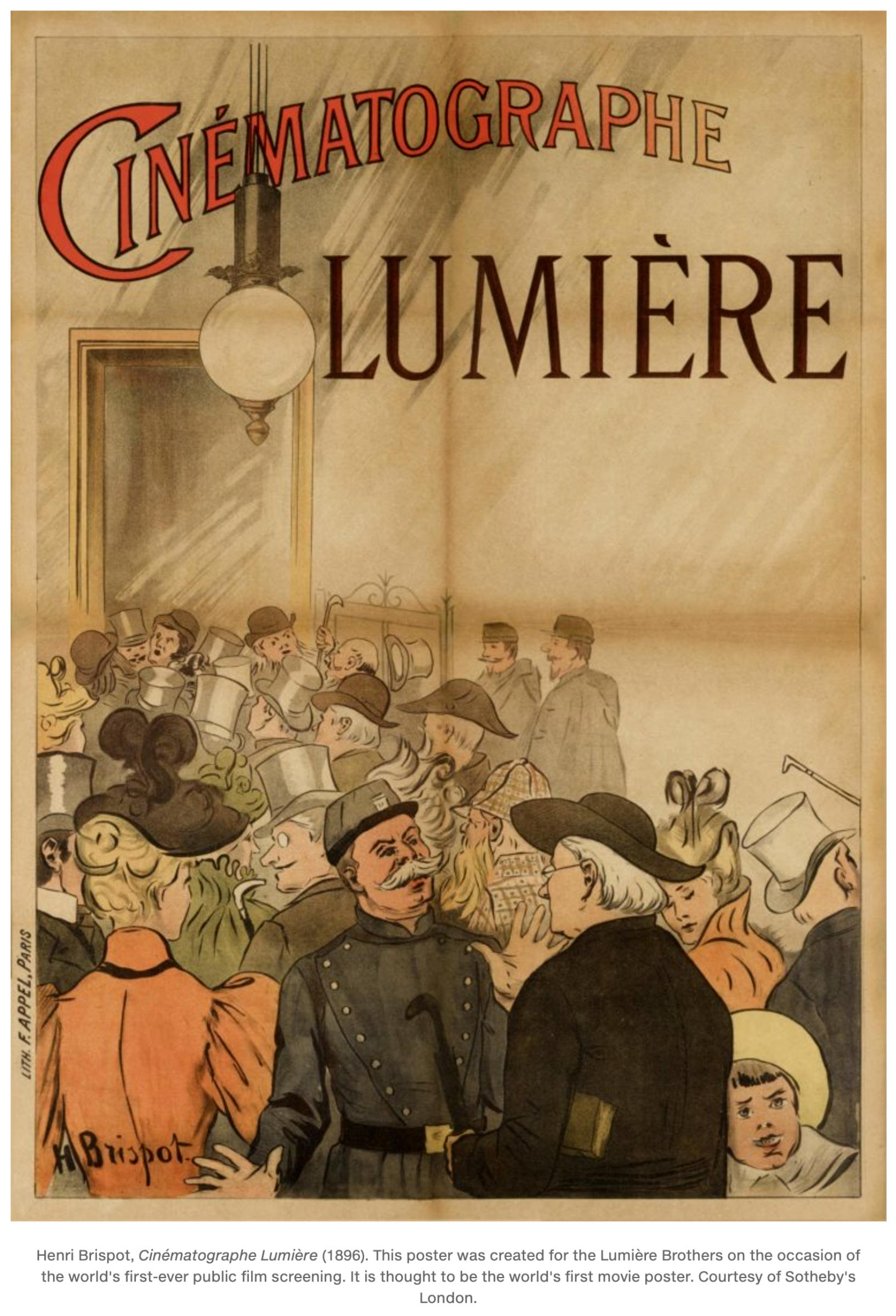
the invention of movies

First Movie Poster – 1896

Toronto. In North America, we usually think of Thomas Edison when considering that aspect of history. In Europe, credit is usually given to the Lumière brothers of France (of Autochrome fame).

Actual work on motion predates photography when mechanical devices were designed to show motion. The first use of photography to study motion is attributed to Eadweard Muybridge, an English photographer.

Today, we seldom think about the impact of movies on society given the internet, smartphone videos, and television. However, the grammar of movies was created last century based on the even earlier grammar of live plays. As motion pictures evolved, their  grammar has infused television. Movies rapidly ate up plays, books, short stories and ideas as weekly fodder to generate the material demanded by theatre audiences.

The illustration above is the very first known movie poster (1896) created for a presentation that almost no one attended. Today, thanks to institutions like Ted Turner’s Turner Classic Movies (TCM), the rich production of California’s Hollywood last century can be viewed and assessed for its realism vis-a-vis the source material and modern day television serials.

My thanks to good friend George Dunbar for sharing this piece of photographic history with me.

Posted in history | Tagged , , , , , | Comments Off on the invention of movies

controlling depth of field

a 9 leaf iris diaphragm c1970

Toronto. As a general rule, the longer the focal length of a lens, the smaller its maximum possible f/stop and the less its depth of field. Conversely, the shorter the focal length, the greater the depth of field and the larger its maximum possible f/stop can be. The human eye has a relatively short focal length and a very wide depth of field making almost everything you see in focus – especially in sunlight when the iris closes to help limit the light intensity hitting the retina.

Smartphone cameras also have short focal lengths. My older smartphone has a camera lens of 3.3mm f/2.4 (equivalent to a 35mm lens in angle of view). Newer models have a lens equivalent to a 28mm lens and its wider angle of view and even greater depth of field.

Once photographic lenses increased in speed, a fixed Waterhouse stop was generally used to increase the depth of field (and reduce the light hitting the sensitive media). A slot in the lens barrel was used to slip the Waterhouse stop between the lens elements. Different Waterhouse stops were made available to adjust depth of field.

When iris diaphragms became common place, Waterhouse stops disappeared and the issue was the number of leaves used. The more leaves that were used, the more expensive the diaphragm was to make and the rounder the tiny aperture became. Aperture shape  affected the bokeh of the lens.

Posted in history | Tagged , , , | Comments Off on controlling depth of field

noir et blanc

Photo courtesy of PhotoEd magazine.

Toronto. My good friend and our PHSC treasurer, John Morden, also collaborates with wife Sonja Pushchak on the very successful PHSC News monthly pdf newsletter.

John writes, “Below is a link to a competition that Rita is having in her magazine [PhotoEd]. I would normally put this in the next issue of the classifies in the NEWS but the deadline date is before the next issue. What about a post on the website?”

For those of you who are digitally challenged, the twitter link is here.

Posted in activities-other | Tagged , , , | Comments Off on noir et blanc

fast photo prints in 1924

fast printing at Black’s. Click for the 1924 process.

Toronto. In the days before the end of the broad popularity of film, you could take your exposed colour rolls to a fast film service outlet like Black’s or Japan Camera and see the prints in an hour. In the 1950s, the local drugstore could sent your black and white rolls to a service like Chas. Abel here in the city and have them back the following week with a set of prints for each roll.

In 1924, automated bulk processing of prints was a novel idea. This article in the March 1924 issue of Science and Invention illustrates one set of machines that significantly cut the number of people needed to process film. The article suggests that the negatives are pre-35mm and can be contact printed. The article doesn’t mention any film size criteria, just that the negatives are “wooden framed”.

Perhaps there was enough volume for runs of different size negatives. Wooden frames suggest glass plate or cut film although roll film had been manufactured and sold  for decades.

Posted in history | Tagged , , , , , | Comments Off on fast photo prints in 1924

ya got mail

Exchange Journals

Toronto. Any group or society needs to have a list of its members, including photo historical societies. Our society was founded in late 1974 and began to issue a regular newsletter/journal in March 1975.

Most members are paying members. That, plus events like annual fairs, fund the society. Late in May 0f 1983 we recorded our first exchange member, the Pennsylvania PHS. Exchange members are similar groups who have agreed to swap newsletters or journals in lieu of paying the annual membership fee. In 1984, under the guidance of the late Bill Belier, exchange membership grew to 22 (the PPHS dropped out after the first year of exchange).

By the late 1990s, we had about 47 exchange members which has dwindled to 20 by this year for many reasons (mostly changing interests). Exchange newsletters are reviewed and the review is sent out with the journal. The newsletters are then filed in our library and available on request to any current member.

When the pandemic hit and social contact was discouraged, editor Bob Lansdale led a few other members to send a set of exchange newsletters via pdf to all current members. Bob arranged permission for those newsletters used in the pdf release. He then grouped each set as a magazine supplement. If you are a current member and haven’t seen the newsletter supplements, drop me a note at info@phsc.ca.

Posted in history | Tagged , , , , , , , | Comments Off on ya got mail

photographica c1925

f/2 camera and bright projector of film stris c1924

Toronto. The magazine Science & Industry addressed the wide audience of tinkers and experimenters (mostly boys and youths) and as such it included a wide range of things. In this example article, a camera is shown, but unnamed. The take home was that it had an f/2 lens and could snap theatre and street scenes at night under the existing light in those environments.

The second article covers a unique projector. Again unnamed, this machine uses an “ordinary car headlight bulb” and a resistance to run on house current. Since such a bulb in 1925 took 6 volts and house current was 115 volts, the resistor would run quite hot.  The bulb is like a point source illumination so the result would be a very contrasty light. Prints were photographed on movie film and each frame could be shown separately.

A rather tedious conversion to save the size and weight of a stereopticon projector. We had a more sophisticated projector (by SVC) when I was a kid that showed both slides and film strips like the film used in the 1925 projector. A thank you is in order for friend George Dunbar who offered this tidbit of photographic history.

Posted in history | Tagged , , , , | Comments Off on photographica c1925