the world as seen by Inge Morath

A foggy city view – by Inge Morath

Toronto. Inge Morath was an Austrian-American photographer. At the time of her second marriage (to American playwright Arthur Miller), she emigrated to the States. Her work was featured in the TIME–LIFE Photography series in the late 1960s, early 1970s.

Inge was a member of the famous Magnum Photo organization in Paris, France. Stefan  Musil, of the Austrian Gallery “Galerie Ostlicht”, dropped me a note a couple of weeks ago that Inge’s work would be in a gallery exhibition there from December 9th, 2020 until June 2nd, 2021.

If you are in Austria anytime the exhibition is on, be sure to drop in. Meantime, those of us who are homebodies – by nature or by pandemic rules, take a browse online. You may find a print to add to your collection.

Posted in photos | Tagged , , , , | Comments Off on the world as seen by Inge Morath

what a combination!

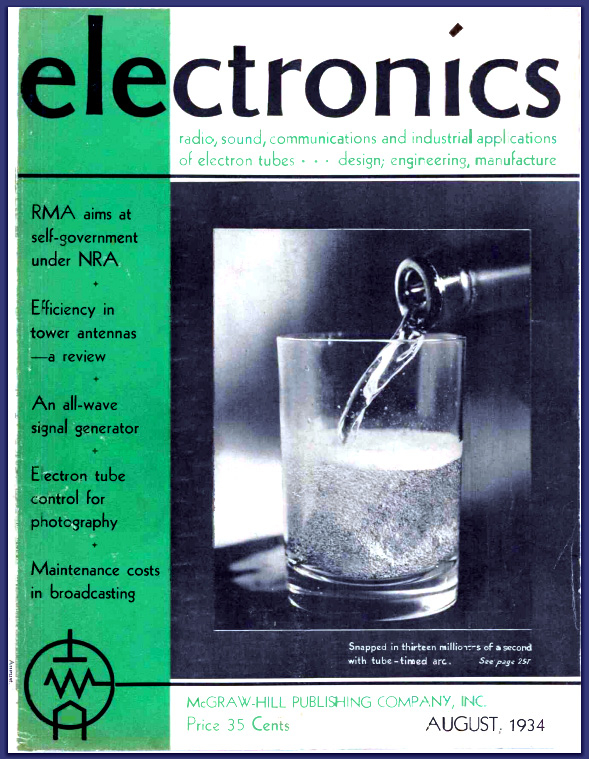
Cover – Electronics Magazine August 1934

Toronto. Movies and Electronics (not the typical science fiction variety movie) came together in the 1930s to extend human understanding. The 1930s were an exciting time (aside from the devastating depression) in photography and in electronics, The minicam revolution gained traction, German camera manufacture was at its best, radio sets and radio networks thrived, colour photography continued to evolve, the electronics industry was booming with new discoveries rampant, and Edgerton was at his best with strobes, but it took a nasty war at the end of the decade to move the world ahead.

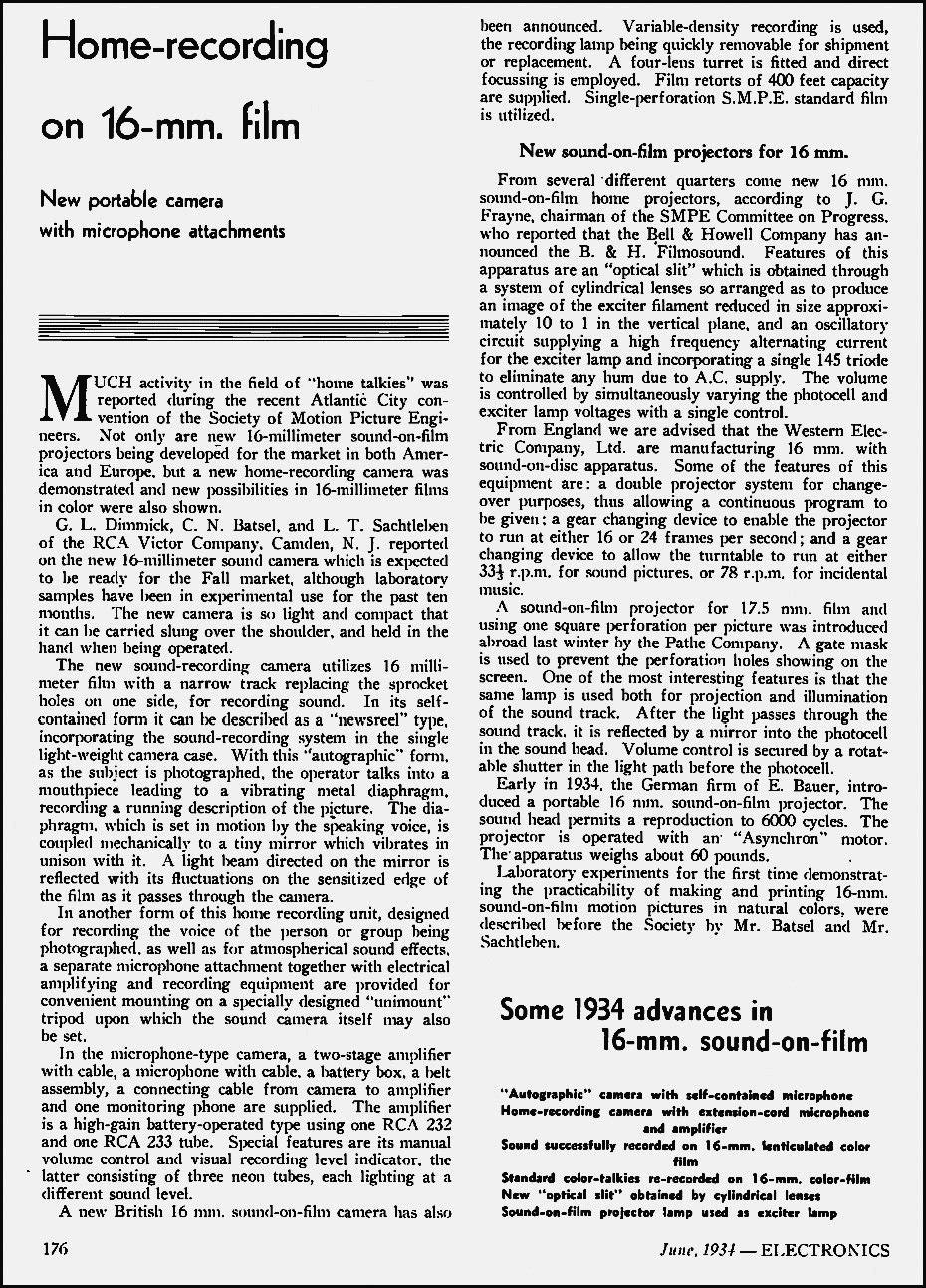
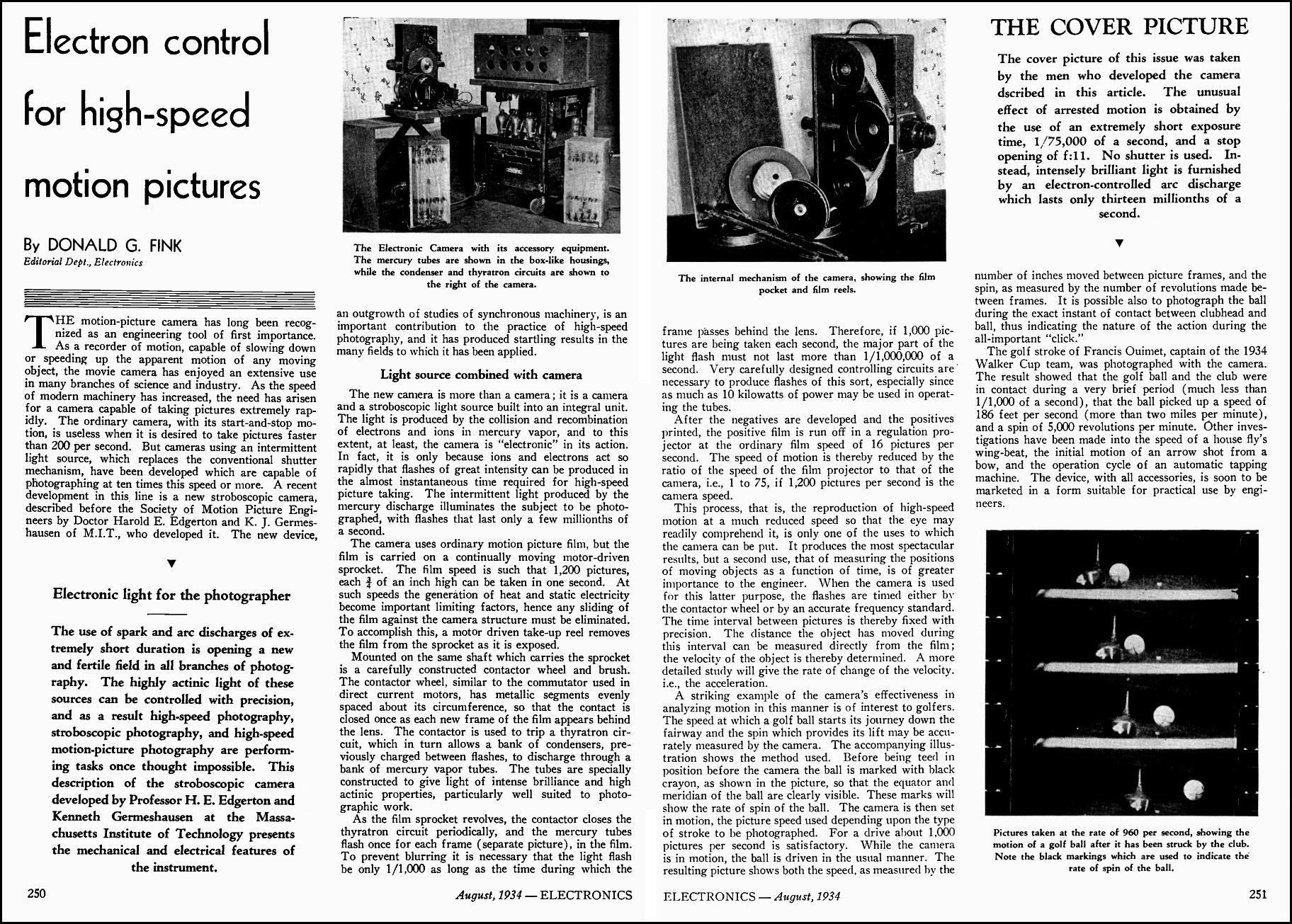
Electronics magazine for 1934  (June and August issues) reported exiting news regarding 16mm film and electronics. For home movies, it was advances in on-film sound, and colour film matching the 35mm colour film used for Hollywood extravaganzas.

The application of high speed and electronic control to industrial and scientific movies sparked a greater understanding of motions too brief for the unaided human eye to see. Electronic circuits allowed each frame to be synchronized with a strobe light flashing at  about 1 millionth of a second per frame.

Once you overcame the struggle imposed by the depression, it was an exciting time indeed according to my late father. Thanks are due to good friend and fellow photographic historian George Dunbar for sharing this find with me.

NB. the lower left of the magazine cover shows the schematic symbol for a triode vacuum tube. Current flows between the plate (upside down capital T which is positive) and the filament *upside down V which is negative). A low voltage high current battery between the sides of the V make the filament glow bright red and boils off electrons. The squiggly horizontal line is the grid. A very low current and voltage between grid and filament controls the flow of electrons between the filament and plate. This amplifies any alternating current signal. Solid state devices put an end to these archaic components of a by-gone era.


Posted in history | Tagged , , , , , , , | Comments Off on what a combination!

ain’t many coloured folks here

Saturday night in a saloon, Craigville, Minn., September 1937 – Russell Lee

Toronto. In the 1970s, I enjoyed the local library’s coffee table sized books of famous photographs and American photographers. In these books, I learned of the Farm Security Administration (FSA) program from the 1930s/40s and how it recorded the impact of the depression on American poor. Photographs were taken by people like Walker Evans, Dorothea Lange, and Russell Lee.

To my innocent eyes, the very few American Blacks in the photos seemed natural. I never thought about why or how this came about even though people of colour in America exceeded the population of Canada and were disproportionally poor.

Atlantic Monthly, an excellent magazine, published in its December 2020 edition the article “Whitewashing the Great Depression” by Sarah Boxer. The article discusses how the FSA intentionally encouraged photographs of mainly poor whites. Well worth a read.

A big thank you to my friend and photographic historian, George Dunbar, for sharing this fid with me.

Posted in history | Tagged , , , , | Comments Off on ain’t many coloured folks here

Amalgamated Photo History Newsletters

Vol 1-7 of our Amalgamated exchange newsletters

Toronto. We issued the 7th in our series of exchange newsletters recently (we just held our FIRST ZOOM Toronto meeting this month). Meantime, members received this pdf version of the amalgamated newsletters from our exchange members who gave their blessing for inclusion in this venture. In the preamble, Martin Magid, (in the state of Georgia when he spoke Wednesday via ZOOM) offered a reproduction of an interesting article on the posographe which was the subject of a post back on February 23, 2017 featuring a photo of my posographe and its case.

I hinted these packages were coming for members, ” … we elected to compile other material in pdf files ready to send to members IF they supplied an email address AND had a fast enough internet connection to receive the 2 – 10 mb or so pdf files. …”.

Well, the Volume 1-7 file (5.5 MB) went out last Friday, December 18th. If you didn’t get it but you do get our newsletters, drop me a note (news@phsc.ca). I will verify you are a 2020/2021 member and send off a copy. If you are a current member and didn’t see a copy, please check your junk folder. This and all other specials will only be sent to paid members. Not one yet? No big deal – pull your plastic and use the PayPal set up at the top right of this web page. Note that we will continue to send our PHSC News to all who are on our MailChimp list – PHSC member or not.

Posted in journal | Tagged , , , , , , | Comments Off on Amalgamated Photo History Newsletters

valau for money

1930s Leitz VALAU ring in nickel for the Elmar lens

Toronto. Leitz first introduced the Leica in the mid 1920s to keep employment up at their optical works in Wetzlar during extreme inflation in Germany. Bad timing as it turned out. A few years later, the dirty 30s hit with a world wide depression.

Leitz was busy encouraging photographers to buy their well built, well designed tiny camera at a time when large cameras and contact prints or slightly enlarged prints were the norm. A lot of effort went into assuring potential buyers that a small negative could create a large print of pleasing resolution through enlarging.

Money was tight in the 1930s and Leitz promoted its Elmar 5cm lens as ideal both on the camera and on the enlarger. Those of us who developed and enlarged film a few decades ago know that when enlarging you open the enlarging lens wide open to focus and then stop it down a couple of stops or more to expose the photo paper. This process means focussing with a bright image and narrow depth of field then printing with a dimmer light for a longer period with a wider depth of field to compensate for any discrepancy in focussing. Generally, stopping a lens down a couple of stops was said to improve the resolution.

The problem with the 5cm Elmar is that the aperture is controlled by a tiny tab on the front of the lens.  Almost impossible to see in a darkroom with the lens pointing down. The solution was a ring called a VALAU that moved the tab while transferring the setting to the edge of the lens and converting it to an exposure multiple for correct photo paper exposure (eg. 1 for wide open, 2 for double the exposure, 4 for four times the exposure, etc. instead of f/stops). The tab shown above acted as a very weak click stop.

The title of this post is a riff on the 1950s British movie called “Value for Money” and the expression “value for the money” meaning a good deal for the buyer.


Posted in history | Tagged , , , , , | Comments Off on valau for money

another kind of halide

Halide Mark II app for iPhone

Toronto. Those of us who creak getting up – chairs or stairs – can remember the days of film and glass plates when the light sensitivity of silver halides made our art practical. But this post is about a totally different kind of halide.

The most popular camera today – or so facebook (flicker?) says- is the ubiquitous one tucked away in every smartphone. If you are lucky (or just have deep pockets) yours is a new or newish iPhone. The big issue with these amazing “computer in a pocket” gadgets is that the camera is an auto everything device totally suited to today’s “hurry up and stand still” amateur and equally totally UNSUITED to the professional.

The app Halide Mark II (American site) changes everything. The app digs into the guts of the iPhone camera and allows RAW images, manual control, manual focus, and even “zebras” and “loupes”! Do a Google search  for halide mark II video tutorials about this app and see just what the amazing tiny camera can do with the right tools.

A bit of a downside may be the annual fee (or a one time fee of about 4x the annual fee that lets the app and updates last for a few years). The Canadian price vs. the American price is slightly higher at $15.99/year vs. $11.99/year. Halide will also work on the newer iPod Touch which after all is just an older smartphone sans the actual phone part. The app deprecates nicely omitting features not supported on older iPhones.

Posted in camera | Tagged , , , | Comments Off on another kind of halide

doin’ the lomography

William Klein edition film camera by Lomography

Toronto. Brigit Buchart of Lomography is at it again, this time with the “Lomo’Instant Wide William Klein Camera and Lenses Edition” of the Lomography film camera.

All the tasty detail is here from a description to an order link.

So any of you film enthusiasts can anty up 200 smackers in USD ($250 CDN) and join in the fun of shooting “instant” photos the old way.

The title of this post is a riff on that old 1962 song “The Loco-motion” sung here c1988 in the UK by Australia’s Kylie Minogue on her album called Locomotion.

Posted in camera | Tagged , , | Comments Off on doin’ the lomography

freezin’ season

Striations of Time – Paul Nicklen

Toronto. As we enter the season of ice and snow, I see that Galerie GADCOLLECTION over in Paris, France is featuring the photography of Paul Nicklen from the 5th of this month to the 7th of February next year. Given the COVID-19 situation, I doubt anyone will fly over to Paris, but you never know.

Paul features the Antartica Icebergs which spoke to me after our own Ms Sonja Pushchak featured photographer Michelle Valberg and her landscapes of our Arctic Icebergs in the PHSC News for December 2020.

Even if you cannot get to Paris in time, visit their display of Paul’s work and enjoy! ho knows, you may even find a print for your collection.

Posted in people | Tagged , , , , , , , | Comments Off on freezin’ season

FREE ZOOM AGM & show and tell

FREE AGM & Show and Tell (sign in at EVENTBRITE – Click here)

Posted in program | Tagged , , , | Comments Off on FREE ZOOM AGM & show and tell

… the sincerest form ….

Hasselblad

Toronto. A very common expression is, “imitation is the sincerest form of flattery“. And all the makers of high end cameras had it in spades! Manufactures in Russia, Japan, and even fellow German firms aped the design of the Leica, Contax, Rollei, and even the Sweden’s Hasselblad.

In a way, such imitation was helpful to the amateur photographer giving some consistency to cameras and offering lower cost alternatives. To me, the closest copy of a Hasselblad was the Zenza Bronica. The imitations of the Rollei, Leica and Contax are legion – so much so many people collect these imitations. A rare version/model always attracts fakes as well.

The lens on the Hasselblad in  the above photo is remarkably like the Leica lenses of the 1970s and later, especially in markings and outer material.


Posted in history | Tagged , , , | Comments Off on … the sincerest form ….