zooming to the future

ad for 1932 B&H innovative zoom lens

Toronto. We take zoom lenses for granted today. Almost all digital cameras – mirrorless or DSLR – use zoom lenses. We have grown lazy and just adjust the lens to frame the scene rather thsn moving back or forward physically.

Not surprisingly, the first use of zoom lenses was on movie cameras. When I bought my Exakta IIa in the late 1950s, prime lenses were king. Zoom lenses for still cameras were expensive with a rather narrow range of focal lengths and modest apertures.

This announcement by Bell & Howell in the January, 1932 issue of International Photographer gave readers a taste of the future of photographic lenses. Today, smart phones are still in the prime lens stage with recent designs adding multiple lenses and technology to switch from one to the other. Soon we should see the zoom technology on the ubiquitous smart phone too!

A big thanks to our good friend George Dunbar for sharing this unique find with us.

Posted in history | Tagged , , , , | Comments Off on zooming to the future

scanning for memories

scanning negatives with Lomography kit and smart phone

Toronto. The folks at Lomography are best known for their odd ball films and inexpensive cameras and lenses. In this digital era, the film aficionados are in a minority. Those of us with negatives galore have discovered the virtues of digitizing the frames and using key words etc. in the resulting files as exif, etc. data. This discipline makes searches simple (if relevant key words were used).

We progressed from specialized scanners, to general scanners, to office machines that united printers, scanners and fax functions, to copy stands and digital cameras, to copy stands and smart phones. Software took off with means to store, retrieve, and ‘develop’ i.e. edit digitized photos.

Now Lomography has joined forces with a copy stand and light source to use  either a digital camera or a smart phone to ‘scan’ negatives (those taken on Lomography films and others as well). Check out the details at this web site. Prices shown are C$.

Note. The title of this post is a riff on the line ‘dialling for dollars’ in the song sung by the late Janis Joplin called “Mercedes Benz”. Joplin’s songs may be an acquired taste but this one like ‘Me and Bobby McGee‘ is worth a listen!

Posted in activities-other | Tagged , , , , , | Comments Off on scanning for memories

accessorize your Ektra

Article on accessories for the Kodak Ektra

Toronto.  When the USA joined the WW2 fight, it lost all the Germany minicams. In the mid 1920s, the tiny Leica set the close-focus standard for the normal (50mm) lens at 1 metre (or 39 inches). Closer shots meant using extension tubes or close-up lenses or other gadgetsuld

Once the European minicams were lost to America, Kodak stepped up to the challenge and created the Kodak Ektra, an amazing camera that out did the specifications for all traditional German high end  minicams. Kodak intended that the Ektra would fill the gap left by the loss of cameras like the Contax, Leica, and its own line of German-made Retinas.

If you happen to have an Ektra, especially without flash sync, then you have a rare camera indeed.  First sold in 1941, the Ektra was reintroduced again post war. Unfortunately, the Ektra suffered from a few fatal problems: It was very expensive; it had the worst shutter on any camera (shutter failure was almost inevitable); and every lens interchange was incredibly complicated.

The June, 1941 issue of Popular Mechanics has an article on accessories for this amazing design by Kodak. A big thank you is due to our good friend and fellow PHSC member, George Dunbar, for sharing this article with us! My friend, the late Bill Belier, also mentioned to me that the Ektra shutter was prone to mechanical failure and any potential camera buy for a  collection absolutely had to be tested.

Posted in history | Tagged , , , , , , | Comments Off on accessorize your Ektra

first brick in the wall

Ad introducing the Argus C3 minicam which became very popular

Toronto. Talk about great timing! On the eve of WW2 Argus announced their new C3 camera. This ad from the March 1938 issue of International Photographer aims at the average America with these key points:  This miniature camera has features like more expensive or foreign cameras; the camera sells for a fraction of the cost of a German high end camera; it is fully made in America.

The C3 went on to be a long running top selling model for Argus. Many C3 cameras were sold here as well.

Since it had a box-like sharp edged body design and was rather heavy, owners affectionately called it “the brick”. A buddy of mine had a C3 and loved it.

Thank you, George Dunbar, for sharing this find with us!

Note, the title is a riff on a song titled, “Another Brick in the Wall” from Pink Floyd’s 1979 dual CD opus, “The Wall”. It was also an LP record and a movie!


Posted in history | Tagged , , , , | Comments Off on first brick in the wall

eenie, meenie, minie, eyemo

February, 1938 ad from the International Photographer

Toronto.  Bell & Howell had many famous trade marks. One was the Eyemo movie camera for professionals.   This rugged camera was the darling of the movie newsmen of the day. Many of us saw their results in the movie house news reels that preceded the Main Feature.

Eyemos were used in the D-Day landings on June 6, 1944 as noted by the late Bob Lansdale and linked on our website. The Eyemo ad shown here is from the February, 1938 issue of International Photographer, about a year and a half before War in Europe broke out..

The post title is a riff on the ancient child’s counting rhyme, “eeny, meeny, miny, moe” popular in various wordings and spellings the world over. As a child, I remember it being used to choose the first seeker for a game of “Hide and Seek”.

A big thank you is in order for our good friend and photo historian extrodinare, George Dunbar who shared this advertisement with us.

Posted in history | Tagged , , , , | Comments Off on eenie, meenie, minie, eyemo

hey, Stewart – let’s make a movie

Ad for the Stewart Warner movie camera back in 1933.

Toronto. I always thought Stewart-Warner made meters and gauges. But no, they also briefly made movie cameras before the company was reorganized and transformed into a winner from a loser.

The gory details of the company and its rebirth are told by the “Made in Chicago” museum (a fascinating site that I have quoted many times).

My thanks again to that intrepid researcher and long retired cinematographer (and still photographer), George Dunbar, for finding and sharing this advertisement with us. Oh, yes – the ad is from the July, 1933 issue of the American Cinematographer (1933 was the year of revolt at S-W and its rebirth).

Posted in history | Tagged , , , , | Comments Off on hey, Stewart – let’s make a movie

tish tash

International Photographer article on Roy Tash and the Quints

Toronto. An article in the International Photographer for December, 1935 sure brought back memories. The article was called, “Shooting the Quints”. Both Roy Tash and the Quints were famous, especially here in Canada. Roy was an expert in cinematography, while the quints were the first quintet of babies ever to be born and survive back then.

Bill Belier and Ev Roseborough knew Roy and set out to meet with him back in October, 1988 for an interview to be published in a Journal article.  Sadly Roy was too ill to see them and died a few weeks later on that December. Bill Belier saw Roy’s daughter instead and finished his article titled, “Roy Tash – Canada’s Eyes and Ears of the World” for the Photographic Canadiana 14-5 (P16-18) dated March – April 1989.

My thanks to George Dunbar – good friend and enthusiastic photography researcher – for sharing this article on Mr Tash with us.

Posted in history | Tagged , , , | Comments Off on tish tash

a 2-4 meeting on ZOOM

Toronto. Wow! we held  our  twenty-fourth executive meeting via ZOOM last Wednesday. Behind the scenes (some of) your executive have been very busy searching out alternative places/dates for this year’s fairs, shows, and auctions. As mentioned last month, we will be taking March off and moving our April meeting to the LAST FRIDAY of the month (April 29th) to join the ESHPh group in an exciting series of presentations and discussion on our favourite topic.  Working title for the symposium is “TECHNOLOGIES, EXPEDITIONS & EMPIRES – THREE-COLOUR PHOTOGRAPHY AROUND 1900”.

As mentioned last executive meeting, our president, Clint Hryhorijiw, will be one of the three moderators at April’s Symposium, while our programme director, Celio Barreto, will operate behind the scenes. We will be posting more information both here and on other media such as EventBrite. Our May presentation is with Francesca Strobino (moved up from June) – see May’s PHSC News (or a later post)  for details.

David and Louise are now working on a third issue of our journal and welcome ALL hopeful writers with stories about photography, especially here in the Great White North.

Finally, remember that our membership year is now from January 1st to December 31st. All members whose memberships previously ended April 30th of 2022 will be extended to December 31, 2022 at no added member cost. You’re welcome!

At the March PHSC Executive Meeting

Posted in activities | Tagged , , , , , | Comments Off on a 2-4 meeting on ZOOM

Photographic Canadiana Vol 47-4

Jim Wong-Chu, [Portrait of Wing Wong], gelatin silver print, [after 1977] (RBSC-ARC-1710-31-14, Jim Wong-Chu Fonds). © UBC Library Rare Books and Special Collections.

Toronto. This is our second issue by interim editors, David Bridge and Louise Freyburger who ably stepped up to the challenge of producing the journal after we lost our previous editor, the late Bob Lansdale, last summer.

Members WITH an email address received this informative 39 page magazine via pdf on Tuesday. It  is  the Photographic Canadiana 47-4 dated January-February-March 2022.

This is another fine issue assembled, augmented, and produced by our interim editors creating the excitement we all felt reading editor Lansdale’s work. This issue includes “Gelatin Dry Plate Manufacturing In Canada 1881-1905: A Tenuous Cottage Industry – by David J. Kenny and Robert Lansdale”, “chinatown forever changing: Jim Wong-Chu’s Pender East – by Brandon James Leung”, “Remembering John Kantymir”, and “Where Angels Come to Earth- as reviewed by Joyce MacPhee”.

Drop me a line at info@phsc.ca if you are a member and haven’t received this special pdf edition. Not a member? Easy-peasy, just break out your plastic (VISA, MasterCard, etc.), follow the rules at the upper right of this page and sign up via PayPal (no PayPal account needed – we will pay the modest fee). Membership is an incredible bargain. Period!

This entry was posted in journal and tagged , , , , , , . Bookmark the permalink.
Posted in journal | Tagged , , , , , | Comments Off on Photographic Canadiana Vol 47-4

a wily marketing plan

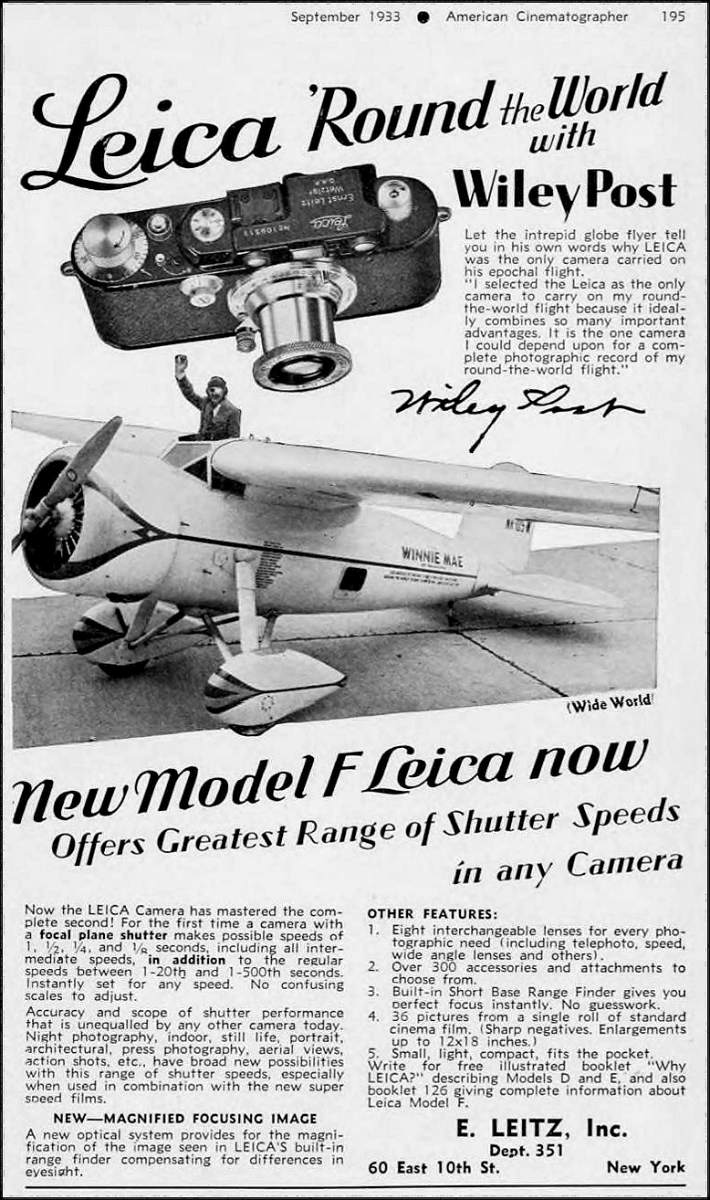
Wiley helps Leitz NY selll its Leicas

Toronto. The challenge facing Leitz NY was how to swing the photography fraternity from the bulky cameras of the day to their particular variety of 35mm minicam camera. The boys in NY came up with the idea of touting the camera’s use to record historic events accomplished by well known and famous names in America.

One such name was Wiley Post, That past summer, Post became the first person to fly solo around the world just two years after he and a navigator flew the first fixed-wing flight around the world. Sadly, Post died just two years after his epic solo flight – in a well documented plane crash along with his friend and another household name in America – Will Rogers.

My thanks to my good friend and fellow photographic enthusiast, George Dunbar for sharing this ad from the September, 1933 issue of American Cinematographer.

Posted in history | Tagged , , , | Comments Off on a wily marketing plan