lucky seven

ad for the little SEPT in 1923

Toronto. We occasionally see a SEPT camera offered at one of our events. The ad at left is from the January 1923 edition of the American Cinematographer. While the little Sept is described as a ‘movie camera’ in this ad, it could also do stills on the small roll of 35mm film and, shades of Robot, even a burst of rapid sequence shots.

Made by Debrie in Paris, France, special cartridges were used. Manufactured  from about 1922 to about 1927 it was apparently sold into 1940. The tiny marvel offered an owner seven distinct functions, hence the name Sept (seven en Français).

A big thank you goes to George Dunbar for sharing this advertisement with us.

Posted in history | Tagged , , , , , , | Comments Off on lucky seven

for the birds …

article on wartime avian photographers

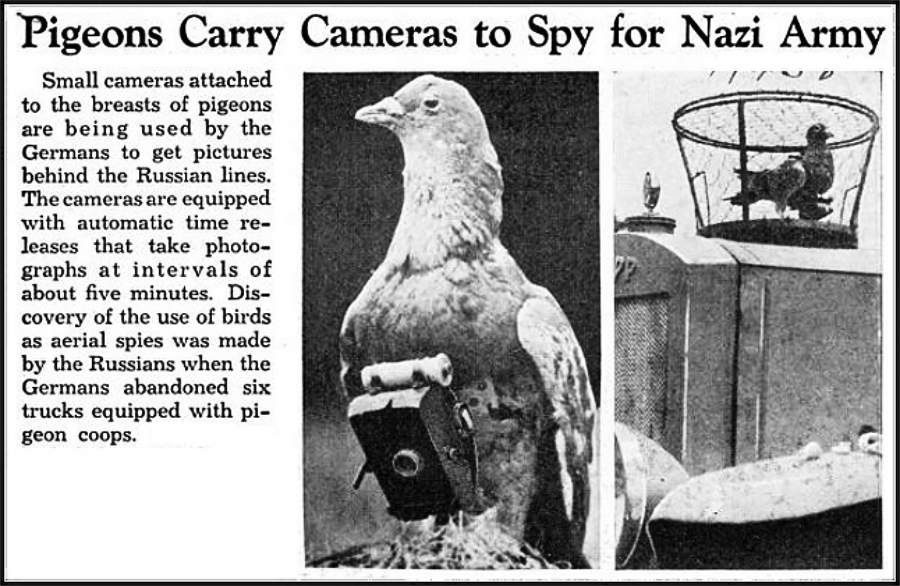
Toronto. Some ideas work; some don’t. In 1942, the third Reich experimented with pigeon photographers according to this article in the September, 1942 issue of Popular Mechanics . Cameras were attached to pigeons and set for automatic operation over a period of time. Released over Russia, I guess the Nazis hoped the photographs would offer cheaper aerial surveillance.

War time brought out many new ideas and experiments, but as I suggested, some worked; some didn’t.

Thanks to my good friend, George Dunbar, for finding this article and sharing it with us, Was it a spoof? was it true? Don’t know. Both sides tend to diss the other in any war. WW2 was no different.

Posted in history | Tagged , , , , , | Comments Off on for the birds …

at the push of a button …

1942 article on an electric
push button camera

Toronto. An article in the April, 1942 issue of Popular Mechanics touts that, “Pictures can be taken at the rate of one each second with an electric studio-type camera”.  A casual read suggests that the camera predates Edward Land by a few years, but not so.

Photographs are caught as usual on a wide roll of ordinary film requiring the usual negative processing then printing each frame to get the positive print.

Oh, well. Thanks to that inveterate photography historian, George Dunbar, for finding and sharing this tasty tale of an electric ‘push button’ camera. Great for taking pass photographs to protect factory operations during the war (ww2).

Posted in history | Tagged , , | Comments Off on at the push of a button …

the thrill of movies

December 1937 advertisement for Ciné-Kodak cameras

Toronto. Kodak got into movie cameras and projectors in the 1920s to sell its amateur movie films. This ad from the December, 1937 edition of International Photographer shows a sampling of Kodak’s line-up of both 8 and 16mm cameras.

Kodak also offered processing including a bleaching bath so the original negative film came out positive and ready to view (with a Kodak projector, of course).

A thanks goes to my good friend, George Dunbar, for sharing this interesting Kodak ad from over 80 years ago.


Posted in history | Tagged , , , , | Comments Off on the thrill of movies

camera is cheap and a film for free

ad for remaindered Twin Flex in 1942

Toronto. The Univex Corp set out to capture the low end photographic market in the States. The war in Europe caused a hiccup in their film supply. Univex used a custom style core on its “00” roll film with the film manufactured in Belgium.

Univex (Universal Camera Company) survived this situation after a near death experience. This ad claims the Twin Flex is, “A GENUINE PROFESSIONAL TYPE REFLEX CAMERA AT A LOW PRICE THAT YOU NEVER DREAMED POSSIBLE”. Even before the remaindered price of “$2.98 – film free), the retail price was a mighty $5.50 for “… The Type Camera
That News Photographers Use”. Skillful words that attracted the gullible in thousands.

This particular advertisement appeared in the July, 1942 issue of Popular Mechanics magazine. In 1940, near bankruptcy, the company found an American film supplier just before America leapt into WW2 as well – out of the frying pan and all that … A nod to my good friend and fellow PHSC member, George Dunbar for sharing this ad with us. And a thank you for the information in McKeown’s 11th edition regarding the Universal Camera Company.

Note, the title is a riff on the delightful Dire Straits song, “Money for Nothing“.

Posted in history | Tagged , , , | Comments Off on camera is cheap and a film for free

in the briny deep

Ambrotype recoved from a downed ship after some 165 year in the sea

Toronto.  The BBC News for March 26, 2022 has a story titled. “SS Central America: Haunting photos recovered [in] the ‘ship of gold’ wreck on ocean floor”. The photographs that that survived the watery grave were all cased images with well made cases and seals.

The BBC states, “It was a hurricane that sealed the fate for 425 people returning to the US east coast … .

” … some passengers were also carrying something of more personal value – photographs.

“Salvaged from the ship’s wreckage in 2014 were daguerreotypes, the first successful commercial form of photography – a one-off picture held on a metal plate – and ambrotypes, a type of glass plate photography.”

Visit the BBC site to see and read about the discovery. Thank you to my good friend, George Dunbar, for bringing this story to my attention!

Posted in history | Tagged , , , | Comments Off on in the briny deep

if you can’t beat them …

1937 ad for new smaller cheaper model Speed Graphic camera

Toronto. Two events likely resulted in this version of the famous Speed Graphic. First the continuing depression and the need to economize; and secondly the success of the minicam and enlarging making smaller cameras very popular.

As advertised in the December, 1937 issue of the International Photographer, a new version of the Speed Graphic by the Folmer Graflex Corp in Rochester was advertised as featuring  “economy and versatility”. The film size was reduced to 2-1/4 x 3-11/4 while the camera offered interchangeable lenses, a built-in focal plane shutter and ability to add leaf shutter/lens combinations, some with flash capability.

The basic camera was sold with the focal plane shutter but no lens. My thanks to fellow PHSC member and avid photo historian, my good friend George Dunbar, for sharing this ad with us.

Posted in history | Tagged , , | Comments Off on if you can’t beat them …

Canada, eh?

A Canadian story in the September, 1938 issue of American Cinematographer

Toronto. America is well known for its rather insular approach to us small fry. But occasionally the mighty country to the south goes out of its way to feature an article on a Canadian event.

This article, called, “Canadians Pack Sports Arena to see Duncan Little’s Film of Race” tells the story of a film shown in the new sports arena in the town of Shawinigan Falls, Quebec by New Yorker Duncan Little. The projector was the Bell and Howell model 130, designed for auditoriums. The projector used the then new 1,200 watt lamp.

A big ‘thank you’ goes out to our good friend and retiree, George Dunbar for sourcing and sharing this rare Canadian story in an American magazine, in this case the September, 1938 American Cinematography magazine.

Posted in history | Tagged , , , , | Comments Off on Canada, eh?

go big or …

ad announcing Kodachrome for professionals

Toronto. For decades, I thought of Kodachrome as home movie or 35mm slide film. Journal editor, the late Ev Roseborough, corrected me as did another journal editor, the late Bob Lansdale. When Kodachrome was introduced (1935) it was limited to 16mm home movie film since the Kodak plant in Rochester had limited Kodachrome processing capability. The next leap was 35mm transparencies (slides).

But in November 1938 professional cut film up to 8×10 inches a sheet was announced. The ad here is from the November 1938 issue of American Cinematographer. Back then colour film had to be corrected for the principle lighting used – daylight, tungsten, floodlights, even fluorescents. Modern day digital users don’t realize just how much automatic ‘white balance’ has simplified things. Cut film Kodachrome for daylight use was in the near future.

The cut film version of Kodachrome was balanced for ‘clear Mazda lamps’. The film speed was about 1/3 that of Eastman portrait or SS panchromatic B&W film (pitiful speed today). To use it in daylight, or other kinds of incandescent bulbs, a filter on the lens was necessary.

My thanks to good friend George Dunbar for finding and sharing this ad with us.

Posted in history | Tagged , , , , , , | Comments Off on go big or …

a question on some Canadian Photographs

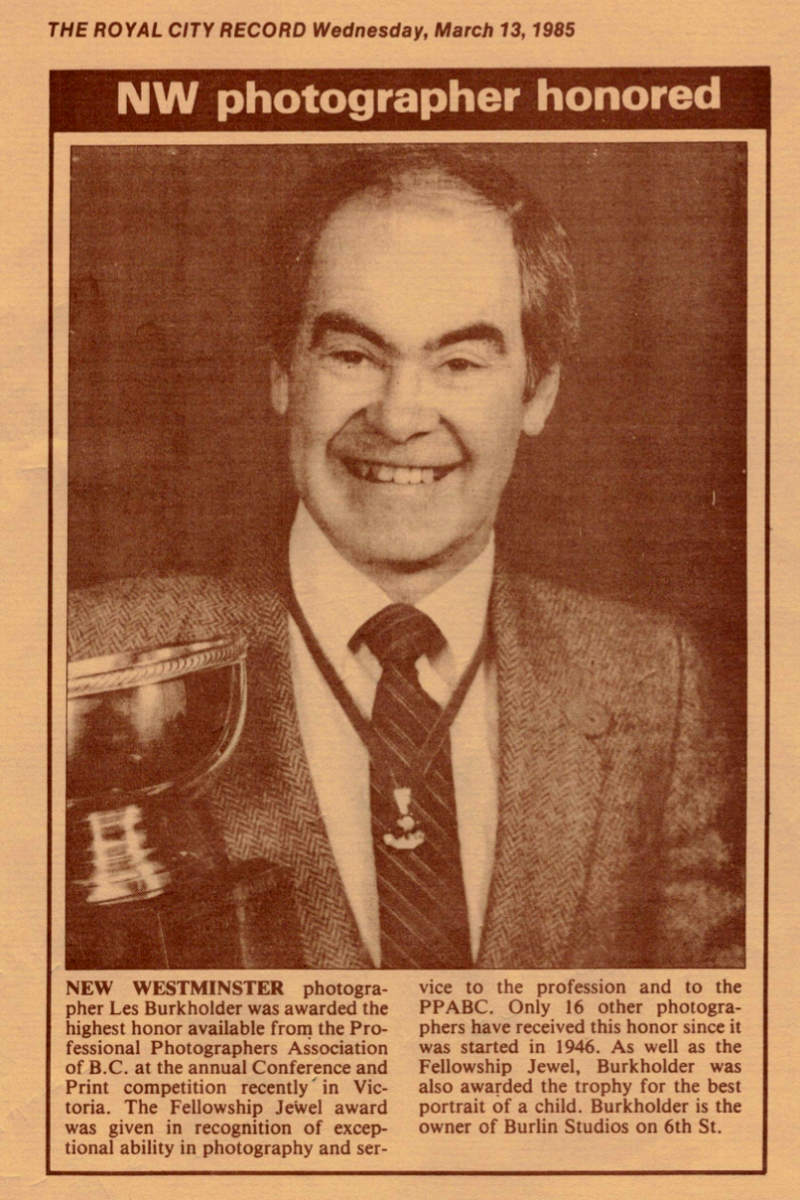
Les Burkholder awarded

Toronto. I often get interesting emails for the PHSC. For example, Mark Mackave wrote to the PHSC on behalf of his nephew, Cody Mackave about a photograph collection. If you can help Mark, please drop me a line so I can forward it to him.

Mark writes, “. I am contacting the Society on behalf of my Nephew, Cody Mackave, who owns the Burlin Studio negative archive and photo collection. The collection consists of +/- 150,000 negatives primarily in 5 x7 and 4 x 5 format. Additionally there is a collection of loose  photographs, and sample prints which are mounted and some are framed. Frederick (Fred) Mauritz Burlin owned the studio from +/- 1948-1972 Les Burkholder then owned it from 1972 -1992. The studio continued to operate under different owners until 1997.

“Fred Burlin and Les Burkholder were both award winning Canadian photographers and both received numerous awards and accolades including the Fellowship Jewel Award, the highest honour from the Professional Photographer Association of BC (PPABC). Please see the Flickr link immediately below to some of Mr. Burlin’s work. I have included a second Flickr link below to an interesting article on Mr. Burlin, which was published in the Ansconian Magazine in the March-April publication in 1955. I have also attached a PDF from a page of the Royal City Record of Mr. Burkholder receiving a Fellows

hip Jewel Award through PPABC in 1985.

Burlin Studios – Photo Archive | Flickr 

https://www.flickr.com/gp/11908964@N08/063M84

“Mauritz Burlin – Ansconian Magazine Article 1955 | Flickr

https://www.flickr.com/gp/11908964@N08/3e8238

“I am curious if members within your group are familiar with the work of these two gentlemen and if they were members of the Society. My nephew Cody and I believe collection of negatives and photos has historical importance and we would like to see the collection preserved in its’ entirety. Cody is seeking potential buyers or historical associations who may be interested in acquiring this rich source of fine photography in the collection. We are seeking any information that senior members of PHSC could provide us which may assist us in our quest and would be very grateful for anything you could provide. Time is of the essence to achieve our goal and your earliest reply would be much appreciated.  Please don’t hesitate to contact me if you have any questions or if you require any additional information.”

Posted in photos | Tagged , , , , | Comments Off on a question on some Canadian Photographs