remember when?

Lockhart’s 1931 ad on page 122 in the Magnet

Toronto. There was once a camera exchange across from Simpson’s department store in the Temple Building (Toronto’s first skyscraper) on the north-west corner of Bay and Richmond in downtown Toronto. According to the ad in the 1931 Magnet magazine, they had a new store at 29 Adelaide St West.

From the 1960s on, I favoured Toronto Camera Exchange, Henry’s, Downtown Camera, or Queen Street Camera Exchange. These shops were around Church and Queen area, and over on Yonge. I also visited Drake Delta on Yonge around Bloor.  Remember when?

My thanks to George Dunbar for the photo of the Temple Building in the TPL archives and Lockhart’s Camera Exchange sign. The 1931 ad in the Magnet is from YUMPU. Hard copies of this issue of ‘the Magnet’ and all other issues are at the Jarvis Archives, Jarvis Collegiate in Toronto.


Posted in history | Tagged , , , | Comments Off on remember when?

wintery wonders

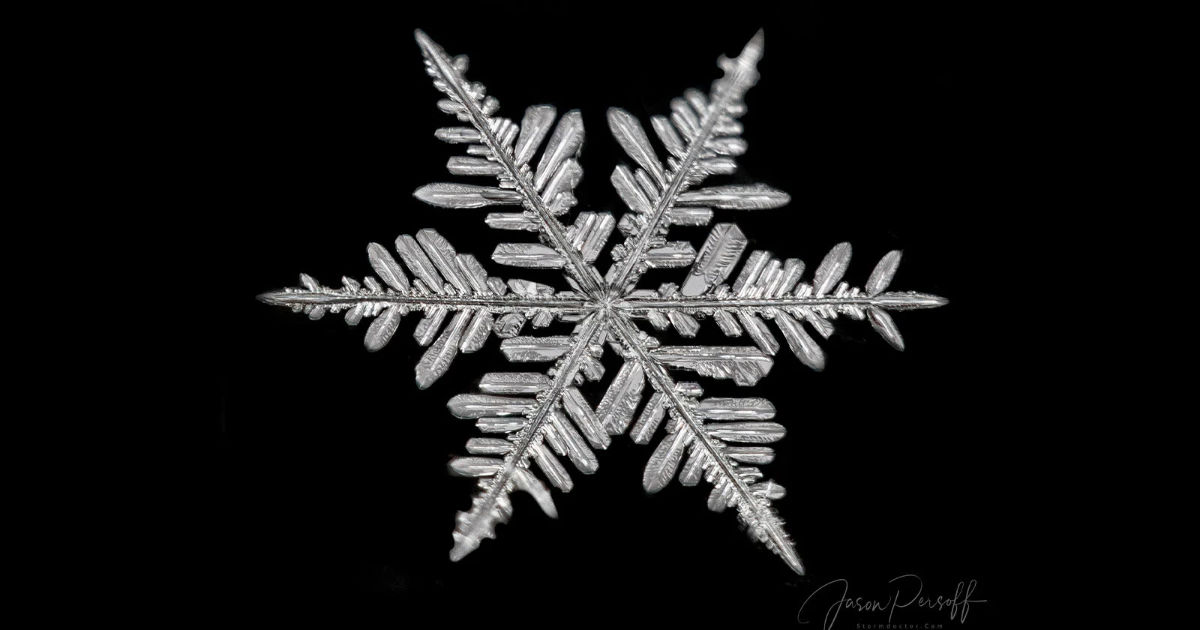
Snowflake by Dr Jason Persoff, courtesy of PetaPixel

Toronto. The other night my wife was on the Weather Chanel when she spotted a story about a photographer who captured images of snowflakes. We couldn’t find the short video again and the name of the photographer was forgotten, but not the basic idea of his camera and lens.

We searched at length on the Weather Channel and the internet but had no luck. A few days later, I spotted the video on my iPod Touch (in the Weather Channel app). Once I saw the video and knew the photographer’s name, it was easy to find him and the video on the internet.

The images were taken by a Jason Persoff, On smugmug.com  shown here, the tag line says “SEVERE WEATHER PHOTOGRAPHY under his storm doctor web site (actually the link goes to his SmugMug page). Dr Persoff was born in Denver and continues to live in Colorado. Visit his page on SmugMug and read  his story on PetaPixel (Photographer Seeks Perfectly Formed Snowflakes for Magical Photo Series) or Pinterest (Snowflakes and Winter – Jason Persoff).

Photographs of snowflakes have been taken for decades now using film cameras. Dr Persoff uses a Digital camera with extension tubes and a macro lens. And the black background? It’s from the sock he uses to catch snowflakes and decide which is worthy of a photograph! PS. Dr Persoff finds Photoshop a big help to merge the many images of a single snowflake rendering the tiny crystals in sharp focus.

Posted in people | Tagged , , , | Comments Off on wintery wonders

flyin’ high

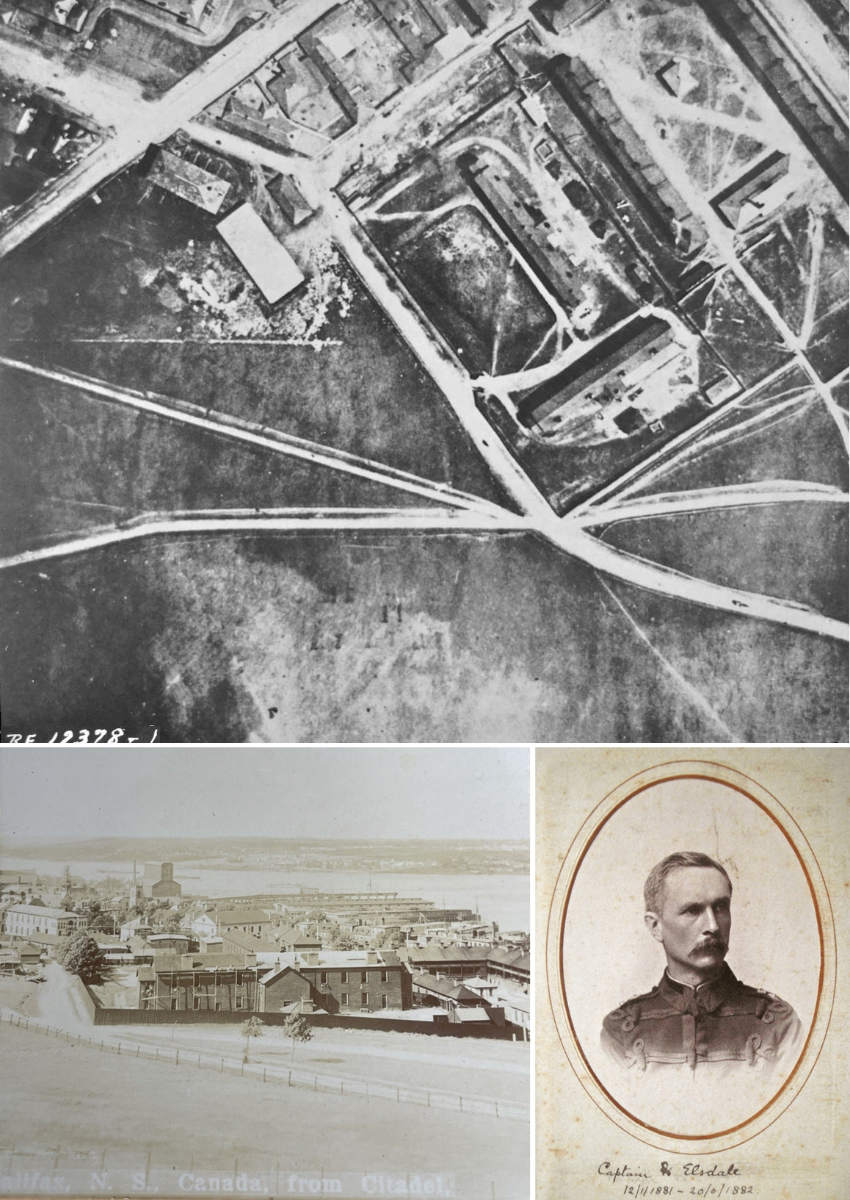
Captain Elsdale, Balloon Photographer in Maritimes

Toronto. Jeff Ward was here in the city in August of 2017 (Canada’s 150th) and spoke at our monthly meeting. Since then Jeff has been in periodic communication with the PHSC.

Under Facebook in a series of articles called, “The Early Light Project“, Jeff is “Sharing information about photographers in (or from) Atlantic Canada in the first 100 years of photography (1839-1939)”.  This included an article about balloon flight and the experiences of Captain Elsdale.

Jeff writes, “As you may know, I have been posting about photo history here in Atlantic Canada for the past year or so.

“In a post around Christmastime, I spoke about an experimenter named Elsdale and his work on balloon aerial photography.

“Here is a link to the post.

Jeff wrote to me after seeing my post on Nadar and the balloon drawing of the French Photographer in full flight with endless numbers of photo studios beneath his saloon. Have a look at Jeff’s articles (if you don’t have a Facebook account, just join – no cost).

Posted in history | Tagged , , , | Comments Off on flyin’ high

room for a better one

Fox Talbot and camera in 1864 portrait (on the PetaPixel website).

Toronto. The title is a riff on the old saying, “… build a better mousetrap …“. One of the earliest cameras was called a mousetrap by the spouse of its creator. It was basically a very small camera obscura. A light tight wooden box held a piece of salted paper at one end and a short focal length lens at the other.

Next to the lens was a small corked hole. The cork was removed briefly to check the progress of the exposure (a latent image was not used – the salted paper was like the printing out paper of a later age).

The resulting exposure was inverted – light areas were dark and vice versa.We would later recognize this as a negative. By placing a second sheet of salted paper under the ‘negative’ and exposing the sandwich to sunshine, a ‘positive’ print was created.

All this was part of William Henry Fox Talbot‘s experiments shortly before Daguerre’s iconic announcement. Talbot had succeeded in ‘fixing’ the ‘negative’ and ‘positive’ salted  papers by using a diluted solution of salt.

We have come a long way since the late 1830s in film based photography: more sensitivity, better resolution, latent images, greater flexibility – and better cameras!

PS. Checkout our website (use the search box in the upper right side) to see more about Talbot.

Posted in history | Tagged , , , , | Comments Off on room for a better one

ya can’t win ’em all …

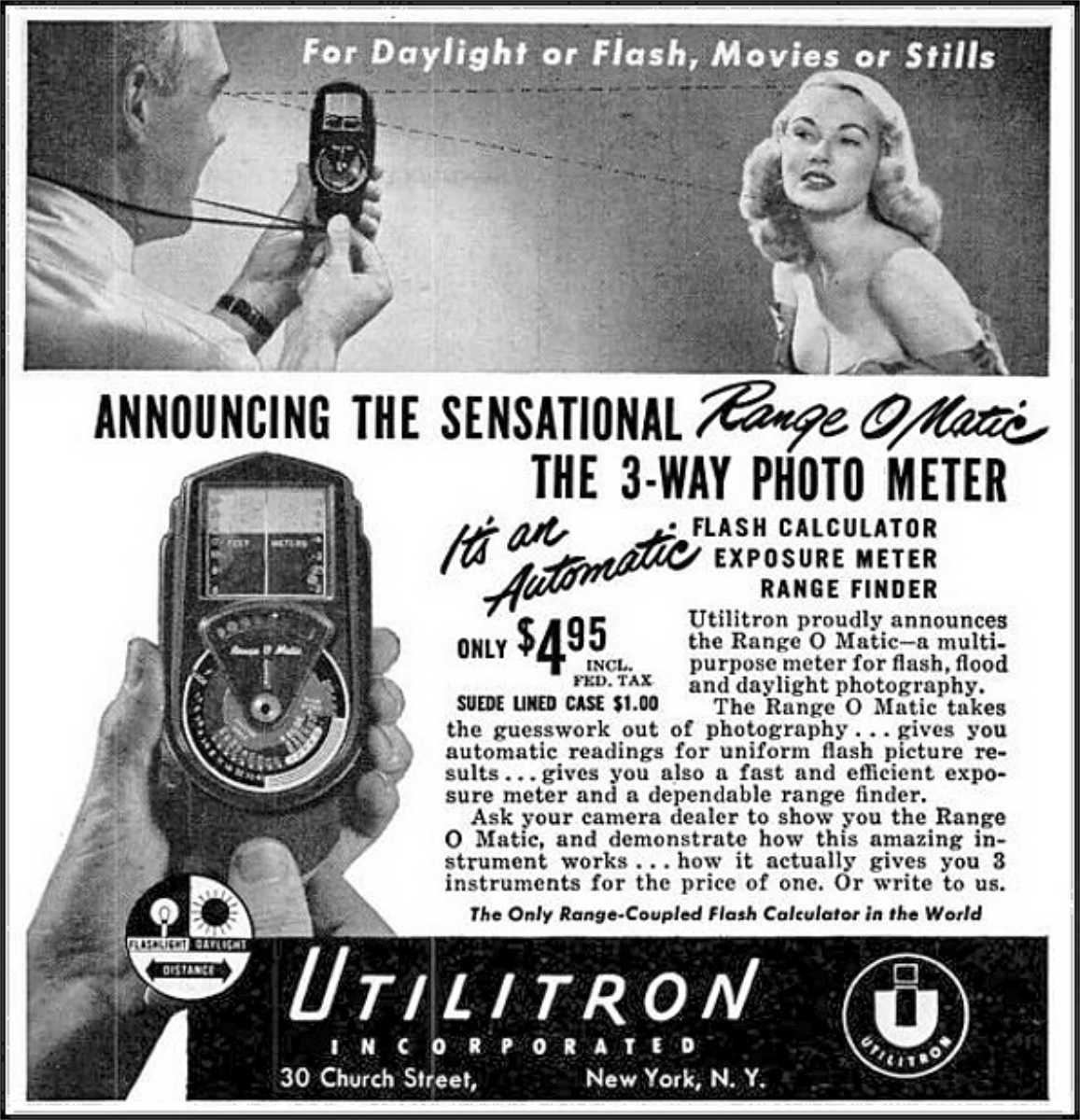
Summer 1950 ad for the Range O Matic photo meter by Utilitron

Toronto. There’s an old saying, “one born every minute” attributed to P T Barnum but actually older. The resulting population subset forms the potential audience for the type of gadget advertised in a 1950 issue of Popular Mechanics.

Utilitron, the maker of the “Range O Matic” is careful to state only the attributes of the gadget and let the reader’s imagination fill in the blanks. At $4.95 including tax, the company aimed at the bargain hunters in the would-be photographers’ fraternity. It cost much less than any one of the three instruments it was said to replace.

Sadly, it was nothing more than a clever extinction meter with a few attached nomograms. True light meters like a Weston Master or a GE were more expensive and far more accurate in use. The maker seems to have disappeared into the long night as has the Range O Matic (except the occasional one that is offered to collectors).

My thanks to good friend George Dunbar for spotting this ad from last century and sharing it with us.

Posted in history | Tagged , , | Comments Off on ya can’t win ’em all …

Lucy

the business end of my camera lucida – over a century old

Toronto. The Camera Lucida was often used by artists to view both the scene in front of them and the canvas in their lap. This marvellous little optical device  (Lucy) was invented by Wollaston around 1806. It is forever tied to photography and the idea of the negative/positive process. In the early 1800s a well to do young Englishman enjoyed both travel and dabbling in the arts as an amateur painter. His fertile mind was constantly experimenting with ways to improve the processes he used.

Late in the year 1833, he found himself in Italy by the shores of Lake Como sketching a landscape with the help of his ‘Lucy’. He later wrote in his diary:

“One of the first days of the month of October 1833, I was amusing myself on the lovely shores of Lake Como, in Italy, taking sketches with Wollaston’s Camera Lucida. In honesty, I should say, attempting to take them, but with the smallest possible amount of success. For when the eye was removed from the prism, in which all looked beautiful, I found that the faithless pencil had left only traces on the paper melancholy to behold.

“I then thought of trying again a method which I had tried many years before. This method was to take a camera obscura and to throw the image of the objects on a piece of transparent tracing paper laid on a pane of glass in the focus of the instrument. This led me to reflect on the inimitable beauty of the pictures of nature’s painting, which the glass lens of the camera throws upon the paper in its focus-fairy pictures, creations of a moment, and destined as rapidly to fade away.

“It was during these thoughts that the idea occurred to me: how charming it would be if it were possible to cause these natural images to imprint themselves durably and remain fixed upon the paper! And why should it not be possible? I asked myself.”

Back home in England, the artist succeeded by 1835/36 in creating permanent ‘sun drawings’ and the negative/positive process to aid him in painting. The gentleman was William H Fox Talbot. The same gentleman was astonished to learn of Daguerre’s January 1839 announcement of the Daguerreotype process as the first successful means to create a permanent ‘sun drawing’.

NB: The above journal entry is included in André Jammes’ 1972 book on Talbot in the Photography: Man and Movements series published by Verlag C. J. Bucher in Germany and shortly thereafter by Collier Books (Macmillan Publishing) over here. It is well worth the read if you are at all interested in Photographic History.

NB: The title of this post brought to mind a Beatles song on the Sergeant Pepper album, “Lucy in the Sky with Diamonds

Posted in history | Tagged , , , , , | Comments Off on Lucy

come to CAPA

Hypnotizing – by Bertin Francoeur

Toronto. Taking a breather from historical topics, we move on to modern day photos at CAPA. For many years, the Canadian Association of Photographic Art (CAPA) has been a member of the PHSC. The association is a collection camera clubs, not unlike the O3C.

Members of CAPA are active in the pursuit of eye-catching photography with modern(ish) gear. You can read their latest newsletter here (or read it directly if you are a member).

The photo at left is a composition by Bertin Francoeur of the Trillium Photography Club in Burlington called  Hypnotizing. Bertin recently won Gold for this shot. Well done!

Note – the title of this post is a riff on the saying, “Come To Daddy“.

Posted in activities-other | Tagged , , | Comments Off on come to CAPA

closings and openings

Nadar élevant la Photographie à la hauteur de l’Art (“Nadar elevating Photography to Art”). Lithograph by Honoré Daumier, appearing in Le Boulevard, 25 May 1863

Toronto. An optimist would say as a door closes, another opens. That is, as technology goes ahead, old jobs and industries die off and new ones take their place. Photography is no different. When it was announced in 1839, a French wag was said to comment that photography made the portrait painter redundant.

In fact photography opened family portraits to far more people. When the only recourse was to have a painting commissioned, few could afford the time or cost. With photography, the far shorter time needed for making a ‘likeness’ and relatively small cost opened the door to many, many more subjects.

This post shows a caricature of the French photographer nick-named Nadar in a balloon in the mid 1800s. You may have come across his name before – in 1858, he was the first person to take an aerial photograph (he used a balloon since the motorized airplane had not been invented).


Posted in history | Tagged , , , , | Comments Off on closings and openings

Morse and Photography

Samuel F B Morse in 1857

Toronto. Samuel F B Morse was both an artist (painter), and teacher. Closely involved with the North American telegraph, his name lives on as the co-inventor of the Morse Code.  This a code known to telegraphers and amateur radio operators alike.

Morse is also famous (or should be) to photographers. Morse happened to be in Paris in 1839 after Daguerre made his iconic presentation via M Arago. Being an artist, Morse was fascinated with the concept of ‘light painting’. So much so that he met Daguerre in person and later wrote to his younger brother’s newspaper, the “New York Observer“, promoting the Daguerreotype concept in North America helping to raise awareness of that most famous of photographic processes. Caution: much of the linked article for the New York Observer addresses the later use of the name as a newspaper associated with Donald Trump, not it’s original newspaper name (long ended) which was association with the Morse family.

So the next time you hear/see the name ‘Samuel Morse’, think photography as well as telegraph!

Posted in history | Tagged , , , | Comments Off on Morse and Photography

outta da blue

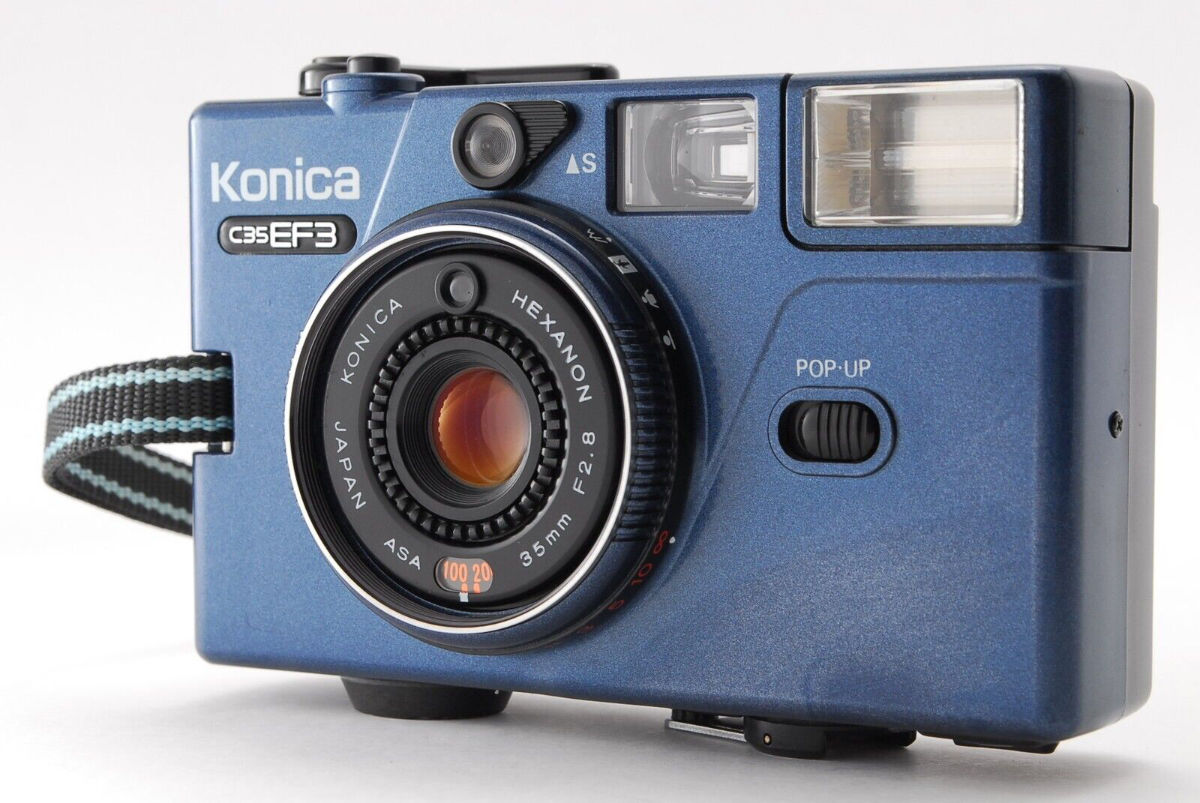
Konica C35 courtesy of Kona Markets, Japan via Ebay

Toronto. After my girls were graduated (about 1999), I bought them each a Konica  film camera with built-in metering, flash, and 35mm f/2.8  lens. One camera was red; the other blue. Both came with a matching case.

One daughter was using hers to capture scenes in Barcelona when ‘out of the blue’ a thief ran up and snatched the ‘camera’ as it hung from her knapsack. Ironically she had taken the little camera out of its case to be more ready for action leaving the thief only the empty case.

These little cameras saw lots of use over the years – sadly one sans case … Konica made many versions of the C35 over the years including the two beautiful coloured ones that gave my children great pleasure. Visit our fairs or auctions and you may find one for your collection (or use if you are into film technology).


Posted in history | Tagged , , | Comments Off on outta da blue