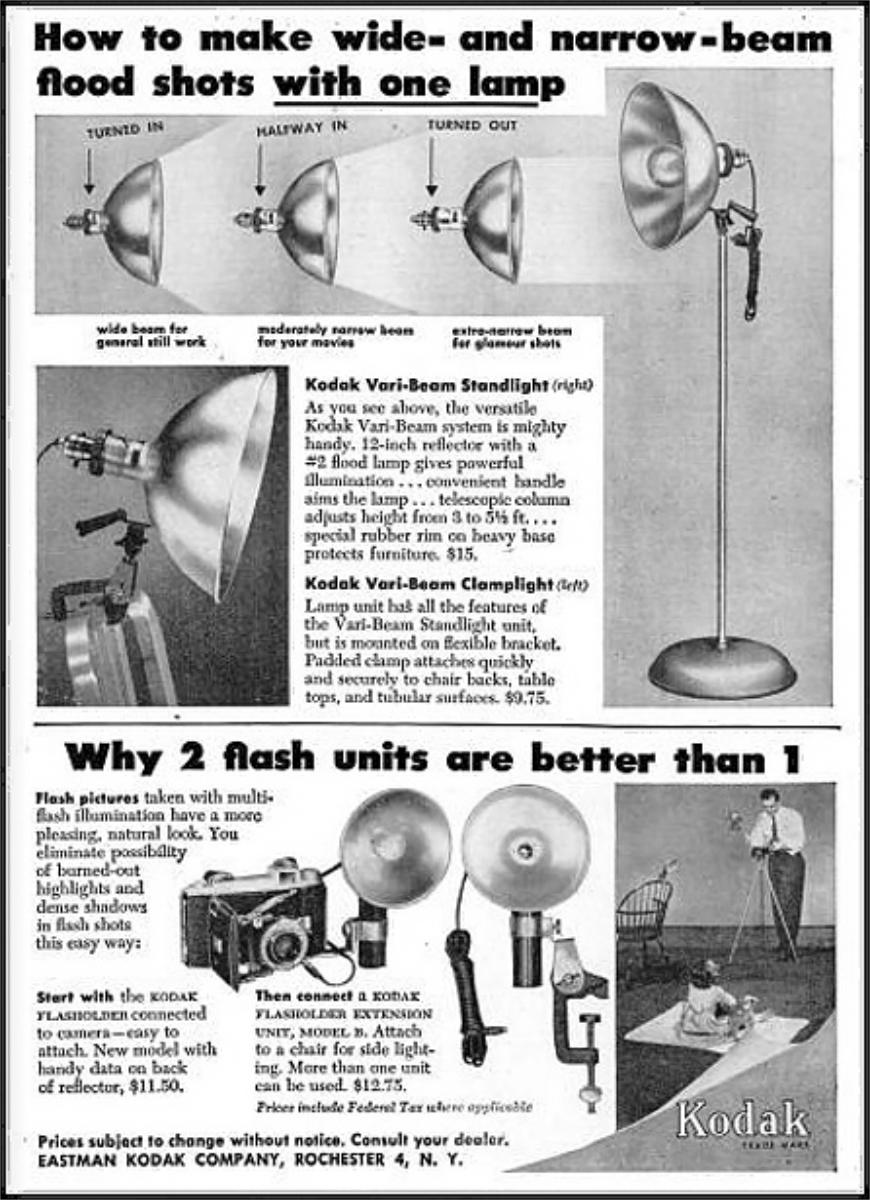
broaden the beam, matey

A neat way to change the lighting from broad to tight

Toronto. In the early days of photography, studios took portraits by soft northern light, avoided appointments on cloudy days, used ‘unobtrusive’ hand holds, neck braces and clamps to hold the patient, (I meant subject) steady for the seconds/minutes needed to effect a likeness.

They say necessity is the mother of invention. In mid 20th century photographic circles, media and lenses were still abysmally slow. To allow faster shutter speeds and avoid subject motion without handholds, braces, clamps, etc., studios used a variety of photo floods. A broad flood would throw a wide beam of light making shadows soft and modelling the subject in a 3D look. A tight beam could be used to highlight aspects of the subject at the risk of harsher shadows, or a medium beam could be added on the background to ease overall contrast.

Professional studios could easily buy different kinds of reflectors to suit their strategy on illumination. Amateurs on the other hand struggled to buy extra lights or even to understand how the beam affected the subject and photograph. My first venture in artificial lighting meant affording only a single reflector/socket and in a narrow beam at that. Needless to say portraits were harsh, contrasty, and very poor. Years later we had a photo taken by a ‘professional’ Airman. “Smile” he said as he turned  on the narrow flood and snapped the shutter. We all squinted in our formal photos …

Kodak solved the amateur’s illumination dilemma by offering a photo flood reflector on a stand with the beam adjustable by moving the socket in and out of the reflector as shown in this 1951 ad. You can also see the use of two electronic flashes to soften shadows, but that’s another story.

Our thanks to good friend and PHSC member, George Dunbar, for discovering and sharing this Kodak advertisement from the March, 1951 Popular Mechanics magazine. Ahhh, memories of the days when ASA (ISO) 200 was considered ‘fast’.

Posted in history | Tagged , , , | Comments Off on broaden the beam, matey

35th exec meeting by ZOOM

Toronto. If you are counting, you will see we missed posting meeting number 34 (February 2023). In February  we had a rare session with too few voting members of the exec being present – due to a variety of situations. A perfect storm if you will. This exec meeting had better participation. But speaking of perfect storms, we too are digging out – snow anyone? We have lots on hand!

Please note that our Newsletter still needs an editor. Meantime, journal co-editor, David Bridge will send out a brief newsletter in March (as soon as we clarify a few things). Nevertheless, if you would like a personal copy but haven’t joined up as yet, just drop me a note at news@phsc.ca.

Our membership secretary was available and had video this time as well as sound. The membership report for March will arrive shortly. Membership reported two new three year memberships.  Meantime our treasurer reported three one year membership renewals.

The monthly meeting for March will be decided in a few days, as will the spring auction. We are planning to hold a consignment/member auction with lots potentially accepted at the door. Early lots with photos will be posted here along with dates, etc.

Our next  journal will be out as a pdf file this month or next. President Clint discussed our  decision to move from hard copy to PDF files with an EBSCO contact. (EBSCO manages subscriptions for a number of institutions).

Can you smell spring yet? Meantime, “Have a great winter and let’s hope the seventh wave of COVID-19 and its restrictions stay very modest at best!”.

Posted in activities | Tagged | Comments Off on 35th exec meeting by ZOOM

where do you go pro, my lovely

A GoPro Digital Camera from an article on How-to Geek

Toronto. Digital photography has been around now for about 3 decades as a viable alternative to film. It is long past the time older digital cameras could be considered as collectibles.

In fact a growing number of people have never used a film camera (aside from niche fanatics). Nor bought film; nor saw a photograph emerge from blank paper. They only know digital smartphone images in full colour – cameras where monotone (black and white) is a filter.

The other day on the site How-to Geek, Tim Brookes postulated, “5 Reasons You Should Buy a GoPro (or Similar Action Camera). This article addresses rugged digital cameras intended for use under extreme conditions. These aren’t your regular mirrorless cameras,   professional DSLRs, or the now ubiquitous cameras in smartphones. They are intended to go one mountain bikes, climbing, hiking, underwater and in fact anywhere a regular digital camera would struggle.

The retailing of these special ruggedized digital cameras is another indication that digital cameras are now mainstream. Still long for yesterday? Drop into one of our auctions or fairs to see the older digital cameras, film cameras, lenses, etc. suitable for either use or collecting! The latest dates and locations are in our right hand sidebar.

Note. The title I used here is a riff on the 1969 song,”Where do You go to My Lovely” byPeter Sarstedt. The aspect ratio is off but not the song. A later version by Peter exists (1998) but it isn’t as haunting as the original version.

Posted in camera | Tagged , , , , , , | Comments Off on where do you go pro, my lovely

an easy image back-up

little boy by garden – summer 2012

Toronto. George Dunbar is a fierce supporter of the virtues of printing digital images: The human eye can view prints without fancy software or equipment that may go out of date and leave these memories forever lost. Also, prints are a neat image back-up (they do miss the digital notes, key words, EXIF data, etc.).

My wife has a very positive opinion on the value of the printed photo too. She points out that browsing a shoe box or an album full of prints is long gone.

And now Sydney Butler comes along with this article “5 Reasons You Should Print Your Smartphone Photos” recently published on one of my favourite blogs,”How-to Geek“. While the article talks about the Smartphone, it applies to all digital cameras – smartphone cameras are the norm these days with the younger folk (and some old coots too:-).

Posted in history | Tagged , , , | Comments Off on an easy image back-up

all lens

Ermanox with Ernostar from ‘Zeiss and Photography’ courtesy of author Larry Gubas

Toronto. Heinrich Ernemann began making cameras when it was founded in 1899 Dresden. In 1926 it was part of the amalgamation which was called Zeiss-Ikon. The Ermanox camera used a single glass plate and a focal plane shutter. The f/2 100mm Ernostar lens was designed by Ludwig Bertele.  At the time, it was the fastest still photography lens ever made. For the first time candid shots could be taken indoors – if taken by an expert like Erich Salomon.

The designer moved to the Zeiss organization along with the lens design which served as a basis for the Zeiss Sonnar and Biotar lenses. The photo at left is from the very detailed history in the excellent book ‘Zeiss and Photography‘ by Larry Gubas (sadly long out of print – only 400 copies were ever made).

We have posted many notes about Ernemann and the Ernostar lens, such as our September 1, 2021 post titled, “cat’s eye” on an ad for the Ernostar. Type in the term “Ernemann” in the search bar of our site to see these and other Ernemann posts,

Note. The post title is a riff on the expression, “all hat and no cattle” which certainly doesn’t apply to this amazing little camera (c 1924).

Posted in history | Tagged , , | Comments Off on all lens

tong wars

Zuma bamboo tongs – courtesy of Amazon and Limo Studios

Toronto. Sorry, I don’t refer to any Chinese gangs in this post. Instead, I discuss photography tongs – A minor accessory for B&W darkrooms – usually bought in sets of three.

In the 1960s, I used tongs made of three different materials – sturdy stainless steel tongs, bamboo and rubber tongs (my personal favourites), and plastic ones (they were old, used, and came with small plastic trays).

Under the soft glow of the darkroom safelight, each tray of chemistry had its own pair of tongs. The tongs were often colour coded so they could be tied to the same tray of chemicals. While a print was immersed in a chemistry, the tray was gently rocked to ensure even coverage. The tongs could be used to rearrange prints as need be.

After a print developed, it was lifted by one corner with the tongs and drained from the diagonal corner then dropped in the stop bath. A second set of tongs repeated the process and dropped the print in the fixer where after a time the process was repeated with the third pair of tongs and this time the print was dropped into the wash water.

At the end of each session trays and tongs were washed, stop bath tossed, and developer and fixer returned to their respective containers ready to be used once again. Those were the days (or nights) with quiet contemplation as a miracle unfolded on each photo paper!

Posted in history | Tagged , , | Comments Off on tong wars

developing an interest

Developing an Interest courtesy of a Kodak ad in January 1951

Toronto. The ad at left is from an old Popular Mechanics magazine, courtesy of my good friend George Dunbar. George writes, “A Testimonial from GD: Many became photographers because of the magic of the darkroom.”. The ad, of course, is Kodak’s encouragement to buy its darkroom kit to extend the pleasure of photography to developing prints and even films.

These kits all make  contact prints only. Their retail price is far too low even for Kodak to accommodate an enlarger – so necessary with 35mm and 828 films to get a decent size print. To help the amateur, the kits came with ‘Velite’ paper, usable without need for any safelights or darkrooms.

Okay dear reader, what was your incentive to adopt photography as hobby or as a profession? In my case, it was the gift of a little plastic camera – a  baby Brownie. It was given to me by my dad when I was eleven. The following year, was my first ever school trip. Our grade six class went off to see the sights. And I brought along my trusty Brownie and  some Super XX film rolls which I believed was “high speed” (according to Kodak). Sadly, it was certainly not up to the task of indoor snaps with my little camera with a fixed focus f/16 lens and 1/25 second shutter.

I did have tons of curiosity though, and wrestled with photography and radio as serious interests over the next decades. Again I ask, what’s your story, dear reader?

Posted in history | Tagged , , , , | Comments Off on developing an interest

family history

a c1900 photograph of a mother and her home and first five sons

Toronto. Every family seems to have a ‘keeper’ of records and a photographer who diligently records and photographs the minutiae of life as it is lived.

A few decades back, my parents answered a knock on their front door. A young woman introduced herself. She turned out to be married to a distant cousin of my father and was deeply into family history.

Invited in for ‘a cuppa’, she took out the photograph shown here and asked my parents if they knew who the people were – and when and where the photo was taken. My dad exclaimed that he knew. It was his mother and his first five brothers taken at their home around 1900. The photo was taken about a decade before he was even born!

We often think of Ancestry and its many databases and indicies allowing detailed research of family history in an organized fashion. That data is augmented to an astonishing degree by ‘word of mouth’ notes – and photographs. In fact, without photographs, we would be hard pressed to even know how our ancestors looked, how they lived, where they lived, etc.

We owe a deep debt of gratitude to amateur – and professional – photographers for taking family photographs. And to the many ‘pack rats’ who have kept the photos safe over the decades. Pictures go a long way to making information from data bases and notes come alive.

Posted in history | Tagged , | Comments Off on family history

all that noise

Effect of Topaz Photo AI on a digital image

Toronto. One of the short comings of digital images is that they are a bit noisy (especially in poor light or with a high ISO setting). To that end, I had a program at one point that removed noise and made the images appear much better (Noise Ninja).

Recently, PHSC assessed the app called ‘Sharpen AI‘ for image sharpening. Since I already have, use, and like the ‘Focus Magic‘ plug-in, I saw no need to cough up another $79US.

Now Brian Matiash extols the virtues of Topaz Photo AI for both sharpening and noise reduction on images – at $199US. There is a free sample – check it out.

Note: The title of this post is a riff on an old CBC program that I enjoyed called, “All That Jazz”. Here are some current CBC programs you can enjoy on your computer.

Posted in photos | Tagged , , | Comments Off on all that noise

foto finnish

Repair shop at Camera Rescue Centre in Finland

Toronto. We have one thing in common – we collect cameras: going to garage sales, camera fairs, camera shops, etc. we constantly strive to find an addition for our collection or a better example of a model we already have.

The guys at Camera Rescue in Finland take a different approach – instead of searching for a better example, they restore old film cameras to working order once again.

To learn more about this approach, visit their web site, Camera Rescue. And for those unfamiliar with the repair concept (in this day of ‘toss and buy new’) watch the brief ‘history of the shop’ video.

Learn of their goal to “save 100,000 cameras” while they strive to increase the pool of cameras for the niche enthusiast of film technology. Who knows, some models may well suit your collection!


Posted in camera | Tagged , , | Comments Off on foto finnish