a list of firsts

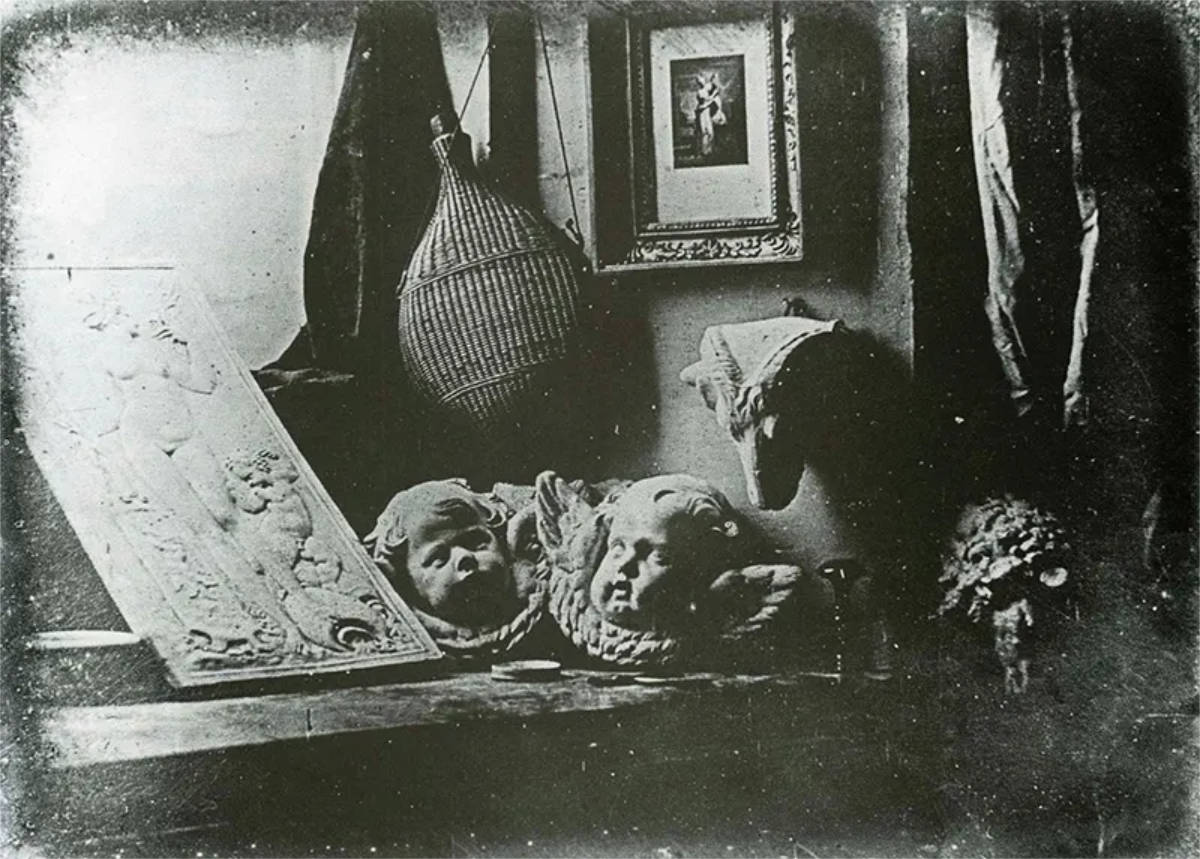
A c1837 still life daguerreotype by Daguerre while he experimented with the as yet announced process

Toronto. When first announced few photographs were readily available. In short order however, the number of photographs (and photographers) mushroomed as the new phenomena sped ’round the world. Today, we see literally millions of photographs.

Some History of Photography books have illustrations of the ‘first’ photograph in various categories. It seems that this passion of identifying the ‘first’ in each category quickly disappeared as the art matured – until now.

In the course of his research, George Dunbar came across a web site that bravely tries to list the many photograph ‘firsts’, especially those that happened long after 1839. Have a  look at the article, “Famous First Photographs in History: From the Oldest Photo Ever to the First Photo Shared on Internet” on the, ““, web site.

Note that the photos and text are of interest to all who research photography. The material on the site is somewhat marred by the incessant advertisements. In any case, I appreciate my good friend George’s generosity in sharing the above link with me (and the society).

Posted in history | Tagged | Comments Off on a list of firsts

photo history in a nutshell

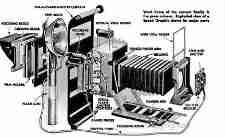
an exploded view of a 1952 Speed Graphic from an article in the Popular Mechanics July 1952 issue.

Toronto. Since the previous post discussed digital photographic history, I thought this post could look at analogue photographic history. A brief condensed version was written last century by two folks – Valentino Serra (Photographic Illustrator), and Beaumont Newhall (Curator at GEH). Beaumont Newhall is well known to many of the readers of this site for his books on Photographic History.

The article, beginning here on page 72 of the PM July 1952 issue, is courtesy of Popular Mechanics and Google books. It was suggested by my good friend and fellow photo historian, George Dunbar. George found this article while searching magazine advertisements for interesting material on the photographic industry. Please note the article is copyrighted material.

If you enjoyed this article, but haven’t bought Beaumont Newhall’s books, be sure to keep an eye out for them (search used bookstore or visit one of our events – you might get lucky!

Posted in history | Tagged , , | Comments Off on photo history in a nutshell

the start of it all

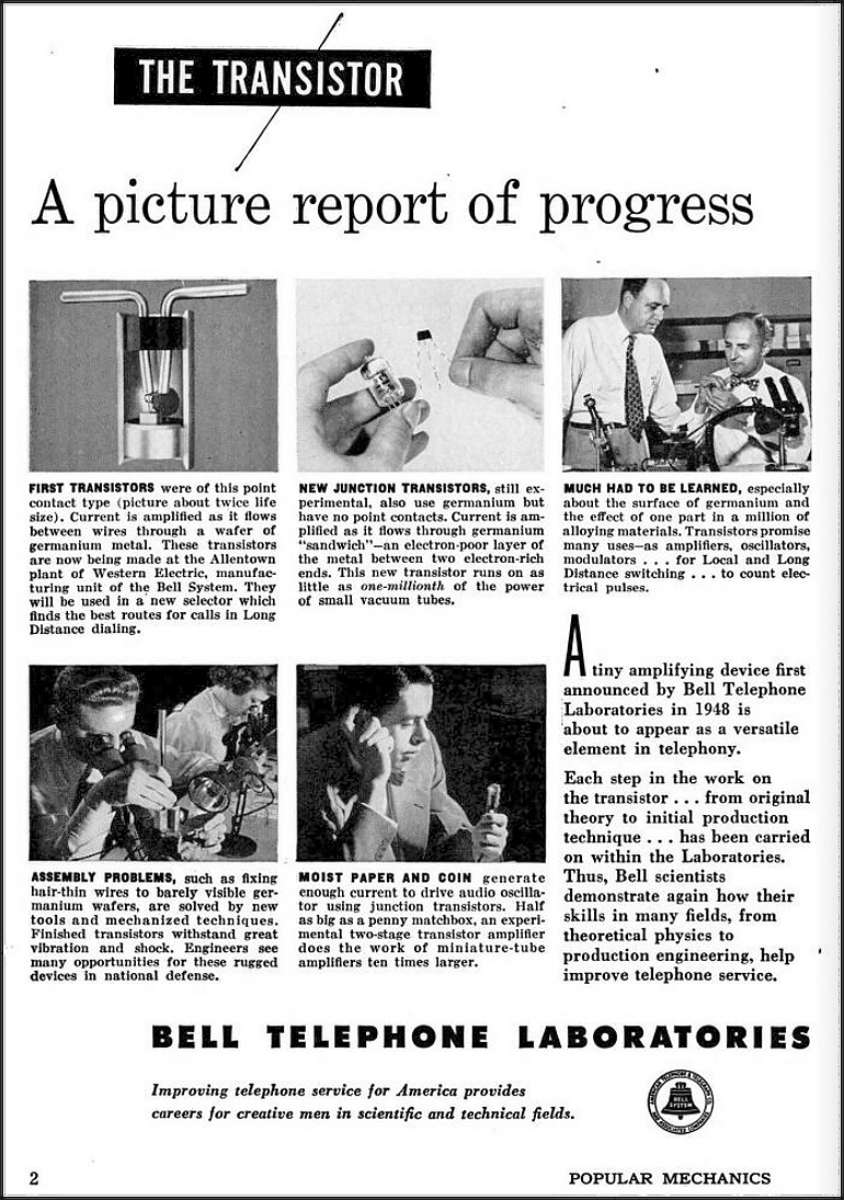
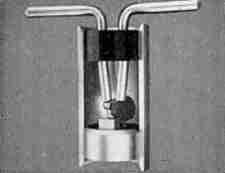
the point contact transistor invented by a trio of Bell Labs Scientists

Toronto. And by all, we mean digital photography, not the 1839 analogue photography (metal, glass, film, paper plus liquid solutions). When radio and electronics began early last century, vacuum tubes did not exist. A few years later, on into the mid last century, vacuum tubes were invented and systematically improved and reduced in size. But even the smallest of vacuum tubes was far too big and limited in function for use in this century.

In 1947, Bell Labs in New Jersey announced the invention of the transistor (TRANSfer resISTOR). At 1/10 the size of a miniature vacuum tube, it replaced a triode tube in audio amplifiers. Transistors evolved rapidly, to geranium, then silicon, and both power handling, and the usable frequency continued to rise. To make operations even faster, integrated circuits with many transistors on a tiny chip came on the scene (This evolution affected makers too. For example, Intel began operations, not as a transistor company, but as a maker of integrated circuits).

Rapid miniaturization followed Moore’s law. Miniaturization and integration in each new design eventually resulted in literally millions of tiny transistors on a small chip. In the latter part of the last century we began to see solid state sensors which created full colour images from reflected sunlight and indoor lights. The image size was rated in pixels (Picture Elements).

Today even cell phones (smartphones) have solid state cameras built-in. Professionals and more advanced amateurs use digital cameras. Film cameras and technology is still in use by a small niche of enthusiasts who extol the quality of an analogue image over an image digitally created. For digital cameras, “development” is by computer applications either in the phone or on the desktop/laptop. Since digital camera began life nearly three decades ago, it is time we began collecting the pivotal designs before they become too expensive.

A down side to the speed and convenience of digital devices is the inability to get parts or repairs in later years whereas mechanical cameras can be repaired and continue to function well beyond their date of design, manufacture, and sale.

My thanks to good friend George Dunbar, for sharing the Popular Mechanics July 1952 ad by Bell Laboratories talking about the transistor four years after it was first announced. A few years later transistors became common in the retail market and in appliances of the day. Like photography itself, vacuum tube products and solid state devices were offered side by side for many years.

Posted in history | Tagged , , | Comments Off on the start of it all

who is this guy, anyway?

A great place to checkout early photographers in the Hamilton area.

Toronto. Over the years we have had many studios and photographers in Canada. It takes a lot of digging to unearth facts today like location of studio, kinds of photos, personal history, etc. Some large and well known studios like Notman and Karsh appear in  numerous books.

Some like Notman even recorded details and numbered photos. The museum associated with McGill University in Montreal, the McCord Museum, has a large collection of Notman prints and a record of known numbers (plus other historic prints).

Do you collect photos? Ever wonder about the photographer? Try asking at your local archives or historical society. If your guy operated in the Hamilton area, The Flamborough history folk may have some information for you.

Our thanks to that good friend and fellow member, George Dunbar, for sharing this marvellous find with us.

Posted in history | Tagged , , | Comments Off on who is this guy, anyway?

squaring the circle

1952 ad for the American made TLR called the Ciro-flex

Toronto. When collectors think of TLR design, they usually think ‘Rollei’. Other firms also made cameras in the TLR design. Most of these cameras seem to follow Rollei in general layout and style.

To hop on the minicam bandwagon, the famous professional camera maker of ‘Graflex’ fame bought up a small American competitor who made and sold the Ciro-flex cameras. Graflex advertised the economic TLR line as “How to take the guess out of picture-taking” in its April 1952 Popular Mechanics ad.

My thanks to my good friend and fellow photo-historian, George Dunbar, for suggesting this idea and providing the ad from Popular Mechanics.

I think of the post title as a TLR format (square) and the ‘circle of confusion‘ (circle). The mathematical meaning is explained by the wikipedia article. Loosely, it means to join two things usually thought to be mutually exclusive.

Posted in history | Tagged , , | Comments Off on squaring the circle

Ian P Archer 1958 – 2023

Ian Archer and a field camera acquired for his collection.

Toronto. We were sad to learn of the death of Ian on Wednesday, April 19, 2023. Ian was a long time member of the PHSC and a frequent contributor to our monthly ZOOM meetings. He would have reached 65 later this year.

Ian joined the PHSC back in 1983 while he was at Eddie Black’s. The photo at left is from his Facebook page showing Ian with an addition to his collection from one of our more recent auctions.

Ian is survived by his wife of over 42 years, Joyce Allison Archer ( née Major) and son Devon Paul Archer.

Ian was born in Ottawa, after his parents immigrated to our capital city from the UK. In addition to Joyce and Devon, he is survived by his brother, Andrew, and sister, Norine, along with their spouses, two brother’s-in- law, five nieces, four nephews, five great nieces and a great nephew.

A formal obituary will appear in the Toronto Star early next month.

Ian and our late editor, Bob Lansdale with two Graflex cameras from one of our auctions

Posted in people | Tagged , , | Comments Off on Ian P Archer 1958 – 2023

I swan …

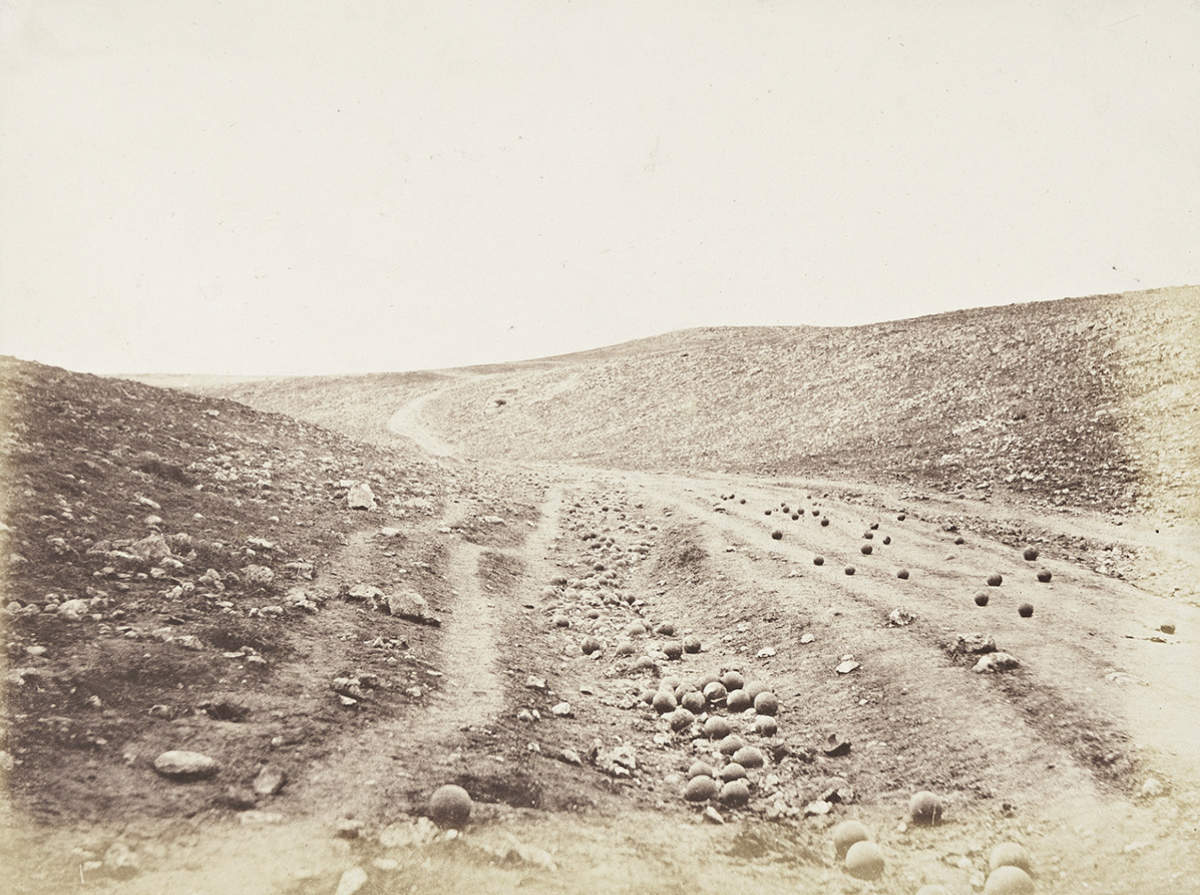
original salt print by Roger Fenton, “Valley of the Shadow of Death”

Toronto. Okay all you photo print collectors! Here is your chance to add some authentically historic prints to your collection.

Under the auspices of sister organization, The Daguerreian Society, Swann Auction Galleries in NYC are auctioning 100 works from the Stephen White Collection in today’s (Thursday the 27th) auction.

The gallery says  in part, “Photography’s immediate importance in documenting and sharing information serves as an early theme, including Roger Fenton’s pioneering image from the Crimean War Valley of the Shadow of Death, and an exceptionally rare view that documents the vicinity of the execution of Emperor Maximilian in Mexico.

“The idea that photography possesses a dual or hybrid identity as both an art form and documentarian tool is ever-present, and continues throughout, including an astonishing large-format example of Tom Howard’s surreptitious and immediately iconic image made at the execution of Ruth Snyder, an early print showing the Wright Brothers’ first flight in the Kitty Hawk in 1903, and Garry Winogrand’s noir portrait of Victor Riesel, a syndicated journalist blinded after an acid attack.”

Visit the gallery link above and swap some $$$ for a piece of history.

Posted in activities-other | Tagged , , , | Comments Off on I swan …

dying, dying, dying

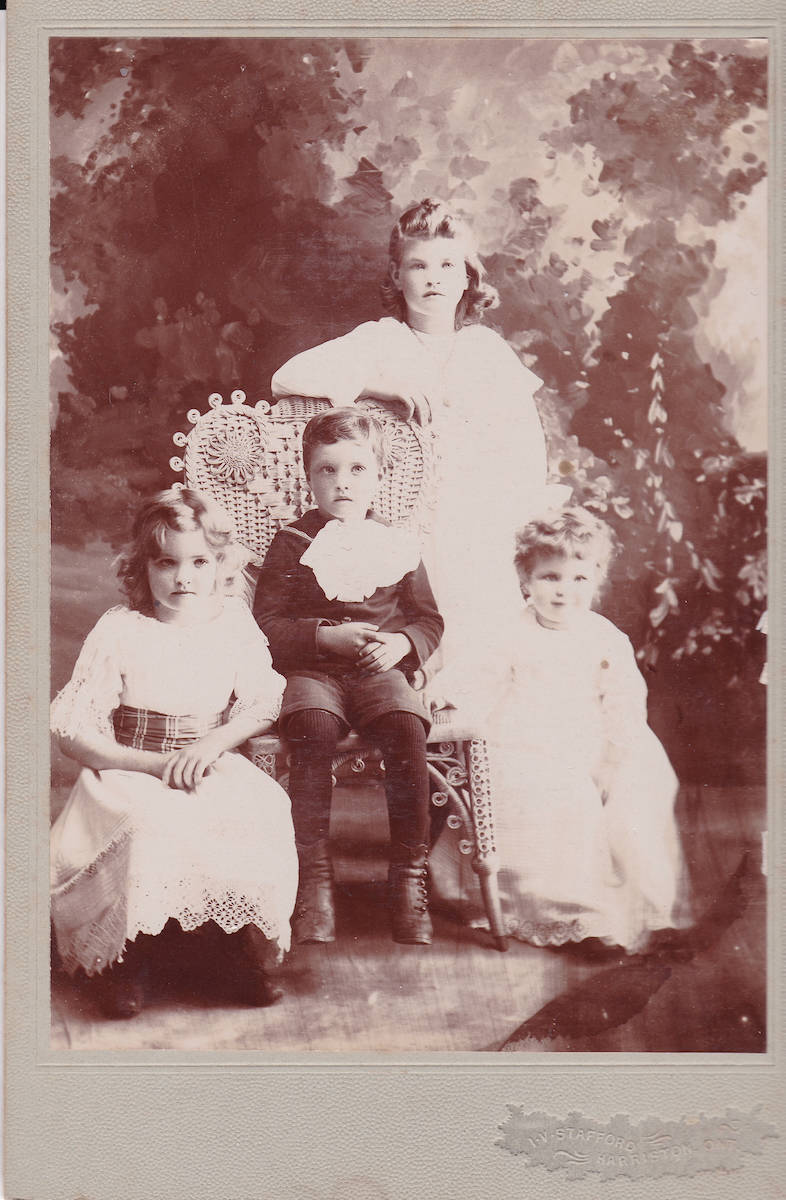
1880s or 1890s cabinet card of four children. Highlights are washed out now.

Toronto. Members of the PHSC (and most other readers of this site) collect cameras and/or photos. A few collectors even specialize in photographs. Some are eclectic, some collect by kind, some collect by subject, some collect by process, etc. Our late editor Bob Lansdale was partial to CdVs and other cards where the photograph was made with the carbon process. Carbon process prints do not fade over time.

The cabinet card shown here was printed c1885 in Harriston, Ontario (about an hour north-west of Toronto). While the glass plate in the studio may have been correctly exposed, developed,  and printed, today it shows washed-out highlights. If the subjects survived the vicissitudes of childhood and early youth and married, they could be the great- or great-great-grandparents of today’s people.

Visit one of our events and you just may find a photo – cased, carded, mounted or bare – to add to your collection. PS. Visit the auction at the end of this month, and our spring photographica-fair next month (May 28th – see our website’s right hand side bar).

Note: The title of this post is part of a line from Tennyson’s poem, “Blow, Bugle, Blow“. This is a favourite poem of mine, along with his poem “The Lady of Shallot”. Both were memorized about 75 years ago in grade school. As children, we memorized poems but were too young to do any proper analysis.

Posted in history | Tagged , , , | Comments Off on dying, dying, dying

what a bargain!

1952 ad for the Graflex Ciro 35 camera

Toronto. I’ve noticed over the years that in every industry larger companies buy up smaller ones for a variety of reasons – features, expanded territory, potential, etc. The photographic industry was/is no different as attested by the early years of Kodak.

My good friend and fellow PHSC member, George Dunbar, sent me this interesting link to a Graflex ad in Popular Mechanics (May 1952 issue).

Post war, Graflex added the Ciro camera line to attract ‘modern’ customers who viewed the large traditional Graflex cameras as old fashioned vs the  more modern designs that used 120 or 135 roll film.

The Ciro 35 line was touted as a bargain at ‘under $50’.  In this way Graflex was suggesting an aspiring amateur could get a better deal by buying a home grown camera. All too soon, the more serious amateur would turn to interchangeable lenses or add-on lens elements to make his camera more flexible – features not offered in 1952 by the Ciro line.


Posted in history | Tagged , , | Comments Off on what a bargain!

fuzzy girl

portrait taken with a Thambar 9cm lens and screw-mount Leica

Toronto. Like all hobbies and professions, photography had fads from time to time. The late part of the 18oos and earlier part of last century, pictorialism took over for a time. Proponents of pictorialism used photography as a basis for art, including using a soft focus approach.

By the time Leitz retailed its Thambar lens, the fad was almost over. A few of the lens were made during and after WW2, but the total Thambars made was less than 3,000. The lens used uncorrected peripheral rays to create the out of focus look. Stopping down sharpened the image. A special silver central spot filter blocked out the sharper central rays. Unfortunately, use demanded varying the aperture, the scene, and the special filter making it difficult to take a great shot.

I bought my lens used at Downtown camera who sell one today (by special order and with a bayonet mount rather than the old screw mount).

While the Thambar was a failure in sales, it is in high demand by collectors of Leica lenses. You can see in my photograph that the lens focussed on the edge of the chair, not the child’s face as intended. An interesting lens, but hard to use. It was brought back briefly in a bayonet mount and very high price.

Note: The post title is a riff on “Funny Girl“, a story about Fanny Brice that was offered in various ways (stage, movie, musical, etc.). Here is Barbra Streisand singing the namesake title song, “Funny Girl“.

Posted in history | Tagged , , , | Comments Off on fuzzy girl