the colour blue

APS holds a cyanotype workshop Nov 25, 2023

Toronto. Our friend Horst Herget is holding a “Cyanotype workshop” at the next APS meeting (November 25th).

Horst writes, “Cyanotypes are beautiful to behold and easy to make. Peter Friedrichsen will show you all you need to know to make your very own. Workshop held on November 25th at Daylight Studio in Leaside. Suitable for all abilities. 

“Overview: The Alternative Process Social – APS – is thrilled to have Peter Friedrichsen instruct the cyanotype workshop. Peter is a natural instructor who will teach you all you need to know of this 1840’s process. The workshop space will be set-up with three complete stations using UV exposure units. Both digital negatives and photograms images will be made. Two images provide by participants in advance will be converted in roughly 5”x7” digital negatives.

Details:
Cyanotype workshop with Peter Friedrichsen.
Saturday November 25th, 3.5 hours, 1pm-4:30pm
Location: Daylight Studio Leaside, 28 Industrial Street (off Laird, south of Eglinton),
M4G 1Y9, unit 222. The space is home for APS’ monthly meetups
The 3.5 hour workshop is $200+HST, limited to six participants.
All materials included, plus two digital negatives of images provided by the participant and handout of the process & resources.

How to register:
Please email to info@DaylightStudioToronto.ca

Posted in activities-other | Tagged , , | Comments Off on the colour blue

time after time

a Kodak Timer – used with a light tight tank and thermometer

Toronto. In the glass plate/film era, a latent image was captured and developed. If necessary. the resulting image could be reversed and enlarged. The earlier media were insensitive to many visible colours created by less energetic light rays. These media were developed under subdued, often red, lighting. The media could be inspected to determine if the development was sufficient for a good print. Such media became known as orthochromatic.

Eventually the media were increased in sensitivity and to all visible colours. These glass plates/films were known as panchromatic and had to be developed in total darkness. Since observation throughout the development process was not possible, a new developing method had to be designed. This was the so called time-temperature process. The developer was kept to a universal temperature like 68 degrees Fahrenheit and developed for a fixed time withe duration depending on the media and development formula.

Under exposure or over exposure could no longer be compensated by developing for more or less time. If the media were “pushed” a stop or two then the time was extended appropriately.

NB. The title of this post is the title of a 1983 song by Cyndi Lauper, sung here by Ms Lauper.

Posted in history | Tagged , , , | Comments Off on time after time

a supporting stand

A Leitz table tripod 14100 from the 1950s in closed position

Toronto. In this day of smartphones and digital cameras with maximum  ISO settings beyond our wildest dreams in the film era, camera supports are seldom necessary (other than to take selfies or closeups where framing is critical).

In the early days of photography, studio cameras were massive pieces of furniture usually with four legs terminating in wheels to move across floors. Outdoors, cameras were mounted on sturdy tripods – the three leg wonders were quite stable on either uneven ground or level ground. The camera could be raised or lowered or turned in place allowing a steady photo to be created with media that took a few seconds or longer exposure.

The trusty tripod was a ubiquitous accessory for well over a century of serious photography adding both stability and framing to each photograph. When faster media arrived in the 1870s, handheld cameras using shutters became popular – often so called detective cameras since they could be operated without the tripod appendage. We continued to use tripods indoors and for close-ups and/or where framing was important.

When we approached the end of film and the beginning of digital technology, tripods and other stands be came unnecessary for most photos. Even at slower ISO ratings there was often built-in optical stability to counteract a small bit of shake. In the late years of last century, I used a tripod, clamps, and even the camera strap to steady my camera. Holding the strap of my Leica tight around my neck, I could take photos as slow as 1/8 second successfully without any built-in optical stability. Of course I was much younger then …

NB. Regular tripods are so common, even today, that I chose to show one of my small Leitz table top tripods. A ball & socket head can be added to allow limited camera adjustment.

Posted in history | Tagged , , , , | Comments Off on a supporting stand

tossed upon cloudy seas

storm clouds in the east

Toronto. Cloud photography was a challenge in the earlier years of our art. The media were mainly blue light sensitive. Both sky and cloud showed dark on the negative material when the landscape or person was suitably exposed.

To correct the ‘white’ area above the scene in the print, a separate negative for sky and cloud could be made and added carefully. In later years, a yellow filter used with orthochromatic film could capture sky and cloud as well as the scene below. Some filters were clear on the lower half and yellow on the top half so with careful exposure and framing both the sky and the scene below appear natural on the negative and the subsequent print.

For panchromatic film, the yellow filter or a polaroid filter could intensify and darken the sky making clouds stand out. Since halloween themes of ghosts and pumpkins seem common place today, I chose to show a stormy cloud scene and used the story by Noyes. I once read his poem to my children, literally, “scaring the pants off them”!

NB. The title of this post is a phrase from Alfred Noyes’s haunting poem, “The Highwayman” first published in 1906. It is a suitable memory of Halloween!


Posted in history | Tagged , , , , | Comments Off on tossed upon cloudy seas

the best of times

A Century of Cameras – 1st edition 1973

Toronto.  to quote Charles Dickens and his book, “A Tale of Two Cities”. The 1970s was when the PHSC was formed (1974). In the 1970s  camera collecting, image collecting and photo history were growing in popularity.

Collecting clubs formed, books were published, old cameras gained value, camera fairs were held, museums, archives, libraries, and art galleries had photography sections and exhibitions were held at places like the CNE and the underground passage ways in downtown Toronto.

Establishments like George Eastman House in Rochester became hot attractions. There was a scramble for fresh speakers knowledgeable in the old processes and old equipment. Data on early cameras was unearthed. Camera serial numbers were correlated with dates and camera models.

As the era of digital technology arrived, film technology and the early days of photography faded from interest – other than high end cameras and photographs by famous studios of famous people, especially older photographs. Meantime the PHSC and its publications and event continue to thrive. Truly the best of times.

Posted in history | Tagged , , , | Comments Off on the best of times

moonlighting …

under a dim red glow

Toronto. … by the dim ruby red light. One thing the digital crowd misses in photography is the darkroom. Digital photo files are corrected – developed – either in the smartphone or on a computer, then printed on an inkjet or just sent as an email or message.

In the days of plates and film, when a photograph was taken, the job was only partly done. Then the negative had to be developed (by red light if orthochromatic or in full darkness if panchromatic or colour). Next, negatives were printed by the dim red light (b&w papers were always orthochromatic). However by their very nature colour process films and papers were panchromatic and had to be developed in total darkness – either a room or a light-tight  tank.

To create the print, developers and paper grades, paper types, etc. were chosen; negatives cropped and sized. Processing a roll of 36 photos could easily take all night. Would I go back to film days? Nope! Been there. Done that. Got the T-shirt. Nowadays I’m old and lazy. I like the ability to use apps on the computer or smartphone to modify a shot.

And unlike the photo at left which I took and was originally badly overexposed, (shadows blown out on the negative), digital technology all but guarantees a technically correct shot (other than focus and/or blur). Even ultra fast sensors obey the laws of physics. You shoot too fast for the light and the focus is way off.  You move in low light and the image blurs.

Regardless whether you go film or digital, the subject choice and framing are paramount! PS. if you enjoy the ambiance of film prints, by all means drop in on one of our shows to get film materials to take and process analogue! Of course there are also lots of goodies to augment your collection of photographic memorabilia.

Posted in history | Tagged , , , | Comments Off on moonlighting …

a bevy of pretty perfect pictures

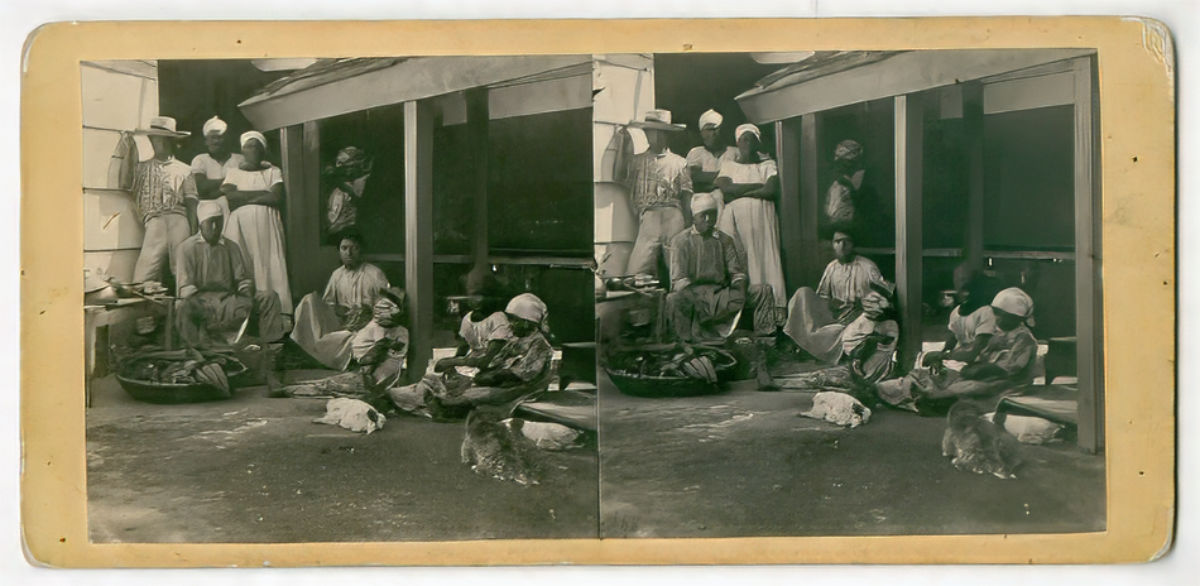
typical stereo image from the Robert Wilson collection

Toronto. On November 1st and 2nd, 2023. A number of photographs in the collections of the late Dr Robert Wilson (a long time PHSC member and PHSC executive) and the late Harve Sherman (both of Toronto) and the late Miljenko Horvat of Montreal will be auctioned by Liveauctioneers in the Canada Book Auctions. Bids can be placed online at Liveauctioneers.

A notice was also posted by the Daguerreian Society. Here is a great opportunity to add to your old photos collection by bidding online in these two auctions. Check out the catalogue in advance to see the variety of photos (and stereo cards) being offered.

Posted in activities-other | Tagged , , | Comments Off on a bevy of pretty perfect pictures

Lorne Shields featured in Rochester

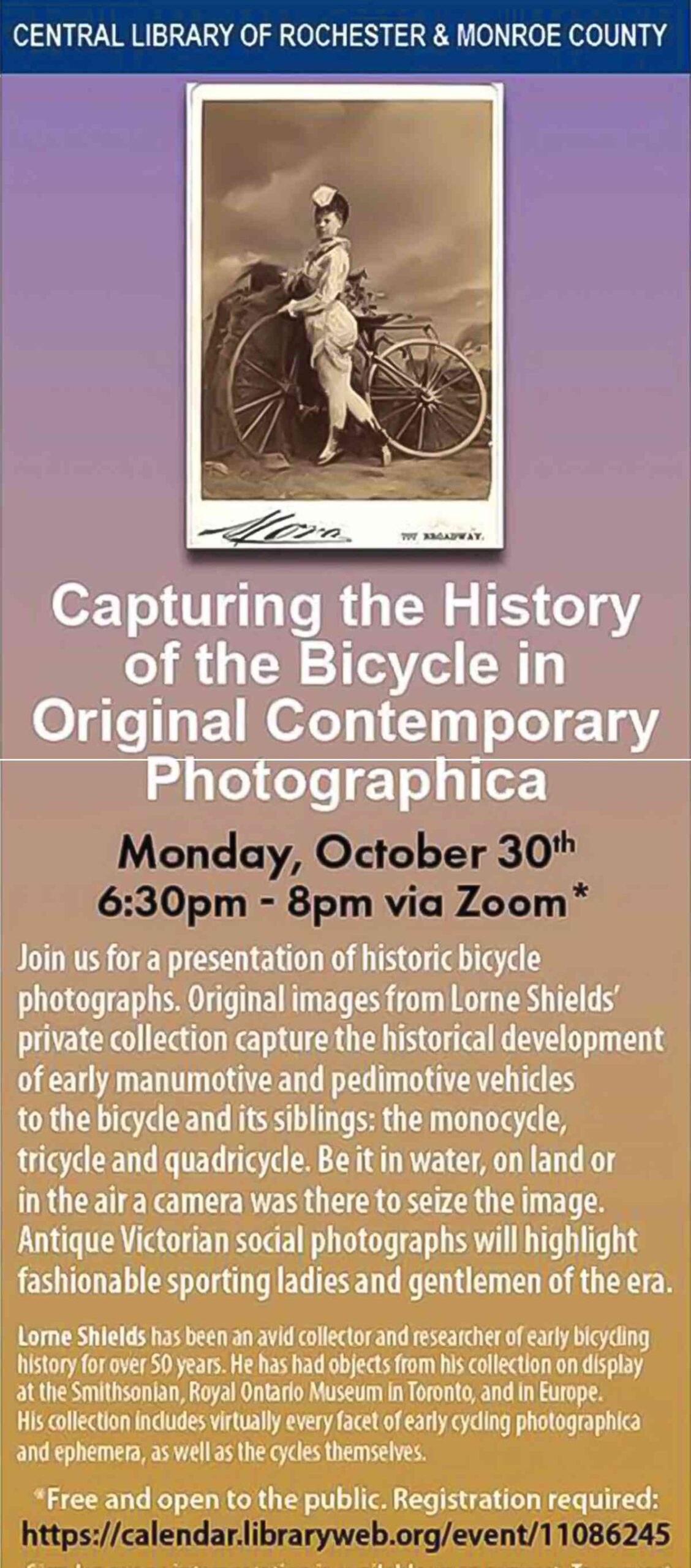
Our Lorne Shields will be presenting a lecture on “Capturing the History of the Bicycle in Original Contemporary Photographica” hosted by the Central Library of Rochester & Monroe County, Literature Division, via ZOOM on October 30th. It’s a free session.  Register for this event here:  https://calendar.libraryweb.org/event/11086245

Lorne Shields by the Rochester Library Oct 30th, 2023

Posted in activities-other | Tagged , , | Comments Off on Lorne Shields featured in Rochester

gooey stuff

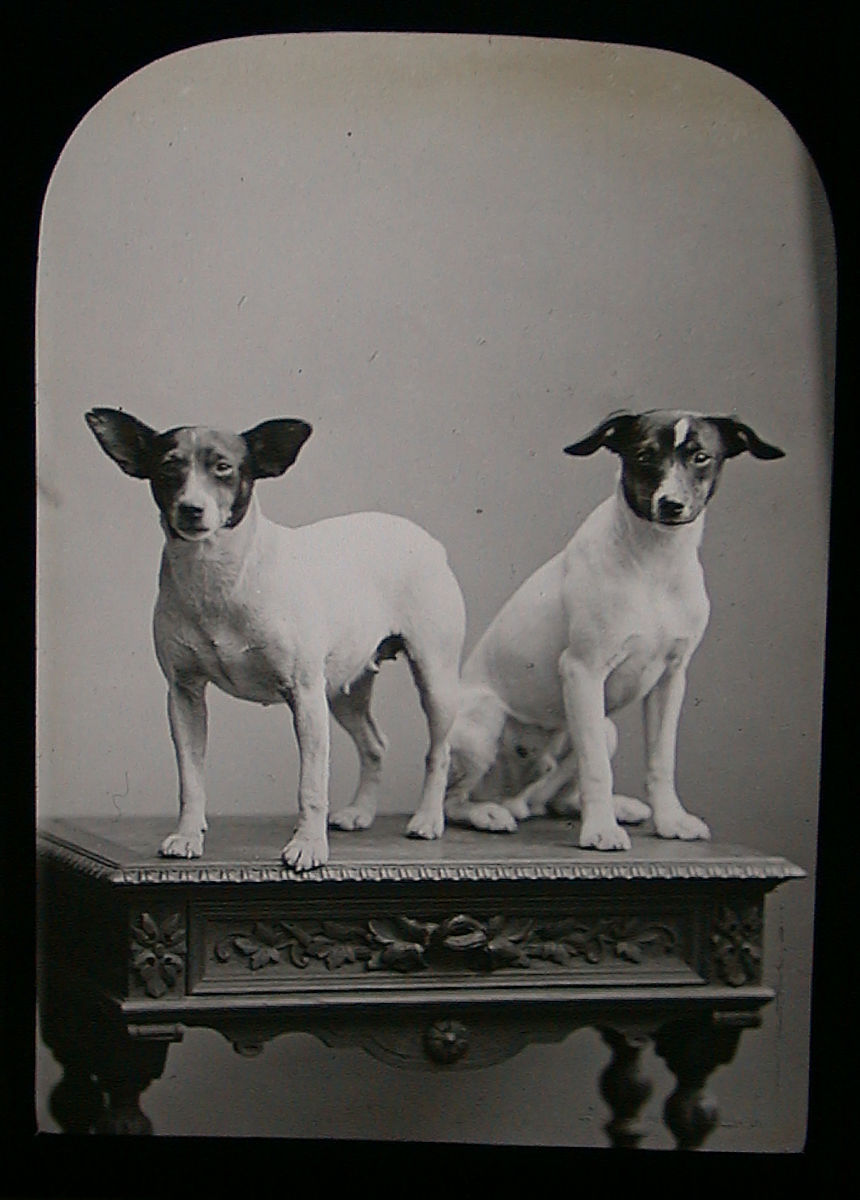
terriers in a glass plate slide

Toronto. The positive/negative process most common in plate/film photography uses a characteristic of silver halides (silver salts). This characteristic is a sensitivity to light. The more light, the more silver halide bonds that are broken leaving more tiny atoms of metallic silver that appear black to the eye.

When a coated plate or film or paper is exposed to light, a latent (invisible) image is formed. A far more intense light exposure brings out a visible image (printing out paper). Certain chemicals called developers can change the latent image to a visible image. To work, the developer must be slightly alkaline. Water or a weak solution of acidic acid will stop development. The fixer chemistry washes away the unexposed silver salts rendering the image more or less permanent. A water bath washes away all residual chemicals (fixer, etc.) helping to make the image permanent.

To eliminate the paper grain and improve resolution glass plates and later optically clear films were used. The initial problem was that the silver salt solution would not stick. Various optically clear solutions that did stick to both the base material and the sensitive solution were used successfully.

From the beginning of photography efforts were focussed on improving sensitivity, increasing resolution, softening contrast, and capturing natural colours directly. The earlier processes were so slow a sensitive plate had to be created shortly before exposure.

)Initially, the sensitivity was only at the high end of visible light (blue) and higher. Over time chemical additions to the light sensitive emulsions brought about sensitivity to the full spectrum of visible light (partly sensitive plates/films were called orthochromatic; full spectrum sensitive plates/films were known as panchromatic and had to be developed in total darkness).

When wet plate photography arrived (our logo is the etching of  a wet plate itinerant photographer with his gear on his back) the sensitivity was increased BUT only if the plate was created, exposed, and developed while still wet. Mathew Brady used a horse-pulled darkroom to record the American civil war. Even wet-plate media sensitivity was too slow for any sort of action shots.

When dry plate photography and later films came along, the sensitivity was improved to the point were instantaneous photos could be taken and later developed. A shutter was necessary to control the sub-second exposures. Years later the sensitivity reached the point where tripods were unnecessary in daylight.

Today with digital technology, slow sensitivity is just a foot note in history. Most digital cameras have a lowest sensitivity (ISO 200) that was once considered fast, and later still normal speed.

Posted in history | Tagged , , , | Comments Off on gooey stuff

a darkening day

watching and capturing the 1912 total solar eclipse in Lisbon

Toronto. Today, we are rather blasé about solar eclipses. but how were they handled over a century ago? A dark shield was still needed to protect eyes, but the cameras as shown here were far different. This scene of a pending total eclipse of the sun was taken back in 1912 in Lisbon.

You can see bright shadows so the eclipse has not yet happened. The most interesting fellow is the one with the huge field camera extended for a long focus lens, and firmly steadied with a tripod, a little ‘table’ on top of the tripod and two weights as anchors on the floor to keep the legs from slipping.

The two folk at left appear to be using a dark filter glass while one of the two at right makes notes and the other peers into some kind of device. The photo is here on Facebook (make sure you are member, or join up for free) and was copied from this site. English translation of the Portuguese is offered.

A thank you is in order for my good friend George Dunbar for finding this interesting site/photo and sharing it with us. NB. There are a few Facebook ‘channels’ devoted to the history of photography including our own.

Posted in history | Tagged , , , , , | Comments Off on a darkening day