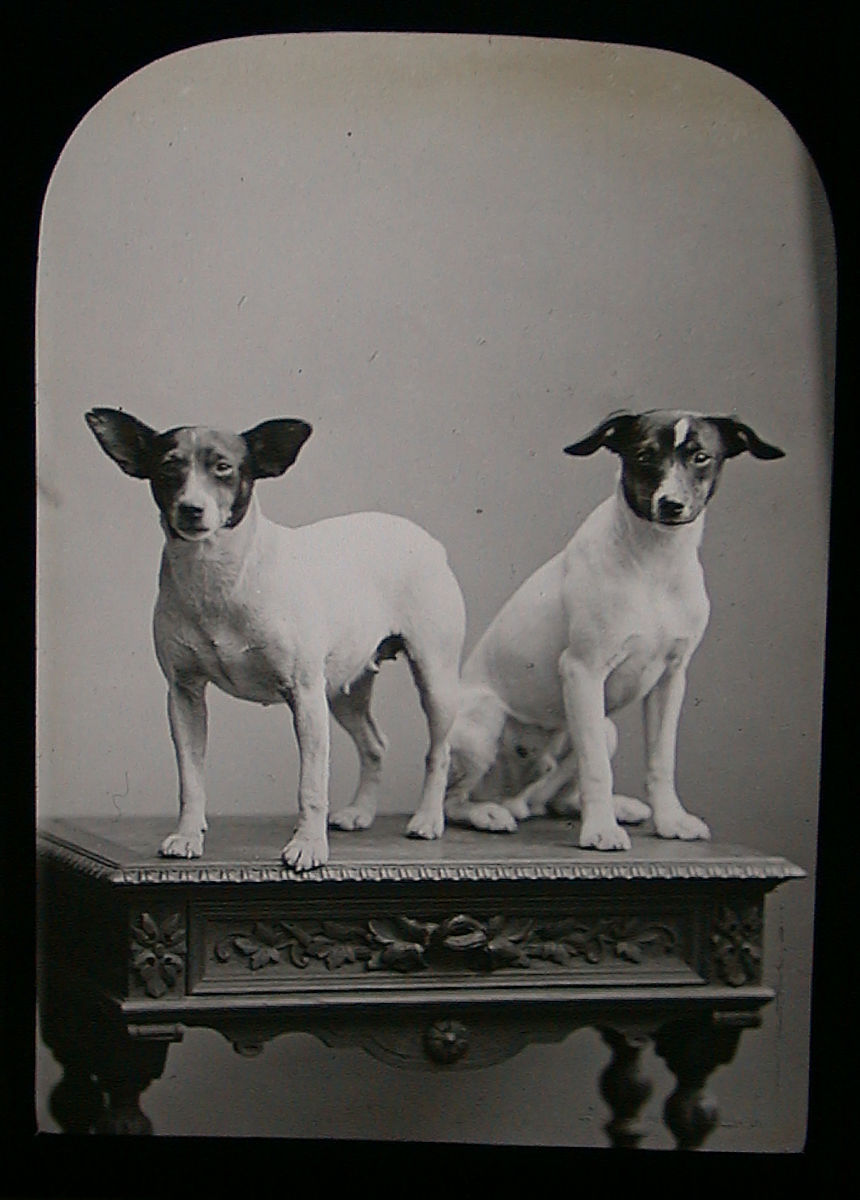
terriers in a glass plate slide
Toronto. The positive/negative process most common in plate/film photography uses a characteristic of silver halides (silver salts). This characteristic is a sensitivity to light. The more light, the more silver halide bonds that are broken leaving more tiny atoms of metallic silver that appear black to the eye.
When a coated plate or film or paper is exposed to light, a latent (invisible) image is formed. A far more intense light exposure brings out a visible image (printing out paper). Certain chemicals called developers can change the latent image to a visible image. To work, the developer must be slightly alkaline. Water or a weak solution of acidic acid will stop development. The fixer chemistry washes away the unexposed silver salts rendering the image more or less permanent. A water bath washes away all residual chemicals (fixer, etc.) helping to make the image permanent.
To eliminate the paper grain and improve resolution glass plates and later optically clear films were used. The initial problem was that the silver salt solution would not stick. Various optically clear solutions that did stick to both the base material and the sensitive solution were used successfully.
From the beginning of photography efforts were focussed on improving sensitivity, increasing resolution, softening contrast, and capturing natural colours directly. The earlier processes were so slow a sensitive plate had to be created shortly before exposure.
)Initially, the sensitivity was only at the high end of visible light (blue) and higher. Over time chemical additions to the light sensitive emulsions brought about sensitivity to the full spectrum of visible light (partly sensitive plates/films were called orthochromatic; full spectrum sensitive plates/films were known as panchromatic and had to be developed in total darkness).
When wet plate photography arrived (our logo is the etching of a wet plate itinerant photographer with his gear on his back) the sensitivity was increased BUT only if the plate was created, exposed, and developed while still wet. Mathew Brady used a horse-pulled darkroom to record the American civil war. Even wet-plate media sensitivity was too slow for any sort of action shots.
When dry plate photography and later films came along, the sensitivity was improved to the point were instantaneous photos could be taken and later developed. A shutter was necessary to control the sub-second exposures. Years later the sensitivity reached the point where tripods were unnecessary in daylight.
Today with digital technology, slow sensitivity is just a foot note in history. Most digital cameras have a lowest sensitivity (ISO 200) that was once considered fast, and later still normal speed.