a Kodak projector – I swan

1955 ad for a Kodak Signet 35mm slide projector

Toronto. Here is another pre-carousel projector from Kodak as shown in this rather wordy ad from the October, 1955 issue of Popular Mechanics. To promote the line of 2×2 transparency slide films,  Kodak made and sold well-designed and well-built 35mm projectors.

Thanks is due to my good friend George Dunbar for spotting this advertisement and sharing it with us. Sadly, all film projectors – Kodak or not – are passé in these days of digital wizardry. Digital files and digital projectors have replaced the films and bulky film projectors of yesteryear. Mind you, our fairs and auctions are often a good place to spot a film projector to add to your collection.

NB. The title of this post is a riff on the homophones “Signet and cygnet“.  While pronounced the same, the meanings differ.  The first spelling, with a capital ‘S’, means an official seal especially used in the UK (and a 1950s Kodak projector). The second spelling means a young swan.
Posted in history | Tagged , , , | Comments Off on a Kodak projector – I swan

rhymes with rhinos

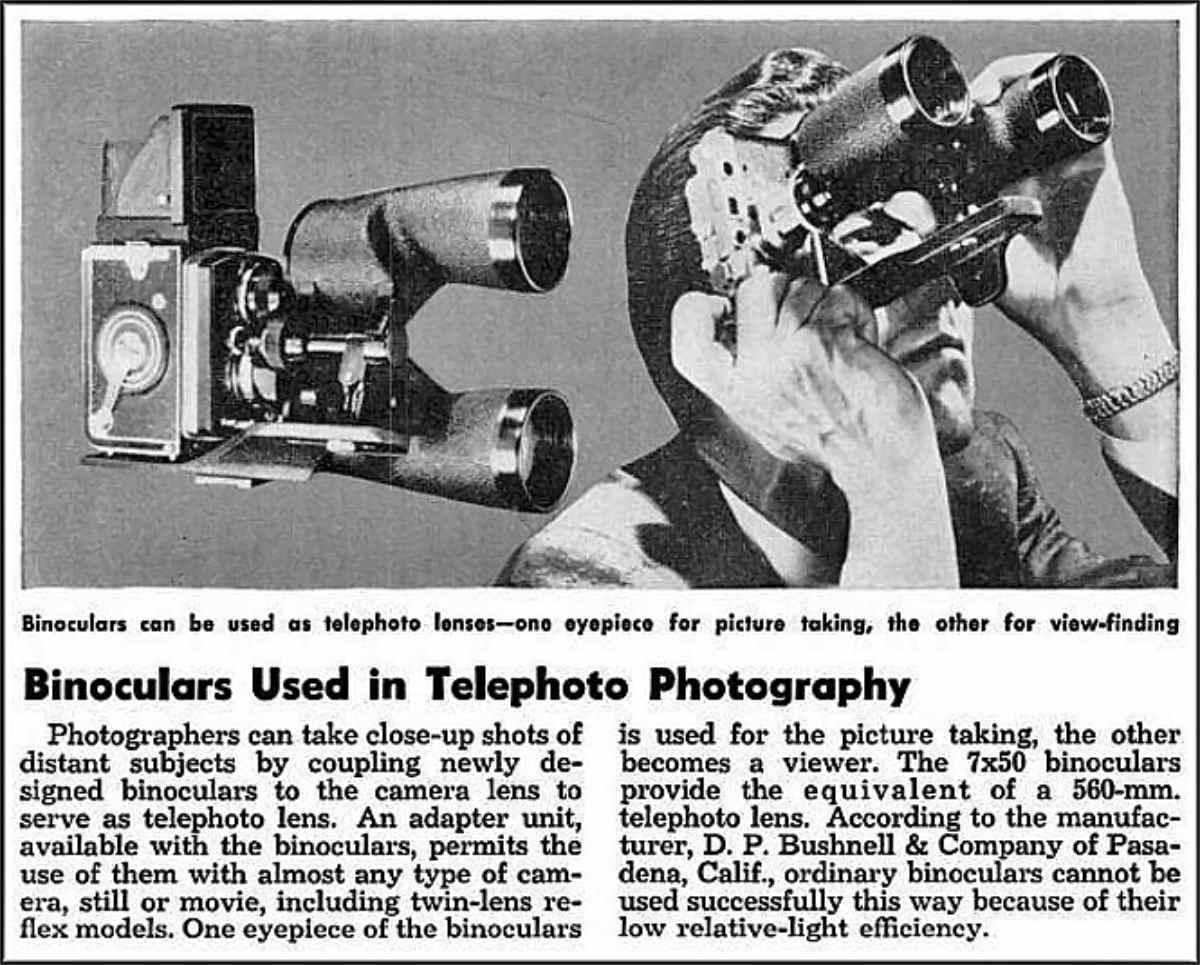
article in September 1955 shows Bushnell 7×50 binoculars used as a telephoto lens

Toronto. This article in one of the fall of 1955 issues of Popular Mechanics magazine is a puff piece for Bushnell binoculars.

The article notes how the binoculars can be attached to a camera as a telephoto lens creating a ‘560mm’ equivalent lens. The article states that “ordinary binoculars cannot be used because of their low relative-light efficiency”.

I imagine the low efficiency comes from older or cheaper binoculars without coated lenses. Around the same year 7×50 coated lenses binoculars made in a small German factory were attached to a Minox camera with an adapter and worked quite well.

Regardless of the promotion of the Bushnell brand, the idea of using binoculars as a telephoto lens via an adapter was a terrific idea back in the days of  prime lenses and film. It was a wonderful alternate use for binoculars.

My thanks to my good friend George Dunbar for spotting and sharing this article. PS: I still have my 7×50 binoculars but the Minox is long gone, swapped for a screw mount Leica.

Posted in history | Tagged , , , | Comments Off on rhymes with rhinos

brother, can you spare $2.98 US?

Oct, 1955 ad for a HIT-like camera marketed by a Chicago firm

Toronto. Post WW2, any miniature camera was usually called a ‘spy’ camera. Many American marketing companies brought in finished cameras from Occupied Japan and flogged them State-side. Usually the cameras were claimed to be ‘precision’ or ‘precision-made’ although most were just gussied up miniature box cameras.

The cheap price often included rolls of ‘miniature film’, a camera case, and a developing service – or a list of where to take the tiny exposed rolls of film.

For the camera collectors, many of the unnamed cameras are simply grouped as ‘HIT-like’ referencing a tiny Japanese import from the likely maker.

This October, 1955 ad in Popular Mechanics is for one such ‘gold-plated’ model sold directly by the importer, Modern Merchandise Co., in Chicago (you could buy three and pay even slightly less per camera)!

Thanks once again to George Dunbar for spotting this advertisement and sharing it with us.

NB. The post title is a riff on a “dirty ’30s” song from 1932, “Brother, Can You Spare a Dime” sung here by der Bingle (Bing Crosby). My own copy is by Joan Collins.

Posted in history | Tagged , , , | Comments Off on brother, can you spare $2.98 US?

YAR (yet another rangefinder)

a novel rangefinder for the Graflex ‘Pacemaker Graphic’ camera line

Toronto. Graflex had a great line of large format cameras, ruggedly made, and very popular. Many professional news and street photographers used one of the cameras day or night.

One perceived shortfall was the lack of a means to focus accurately in poor light. An add-on rangefinder solved the issue and gave an optional means of gauging camera – subject distance.

To counter the use of an add-on rangefinder, Graflex came up with this illuminated version. Basically, two light breams were projected on the subject and by focussing the lens, the beams could be merged. An ad in the June, 1955 issue of Popular Mechanics describes the way the rangefinder works.

The concept of using battery powered light beams seems to have been somewhat short lived. Most rangefinders I have seen or used relied on the photographer’s eye to merge the desired subject. My thanks to good friend George Dunbar for spotting and sharing this bit of photographic history.

Posted in history | Tagged , , , | Comments Off on YAR (yet another rangefinder)

catch the wave II

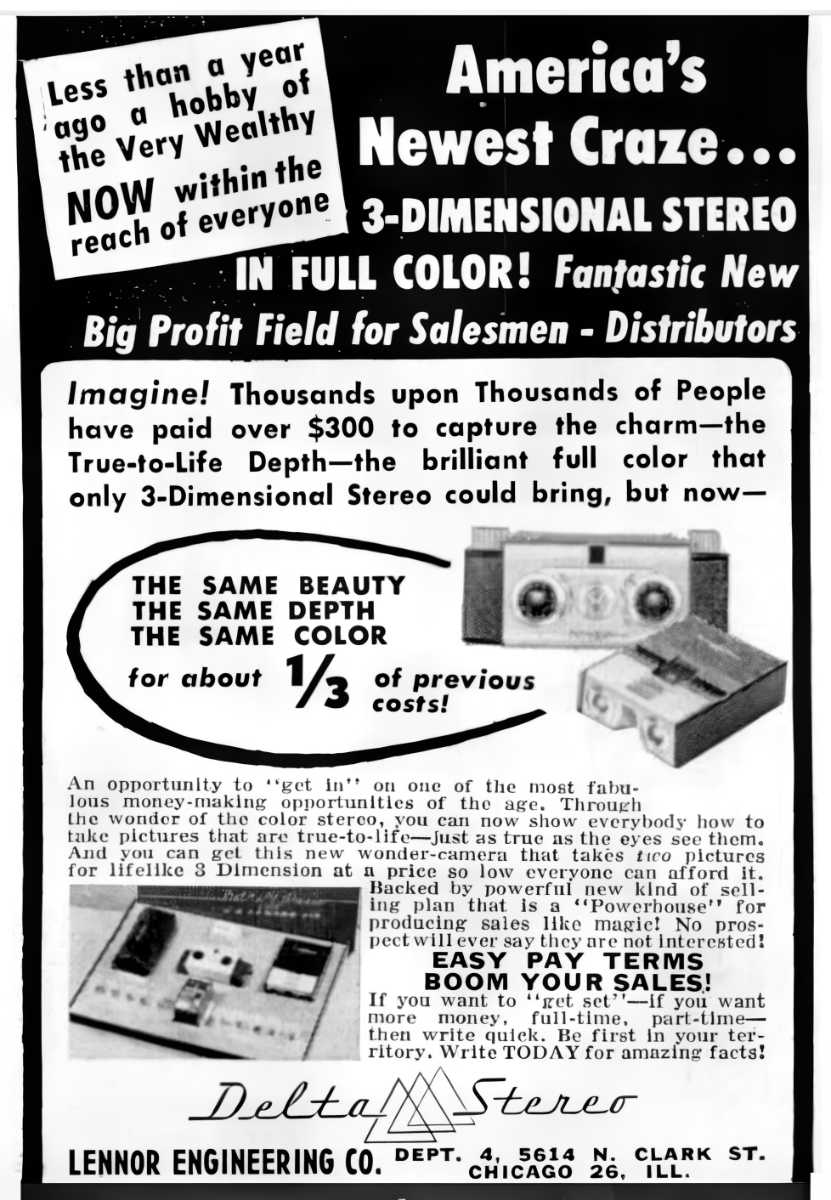
a 1955 ad for the Delta Stereo by Lennor in Chicago.

Toronto. A recent post, “catch the wave“, spoke of Kodak’s technique to ‘monetize’ the latest popularity of stereo in the 1950s. A brief (very brief) competitor emerged in 1955 – the Delta Stereo by Lennor Engineering Co in Illinois.

The company’s product line targeted the same population as Kodak. However, instead of promoting the line, this ad in the October, 1955 issue of Popular Mechanics addresses wanna-be salesmen and distributors. Sadly, the call seems to have fallen on deaf ears. McKeowns lists the Delta Stereo in its 11th edition as a 1955 offering and suggested the price in 2001 was about the original 1955 value – more if the viewer was included.

Like Kodak, Lennor touted (colour) stereo as the ‘newest craze’. Lennor omits any mention of the earlier rise in the stereo fad, stereo’s history before and after photography was announced (1839), or even details of its products. Instead Lennor focusses on its ‘powerful new kind of selling program’ and encourages replies from the marketing side of the line.

Thank you to good friend and fellow history buff, George Dunbar, for finding and sharing this moment in photographic history.

Posted in history | Tagged , , , , | Comments Off on catch the wave II

.. and the kitchen sink

all – except the kitchen sink –  is a Kodak product

Toronto. In the mid last century, Kodak was a giant in the photographic industry. The Feb 1955 Popular Mechanics ad shows just how all encompassing mighty Kodak was here in North America.

The ad offers many darkroom tools that amateurs can even use in a temporary darkroom like the kitchen! The ad shows dad helping his child in the kitchen darkroom thanks to all the tools and ideas from Kodak (the days before it was not politically correct to suggest gender was male only).

A big thank you goes out to my good friend and fellow PHSC member, George Dunbar. George discovered and shared this Kodak ad with us. For those like myself who both shot photos and did the darkroom work, this ad brings back memories. In my case, most of my darkrooms had no running water since it was available a few steps away. Beside which, it is hard to imagine my mother back then letting a KID use her kitchen as a darkroom …

Posted in history | Tagged , , , | Comments Off on .. and the kitchen sink

attention film fans

Help save 120 roll film

Toronto. A note from Birgit Buchart of Lomography fame announces a price cut for 120 roll film to spark sales of their medium format films.

So if you use the old technology in 120 roll format, please dig into your pocket now before all 120 rolls go the way of Kodachrome …

For the rest of us, remember 120 film was used for professional cameras like Hasselblad, Rollei TLRs, etc. and gave great oversize square transparencies (2 1/4 in per side).


Posted in activities-other | Tagged , | Comments Off on attention film fans

history in 50-100 years

Add-on lenses for the iPhone camera

Toronto. The vast majority of photos taken today seem to be taken with a camera in the ubiquitous smart phone.

Professionals and advanced (experienced) amateurs migrate to DSLRs or mirrorless cameras. Software makes the technical aspect of photos almost perfect.

This leaves only the critical focus, lighting, and framing as the domain of pros and advanced amateurs. To complement the smart phone cameras, Reeflex and others offer a variety of add on lenses. Have a look at the articles by Brian Matiash such as his latest one, “Mobile Photography Evolved“.

Brian is a Florida-based professional photographer favouring Adobe products for his lectures. He confesses to using Reeflex products on his own iPhone camera.

This article addresses digital photography (around for two going on three decades as a serious shift in photographic technology). The traditional plate and film  media have steadily faded to the past as digital technology rises to the forefront. Camera collectors as well as niche film users favour the old film gear so often available at our shows under PHSC EVENTS on the right hand side bar.

While we are an historical society in both name and spirit, the occasional post like this one hopefully becomes history in the future while in the meantime serving our member interests.

Posted in lens | Tagged , , , , | Comments Off on history in 50-100 years

catch the wave

ad April 1955 for the Kodak Stereo Camera line – a far less expensive option for stereo slides

Toronto. As mentioned many posts back, stereo has a surge in popularity about once every half century as new technology improves the images. In the 1950s another surge hit with toys, cameras, books, articles, movies, slides, colour, viewers, and projectors all offered in stereo versions.

In 1955, Kodak placed the black and white ad at left in the April issue of Popular Mechanics. While the ad announced the company’s Kodak Stereo Camera and hand viewers, it reminded every reader of Kodachrome colour transparency film and how easy it was to use, especially in their stereo cameras.

Interestingly, the bulk of the ad is taken up with an explanation of stereo as if it is a new phenomenon and not over a century old. In this century, we have seen TVs and movies  use the stereo idea and while there is less eye strain (at least in movies) special glasses were still needed to separate the two images for our brain. So fade out again …

My thanks to my good friend and fellow photography historian, George Dunbar, for spotting this historical ad and sharing it with us. Well done George!

Posted in history | Tagged , , , , | Comments Off on catch the wave

remember Stanley?

A load of tourists visiting Stanley park and the world’s longest uninterrupted waterfront  walkway

Toronto. As a kid in grade school, I remember a photo in my geography book. It was taken in Stanley Park, BC and showed a huge fir tree trunk with an early automobile and people nestled inside at the bottom.

Near the end of the last century, my wife and I spent a rainy afternoon and early evening wandering around the park and taking in its charms while on holiday in the Vancouver and Victoria areas.

You folks who collect images may have some depicting the park and its huge Douglas Firs. In any case, be sure to visit this site and see the glorious history of Stanley park in vintage photographs.

The site, Rare Vintage Photos, has many other collections of photos all carefully grouped for online viewing. Have a look – you may find some that are in your collection – or similar to them!

And a warm thank you is in order for my good friend, George Dunbar, for discovering this site and its charming photos and sharing them with us.

Posted in auction, history | Tagged , , , , , | Comments Off on remember Stanley?