three for the money …

back and top view of Leica III

Toronto. … and four to go,  as the old rhyme says.  And by go we mean drop by our November 19th Estate Auction. One of the lots will be a Leica III just waiting for a new home. This little 1933 gem is black enamel and gutta percha with nickel trim.

The letter ‘O’ at the top of the lens mount indicates that any interchangeable lens with a Leica screw-mount thread is suitable. This camera has very little brassing and the odd scrape, especially what looks like a tripod mark on the baseplate.

Made in 1933, it was one of about 111,o00 made. The viewfinder and rangefinder are very clear and clean. The rangefinder version of the Leica arrived on the market in 1932 with model II. A year later the model III arrived with improved optics for the rangefinder including a 1.4x magnification to compensate for the rather short finder base, and a diopter adjustment for those without 20/20 vision. The III was also the first focal plane shutter Leica with both fast and slow speeds built-in.

Visit the auction this Sunday and you may just grab this beautiful III for your collection!

Posted in auction | Tagged , , , , | Comments Off on three for the money …

HOTP

latest issue – hot off the press – notes

Toronto. Rita has another issue of PhotoEd almost ready to ship.

Rita offers the interesting details of this issue and other news here.

Have  gander and take pity on the moths by opening your wallet to subscribe!

Remember, while the journal title is PhotoEd, the articles are by and for photographers – students or amateurs or professionals .

Posted in activities-other | Tagged , , , | Comments Off on HOTP

aid for the film brigade

help for film fans

Toronto. I did a couple of posts earlier for those that are/want to try the old film technology (Attention Film Fans) and (An Easy Way to Try Film). Claudia Mac, the Assistant Manager at Downtown Camera (89 Queen St East) took the time to write me with a suggestion and a clarification on those posts.

Claudia writes, ” … I oversee the analog offerings here. … we are a Lomography dealer and a local Canadian company ready to sell their cameras and film.

“There was no reference to where you can purchase disposable cameras or where they can be processed in Canada.  It so happens that particular brand of cameras (Wedding Star) we have experience with as we have processed many of them and unfortunately, we have found they have taped film ends together causing jams in our processing machine and in the camera.  If it jams in the camera, it will be inoperable thus ruining opportunity to take analog images at the special event which normally is a wedding.

“We have invested in 2 dipDunk machines from Germany (1 BW and 1 colour) to ensure we have new film processing machines that can push and pull film.  We have a club to promote our analog offerings with discounts.  We sell 110, 127, 620, 4×5 and 8×10 film, we can process up to 4×5 but have made partnerships with other labs who can process the 8×10 film even Kodachrome.  We are also processing ECN2 still-film in house.  These are just some of the things we have done to strengthen ourselves in the analog field.”

I was not aware that any ‘bricks and mortar’ store in Canada carried the line. Possibly to lower costs, the makers ‘Wedding Star’ cameras use film ends. When I used one hour processing services years ago, any personal film joining by tape was a big NO NO. Downtown Camera can easily process your films for you too.

Not mentioned is the used gear they carry. A few decades ago I bought a Leitz Thambar fro Mike at Downtown camera’s old location a few doors closer to Yonge Street.

Please consider venturing downtown and check out Downtown Camera at 89 Queen East. Subway is your best bet as traffic and parking are a mess in Toronto downtown these days (I am forced to use taxi service now any time I head downtown from the west end near Mississauga).  PS. Don’t overlook our auction this November for film gear and collectibles.

Posted in film | Tagged , , | Comments Off on aid for the film brigade

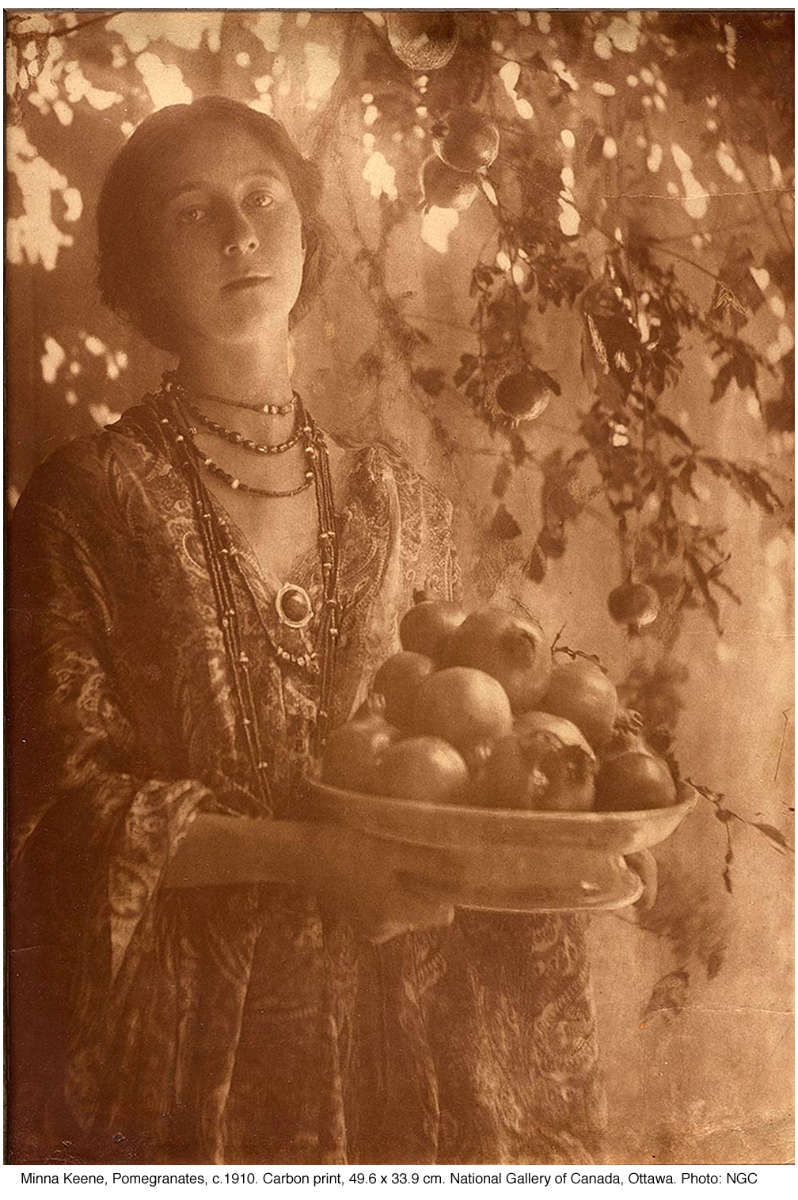
a Keene sense of subjects

Minna Keene – carbon print c1910 – from NGC archive

Toronto. Our resident photo historian, George Dunbar, dropped me a note the other day after he browsed the National Gallery of Canada (NGC) website. George writes, “The Photography and bio of Minna Keene are found on this National Gallery of Canada web site: https://www.gallery.ca/magazine/your-collection/across-the-globe-the-life-and-career-of-minna-keene.

“Minna Keene (1861-1943), born in Germany, moved to England where she met her husband and began photography. They moved to South Africa, and eventually to Canada in 1913.”

The PHSC have a particular interest in both Ms Keene and her daughter, Violet. In the January 1990 edition of Photographic Canadiana (15-4), the cover photograph of George Bernard Shaw was take by Violet Keene. Included is an article on Minna by Andrew Rodger along with a brief footnote. The second article by our then editor, the late Everett Roseborough, covers his recollections and a chronology of daughter Violet.

The article above on the NGC website was written by Mina Markovic in early 2022. Mina is currently our Social Media co-ordinator.  Andrew Rodger spoke to the society back in November, 2001 (see link above). A small world.

Posted in history | Tagged , , , | Comments Off on a Keene sense of subjects

an easy way to try film

disposable wedding favours

Toronto. An easy way to see if you like the look of film-based prints is to pick up a disposable camera!

How-to Geek recently posted an article titled, “How Do Disposable Cameras Work, and Why Do They Still Exist?”. The article was originally released December 2022.

As film began to disappear in the face of digital cameras and smartphones. Film makers brought out cheap ‘disposable’ or ‘one-use’ cameras. The camera was used and taken to a One Hour Photo Shop where the film was developed and printed.

Surprisingly, such archaic cameras are still around. Using one carefully, you can have prints made and see why some people still enjoy using film. PS. our events, like the upcoming auction on the 19th are a great way to get some decent film gear to expand your collection or user gear!

Posted in history | Tagged , , , , | Comments Off on an easy way to try film

if so inclined

Edmonton’s Inclined Railway facility in the early 1900s

Toronto. Various incline and funicular railways were built to allow families with small children, plus the elderly, the frail, and the casual walkers to ride in comfort from one steep height to another – usually a few hundred feet. Often a walkway or set of stairs were provided beside the rail system for the robust or frugal.

The photo here shows one such device in Edmonton. There are many around the world including Niagara’s rail to take families to the Maid of the Mist, and Los Angeles’ Angels Flight to bridge two streets in South LA.

My good friend, George Dunbar, found an interesting site and shared it. George writes, “Some wonderful historic photographs of Edmonton will be found here:https://www.livabl.com/articles/news/photos-edmonton-100-years-ago

“The Incline Railway (also known as the First Street Hoist) connected Strathcona to Edmonton, Alberta – 1908”.

Once again, photography has added to the history of a city – this time Edmonton, Alberta. Please visit both this site for more historic views of Edmonton and your local archives. You may find some unexpected history in photographs!

Posted in history | Tagged , , , | Comments Off on if so inclined

a friendly camerama reminder – this SUNDAY!

Toronto. WOW! Camerama is this Sunday!  We are excited. Gary is excited. Come on down and see what the excitement is all about! Note: only the street name has changed: Garamond Ct. is now Sakura Way.

Posted in activities-other | Tagged , , , , , , , , , | Comments Off on a friendly camerama reminder – this SUNDAY!

what’s in a name

Early Tar Sands workers by Sidney Ellis c1927

Toronto. … or so Will Shakespeare is credited as writing in his famous tragedy about star-crossed young teen lovers.

I thought of Alberta as home of the famous Tar Sands when I was a kid. By the 1960s, the sands became the Alberta Oil Sands or the Athabasca Bituminous Sands. Thick bituminous petroleum was extracted from the sand. Eventually this heavy crude was piped down to Texas to be refined and marketed (as it is today).

My good friend, George Dunbar, chanced upon this fabulous web site for the ‘Imaginations‘ journal and the journal’s photos and history of the Tar Sands/Oil Sands. Note that both Dr Joan Schwartz and the Glenbow museum were PHSC members. Dr Schwartz spoke at one of our Toronto meetings in 2009.

Without the efforts of landscape photographers, we may not be able to visualize the workers and efforts needed to extract the petroleum from the sands and send it to market.

Please visit your local archives, and libraries, and find the many journal articles to discover more about history in your area. We owe so much to the photographers who took the time to record history for us. As for the Alberta Tar Sands, what’s in a name indeed!

Posted in history | Tagged , , | Comments Off on what’s in a name

Estate Auction Fall 2023 – November 19, 2023

Nov 19 2023 auction poster

Toronto.  Get ready for our Fall Estate Auction part two! Date is tomorrow Sunday, November 19, 2023 in Long Branch (south west Toronto) at the usual venue BUT at the slightly later time (see poster) – free parking [OVERFLOW AT GO TRAIN LOT JUST WEST of HALL] and free admission.

Our Estate Auction part two features goodies for both film and digital folk – photographs, cameras, lenses, accessories, books, and more. Come out and enjoy this event. Click on the AUCTION tab here or in the menu bar above for directions.

Everybody is welcome. Sorry, no Consignment lots at the door this time. These lots are all ESTATE – really good items, some rare these days. Just in time to let you augment your collection or user gear [or even for your gifting] !

Click above to see photos in roughly lot order (large photos are in lot order)

We owe Clint a big thank you for photographing, naming (by lot number) and tagging the lots shown here (images arrived by thumb drive & email). Click on the montage above, then on the “Brassaï” book (lot 325), and then on any lot icon to see it larger. The photos in the slide show are in lot order (there may be some variation in the sequence of the thumbnails). This continuation estate auction is shaping up to be really thrilling with a wide variety of lots – something for literally everyone!

LOT INDEX: Clint has provided this pdf searchable version of the list of lots for  Nov 19th. This list will be updated. This is the second version (Nov 16). There are some 65 lots yet to be listed.  List version three was uploaded the early evening of the 17th of November.

LOT PHOTOS: The slide show of photos will be updated frequently as photos are received. On November 5th photos of the first 80 lots were added.  Note: during the auction, the sequence of lots  is the auctioneer’s choice and will vary from the numerical sequence shown.

Batch two arrived Saturday, November 11th and were posted here as of 12:40 am Monday the 13th. A total 168 lots were posted by the 13th. Batch three arrived early the morning of the 15th and were posted at 4:30 pm on the 15th for 193 lots illustrated. Batch four came in early November 16th and were posted at 8:00 pm for a total of 232 lots illustrated. Batch five arrived in the small hours of Nov 17th and were uploaded at 6:45 pm for a total of 276 lots illustrated. Later the 17th batch six arrived and was uploaded for a total of 292 lots!  And finally on Nov 18th the last few lots uploaded for a total of 301 photos/lots. The photographing alone is a huge undertaking by Clint on behalf of the PHSC.

Your left/right arrows will work to move from one enlarged photo to another. The red tags or hand written notations show the lot number.  The photos were adjusted with Affinity Photo, Focus Magic and  Topaz Photo AI as needed – Enjoy!

Posted in auction | Tagged , , , , , , | Comments Off on Estate Auction Fall 2023 – November 19, 2023

leaf it to beaver

autumn leaves

Toronto. The landscape photographers recorded the great outdoors over the years allowing us to see the changes – by season and by time.

Mountains change, leaves fall, forests are lost. All carefully recorded by landscape photographers over the years. Without the patience of these photographers, we might never know how much the landscape has changed.

My first realization of the impact of climate change was seeing the Columbia Ice Field out west. As we stopped for lunch, we noticed the glacier across the road. When we went over and walked the glacier, we were warned to avoid any crevice in the glacier since we would die of thermal exposure long before any rescue attempt.  And this was 20 years ago in mid summer! Markers showed the lower edge of the glacier by year and just how dramatic the change was since the middle of the last century. The highway actually traversed an area that was once ice!

Some landscape photos appear in books and magazines, others in collections and archives and libraries.  Visit your collection or the nearby archives/libraries and take a careful look at progress through the eyes of a landscape photographer.

NB. The title is a riff on the name of a 1957 TV show, “Leave it to Beaver“.

Posted in history | Tagged , , , , | Comments Off on leaf it to beaver