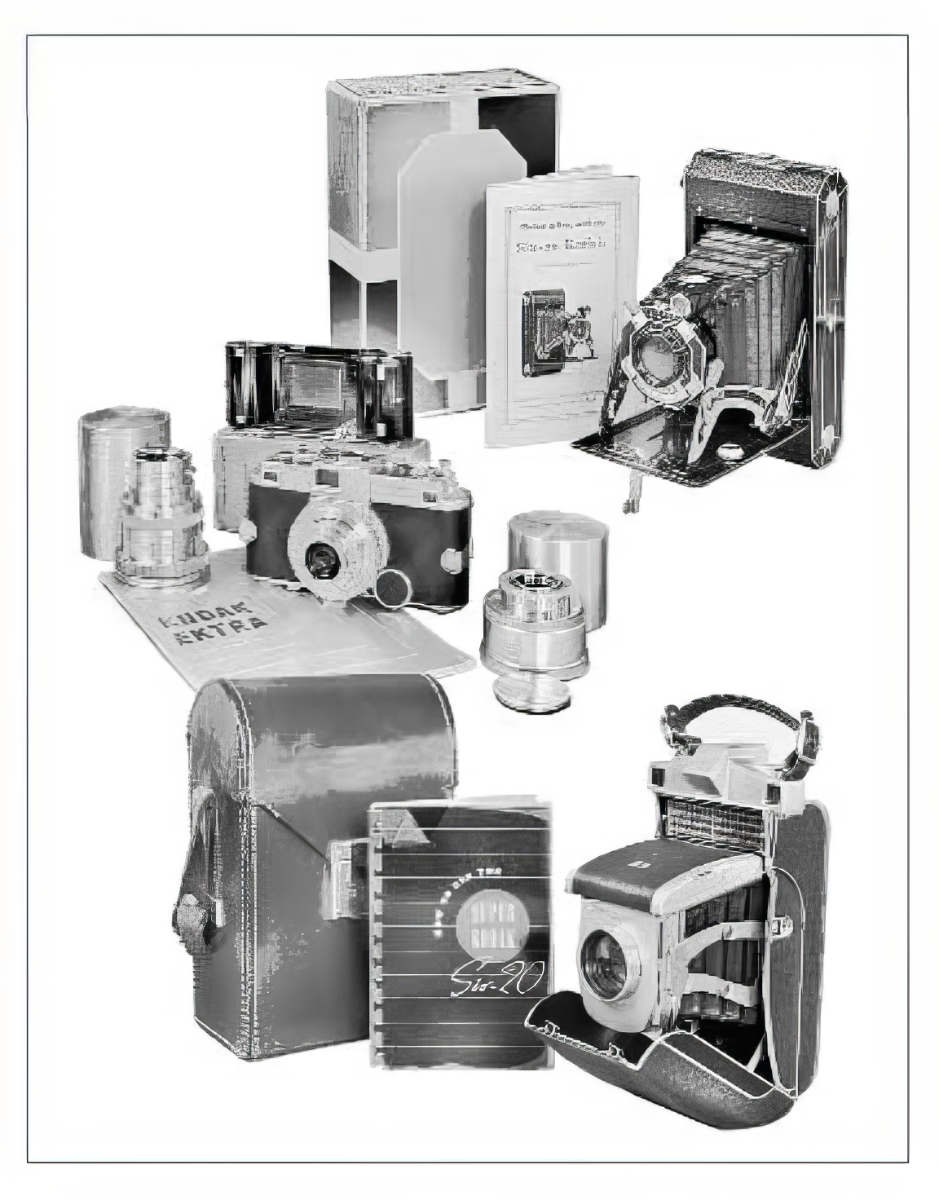
mon dieu! une autre Sept!

The c1922 Sept courtesy of John Wade

Toronto. Like the Ansco Memo, the French camera called the Sept, uses 35mm cine film. A 1920’s camera, it is spring-wound and uses a 5m length of cine film in a unique cartridge.

Originally an Italian design, it was made in Paris by Andre Debrie and sported the name “Sept” for good reason. Sept is French for number seven and the small, heavy camera performed seven different functions (some functions needed special accessories).

Two of the functions are a singe shot ‘still’ camera and a movie camera. Exposures used a single movie frame of the 35mm film or what was later called half frame. (after the Leica took off)

I actually saw a Sept some years ago owned by a member. Today, many sites  (like John Wade or Camera-wiki) cover the unusual little camera. In fact, the image used at left is courtesy of the John Wade site.

The camera came on market a couple of years earlier than the famous Leica which used two ‘movie’ frames per exposure, hence the use of half frame for a traditional movie frame.

Now-a-days most digital cameras sport both ‘still’ and video (movie) functions so the younger folk don’t see just what a big deal it was for a single camera in the 1920s to offer both stills and movies.

Posted in history | Tagged , , , , , , | Comments Off on mon dieu! une autre Sept!

one grand

c1932 babies born at 2 year old Eastern Kins Memorial in Wolfville, NS courtesy of its Randall House Museum via Saltwire

Toronto. A few days ago, Wendy Elliott wrote the article “Continuing the health-care work“. Her article is on Saltwire in the Opinion section of its Atlantic Canada file. To read the article you will need to sign in with your email address.

The site does show the 1932 photograph of the babies born in that hospital (Eastern Kings Memorial at Wolfville, NS). The image, shown on the Saltwater site and here (at left), is courtesy of the Randall House Museum in Wolfville’s collection. The Saltwire cut-line states, “This 1932 photograph shows a gathering of babies born at the [EKMH] … since the facility opened in 1930.”

Well, it’s said a picture is worth a thousand words … do you agree too? In any case, I would thank my good friend and fellow photo historian, George Dunbar, for discovering this photograph and sharing his finding with us.

Posted in history | Tagged , , , | Comments Off on one grand

up, up, and away

Topaz Lab’s Gigapixel 7

Toronto. After minicams became common, time and effort was spent to create developers that would reduce film grain and provided finer detail so negatives could be enlarged more without resulting in so called ’empty magnification’.

A similar situation in digital images results in pixelization as the image size is increased. In the early days of photoshop, many practitioners tried to ‘upscale’ images by carefully repeating smaller increments feeling such a process would offer better images.

In his “Lightroom Everywhere” blog #10, Brian Matiash’s article, “Three Reasons to Upscale Your Photos” extols the virtues of upscaling digital images using AI. His talk reviews the latest release of Topaz Labs’ Gigapixel 7 comparing the result to using the latest Photoshop technology with various settings.

So unless you are a dyed-in-the-wool aficionado of film, have a read of the blog #10 above. And remember, our fairs and auctions often offer both film and digital fans added gear and ideas. Don’t worry too much about this article – in 50 to 100 years it will be history 🙂

Posted in activities-other | Tagged , , , , | Comments Off on up, up, and away

pushing all buttons

you press the button …

Toronto. The invention of the dry plate in 1871 opened the door to sub-second exposures in sunlight through a normal photographic lens. And with sub-second performance came a need for shutters. And with shutters came a need for shutter buttons.

In the 1880s, roll film came into being allowing many shots to be taken on a single roll. And in 1888 the famous Kodak camera went to market and success. A typical Kodak instruction sheet is shown if you click the icon at left. Film and Kodak opened the door to many, many more ‘amateur’ photographers and expanded the use of photography to help record family history.

To differentiate its products from those of Kodak,  Ansco, photography’s distant number two, elected to use a red shutter release button on its cameras. As the late Don Douglas said, “just pass the camera to ‘aunt Tilley’ and tell her to hold it steady and press the red button ..”.  Even today in the era of digital technology, a button triggers the ‘shutter’ to time the light exposed to the sensor cells. But for most folk, the ‘P’ setting on a digital camera (or using a smart phone) avoids any need to understand or set the shutter speed.

Does this post ‘push your buttons’? Then you are showing your age or enthusiasm.

Posted in history | Tagged , , , , , , | Comments Off on pushing all buttons

cute as a button

drawing of the Ansco Memo from “Cameras” by Brian Coe

Toronto. Professionals in the 19th and early 20th century chose a camera size such that the final print was a contact print, and generally not an enlargement from the negative.  As movies grew in popularity, some manufacturers realized that a small 35mm film frame retained decent resolution even when enlarged to the size of a movie screen.

Photographic prints required far less magnification so some firms made cameras using the tiny 35mm roll film intended for movies. Since there was no standard cassette at the time each company made its own. The tiny cameras used a single movie frame as a negative -what was later known as a 1/2 frame once the Leica took hold with its use of a ‘double movie frame’ (1×1.5 inches).

In 1926/7, an American company, Ansco, in New York made a tiny precision camera called the Memo in various versions. This was the first precision camera made in the States. It went to market just a few short years after the famous Leica in Germany. Using a single movie frame piece of the 35mm film as a  negative for each exposure, it was upright like later TLR camera designs.

The little Memo has appeared in many books including Brian Coe’s whimsical 1978 book titled, “Cameras – from Daguerreotypes to Instant Pictures“, and Eaton Northrop Jr’s 1973 opus, “A Century of Cameras” based on the GEH collection in Rochester. The Memo is also covered by various web sites including  Camera Wiki.

Posted in history | Tagged , , , , | Comments Off on cute as a button

Lazarus

A ‘new’ Leica M6 courtesy of Leica Camera, AG

Toronto. The famous little Leica and 35mm film have a long and storied history. The evolution of the current Leica Camera group from the old E Leitz organization is nicely covered by Dennis Laney in his 1992 “Leica Collectors Guide“.

Moving to Toronto in the late 1970s, I found Leica in Toronto was called Wild-Leitz – Leitz and Wild Heerbrug had formed a partnership. A few years later Wild Heerbrug, the Swiss microscope and optical instrument maker absorbed the Leitz organization. The camera and other consumer products were moved to a separate organization and later  became totally independent from Wild Heerbrug.

When the balance of Wild Heerbrug was merged with Cambridge Instruments [CI] in England, CI renamed itself as Leica, PLC. The small Leica Camera Group continued to make precision cameras and lenses, choosing quality over quantity.

When digital technology replaced traditional cameras and film, the group slowly moved to digital products and even better lenses at ever higher prices. To expand market share – and keep the old machines operating – the group reproduced the old film cameras and new lenses at significantly higher prices from the original price when first introduced.

Latest in the line of film cameras is Leica’s first small size Leica with built-in exposure reading, the Leica M6. As one executive at  the group said, “In our factories, you can still see old machines dedicated to film cameras in operation. But in 2015, we thought about throwing everything away because we were only producing 500 film cameras per year. But there has been a nice rebound since then and, in 2023, we will produce nearly 5,000 M6 and MP analogue devices.”

Our president Clint Hryhorijiw reminded me of the Leica Camera Group’s decision to reintroduce film Leicas in these articles from Kosmo Foto  and Photrio. Both sources suggest other makers may plunge into film once again. A similar announcement on the M6 was made directly by Leica Camera AG (the group).

A big thanks goes to Clint for noticing this epic announcement. If you visit any of our events, you can pick up a film camera, perhaps even a Leica. Mind you, the newer lenses are very attractive (to those with the cash). And film? Well “it ain’t dead yet” just ask any film enthusiast.

Posted in history | Tagged , , , , | Comments Off on Lazarus

mr roboto

my IIIf Leicavit Leica base c1958 –  a drop down lever lets the photographer shoot quickly while keeping the camera to the eye.

Toronto. After the 1807s when the faster ‘off the shelf’ dry plates became available, camera makers looked at ways to speed up the photograph taking process. It became evident that the way to speed things up was to find a way to exchange an exposed negative with an unexposed one.

In the dry plate era, some cameras used a mechanical means to ‘drop’ the exposed plate and pop a fresh plate in the ‘film’ plane without opening the camera or resorting to dark slides and swapped holders.

When mini cameras became common, various way were devised to wind a fresh negative in place using a rapid lever or a clockwork spring mechanism. Some camera makers like Otto Berning & company’s Robot line had the mechanism built in so the cameras could shoot in burst mode.

Others used a ‘winder trigger’ in a custom base plate to let the photographer quickly wind the film on one frame after the shutter button was released. These gizmos were often beautiful in their own right like the famous Leitz ‘Leicavit‘ shown here at left. It was made for the IIIf for a decade beginning in 1953. An even more streamlined version was made for some M series cameras.

For professionals, a motorized base was offered. The film was wound to the next unexposed frame by a clockwork mechanism and later by a tiny electric motor.

Modern day users of digital cameras or smartphones have no need for such mechanical  marvels since once activated the digital technology keeps the ‘shutter button’ in an ever-ready state for the next photo, burst, or video.

Note: The post title is based on an iconic 1983 song by the Styx, “Mr Roboto“.

Posted in history | Tagged , , , , | Comments Off on mr roboto

will that be cash or …

Extra battery for an older Nikon digital camera. The camera’s internal battery which once retained user preferences is long dead.

Toronto. … ChargeX (later VISA)! The digital era in photography brought many things – both good and bad. For much of the glass plate/silver plate/film era, cameras were all mechanical and relatively easy for an experienced camera repairman to clean and adjust (some cameras like the ‘bullseye’ Contarex took a seriously trained repairman to even begin to ‘CLA’ the beast).

Digital technology brought miniaturization, increasing sensitivity, and speed between taking and seeing the result. As digital progressed, sensor resolution increased and noise fell. But these virtues came with penalties. Batteries. Non standard sizes. Differing terminal voltages. The batteries were no longer held to a rigid dimensional or terminal standard. AA, AAA, button, C, D, continued to be improved, made and sold.

But where once digital cameras took 2 or 4 AA batteries, they now take batteries shaped and sized to fit within the allotted area created by the device maker. Freed of any general battery standards, every camera and smartphone could be made with its own rechargeable battery. All batteries have a relatively short life span whether measured in shelf life or number of discharge/charge cycles.

We could collect mechanical cameras and with care each one could be used. With rare exception, digital cameras and smartphones use uniquely designed batteries likely to be unavailable years later as newer camera models emerge on the scene. Older digital cameras can be collected but very likely no longer usable.

In our home we have four digital cameras plus an iPod and two smartphones all three of which have a camera. None of them take the same battery! And yet three of the four cameras are made by the same company – Sony. So there you have it. Speed and clarity at the cost of long term usage. My M4 and Exaktas are now over 50 years old and can still be used. The same for my father’s Kodak Folder (hitting 80+ these days).

I have some spare batteries (for the oldest Sony and for the Nikon) but they are the age of the cameras with less and less time before they no longer function.

Posted in history | Tagged , , , | Comments Off on will that be cash or …

In Search of Geraldine Moodie

Cree woman and boy c1895 – PC journal 24-5, page 8 review

Toronto. Yesterday’s post on PhotoEd items mentioned Geraldine Moodie. This triggered in my mind an article on Ms Moodie in our journal.

It was actually a book review of the book, “In Search of Geraldine Moodie”. The review is in the March, 1999 issue (24-5). Written by editor Bob Lansdale, the review discusses Donny White’s book about Ms Moodie and some of her photographs.

The book was published by the Canadian Plains Research Center,
University of Regina in Regina, Sask. at the end of 1998. Both a paperback version and an electronic version seem to be available today.

Consider checking your local library or picking up your own copy.There you can learn the fascinating story and photos of a Canadian photographer as she and her husband faced the unforgiving Canadian north a century or more ago.

Posted in history | Tagged , , , , | Comments Off on In Search of Geraldine Moodie

happy birthday, Hannah

Hannah Maynard courtesy of PhotoEd

 Toronto. The lovely Rita of PhotoEd fame sent this announcement out.

It celebrates many things – have a peek at this Canadian oriented photographic teaching magazine.

We have featured Ms Maynard  and other Canadian Female photographers in our Journal over the years.

Have a look at the above announcement and consider a personal subscription to a very worthy magazine (and we do our bit too by advertising in each issue).

Posted in activities-other | Tagged , , | Comments Off on happy birthday, Hannah