don’t hide your light …

Double Dissolving Balopticon

Toronto. Photography collectors are a gregarious bunch. A subset collects projectors, from the so called magic lanterns which amuse and educate with special slides, to more modern apparatus from last century.

One such collector was the late Dr Robert Wilson. Bob was especially interested in Stereo. He had the rare ability to ‘free scan’ stereo images with his eyes alone. In issue 15-1 his article titled, “Dissolving and Stereoscopic Lantern Projectors” reviews a sub category of projectors which use a dissolve device to smoothly move from one slide to another.

His article begins, “During the early 1900’s a large number of companies sold lantern slide projectors. Dissolving projectors were featured by many of these companies and provided the ability to dissolve one slide into the next.

“As one catalog put it, the dissolving outfit was employed “to avoid the eyestrain and disagreeable affect produced by the alternate darkening and lighting of the screen, together with the ‘racing’ of the slides across the screen in changing”. There were several different designs available to provide the dissolving effect.”

Bob’s detailed article includes the then current prices asked by various makers. Members can read all of Bob’s article in the pdf version of issue 15-1 which is included on our ‘free to members’ DVD. You can join by cheque, credit card, debit card or PayPal account. See the ‘MEMBERSHIP’ menu item above if you write cheques or the Membership details at the far right for all other means of joining or renewing. New members will receive their DVD via Canada Post. If you have any questions about membership, email our Membership Secretary, Lilianne Schneider, at member@phsc.ca.

While we can’t say for sure you will find one of these old projectors at our fall fair or auction, we can say you will find many items of interest for your collection (or use).

Posted in history | Tagged , , | Comments Off on don’t hide your light …

quint essential tash

Tash and the Quints, Xmas, 1934

Toronto. Attention all image collectors! In yesterday’s post (q.v.)we commented on the life of Canadian Movie maker Roy Tash.

In the same issue (14-5), Bob Wilson in his column Image of the Month writes, “On May 28,1934, five identical girls, the Dionne Quintuplets, were born on a farm near North Bay, Ontario.

“At the time, the newsreel companies were quite aggressive in obtaining footage and two photographers were on the site within a day of the birth. Roy Tash was one of them. Since the old farmhouse did not have electricity, Tash reports that he had to round up several car batteries to provide the power for his lights.

“The photo shown here was taken near Christmas 1934, when the five girls were still less than seven months old. Tash, behind the movie camera, and his sound man Alf Nicholson.”

Posted in history | Tagged , | Comments Off on quint essential tash

tish, tash i was taking a movie

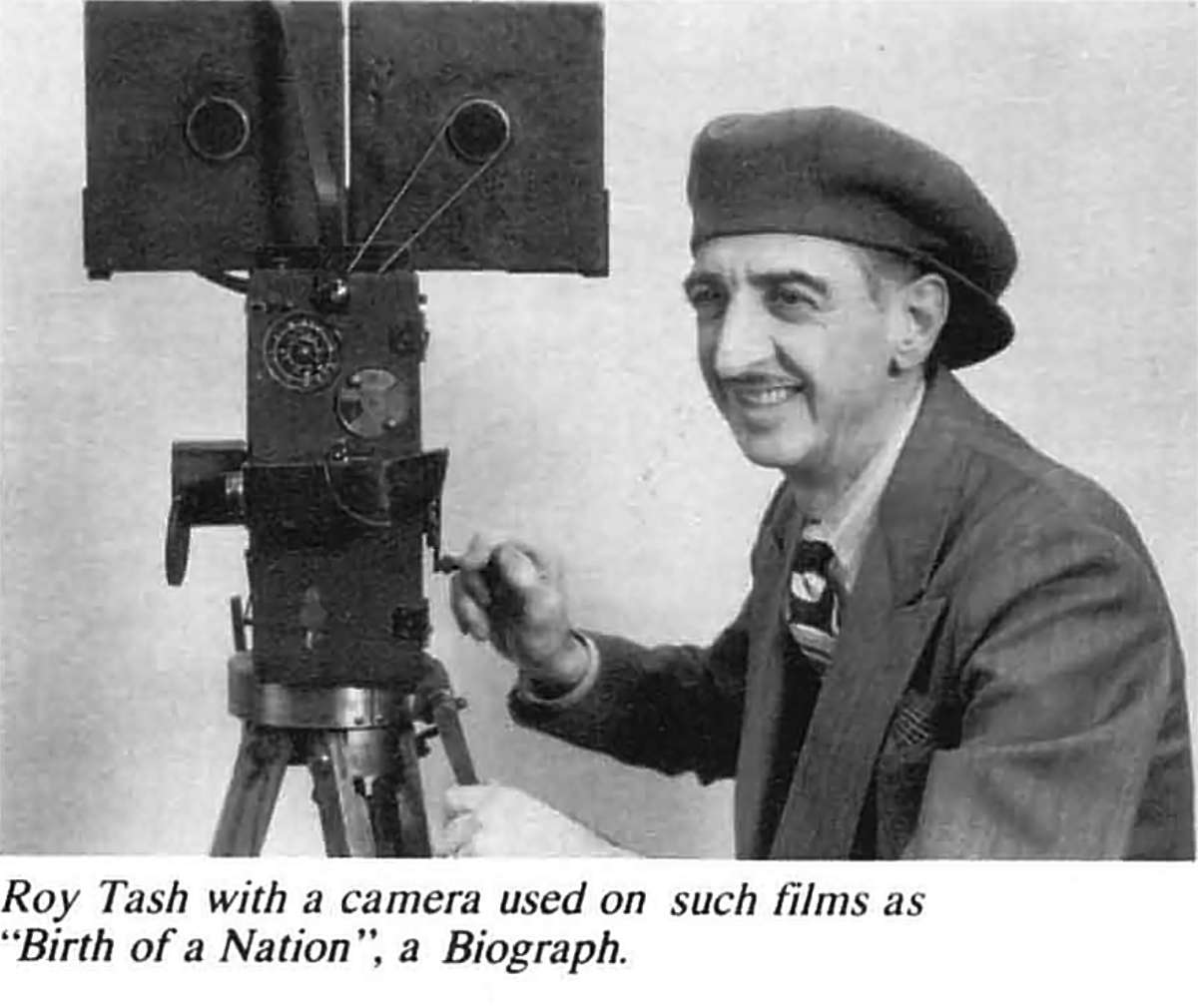
Roy Tash and a Biograph camera

Toronto, … with apologies to Bobby Darin. Roy Tash was a well known Canadian movie maker. His  photo was a covershot on the early spring of 1989 issue 14-5. Roy passed away the previous year (1988) just before the PHSC could interview him.

Nevertheless, the late Bill Belier wrote about Roy in this article, “Roy Tash – Canada’s Eyes and Ears”. Bill began his article with a brief explanation, “In October 1988, editor Everett Roseborough and I arranged an interview with Roy Tash in preparation for the article in this edition of Photographic Canadiana.

“Unfortunately it was not to be. Roy was ailing at the time and the interview had to be postponed and then on December 7th [1988] Roy Tash died. He was in his ninetieth year.

“His daughter, Norma McFadden, graciously consented to be interviewed on her father’s behalf and we are indebted to her for many of the reminiscences and all of the photographs that accompany this article.”

Yo can read Bill’s article on this extraordinary Canadian using the pdf version of issue 14-5 which is included on the PHSC DVD sent to all members. The DVD covers the journal from volumes 1-40. Not a yet a member? It’s simple – and inexpensive – to join. see the menu item ‘MEMBERSHIP’ above if you use cheques, or the membership info to the right under “Membership – Join or Renew!” for those preferring to use a credit card or PayPal account. Any questions? Drop an email to our membership secretary Lilianne Schneider at member@phsc.ca.

Of course, you are invited to come to our fall events where you just might find an old movie camera etc. for your collection! Details will be posted here when they are known.

Posted in history | Tagged , , , | Comments Off on tish, tash i was taking a movie

what an encore!

A model C Kodak with a roll film back – photo courtesy of Alldyn Clark

Toronto. The 1881 Kodak set a new standard for ease of use (and roll film). In 1891 A new Kodak was announced with  added features: different sizes for different films; a choice of film or glass plate back; two viewfinders; focusable.  These Kodaks were made from about 1891-1895.

The late Alldyn Clark, a Bracebridge photographer and camera collector, obtained a rare Kodak camera c1891. The article on this model of Kodak is titled, “The ‘C’ Ordinary Kodak 1891-1895”. Alldyn sent photos and details down to Ev who wrote the illustrated article for issue 14-4.

Ev writes, “Following considerable interest on the part of members, Alldyn Clark, well known photographer and stereo collector of Bracebridge, Ontario, sends us these details of the “C” Ordinary Kodak which he obtained from Ontario Hydro in 1957. Alldyn has restored it to operating condition. Approximately 3,000 were manufactured through the years 1891 to 1895.

“This 4 x 5 inch model has a roll-fllm back, although a plate back was interchangeable. The camera consists of two wooden boxes, one moving inside the other to focus the image. Focussing is accomplished by moving the sliding lever which projects beside the footage scale.”

Although Bracebridge is a few hours north of Toronto, Alldyn managed to attend many of our monthly Toronto meetings back then. He enjoyed the presentations and company of fellow collectors inspire of being quite deaf.

While we can’t guarantee you will find a model C Kodak at a fall PHSC event, you will find things for your collection whether you collect cameras, photos, or photography ephemera. And remember, all members received a DVD with the pdf version of every volume Photographic Canadiana from 1-40. See previous posts to join or ask our membership secretary a question.

Posted in history | Tagged , , | Comments Off on what an encore!

this art triumphant

Unidentified children, ca. 1910 Robertson Matthews (amateur)

Toronto. Many of our members specialize in the collection of photographs. To cater to this audience, Ev Roseborough published detailed articles on exhibitions of the day such as the exhibition, “This Art Triumphant – A Photographic Portrait of Peel 1860-1930” presented by Peel Regional Archives in the Region of Peel Art Gallery. The exhibition ran from October 5 to December 4, 1988.

The exhibition featured both professional and amateur photographers from the towns and villages in Peel Township. The photograph I chose is an amateur photo taken by Robertson Matthews c1910. Photo collectors may have examples from Peel Township photographers of the day or perhaps can find such examples at one of our events this fall.

Ev writes, “Robertson Matthews began photographing about 1902. The son of a Methodist preacher from Albion Township, he was a leading expert in the United States on the international combustion engine. After receiving a doctorate in mechanical engineering from Cornell University he remained there as teacher for many years.

“He loved to return to Bolton each summer, making many photographs. These are not only  technically excellent but emotionally appealing.”

You can read all of this article and other stories first published in issue 14-4 on the PHSC DVD which covers volumes 1-40 of Photographic Canadiana in pdf format. This DVD went out free to all members. Not a member yet? It’s easy and inexpensive – see the menu item ‘MEMBERSHIP’ (cheque) above, or the PayPal button at the far right (card or PayPal account)  to join. Once registered, a copy of the DVD will be sent via Canada Post. Questions can be addressed to our membership secretary, Lilianne Schneider at membership@phsc.ca.

Posted in history | Tagged , , , | Comments Off on this art triumphant

treasure in an attic

young girl, c1877 (1899?) courtesy of the Carbon Studio, NY and published by Alfred S. Campbell Art Co Elizabeth, NJ

Toronto. Our society includes folks whose passion is photos. This is a story of a portrait, a very special portrait taken over a century ago using a special process. The image here at left was the cover photo for the Christmas 1988 issue of Photographic Canadiana. The image at left was sharpened in Focus Magic and the curve adjusted to darken the shadows a bit at the expense of highlight detail in the dress.

For this issue of our journal,  Ev wrote a photograph-related tale, a tale about a beautiful young lady c1877 and a very unusual large, framed, photograph discovered in an attic. In an effort to determine the printing process used, Ev made 35mm shots of the photograph and finally resorted to inspecting the disassembled original.

Ev begins his story, “Sometime before his untimely death Gerry Ham, well known Canadian collector, placed a framed photograph in my hands and asked, “What is it?”

“I was never able to tell him, because a year elapsed before an answer was forthcoming .

“The original had been delivered to Gerry by llgvars Broks, Vice- President of the color lab BGM in Toronto, who had asked the same question.

“Ilgvars had been in Cleveland, Ohio, in 1986, at a house recently purchase by a relative. The attic was full of boxes, some containing family albums, tintypes, coloured black and white photos and a handwritten note book, all of which had lain unattended for many years.”

The full story and all the illustrations are available today on the PHSC DVD of volumes 1-40 of Photographic Canadiana each in pdf format. As a member, a copy of the DVD will be sent to you via Canada Post. See the ‘MEMBERSHIP’ menu item above or the PayPal buttons to the right to join. Our membership secretary, Lilianne Schneider is available to answer any questions you may have at member@phsc.ca.

Posted in history | Tagged , , , | Comments Off on treasure in an attic

a midsummer’s holiday …

Map of Simcoe County c1950s or so

Toronto. … with apologies to Bill Shakespeare.  A long weekend break for the working folk is a great idea! Traditionally, The holiday in question is August 1st and celebrated the first Monday on or after the 1st.

One or two problems: The name of  the holiday varies by time, city and province. Sometimes it is federal, sometimes provincial and some times municipal. This means some folk have the day off, others do not. Stores and entertainments may or may not be open that day in one city or another.

When I was a kid, we called August 1st “Simcoe  Day” in memory of John Graves Simcoe, the first Lieutenant-Governor of Upper Canada. Later it became the “Civic Holiday” and later still [in Toronto]  “Emancipation Day” while the defined long weekend remains the “Civic Holiday” (sort of).

Growing up on Lake Simcoe, the name “Simcoe Day” made sense to my young mind. No matter the name, it is a welcome pause after summer begins and before fall sets in. Happy Holiday, everyone! And as they say, “See you in September”.

Posted in activities-other | Tagged , , | Comments Off on a midsummer’s holiday …

simply de-vine, my dear

cabinet card with vignette – Gagen and Fraser Studio, Toronto

Toronto. Continuing on with issue 14-2, another article by Ev discusses an old print tool – the Vignetter. Ev’s article is called, “An old friend, nearly forgotten, THE VIGNETTER”.

The basic idea of this tool is to block out a bit or much of the background with no sharp lines between the subject and the background. For a portrait, the resulting head and shoulders print appears to be like that of a sculpted bust.

Modern denizens of the smartphone brigade even have an ‘edit’ feature for their photos called ‘vignette’ with the degree of vignetting similarly variable.

Ev begins this article as follows, “We often hear the expression “vignette“. The word is the diminutive of the French vigne, which was derived from the Latin vinea meaning a vine.

“It was attached to ornaments representing vine leaves, tendrils and grapes in ancient manuscripts, flowers, head and tail pieces in books. Later it was applied to any woodcut or engraving not enclosed by a definite border.

“After some search I found the above example [in the article] of true vignette lettering. Even if the early photographers couldn’t pronounce it, [vin-yet] they found the idea of soft edges very handy. It solved the problem of what to do with hands, flattered corpulent sitters, and resembled a sketched portrait.”

Well, you know the routine by now … Join the PHSC and we will send you your own DVD where you can read Ev’s story in the pdf file for issue 14-2. See ‘MEMBERSHIP’ above to use a cheque, or the buttons at right to use your credit card or your PayPal account. Address any questions to our membership secretary, Lilianne Schneider, member@phsc.ca.

Posted in history | Tagged , , , , , , | Comments Off on simply de-vine, my dear

inky dinky parlez vous

The Inky spotlight and a snoot

Toronto. Issue 14-2 has a wealth of interesting stories by the editor. This a story about a small incandescent spot light with attachable accessory snoots to create a small circle of illumination.

I used a variation of a line from a WW1 song as a title. I picked up a similar spot light years ago at a PHSC fair. The light by Kliegl Brothers has the snoot built in.

Ev tells a hilarious story of acquiring an Inky and snoots for his new studio. The tale begins, “The very thought of God admitting that you have more information than He is mind-boggling, to say the least. This small-scale working model provided me with valuable experimental data if that event should occur, and a moment so mirthful that I don’t care if it never does.

“After months of planning in the old “third floor studio” at Eaton’s [Toronto Store], the “new” commercial studio had just been opened. The walls were new, the paint was new, we had some new lighting equipment and I was very proud of this accomplishment, achieved with so much effort and so few dollars.

“Some things were necessarily inherited from the “old” studio; equipment and our Supervisor.”

Members back then could read Ev’s anecdotal tale in the paper copy of issue 14-2. More recently members could read the pdf version of 14-2 on their personal PHSC DVD. Not a member? It is both inexpensive and easy to remedy. Follow the menu  item ‘MEMBERSHIP’ above if you prefer to use a cheque, or go to the right hand sidebar to use a credit card or your PayPal account. Once registered, we will send your DVD via Canada Post. Any questions or problems, please email our membership secretary, Lilianne Schneider membership@phsc.ca.

Posted in history | Tagged , , , | Comments Off on inky dinky parlez vous

the Canadian connection

Archie Johnson aboard his sail boat c1950

Toronto. Apologies to Gene Hackman and the exciting movie, “The French Connection”. In late 1987, one of our founders and a driving force for our fairs, the late Lauro (Larry)  Boccioletti, wrote an article in issue 13-3 called, “ARCHIE JOHNSON, an overlooked Canadian experimenter”.

3D movies have been around for some time – I saw one in Montreal in the late 1950s. But as Mr Johnson discovered, no one made any means for amateurs to record and project 3D movies.

Lauro begins his article as follows, “Last October, you may recall that we held our annual Fall Fair at the Lakeshore Inn, Toronto. As part of the publicity. the Toronto Star ran a photograph of me with a selection of cameras from my collection.

“The article contained a paragraph stating that the public were welcome to bring along any cameras that they wished to have appraised while in attendance at the Fair. We were delighted with the response. Public interest was keen throughout the day and at times the lineup was four deep in front of the evaluation table.

“The Toronto Star publicity had certainly paid off. There is, however, an interesting little twist to this story!

Members that year enjoyed reading Larry’s story and how he discovered the amazing gadgets that created and projected stereo (illustrated, of course). More recent members could read the pdf version of this issue on the PHSC DVD. Not a member yet? Join and read this interesting story. The DVD has all volumes of Photographic Canadiana  from 1 to 40. To join, see the above menu item ‘MEMBERSHIP’ (cheque) or the right hand sidebar (credit card or PayPal account).

Posted in history | Tagged , , , , | Comments Off on the Canadian connection