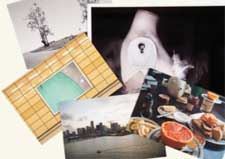
Miracle Repair Tips

IIIa Leica (left) Family photograph c1922

NEXT TORONTO MEETING: Wed, January 18, 2017
Russ Forfar, Lincoln Ross: Miracle Repair Tips

Both Russ and Lincoln have spoken to the PHSC some 20 years ago.  Russ will give hints on repairing legacy film cameras like the late 1930s Leica shown at left of the icon.

Lincoln will speak about repair and conservation of old photographs like the c1922 stained and creased Kodak picture at the right of the icon.

The public is welcome. Go to our Programs page for times and directions.

Posted in program | Tagged , , , , , | Comments Off on Miracle Repair Tips

A Flashy Camera

SELSY Flash and IIIa Leica c 1947

Toronto. Leitz didn’t add factory synchronization until the model IIIf in 1950. However, there were many options for adding a flash gun and synchronization pre IIIf. This particular flash was manufactured for Leitz New York in the mid 1940s. A matt finish in the reflector allowed softer lighting for portrait work.

The flash used batteries and an Edison base bulb or adaptor. The synchronization was accomplished by a custom base plate for a specially modified IIIa camera. The code name for this flash and base is SELSY. The gun is a model VIIIA. Various flash guns were made by Leitz Wetzlar and Leitz New York.

Continue reading

Posted in camera | Tagged , , , | Comments Off on A Flashy Camera

The Long View – Ed Burtynsky – The New Yorker Magazine

Edward Burtynsky

Toronto. George Dunbar sends along this note about a recent New Yorker article on Toronto Photographer Ed Burtynsky:

“A superb feature article about Canadian photographer, Edward Burtynsky, appears in the latest issue of the New Yorker magazine (Dec. 19 & 26). “The Long View” by Raffi Khatchadourian describes Burtynsky’s early life, education, marriage, business (Toronto Image Works) and his current world-wide travels as an “art photographer.”

“His amazing photographs of “a changing planet” are now appreciated in galleries and museums.”

I first heard about Burtynsky when I went to TIFF with my youngest a decade ago. We stood in line on a rainy September day waiting to go in to see Manufactured Landscapes and listen to its director, Jennifer Baichwal. A screw-up in tickets left us with a single ticket. My daughter waited in line after I went in. A second screw-up resulted in the interview and show proceeding while seats stood empty and no line up was allowed to enter.

The film opened my eyes to the awe inspiring size of Chinese factories and their efficiency, plus the devastation reeked on south Asian shores to recover Western iron and precious metals. Some time later, on a PHSC visit to the AGO, I saw one of Burtynsky’s photographs of the Three Gorges Dam being built in China – a massive-size photograph, awesome in its detail and scope.

Posted in people | Tagged , , , , | Comments Off on The Long View – Ed Burtynsky – The New Yorker Magazine

PHSNE Snap Shots PDF now available

Toronto. The folks at PHSNE have produced Volume 22, Number 5 of their Snap Shots newsletter in pdf format.

The newsletter announces the members auction next month. There are plans to have  a new website early in the new year. A paywall will protect a members-only section containing  exclusive articles and information.

Additional articles in 22-5  include:” Archive Your Photos for 1,000 Years,  Harvard Business School Features Inventions of Edwin Land, [PHSNE] Membership Notice, The Eljy Miniature [Camera], Kodak Uncovered a Government Secret, Adobe Offers a ‘RAW’ Deal, Save the Date: Spring 3015, and more,

Posted in activities-other | Tagged , | Comments Off on PHSNE Snap Shots PDF now available

Steady as you go…

Leitz Table Tripod TOOUG c1950

Toronto. Leitz sold many tripod adaptors and steadying gadgets before the war. The first table top tripod complete with a ball and socket head came out in 1949. The early models were code named TOOUG and had a black crackle enamel finish. Later models had a smooth grey finish and came without a ball and socket head of which different models were offered.

The tiny tripod and a head were terrific for steadying the camera. I used a large ball and socket head on a newer model tripod to steady my M4 to my chest. I also used it on sofa backs, fences, trees, etc not just tables.

A wonderful and versatile little gadget in the days when ISO 400 was considered super fast.

Posted in camera | Tagged , , , | Comments Off on Steady as you go…

Matthew Isenburg dead at 89

Matthew Isenburg courtesy The Daguerreian Society

Toronto. Since I published a post just three days ago, both the Daguerreian Society and Dr Marcel Safier have posted an obituary. The Daguerreian Society obituary is on the lower left of that organization’s website and was distributed via the Constant Contact distribution service as well.

Marcel belongs to both the Daguerreian Society and to the PHSC.  Dr Safier lives in Australia and stayed with our editor Bob Lansdale while visiting Toronto.

His writeup on the late Matthew Isenburg is printed on the British Photographic History website. I received this article courtesy of Bob Lansdale who received it from Elizabeth Isenburg. Thanks to both people,and to Marcel.

Posted in people, processes | Tagged , , , | Comments Off on Matthew Isenburg dead at 89

PHSC News pdf For December 2016

Rollei 35. Click above icon for latest PHSC News!

Toronto. Editor David Bridge has done a tasty issue for Christmas using the new layout and help from Assistant Editor Sonja Pushchak.

This issue shows a photograph of ‘Window Dressing’ from the Toronto Archives Fonds of William James, a prominent Toronto Photographer back in the day.

Our latest Toronto meeting this month is announced followed by notice of a new book about Reuben Sallows in full colour. The book is written by Mike Smith (who spoke to us on Sallows and Postcards this past fall), and Larry Mohring. Copies to be available at this meeting at a special PHSC price.

Geoffrey James was interviewed by Sonja and she selected a delightful sample of his work as Toronto’s Photographer Laureate.

A new columnist, Lorne Shields, presents the first column of The Cycle Diary with a couple of topical (i.e. winter snow) photographs. Followed by more details about the Exhibit now at the ROM on World Wildlife Photography.

That and much more can be viewed or printed here or by clicking the above icon of a gold plated Rollei 35 camera.


Posted in newsletter | Tagged , , , , , , , , | Comments Off on PHSC News pdf For December 2016

“I,” said the page, beginning to fade.

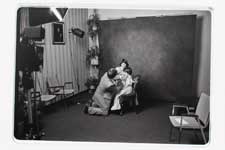
Portrait at the Bay. Leica M4 shot of the preparations.

Toronto. The title of this post is from a song by Pete Seeger. On March 15, 1979, I took my family to The Bay at Cloverdale (long gone – became Zellers, then Target, and now empty for over two years).

The professional photographer did a number of portraits of my children that day. The results were shown to my wife and me and those we selected were printed. The framed portraits were hung in a hallway well out of sunlight and even incandescent lighting as the hallway I chose led to bedrooms.

To my dismay, in few years, the photographs faded very badly to a muddy looking brown. They did not last a ‘lifetime’ as suggested in a two plus decade old Kodak ad. The professional had used Ektacolor paper which was intended for both professionals and amateurs.

An article around that time discussed a lengthy American lawsuit between Kodak and professionals who had been chastised by a legion of disappointed clients, especially wedding parties. In 1992, a respected American scientist, Henry Wilhelm, of  Wilhelm Imaging Research, published his 700+ page book on ‘The Permanence and Care of Color Photographs’ which supported the earlier issue with Kodak’s Ektacolor paper. Long out of print, in 2003 the book was offered as a free download from the Institute – a 35 mb informative read, well worth the download and reading time in spite of its dated material.

Posted in book, photos | Tagged , , , , | Comments Off on “I,” said the page, beginning to fade.

Preservation of Digitally Printed Photographs

ICI Rochester NY

Toronto. On December 12 of this year, George Dunbar sent me a followup to his search for an explanation of how his digital prints were printed.

George has always insisted that a paper print of any age can be viewed by eye while digital images need a means to preserve, read, translate and display the image – no mean task in this era of digital photography!

The site he sent me, called the DP3 Project, is one of a handful of sites under the auspices of the Image Permanence Institute in Rochester.

George said in his email message (slightly paraphrased by me), “This site has some fine info on digital printing. I was particularly interested in the pages  describing inkjet, dye sublimation and laser prints.

“You may recall that I was once curious about the technology used for ‘kiosk-printing’ of 4×6 digital photos. Appears that it may currently be’dye sublimation’.”


Posted in photos, processes | Tagged , , , , | Comments Off on Preservation of Digitally Printed Photographs

Matt Isenburg – November 14, 2016

Matt Isenburg by Robert Lansdale, September 2005

Toronto. Bob Lansdale got word of the passing of Matt Isenburg on December 15th. It was confirmed by Elizabeth Isenburg that Matt passed away last month,  November 14th.

I first heard of Matt when the PHSC sold me a copy of his book Photographica at their December 1979 meeting. The book was written by Charles Klamkin with Matthew Isenberg – Matt’s contribution was the photographs he took of cameras in his collection (years later Matt clarified that he preferred the spelling Isenburg for his name, which spelling remained with him the rest of his life).

I first met Matt at our April 2000 meeting when he spoke on  The Evolution of the Camera  using slides and photographs he made personally, including many colour versions of the halftones illustrating Photographica. 

Continue reading

Posted in people | Tagged , , , , , | Comments Off on Matt Isenburg – November 14, 2016