Todd Korol, Photographer

Calgary Snow by Todd Korol

Toronto. George Dunbar sent me this Instagram link to a Calgary Photographer Todd Korol.  Like many today, Todd chooses to use social media to display some of his work as well as his own website.

You will need an Instagram account to see his work. It is easy to sign in and get an account, or you can go to his website and see some other aspects of his portfolio.

Posted in photos | Tagged , , | Comments Off on Todd Korol, Photographer

Single Lens Reflex camera format.

Exakta VXIIa bought the summer of 1958 while I was in Labrador

Toronto. The SLR design dates back at least a century. Checkout the older Graflex cameras. Ken Metcalf on the west coast of the States published a newsletter devoted exclusively to Graflex models of all sizes. There is even a website!

Recently John Linsky sent out an email with a wikipedia link to the history of the modern digital variety of SLR – the DSLR which is the choice of camera makers like Nikon and Canon for models intended for both professionals and serious amateurs. I use a mirrorless Sony camera with an APS-C sensor since an adaptor lets me use some Leica gear I have on hand.

Continue reading

Posted in camera | Tagged , , , | Comments Off on Single Lens Reflex camera format.

Happy New Year Everyone!

Posted in activities, miscellaneous | Comments Off on Happy New Year Everyone!

PHSC Accomplishments in Recent Years

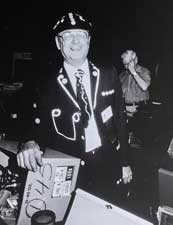
Larry Boccioletti at the PHSC fair – Park Plaza Toronto

Toronto. As PHSC Webmaster, I intended to cover PHSC changes in 2016. On review of the year, I decided to go back a bit further.

Executive
We are truly blessed in the PHSC with a variety of willing and talented volunteers. While many other societies in North American have fallen by the wayside, we have continued to function, adding new venues and publications to our organization.

Our President, Clint Hryhorijiw, continues to bring fresh young people (male and female)  into our executive. These included David Bridge, Louise Freyburger, Judy Rauliuk, Ashley Cook, John Kantymir, Doug Napier, and Oscar Li, a student at U of T (Oscar returned home to Beijing late this fall). New by invitation positions were opened on the executive board. The addition of a  younger generation has produced a most active executive which is much envied by other photographic historical societies.

I had been looking after the Membership records since the abrupt loss of our Membership Secretary Jamie Marr in February 2006. At our April 2006 (and annual general) meeting, Wayne Gilbert offered to be our Membership Secretary, freeing me up to become President the following year.

At our regular monthly Toronto meeting in  April 2007, I was ready to become PHSC President, but disaster struck. The then current PHSC Treasurer, Werner Drechsel, returned to his old company to address a merger in California and he announced his resignation from the PHSC that night, leaving some banker’s boxes for whomever succeeded him. Continue reading

Posted in activities, miscellaneous | Tagged , , | Comments Off on PHSC Accomplishments in Recent Years

Jump

Decisive Moment by Henri Cartier-Bresson taken with an early Leica

Toronto. George Dunbar sent me a Flicker link to people jumping. Use the big sideways arrows (< and >) to go from picture to picture.

When George mentioned the topic, I immediately thought about Leica photographer, Henri Cartier-Bresson, and his famous Decisive Moment print of a man jumping a puddle.

Any of you who have studied physics will know that an object stops and reverses direction at the apex of its motion. The cameras and lenses of the day demanded such timing to ensure the subject would be at its sharpest.

Posted in people, photos | Tagged , , | Comments Off on Jump

People as Pixels

C1917 Photo of US Flag using people as picture elements

Toronto. In this age of digital technology most of us know pixel means picture element which in the film era we called grain.

George Dunbar sent me this remarkable link to a c1917 Library of Congress (Washington DC) photograph of an American Flag using naval staff as the flag’s picture elements.

This and similar photos were taken by Arthur Mole with the careful coordination and supervision of the people by his partner John Thomas.

Think of the patience needed to get everyone in the exact place to replicate the flag in a light breeze. Remember, this photograph was taken with the technology current  a century ago. Remarkable!

Posted in people, photos | Tagged , , , | Comments Off on People as Pixels

The Minicam Boom in the mid 1930s

Fortune Magazine October 1936

Toronto. In 1963 as part of my English assignment at university, I was to research and write a paper. One spring evening, I strolled down to the Montreal Bibliotheque on Sherbrooke Street East. I was unsuccessful  investigating the topic I chose, so I browsed for a bit and spotted an article on miniature cameras.

I asked the librarian to bring the October 1936 issue of Fortune Magazine up from the stacks. In that library as darkness fell, nearly  30 years later, I first read about the Minicam Boom that took place in the USA in the mid 1930s.

The pre-eminant camera at the time, the Leica, had been on the market for twelve years. It had been followed by the Zeiss Contax, Retina, Peggy, and many more. The little cameras had a number of issues to overcome, not the least of which was to sell a mainly contact printing population that a small negative and enlarging could result in a great print. Leitz and its imitators had chosen to use 35mm cine film simply doubling the frame size t0 24 x 36 mm. The earliest books on the Leica spent time persuading the readers that they really could make large prints from small negatives. This encouragement continued into the 1950s. Leitz used famous photographers such as Toni Schneiders in their ads.

Continue reading

Posted in camera | Tagged , , , , | Comments Off on The Minicam Boom in the mid 1930s

Folders are fun too

Toronto. Yesterday, boxing day, I mentioned the box camera. How about the ubiquitous folder popularized by Kodak? The box camera user could upgrade his camera and skills by investing in a folder. These compact cameras used a bellows to set the distance from film to lens allowing even closer photos to be taken, while a better quality shutter and lens increased the range of speeds and f/stops.

Like its earlier siblings, a folder size was chosen to match the desired print size. It was popular in the days when contact prints were common and enlarged prints rare – enlargements came with the minicam craze of the 1930s.

Continue reading

Posted in camera | Tagged , , | Comments Off on Folders are fun too

Box Cameras

Imperial Box Camera by Bob Lansdale

Toronto. Today is Boxing day – or week, or month depending on the marketing pitch! Regardless, it is a fitting day to remember the box camera. I had box cameras as a kid – old Kodaks I took apart; a baby brownie in bakelite plastic; a Brownie Hawk-eye with a flashgun (also in bakelite).

The box style was made from wood, metal, cardboard or plastic. Some had a grained leather covering; others a black paper served the purpose. The lens was usually a simple single element design but occasionally a more complex multi-element affair. Shutters were usually primitive as well. Various designs and styles served as a view finder; anywhere from a simple pointing device to a separate tiny lens and mirror that helped frame the subject too.

The icon for this post is a fancier Imperial Box camera sold at our spring fair in 2013. The viewer gave a bigger view of the scene to be photographed while its placement made portrait format the preferred framing choice.

These basic cameras go back many decades. They are perhaps the simplest of camera designs. The box determines the framing and holds the distance between lens and media (film) fixed. A small aperture – say f/16 guarantees the camera will be in focus from about 6  feet to infinity. The down side of course is the slow speed necessitating use out of doors or with powerful lights or flash indoors. The lens could be a simple meniscus; the shutter a simple spring loaded plate that operated at about 1/25th of a second.

My grandmother used just such a box camera to take pictures of her family outdoors from about 1920 to the 1940s when the advent of war saw her children begin to marry or join the battle in Europe. She kept a selection of prints in an album documenting her family as it grew in size and age.

Posted in camera | Tagged , | Comments Off on Box Cameras

Merry Christmas Everyone!

Posted in activities, miscellaneous | Comments Off on Merry Christmas Everyone!