what’s leaves got to do with it

Autumn Leaves of fall

Toronto. Falling leaves. Cold. Damp. Windy. November in the city and winter is about to rush in. As I write this post on the 1st, we are seeing our first snow flurries of the coming season.

Leaves have a lot to do with photography both in the aperture and the speed setting of film cameras.

The Waterhouse stop and the slot in the side of a lens were in time replaced with a diaphragm device whereby the rotation of a ring on the lens would vary the size of the aperture by causing a change in the diameter of the centre circle and thus control the amount of light hitting the sensitive media, the depth of field (what parts of the scene would be in or nearly in focus), and the look of out of  focus secular light (the bokeh of the lens). This diaphragm device was composed of a series of leaves attached to the ring.

When the media for photography reached an in-camera speed calling for sub-second exposure outdoors, shutters became mandatory. They evolved into various designs including a leaf shutter which used a series of metal leaves, like the diaphragm. This time the leaves were tightly shut and when released, quickly opened fully then snapped shut once again.

The leaf shutter could be synchronized to operate a flash at any speed. Unfortunately its top speed was limited by physics – about 1/400th second for 35mm cameras. Also the ideal location was midway in each lens resulting in expensive lenses. Optionally the elements in front of the leaf shutter could be changed to vary a lens’s focal length slightly (before we had zoom lenses). As a result, leaf shutters were mostly used for mid price range 35mm cameras.

Note that the title of this post is a riff on the title of Tina Turner’s hit song “What’s Love Got To Do With It?” sung here by the lady herself

Posted in history | Tagged , , , , , | Comments Off on what’s leaves got to do with it

1932 – Technicolor and Doctor X

Scene from 1932 Technicolor Doctor X

Toronto. The first time I saw a Technicolor two colour process colour film was the other evening when I viewed the 1932 film “Doctor X” via TV courtesy of TCM who ran the UCLA Film Archive recreated version on safety film. When it comes to colour, I usually think of still images and the struggle I had to process and print three process colour media in the 1970s.Today, digital media and smartphones make the task dead simple be it still or movies (I mean videos).

I found Doctor X interesting for a couple of reasons. Firstly, it was a talkie made just a few years after talkies first came on the market. As such, the film was rife with audible sound effects. The industry wanted to fill every moment with sound of some sort.

Secondly, it used the two colour Technicolor process aiming to make skin tones realistic resulting in everything else looking greenish or brownish. In Technicolor movie cameras, the process made clever use of prisms and filters on reels of film made on nitrate based B&W film. With a bit of film magic, positive dye sublimate prints were made for projection in big cities of the States while the rest of us abroad or in small American towns saw only black and white prints.

I had read about Technicolor’s two colour process but didn’t realize how old it was nor how many process updates occurred to reduce grain and improved colour clarity. Since it was a subtractive positive colour, it took much less light to project, allowing standard projectors to be used.

Posted in history | Tagged , , , | Comments Off on 1932 – Technicolor and Doctor X

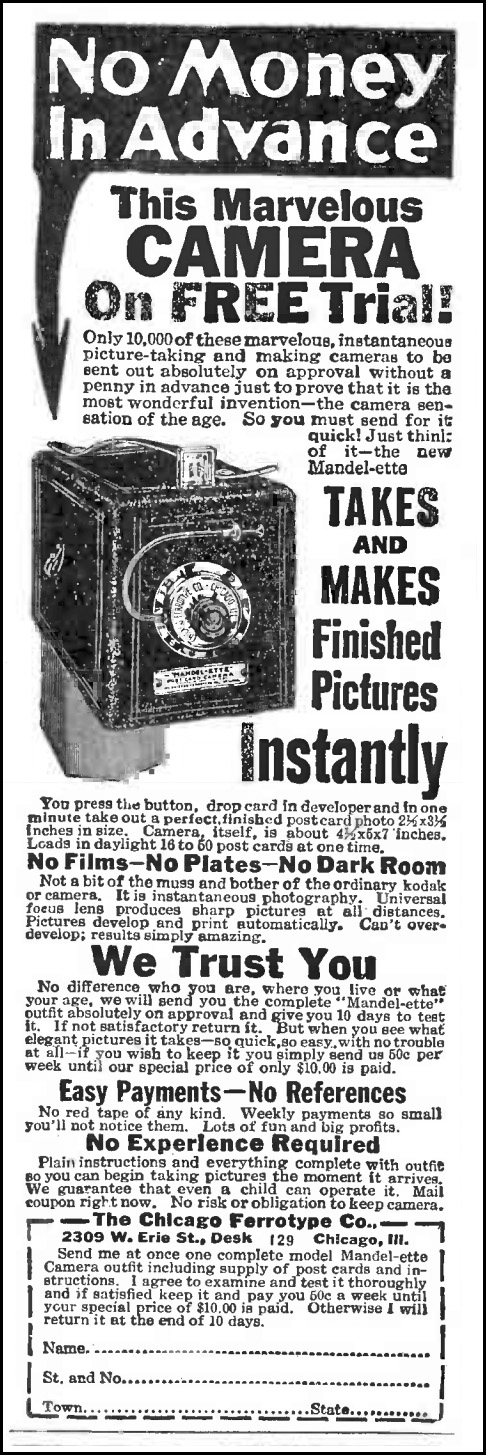
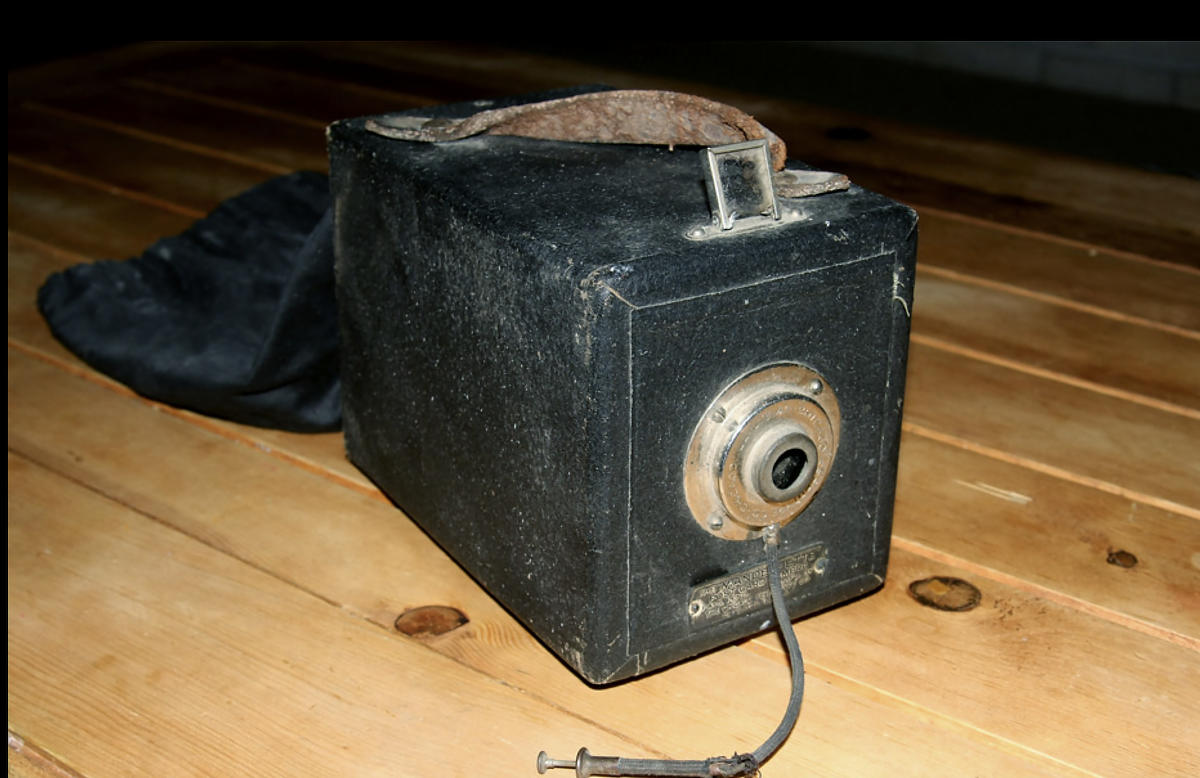
what a bargain!

Mandel-ette courtesy of Jason Penney on Flickr via  Camera–Wiki

Toronto. Do you remember street photographers? They were itinerant photographers who snapped people as they walked along city streets and sold their work accordingly. Sometimes the photo was a ferrotype (tintype) and the finished photo was ready in a minute or two. Other times the subject was given a number to call next day to pick up the photo.

Those who took tintypes may have used the Mandel-ette made by the Chicago Ferrotype Co. (CFC), described in McKeown’s as, “Founded by Louis & Mandel Mandel, the Chicago Ferrotype Co. was the United States’ leading producer of direct positive ‘street’ cameras for tintypes, button tintypes, paper prints, and post cards.

A Mandel-ette today is worth about 8x its original cost.  An ad from 1924 offers about 10,000 cameras for a free 10-day trial. Budding businessmen could pay just fifty cents US a week for twenty weeks to buy the $10 camera if they kept it.  CFC also sold supplies by mail. Interestingly, the camera seemed to be a basic box camera (fixed focus, small aperture) but offered prints in a minute long before Polaroid’s famous “pictures in a minute” system that was offered shortly after the second war ended.

Click here to see the manual or visit Camera-Wiki and after reading the material, follow the link at the bottom of the page (same manual). My thanks to George Dunbar for sharing this 1924 ad he unearthed recently.

Posted in camera | Tagged , , , , , | Comments Off on what a bargain!

scandalous

Robert Notman’s sad story as told by Elaine Naves in her 2013 book

Toronto. And a spooky halloween to you all in this year of the pandemic! I thought it fitting to talk about a scandal that affected the famous Notman Studios. Years ago I bought a coffee table size book of William Notman photographs called “Portrait of a Period” in downtown Montreal. In 2014, I was surprised to see a smaller softcover book with a title that was a riff off the title of the coffee table book.

It was titled “Portrait of a Scandal” and was closely tied to Notman as it was the story of his younger brother Robert who also emigrated to Montreal. The younger man worked for a short time in his brother’s studio in Montreal. Sadly instead of fame, Robert was embroiled in an abortion and worse a murder in his new city. Until I read this book, I never knew that treatments for “ladies’ problems” included medicines that were touted to end unwanted pregnancies.

Amazon Canada quotes the following blurb to promote the book: “In the winter of 1868 a name Montreal society associated with art, good breeding, and culture became fodder for scandal mongers. The Notman name, synonymous with fine photography, was suddenly making headlines featuring the words ‘abortion’ and ‘suicide.’

A dozen years earlier, two brothers fled their native Scotland . They were attracted to Montreal by its reputation for making the fortunes of go-getting Scotsmen. One was destined for fame, the other for notoriety.

William Notman, the older brother, eventually owned the largest photography business in North America. His subjects ranged from royalty, Governors General, and the Fathers of Confederation to Sitting Bull and Harriet Beecher Stowe. His studio immortalized the faces and baronial mansions of the merchant princes of Montreal’s legendary Golden Square Mile–the Molsons, Redpaths, Allans, and Van Hornes.

By contrast, Robert, the younger brother, was drawn into a drama which shook up Montreal’s polite society. After he seduced the beautiful and ambitious Margaret Galbraith, a student at the McGill Normal School, he arranged an abortion for her with an up-and-coming young doctor who soon after committed suicide.

The subsequent trial of Robert Notman became cause-célèbre in the newly minted Dominion of Canada in 1868. Portrait of a Scandal depicts a society that distanced itself from sexual misconduct, while it lapped up its every detail.

Bob Lansdale and I joined a few other PHSC members at Campbell House on Monday, June 16th, 2014, a summery night in the big smoke, to hear author Ms  Elaine Kalman Naves talk about her Notman book.

Posted in book | Tagged , , , | Comments Off on scandalous

electricity to the rescue

September 1917 article on using electricity to sequentially trigger flash powder stands

Toronto. Whenever a new technology or process was announced people found ways to use it for profit. A few decades ago photographers set up multi flash units to light large areas when a shot was taken. The idea of harnessing electricity to do this was far older.

In the early years of the last century when home  electricity was new. the American magazine,”The Electrical Experimenter” published many ways electricity could be used. For example, in its September 1917 issue EE showed an article called, “Electricity Operates Panorama Camera and Flashlights Automatically“, showing a suitcase sized controller that sequentially ignited stands of flash powder.

As a panoramic camera rotated, each flash stand was triggered to evenly illuminate a large indoor commercial area, in this case a room full of electrical power generators, one flash at a time.

The article suggests the camera was also operated by electricity although  such cameras commonly used gears and springs to circle an area. This article and idea is from my good friend and fellow PHSC fan George Dunbar. George is pursuing his natural curiosity with a photo history bias and shares many of his findings with other PHSC members.

Posted in history | Tagged , , , , | Comments Off on electricity to the rescue

Alice is at it again

Sony A7R IV Full frame 61 megapixel

Toronto. After film’s popularity surged in 1880 with the famous Kodak camera, the race was on to increase its detail (resolution) and speed. By the time film faded from popular use, both resolution and speed had increased significantly. A friend of mine suggested digital cameras with 35mm frame size sensors (full frame) would have to reach some 35 megapixels to match the detail possible with 35mm Kodachrome transparencies. While there is no simple correlation between film and digital resolution, common estimates suggest Kodachrome is about 20 to 35 megapixel equivalent in resolution (lens quality and ISO rating are variables to be considered).

Fortunately, just like film, digital sensors have grown in both resolution and speed. When first introduced, digital cameras had sub-megapixel sensors that struggled to offer ISO 400 sensitivity. The low resolution nicely matched the computers of the day.

Modern high end digital cameras can capture 50 megapixels or more with sensitivities beyond ISO 3200. Digital Camera World posted this article (12 Highest resolution cameras you can buy today)  by Rod Lawton on June 12, 2020. This article was the source of the Sony illustration at left.

NB. The title of this post is the witty and whimsical song “Alice is at it Again” written by Noel Coward in 1946 and sung by him on his show in Las Vegas at the Desert Inn. I first heard it on his “Noel Coward in Las Vegas” album which I bought some 60 or so years ago.

Posted in camera | Tagged , , , , , , | Comments Off on Alice is at it again

bigger than Texas …

a huge digital camera from SLAC courtesy of CNET

Toronto.  … and even Ontario! CNET reports that SLAC National Accelerator Laboratory recently announced the world’s largest digital camera. The article on CNET is, “Scientists capture world’s first 3,200-megapixel photos” and states, “They successfully test the focal plane on the world’s largest digital camera, which will eventually help explore the cosmos.”.

Modern day digital cameras have sensors far smaller, topping out under 100 megapixels. We first learned of these giga size images in November 2008 when Felix Russo of PhotoEd spoke on his Gigapan system and modern day panorama images. He later took a 750 megapixel shot of some laggards in the audience (including me).

In November of 2015 I did a post on the Gigaplex system and its 2,100 megapixel photos. The Vancouver shot was captured in 2011 at the Canucks hockey game outside the arena. I also linked to a mountain scene shot in 2013, but you need the Adobe Flash plug-in to see it (Flash is history now).

My thanks to my friend, Russ Forfar, up in the wilds of Southern Ontario.

Posted in camera | Tagged , , , , , | Comments Off on bigger than Texas …

those wonderful old home movies

how to see home movies – a MoMA magazine video

Toronto. I recently did a post on “1839 and all that” featuring a short video on daguerreotype restoration from MoMA in New York City. This post borrows from MoMA magazine once again, this time a 10 minute video showing home movie clips interspersed with shots of four MoMA folk discussing home movies and how to see them through out the video.

Home movies were first taken to capture family events but in time they became an historical statement of the times shown. Have a look and see the home movies in a fresh light. While these clips seem to be entirely American, we can all remember taking some home movies here too.

Again, I thank my good friend George Dunbar for suggesting this link to me. While most clips appear to be 8mm and somewhat fuzzy and off colour, they are valuable in showing how the average person viewed his world last century when 8mm struggled to gain a foot hold in this world of still photography.

The modern smartphone of today takes crisp videos automatically, perfectly balanced for colour and exposure. Most users have no idea how challenging movies were a half century ago when tiny frames on a skinny strip of colour film captivated families.


Posted in history | Tagged , , | Comments Off on those wonderful old home movies

copy, copy that!

c1919 drawing of triode = book page copied

Toronto. In  the early 1900s, some American companies sold fancy copy machines, that relied upon photography, to prosperous companies. Their machines snapped and recorded material directly to photographic paper, which was sometimes developed and fixed automatically.

But not everyone could afford these machines. For example, I was just a little child during the second war and I can remember watching a teacher make handwritten exam sheets using an indelible pencil  to write a master sheet in purple.

This sheet was rolled on what looked like a shallow tray of stiff jelly making the words and letters reversed in the “jelly”. A number of blank papers were individually rolled on the “jelly” and peeled off showing purple words and letters now right way around.

In the late 1950s/early 1960s at work, we had a mimeograph machine. A clerk typed instructions on a gestetner master sheet (stencil) that was wrapped around the machine’s drum. These office machines all disappeared when Xerox copy machines came on the market later on. Initially computer-connected scanners were expensive stand alone machines. Today, all-in-one inkjet printers (scan, print, and fax) are dirt cheap squeezing out most of the stand alone scanners.

I made the copy that post a year ago. At the time, I was using a digital camera and copy stand to record negatives and a scanner plus the Image Capture app to copy prints, papers, book pages, etc. A few decades earlier, I used some Leitz accessories to copy papers and book pages both at home and at the Reference Library.

My thanks to friend and fellow PHSC member George Dunbar for sharing this February 1917 article in Electrical Experimenter magazine showing how one company used a camera set up to do copy work. George found the article while researching for photographic history. Below you can see the machine discussed in the article. The lens and prism are on the right facing the copier platform below.

Posted in history, Uncategorized | Tagged , , , | Comments Off on copy, copy that!

simplicity again

Kodak has a better idea …

Toronto. In the late 1960s, Kodak aggressively pushed its ads to capture the low end of the home movie market. My October 14th post, “eulogy for simplicity” showed one ad Kodak used in this approach.

This teaser ad shows another way Kodak tackled the low end market. In this case, it uses the high end and pricey Bolex as a paper tiger suggesting it was too complicated to give to a wife but hinted Kodak has a better idea.

My thanks to George Dunbar who unearthed this wacky ad while pursuing photographic history and shared it with me.

Posted in history | Tagged , , , | Comments Off on simplicity again