typewriters and cameras? really?

LIFE magazine ad for a typewriter and camera

Toronto. When I was a kid, a popular saying was that “a picture is worth a thousand words“.  In the late 1960s, there were two big ideas in amateur cameras: Super 8 home movies, and 16mm sub-miniature cameras. By then colour photos were a growing portion of  films and prints. Film resolution had improved to the point that both super 8 for movies and 16mm rolls for stills were both practical and desirable.

To attract a wider clientele for its portable typewriters, Smith-Corona offered a huge discount on a camera when one bought their electric or manual model. This pp18-19 June 27, 1969 ad in LIFE is typical of the strategy manufacturers of the day used to gain market share: link your product to a non competitive but desirable product at a deep discount. In this case, buy a Smith-Corona typewriter for your student and get a cheap (low end) movie or still camera for a few dollars more.

Within two decades, the typewriter was dead or dying – replaced by the ubiquitous computer. In business, the word processing system replaced typing pools. At home, the computers and printers of the day replaced the personal typewriter. Such is history.

Thanks to my old friend George Dunbar for sharing this ad with me. George spotted it while researching photographic history.

Posted in history | Tagged , , , , , , , | Comments Off on typewriters and cameras? really?

it’s complicated

Ad for Polaroid Colorpak II in Life Magazine

Toronto. Photographic product makers worked hard at besting one another to capture a larger segment of the ever growing amateur photography market. Typical of the strategy was this May 1969 ad in LIFE magazine touting Polaroid.

The ad emphasizes its inexpensive, technically complex, and super easy to use colour camera! While a Polaroid camera may look complex, most cameras of the era – or any era – are just a shutter, an aperture device, a means to focus, a lens, a sensitive media, and a light tight box to keep the sensitive media and the lens the right distance apart.

As Lipinski says in his 1955 book “Miniature and Precision Cameras” about Leitz’s famous camera, “It can safely be said that the Leica mechanism has evolved around its focal plane shutter. There is hardly anything more in it — there is indeed remarkably little inside a Leica anyway.

My thanks to my good friend and fellow photographic history buff, George Dunbar, for showing me this ad from the May 30, 1969 issue of LIFE magazine.

Posted in history | Tagged , , , , , | Comments Off on it’s complicated

professional photographer

Daring do of the News Photographer

Toronto. From the very beginning of the art we had studio and landscape photographers. As the art evolved,  becoming faster in exposure, simpler in execution, and growing in popularity, the professional focus rapidly diversified.

An example is this 1913 article from  “Popular Electricity and World’s Advance”, showing a news photographer taking to the air in an aircraft whose technology was barely a decade old. Scary stuff showing the daredevils of news photography who will take great risks to make a photo for their newspaper.

This post is based on an article emailed to me by my good friend and fellow PHSC member, George Dunbar.

Posted in history | Tagged , , , , , , | Comments Off on professional photographer

the gang’s all here

Family Photos

Toronto. When Kodak invented their first camera and began marketing it in 1888, for the first time amateurs could take snaps on a roll film and send them elsewhere for processing. In this case sending the exposed film still in the camera and the camera back to Kodak where the roll of film was replaced, the previous roll developed and printed, and prints and camera returned.

By making picture taking easier, the audience for photographic products was expanded and the snapshot phenomenon took hold. Brian Coe wrote a book called “The Snapshot Photograph – The rise of popular photography 1888-1939”. Over time the snaps became more than just a recording of family events and history, but a means to illustrate the evolution of technology, fashion, and even humanity. Today, Facebook considers the most commonly used camera of all is that in the ubiquitous smart phone.

This photograph, thanks to a note from my good friend George Dunbar, is from a 2012 article on the Canada’s History website by Paul Jones titled, “Roots: Understanding Family Photos“. Click on the article link and read what Mr Jones has to say about the family snapshot.

The title of this post is from a 1940s movie of the same name.

Posted in history | Tagged , , | Comments Off on the gang’s all here

All About Enlargers – Part A

All About Enlargers – Part A

Toronto. What do you do when a photograph negative is too small? Enlarge it! You may be surprised to learn that enlarging apparatus came along well before the minicam revolution of the 1930s. In this special members-only supplement (vol 1-6) Part A shows the various devices available to enlarge the existing sensitive materials.

Vol 1-6 was sent out last Friday afternoon to all current members with an email address. If you did NOT get a copy, please email me at info@phsc.ca and I will send you a copy after verification of your membership. Not YET a member? well, for heaven’s sake! Grab your plastic and register via PayPal on the upper right of this page!

Stated in the supplement, “The advertisements and illustrations in this supplement originally appeared in the The Photographist numbers 109 and 110, the journal of the Western Photographic Collectors Association (WPCA) in 1996. The WPCA was affiliated with the University of California Museum of Photography and stopped publishing circa 1996, going into dissolution in 2001. For the story of the history of the WPCA, see the article in Special Supplement Vol. 1 No. 1.

“In an effort to make this material available to collectors, historians and those interested in the history of photography, this content was digitized by the Photographic Historical Society of Canada (PHSC) and Milan Zahorcak from the U.S. in 2019 and 2020 for distribution to PHSC members as a seven part series. The first instalments were about magic lanterns, posing chairs, flash lamps and the last will finish a two-part presentation on early enlargers. If you have any questions or would like higher resolution scans of any of the images, please contact the PHSC at info@phsc.ca.”

Posted in history | Tagged , , | Comments Off on All About Enlargers – Part A

THINK … small

micro-ipso without the cable release or 10x eye piece

Toronto. Decades ago, people said that to get ahead, one had to think big! IBM even had a catch phrase – THINK. Years later when I worked in  a data centre,  IBM folk could get these IBM signs in capital white sans-serif letters on a blue background.

One of the earliest applications of photography was in the scientific laboratory. Scientists used the art to capture the powerfully magnified images they saw in the eye piece of the microscope. Jabez Hogg who wrote a massive primer on microscopy (15 editions from about 1850 – 1900) eulogized its virtues – until he learned a fee was charged to use daguerreotype technology in England (Daguerreotypes had the best resolution available at the time).

Later, microscope makers sold small field cameras and supports to record these amazing highly magnified images. Decades later when minicams became popular, camera makers made accessories to connect their products to microscopes. Leitz brought out a line of accessories called “micro-ipso”. This series of adaptors used a funnel-shaped tube to adjust the camera type and distance. A leaf shutter was included to avoid the motion effect of focal plane shutters on highly magnified images. A tiny telescope ensured both camera and microscope were in sharp focus simultaneously. A double cable release moved the focussing prism out of the way before the shutter operated.

The adaptors connected still and small movie cameras to a microscope. Leitz included a 10X periplan (flat field) eye piece to fit the microscope. Nowadays video cameras and monitors replace all this gadgetry. Scientists and audiences can view the monitor and focus, move, or even change the 1×3 inch glass slides holding thin layers or complete specimens.


Posted in history | Tagged , , , , , | Comments Off on THINK … small

niner, niner, this is ZOOM

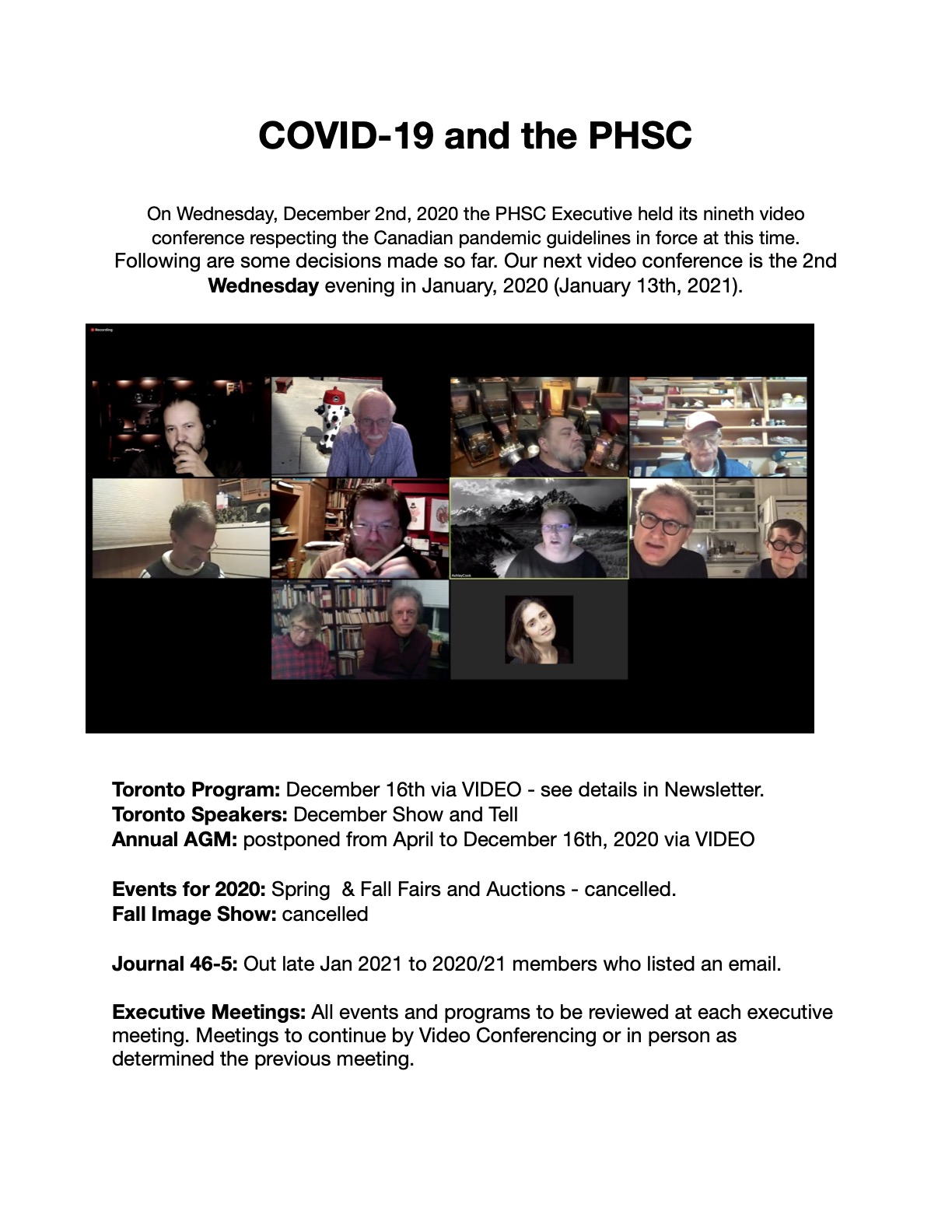
Toronto. We held our nineth COVID-19 inspired exec meeting via ZOOM (This is beginning to feel like normal). Thank you Celio for arranging the meeting once again. Key changes are shown below. Toronto is in RED (Lockdown) at present as we see the second wave of COVID-19. ALL live events are cancelled at least until 2021. Our monthly meeting venue (North York Memorial Hall) is closed to events by the city until at least December 31, 2020. We now hope to do meetings beginning December 16 via video. Stayed tuned.

PHSC News goes out shortly for December. Sign up at news@phsc.ca for a free pdf copy. Members get specials plus the journal via pdf. Contact me if you are a member and HAVE NOT seen the pdfs. Some members have unsubscribed to MailChimp; some emails are invalid; and others have no email on file with the society. Any questions? Just drop me a note at info@phsc.ca

Posted in activities | Comments Off on niner, niner, this is ZOOM

and who might you be?

Who is She?

Toronto, … asked my wife’s 90+ year old aunt many years ago.  The image at left was recently developed. It was from an exposed roll of film (from a bulk roll) exposed in the 1930s Leica IIIa. The film was in a Leitz brass cassette that was likely purchased some years ago, possibly with the IIIa.

As the BBC recently stated, “Camera collector William Fagan obtained a number of film cassettes some years ago, when he bought a Leica IIIa.” Assuming the photo was taken in Europe before WW2, the lady would be over 100 years old today. Perhaps she became a mother and grandmother, then her children or grandchildren may recognize her.

Visit the BBC site for the story and more photos of the trip to Switzerland and Italy. Let us know at info@phsc.ca if you do recognize the photo – no reward, just the satisfaction of helping solve a mystery.

My thanks to two friends and PHSC members – George Dunbar and Russ Forfar. They both took the time to alert me about this story.


Posted in history | Tagged , , , , | Comments Off on and who might you be?

amping it up

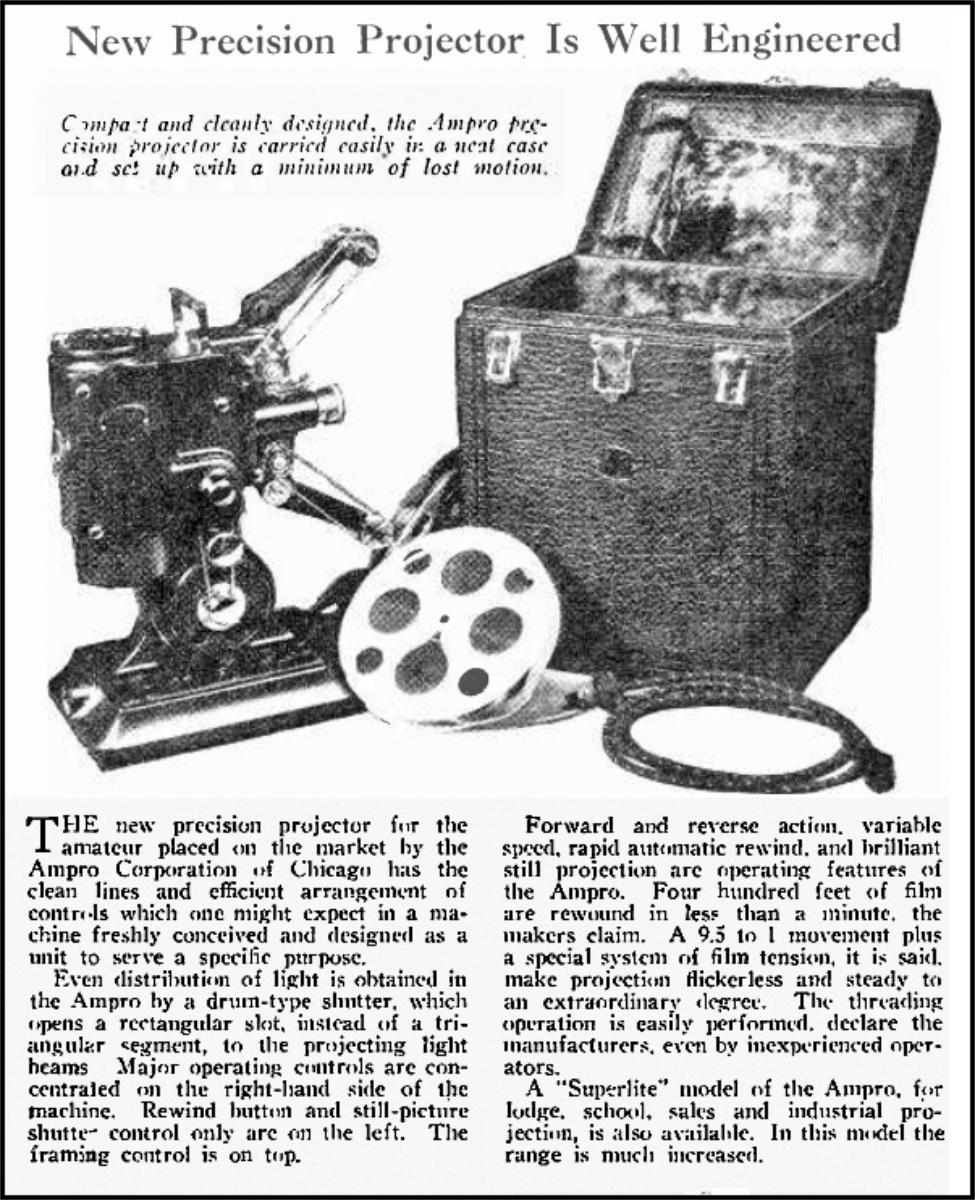
1930 article on an Ampro projector

Toronto. When I was a school kid in grades 7 and 8 a few years after WW2, I was also an occasional  projectionist for junior classes. We showed 16mm educational movies on (to me) a massive Ampro 20 sound projector.

To my delight, I received a note from my good friend George Dunbar that included an article from the August 1930 Science and Industry magazine on an Ampro projector.

Reading it, I was thrilled to recall my experiences as a kid showing junior classes the B&W sound educational movies of the day. I remember once turning the projector’s lens out so far it dropped into my hand and from there to the concrete floor, cracking one element.

A few weeks later, a rather annoyed school principal (he was also my grade 8 teacher) showed me the repair bill for the lens – $10. While a pittance today, it was a sum representing a few days pay in those post war years.

Posted in history | Tagged , , , , , , , | Comments Off on amping it up

quite a mouthful

Stubner mouth operated cable release. MQUOO – 14084 Leitz cable code

Toronto. In the 1950s, the German company Stubner (or Stuber – did he work for Leitz?) made these cable releases. When sold by Leitz for the Leica, they were signed Leitz on the raised button and a 10 inch cable release for screw mount cameras was included. The Leitz cable code for this mouth release and the associated shutter release cable was MQUOO and later 14084. The tiny accessory allows one to snap a shot off by mouth, freeing up a hand. It was intended to stabilize exposures but proved helpful to the handicapped as well.

In April of 1982, Alex Thomas gave me the piece shown, as a gift. “The Leica version is marked as Leitz”, he said. “This one has no markings but appears identical to the marked version”. Actually, the earlier ones were signed Leitz and had rounded/pointed ends instead of flat ends. At the time I knew Alex, he was both a PHSC member and a fair attendee. He had a store in nearby Orchard Park, NY.

According to Hove, the MQUOO was made in 1954. Jim Lager also states it was made in 1954. Both my 1960 catalogue and my 1955-58 catalogue reprint by Hove list it while my 1933 and 1936 catalogue reprints do not. It is mentioned as for the screw mount cameras yet it was sold when the M3 arrived. Morgan and Lester’s Leica Manual (13th edition, 1955) mentions it as for all but the M3 (page 33 photo) but it isn’t in the index. Stuber/Stubner seems to have disappeared as far as the internet is concerned.

Posted in history | Tagged , , , , | Comments Off on quite a mouthful