through the wet-plate camera

a couple of Charlie’s portraits over a century and a half ago.

Toronto. Being a photographer – and a good one – in the mid 1800s took exceptional skill and a fine, artistic eye. Author Lewis Carroll (A.K.A. the reverend Chas. Dodgson) was one such person.

In Bruce Downes’s column (Let’s Talk Photography) in the Popular Photograph issue for January 1951, beginning on page 83, discusses Carroll’s portraits and his unique abilities.

The very first full length book I ever read (I was about 10 to 12 years old) was a paperback edition of Carroll’s “Through the Looking Glass” so Downes’s column has a particular interest to me as I look back through time to those halcyon days of yesteryear. I eventually read “Alice in Wonderland” and Carroll’s poems such as “The Walrus and the Carpenter

A special big tip of my hat to good friend and photo history maven, George Dunbar, for sharing this trip through time with me.

Posted in history | Tagged , , , , | Comments Off on through the wet-plate camera

dating those tiny Photomatic photos

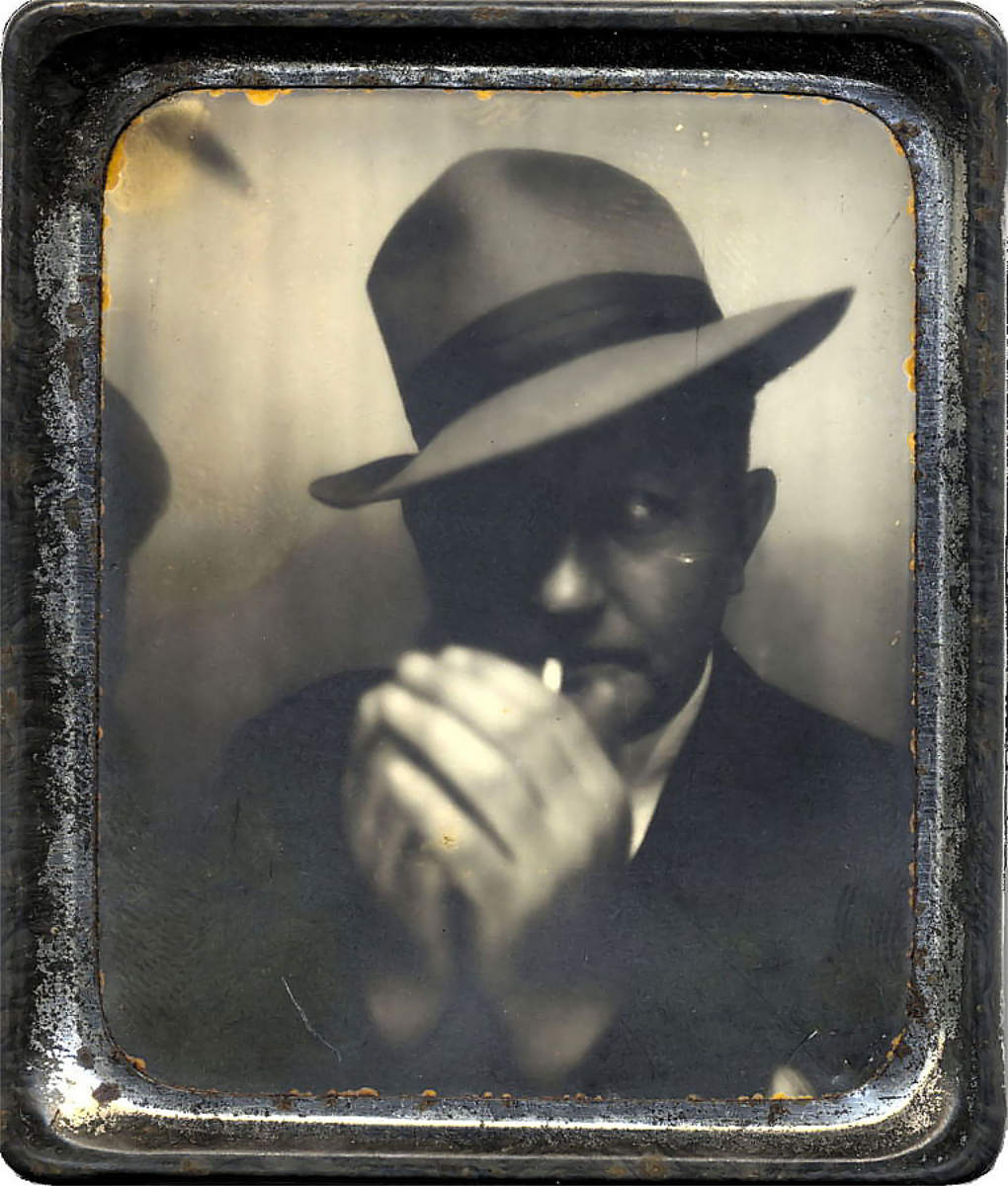
c1940 portrait from a Photomatic booth courtesy Sean Nolan

Toronto. You can pick these little portraits up at one of our events. Nowadays, photo booths give us a few portraits in a short strip of prints.

Sean Nolan has taken the time to date the Photomatic portraits using the frame design. His current release is available here in pdf format. The guide includes this link for other books and updates to the guide. Sean’s work also appears on page 3 in our May 2018 newsletter, 18-01.

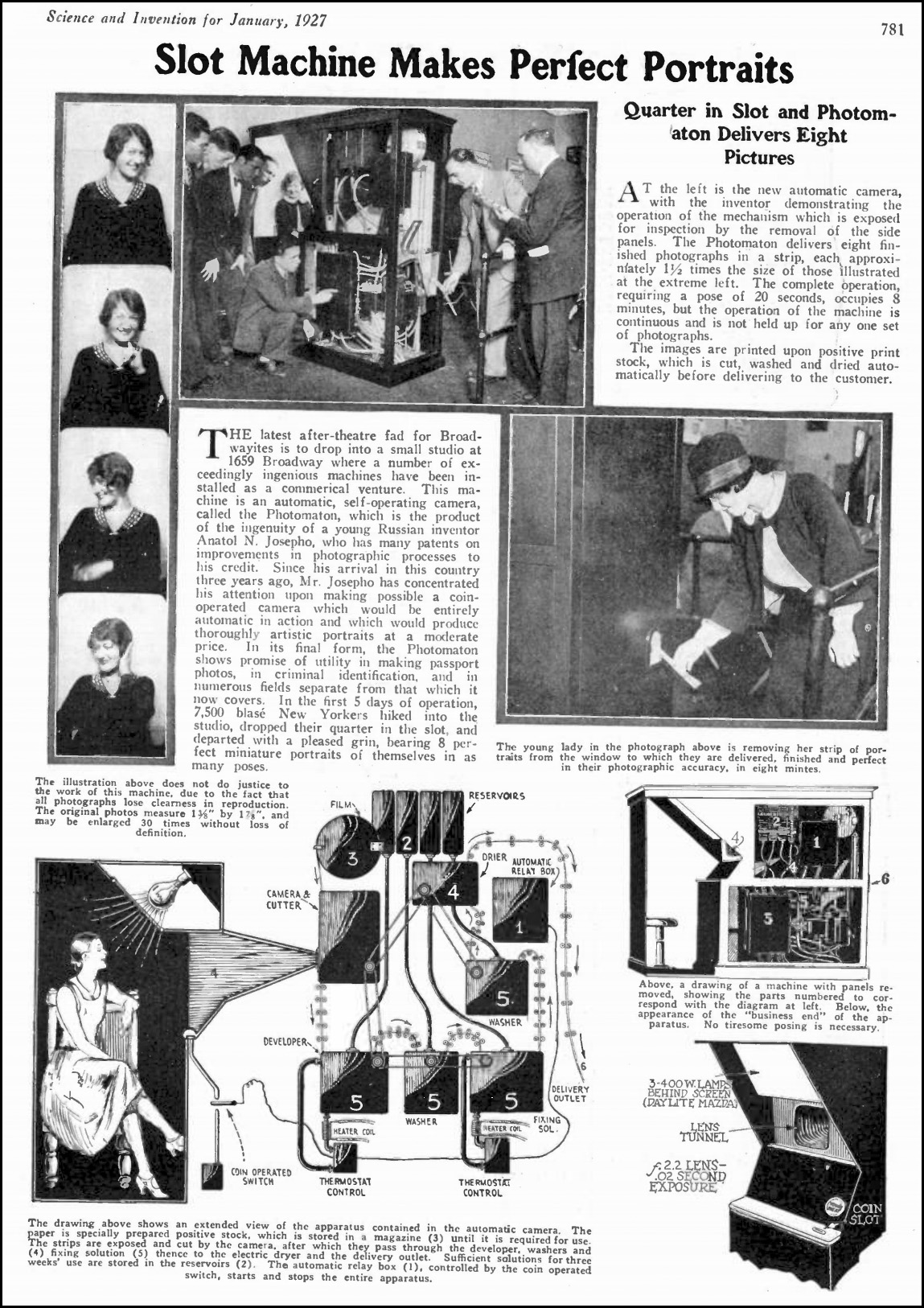
In the May, 2008 issue of Photographic Canadiana, George Dunbar wrote a review of the book, “American Photobooth” by Nakki Goranin. George also found a 1927 article in the magazine “Science and Industry” that illustrates how the booth works. And he managed to locate a booth up here which was written up in our Journal (vol 33-1 for May, 2007).

Sean’s guide begins, “The photo booth was a private place where, hidden behind a curtain, you could take your own portrait. These pictures, taken without professional supervision, are wonderfully informal and often reveal a spontaneity and sense of character not found in more formal portraits of the period. The photographs range from staid passport photos to wacky strips where you could act out a scene in four poses.

“The photo booth was also a place where society’s censors could not enter. Gay, lesbian, or interracial couples could embrace in privacy. Risque self-portraits were possible long before the advent of the Polaroid camera or digital photography.”

Posted in photos | Tagged , , , , , , | Comments Off on dating those tiny Photomatic photos

introducing a photographer to minicams in 1938

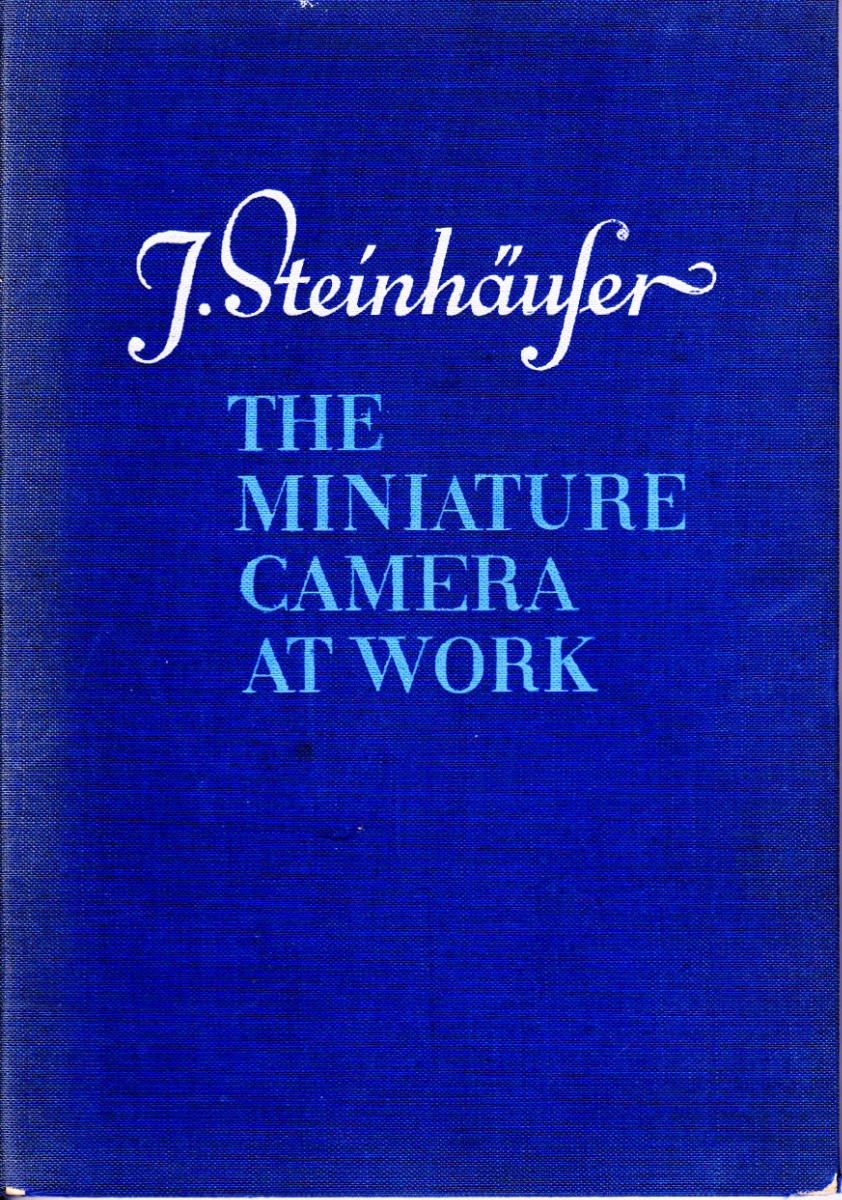
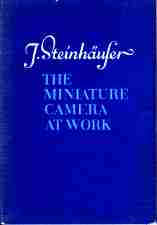
Cover – 1938 book “The Miniature Camera at Work”

Toronto. When Leitz announced the Leica mid 1920s, most photographers used larger cameras and rarely needed to enlarge their negatives. In 1926, the German government arranged for Zeiss to form the mighty Zeiss-Ikon conglomerate in Dresden to rationalize the German camera industry which prior to 1926 was many competing companies often making similar products.

Some high end companies like those making Leicas, Rolleis, etc. decided to waive joining Zeiss-Ikon. In the midst of this rationalization, miniature cameras took off leaving Zeiss ill prepared. By 1932, Zeiss had reacted and offered the Contax I model. They decided to make everything on the Contax better and stronger than the Leica, which was made by Leitz, one of its competitors in microscope manufacture.

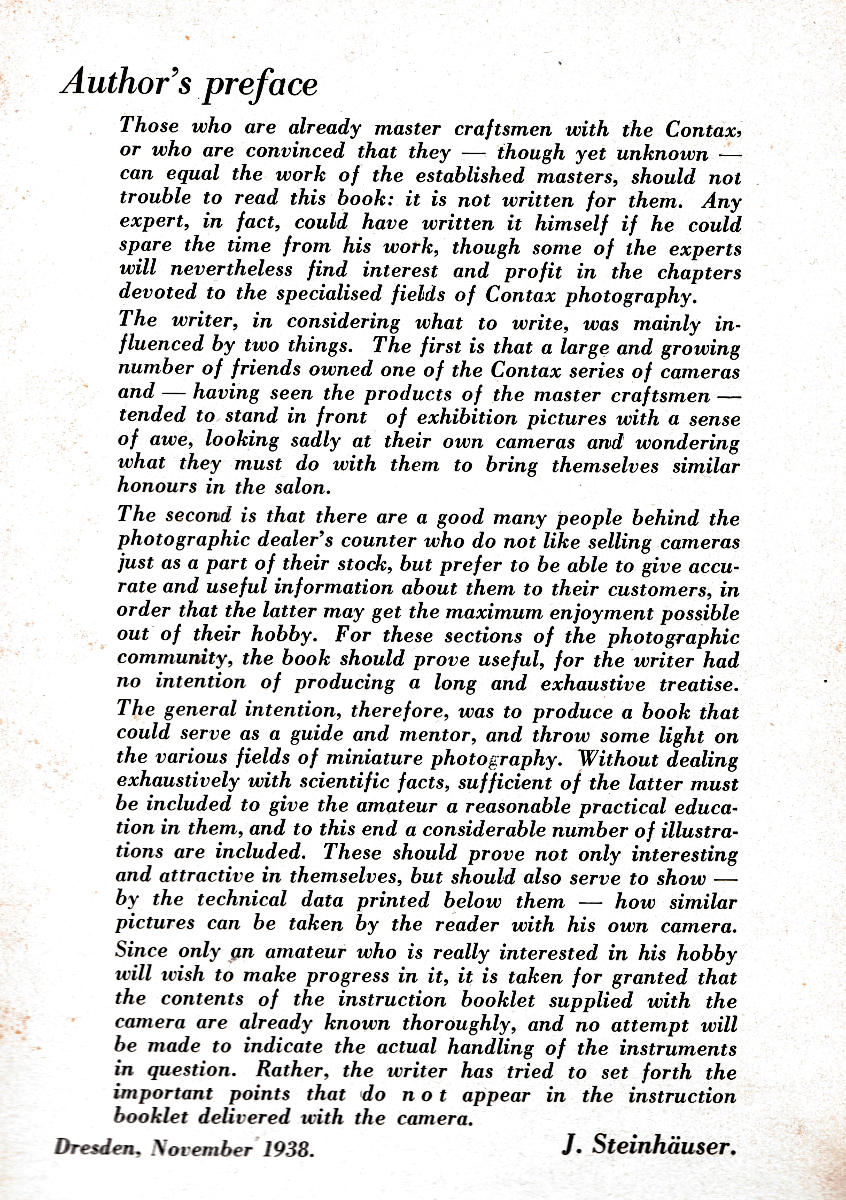
To this end, Steinhäuser, in imitation of Fritz Vith, published a book called ‘The Miniature Camera at Work‘ using Zeiss-Ikon 35mm cameras, and accessories along with Zeiss lenses. While never mentioning Leica by name, Steinhäuser went to great lengths to show how the Zeiss-Ikon cameras were better.

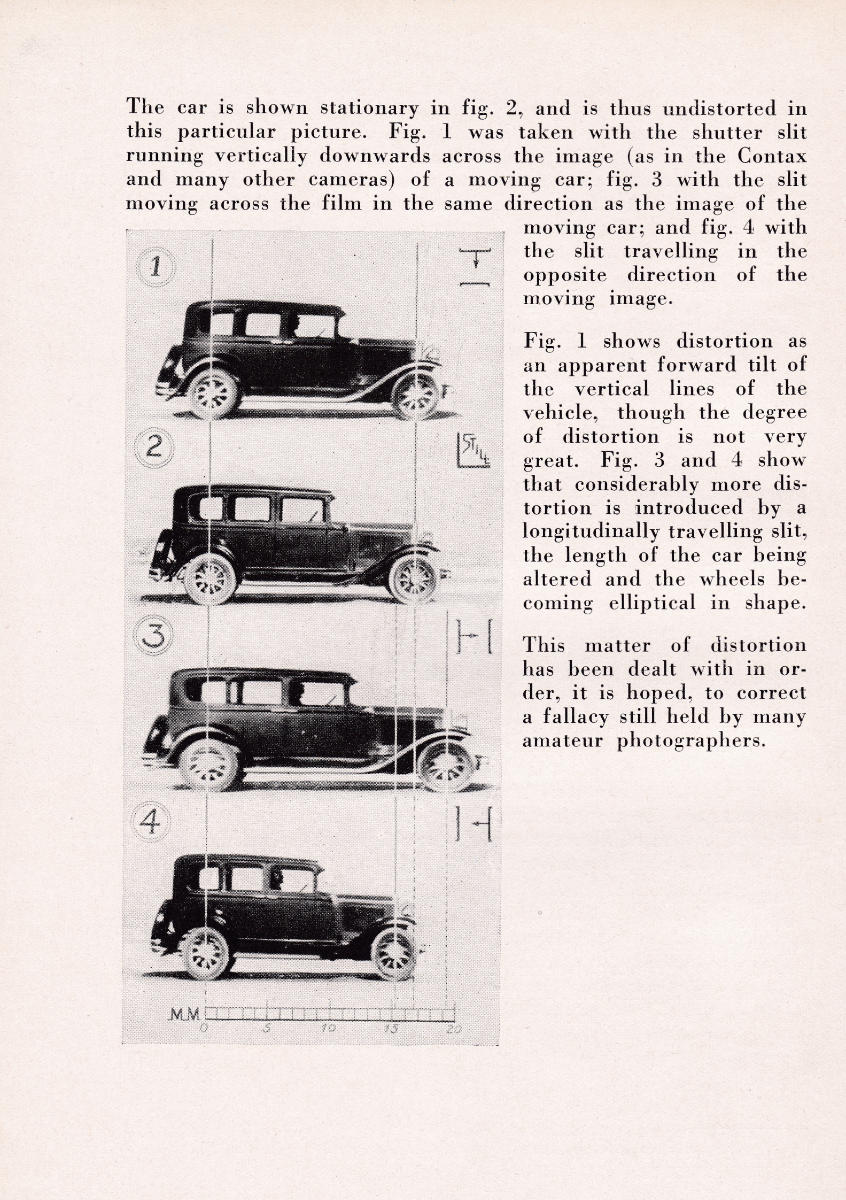
The vertical focal plane shutter of the Contax was made of metal rather than the rubberized cloth horizontal shutter of the Leica. It could sync to flash bulbs at a higher speed and avoided nasty pin-holes caused by the sun. BUT it proved to be an Achilles heel. Made of blackened brass, the slats of the shutter rode on enclosed silk ribbons. As the silk wore and broke, the shutter became slanted and stopped working. The ribbons were enclosed by the brass which often crystallized and broke when being bent to replace the worn ribbon.

Zeiss went to great lengths to make the Contax better than the Leica, but as Lipinski pointed out in his 1955 book, they had to because Leitz had patented all the easy ways to make a sturdy professional miniature camera! Steinhäuser explains the various 35mm camera designs used by Zeiss-Ikon (Contax, Nettax, Super Nettel, Contaflex) while ignoring the simpler approach Leitz used – eliminating items to make their camera cheaper but easily upgraded at the factory.

The one different Leica, the model B, didn’t sell and was only made briefly to offer slow shutter speeds before the regular Leica could accommodate them. Of course today this rarity makes the model B very pricey. By 1930, Leitz had moved to a standardized distance from the film to the lens mount making interchangeable lenses a practicality post camera sales.

Posted in history | Tagged , , , , , , , , , | Comments Off on introducing a photographer to minicams in 1938

the old camera collector

This brochure was printed in 1979 for a photo auction that fall.

Toronto. When the late Bill Belier was near retirement, he used to haunt garage sales for cameras and other photographic ephemera. Anything that was not for his collection, he would buy and sell at one of our meetings. If no cameras were on display at a garage sale, he would ask the seller if there were any in the house that he might buy.

Humour helped here. Bill had a business card showing his name and phone number plus the reminder line that he an “old camera collector”. Some people looked at him and saw an ‘old’ camera-collector not an ‘old camera’ collector- he didn’t persuade them otherwise …

During WW2, Bill had served his country abroad, setting the stage for his life-long love of travel. Post war, his work in camera sales led him far afield. Over the years, I enjoyed his many tales of the camera trade. The brochure (cover at left) was picked up by him over in Europe and passed along to me back home as a memento of his trip.

We shared a mutual passion – Leicas. Bill had many Leicas, much older than  mine, dating back to the rare ‘hockey stick’ variety. These were made even harder to find since Leitz would routinely update any camera returned to the factory for cleaning or repair, eliminating the odd piece of metal that served as the infinity lock. In his collection he also had black models and authentic German military cameras. Early cameras were always black enamel, but once satin chrome was refined, black models became exceptions.

Garage sales, bird dogs (non collectors who travelled and kept an eye out for cameras Bill would like), exhibitor tables, and swaps all helped him build an impressive collection over the years. Mind you, if you aren’t a devoted early riser, you can still get good items for your collection by coming to our fairs, sales, meetings and auctions. Remember, there will be goodies for all pocket books and all collectors, just waiting for you! Please note: COVID rules have curtailed our indoor events for now.

Posted in people | Tagged , , , , | Comments Off on the old camera collector

collecting on the cheap

Bob checks a Box Camera at a recent fair.

Toronto. Not all of us can or want to collect expensive articles. One obvious way is to get in on things early. When this society was formed, camera collecting was growing in popularity but cameras and old photographs were still relatively cheap. By the time a once inexpensive item passes through umpteen collectors and vendors, each extracting a fee, and worse, once the rarity of the item is known, the price may be beyond what we can or want to pay.

There are many ways to ease this burden. Foremost is the garage sale. People put things out just together rid of them. If there is no camera offered, you can always ask – sometimes to your delight this can result in an unexpected gem.

Things that are not of your interest, or that are not as good looking or functioning can be sold to another collector to offset the cost of your ‘keepsies’. Some collectors select accessories, or ads, or brochures, or books etc. instead of pricier cameras and lenses. Others choose to collect inexpensive camera models or cameras made by manufactures that target the lower end of the market. For example, at left is our late editor, Bob Lansdale, checking out an inexpensive box camera at one of our pre COVID fairs. The little gem was far cheaper than the Leicas and other cameras Bob used professionally.

And of course our fairs, sales, and auctions have goodies for all pocket books and all collectors.

Posted in people | Tagged , , | Comments Off on collecting on the cheap

Rita is at it again

PhotoEd magazine for Fall 2021 is coming

Toronto. I recently got a message from Rita Godlevskis over at PhotoEd magazine to say her next issue (Fall 2021 has rolled out. If you haven’t seen the print or the onine (via ISSUU) version of this one of a kind photo magazine, you do yourself a disservice.

To see what you have been missing, pop on over to her magazine’s web site. She is always inventive and  very reader oriented. Collaboration with logical organizations to the benefit of her readers is always upper most in her mind. Sparkplug coffee and Lomography film are a couple of examples.

We had the pleasure of hearing Rita’s talk for the society (PHSC) on May 19, 2021 via ZOOM. If you missed it, you missed a delightful introduction to the state of publishing in Canada and some background to both Rita and PhotoEd. Note that Rita also has a blog!

Rita has suggested changes to our print journal, Photographic Canadiana, and our society has advertised in PhotoEd many times.

Note. Once again I used Noel Coward’s humorous 1946 song, “Alice is at it Again”, sung by him on his show in Las Vegas at the Desert Inn. This time I used it as a riff for the post title.

Posted in activities-other | Tagged , , | Comments Off on Rita is at it again

a corkin’ good time

Mary Zita Payne – photographer

Toronto. I spotted a brief note on CP24 Sunday about a photography/music exhibition in Peterborough’s Cork and Bean. The reviews are very good so if you are nearby Thursday, drop in, have coffee, and more,  and see this exhibit by Kawartha Lake’s photographer Mary Zita Payne and her daughter.

On Facebook, Cork and Bean explain, “We’re hosting a private photography/music exhibit on September 29th with Mary Zita Payne & Melissa Payne! Get your tickets before they’re gone, the link to tickets and more information is in our bio [on their Facebook page]!

“All proceeds from the event will be donated to YES, Youth Emergency Shelter ptbo!” [Peterborough].

Meantime, Mary explains her focus as follows, “Mary is a Peterborough and Toronto wedding photographer and family lifestyle photographer in the Peterborough and Kawartha Lakes area (not far from Toronto).

“My photography business started so organically in July of 2016, when this ride called ‘life’ decided to take our family on a roller coaster ride: After not feeling like herself for a couple of weeks, our 2.5 year old daughter was diagnosed with cancer and would begin her two and a half year chemotherapy battle. Our perspective and outlook on life shifted overnight and our entire world revolved around getting our little girl healthy again.

“The one thing that brought me some sense of reprieve throughout all of the ups and downs, was documenting my daughter’s journey through pictures. I became obsessed with capturing the real and the raw beauty of life. Not only ours, but everyone’s around me.

“I got so engrossed in the photography world that I left my 9-5 job and have been having an incredible time photographing everything and everyone ever around me since! Side note: Our family is now so healthy and healthy with a sprinkle of family chaos ;).”

Posted in activities-other | Tagged , , , , , , | Comments Off on a corkin’ good time

steve talks about frank

Wells Cathedral, The West Front, 1859 (or later), albumen print. by Francis Bedford

Toronto. The Ryerson Image Centre is featuring a noontime “Collection Talk with Steve Evans” on September 30th. Steven has been a PHSC member for many years. Click on the “Register now” link below to hear Steven speak on the historic photographs of Francis Bedford.

“Steven Evans is a Toronto-based photographer and collector who has focused on architecture and the urban environment for over 40 years. Evans graduated from Ryerson University’s Media Studies program in 1982 and as a collector in the years since, Evans has compiled, over two decades, a comprehensive resource of early photographs and other objects associated with the British photographer Francis Bedford.

“The collection surveys Bedford’s impressive achievement as a leading maker of architectural and landscape images during the late 19th century. This talk is an opportunity for the public to learn about the Francis Bedford Research Collection, of nearly 1300 objects, which features the photographer’s early work with illustration and lithography, and examples of his amateur and commercial photography. Register now.

My thanks to my friend and fellow PHSC member, John Morden, for suggesting this interesting talk. Bedford’s prints are well known to photographic historians and image collectors. Here is a great opportunity to learn more about this iconic figure from the early days of photography.

Posted in activities-other | Tagged , , , , , | Comments Off on steve talks about frank

vive la France!

Ad for Foca PF 3

Toronto. The title of this post is a French patriotic expression. When Charlie De Gaulle visited Quebec in 1967, He used a similar expression on the Montreal City Hall balcony (the slogan of the Quebec independence movement) irritating the hell out of the Canadian population and resulting in the cancellation of his visit.

Before WW2, the French company OPL (Optique et Precision de Lavallois S A), decided  to compete with Germany’s Leica and Contax cameras with high quality 35mm cameras of its own design. OPL chose the name “Foca” for the cameras. Their goal was cut short for a time by the war. Ironically the invasion by Germany prompted their return to designing the camera line and it was ready by late 1945, a few months after the war ended.

Details of the Foca line have been published in French and are listed on this site. The definitive book on the line was published in 1997. It is called the “Foca Historica“. An ad appeared on page 9 in the June, 1950 issue of Popular Photography, placed there by Dowling’s of Fifth Avenue. The company modestly proclaimed the Foca as “THE WORLD’S FINEST 35mm CAMERA …” The camera appears to be a Foca PF3, Mod 3. made from 1947-1959 according to data collected by McKeowns’ 11th edition dated 2001/2.

Thanks is due to my fellow PHSC member and good friend, George Dunbar, for sharing this wonderful bit of history with us (it is noted in the Wikipedia article that OPL later merged with SOM, who made the SOM-Berthiot wide angle lens I use on my Leica). Small world!

Posted in history | Tagged , , , , , | Comments Off on vive la France!

the buzz on filters

bee on flower by Rudolf Paproth in “Filter Practice”, a 1962 book by Clauss and Meusel

Toronto. We have it so easy today! The digital camera or smart phone sets the white balance; black and white is a ‘special effect’ etc. In the days of film, especially orthochromatic, filters were essential accessories.

Dr Hans Clauss and Heinz Meusel wrote a detailed book in German on filters and their use in 1962. The book, “Filter Praxis”, was translated into English by L. A. Mannheim and published in 1964/69 by Focal Press and Chilton Book Company as “Filter Practice” – I have Chilton’s 1969 version.

Without filters, outdoors the clouds disappeared. Filters adjusted contrast. While panchromatic films solved the cloud issue, filters were still used on camera to adjust contrast if necessary. With the then colour transparencies and colour negative films, filters converted daylight colour balance to tungsten and vice versa. The problem of colour cast was especially trying in those days. This book discusses the technicalities of all filters and how they can be effectively used.

Today, instead of fussing with filters on the camera or in the darkroom, we use a photo application on our smart phones or computers. Our late editor, Bob Lansdale, was a perfectionist – he refused to use an application’s automatic conversion from colour to B&W, instead he doggedly used the sliders to adjust the conversion of each colour in each picture manually. This gave the best contrast and most realistic result for a colour photograph as it was converted to B&W (compare images for Photographic Canadiana, volume 46 online and in print to see the effect) .

Posted in history | Tagged , , , , , , , | Comments Off on the buzz on filters